Category Archives: climbing

Cutting Up an Ox

IMG_1312

Ben Sasse fears for our youth.

He is a U.S. Senator, and therefore he is a very busy man with little time to spare for side projects. Yet, so great is his concern for our kids’ predicament that he has taken the time to write a book about it. It is not a bad book, even if you disagree with what it says. You will have to trust me (or not) on the exact contents, because, “You may not make this e-book public in any way”, is all I will quote directly from it.

His thesis is laid out in the book’s title, The Vanishing American Adult, and he has summarized the gist of his prescription in the subtitle, Our Coming-of-Age Crisis – and How to Rebuild a Culture of Self-Reliance.

In the text, he depicts a generation afflicted by aimlessness. They have been stunted by coming up in the shade of social media and cultural relativism. Deprived of the harsh choices and bright lessons that come with social responsibilities and traditional rites of passage, kids have grown passive. They lack the ‘grit’ to sustain our society.

I won’t quibble with his depiction. Social media is a blight. The current generation operates on the assumption that ‘someone will take care of it’. Giving up is always an option for them.

I do disagree with his diagnosis and prescription, however. He seems to think that helplessness and hollowness result from a deficiency of citizenship. The correction would then involve a big shot of citizenship. He is completely mistaken. In fact, emptiness is the natural outcome of citizenship, and helplessness is just a reactive symptom.

On the most basic level, citizenship is a position in which one gets told that one’s life is fungible. One’s time, attention, motivation, and psyche can be chopped up and traded for goods to satisfy certain needs. Of course, Sasse recognizes this situation. He mentions “development of the individual” on a couple of occasions as a worthy pursuit, but only if it is pursued to certain ends (becoming responsible, self-sacrificing, ‘gritty’ – in other words, all those things that make a solid citizen). As far as I can tell, only the ends distinguish healthy developmental activities from selfishness, in Sasse’s estimation. And in a shocking coincidence, healthy ends are those for which the goods of citizenship come in handy.

“Why won’t my blood sugar go down?”

Maybe my analysis is unfair. Sasse contends that we are all a little defective, and our institutions may be a little defective, too. We should not expect a perfect synergy between man and social machine, even though the basic program is sound and actually the best that we can do.

But I hear differently all the time.

“I’m doing all those things that the diabetic educator told me to. I have changed my diet. I am walking every day. I am taking my medications like clockwork. So why is my blood sugar still high?”

This person is in my office every day, wearing a different, outfit, a different ethnicity, or a different gender. Yet they are the same person. They have a sit-down job, or two, in which they spend 40-60 hours per week dealing with an incestuous dataset – something so about itself, whether it is driving a cab or processing claims, that it demands attention to automatisms rather than any  particular skill. To ensure that their attention does not waver, an overseer tracks their activities and rates their efficiency. Their extraneous physiological and psychological functions are regulated by the employer as distractions.

The citizen in my office sleeps 6 hours per night, or less. They drink energy drinks to keep going, and eat foods which the package or the vendor says are healthy, because they haven’t the time or energy to prepare their own food. They are too exhausted to exercise properly.

As a result, they are obese, diabetic and hypertensive. As a result, they now require one of the goods for which they can sub-divide themselves: medical care.

Which brings us to where the defense of citizenship as a natural-born fertilizer for human development, breaks down. The trouble with the whole thing is not the palate of goods on offer, their costs, or the means of valuation. The trouble is the chopping, because the roots of experience (attention, motivation, responsiveness, etc.) can’t be cut up for a purpose, especially for delayed gratification of a specific need. The very notion mistakes the nature of needs and the relationship between our needs and our activities. Here, Sasse may have been better served by spending a little more time reading Nietzsche, and a little less time reading Rousseau and the Bible.

For an organism’s needs can’t really be parsed. The motivations underlying our activities are merely aspects of a single motive which Nietzsche labeled ‘will to power’. Even when we try to perform an isolated act of attention, we feel something about it, our neuro-hormonal system responds to it, and it tires us globally.

But Sasse seems to think there’s a neat way around the problem of dividing the indivisible.

Life on the Farm or 8 Pitches Up?

In the latter half of the book, Sasse talks about how he sent his daughter to work on a ranch. The idea was to teach her how to enjoy work – not any particular task, but work itself. Basically, he sought to teach her how to thrive as an instrument. It’s pretty clever, really.

He explains the strategy in a vignette:

Martin Luther met a man who had just become a Christian and wanted to know how best to serve the Lord. He asked Luther, “How can I be a good servant? What should I do?” He expected Luther to tell him that he should quit his job and become a minister, monk, or missionary.

Luther replied with a question, “What do you do now?

“I’m  cobbler. I make shoes”, the man answered.

“Then make great shoes”, Luther replied, “and sell them at a fair price – to the glory of God.”

In other words, find integrity in being a good instrument. I think the flaw in this reasoning is obvious: Why not make great shoes to the glory of Satan? It’s the devotion part that really matters, right? This notion of the human lost at heart and essentially in search of a set of rails (any rails) undergirds fascism through the ages, and it works superficially, so long as the social venue is stable.

But I took another path with my kids, because I learned more from sitting on a ledge, than I ever did from a job.

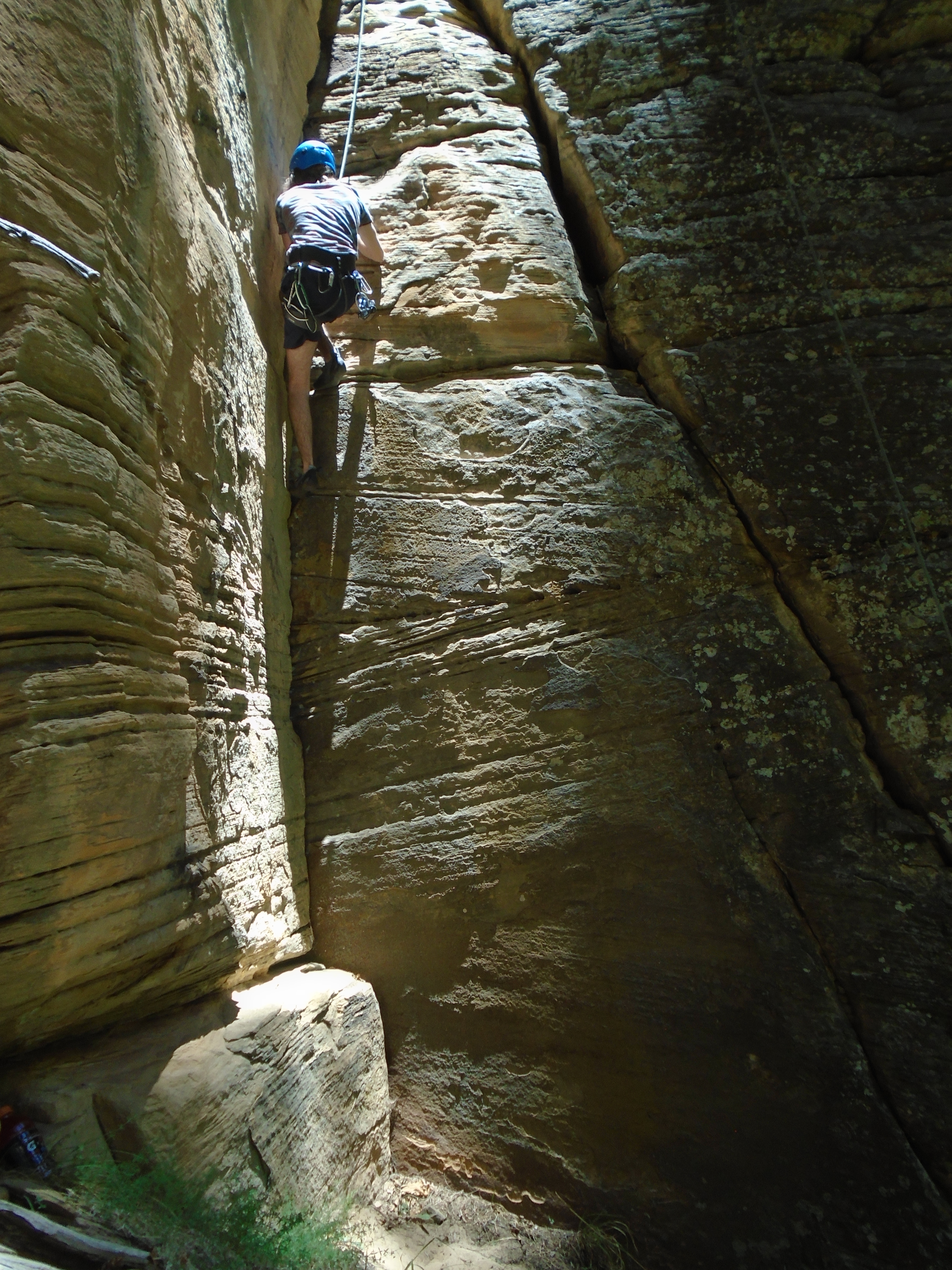
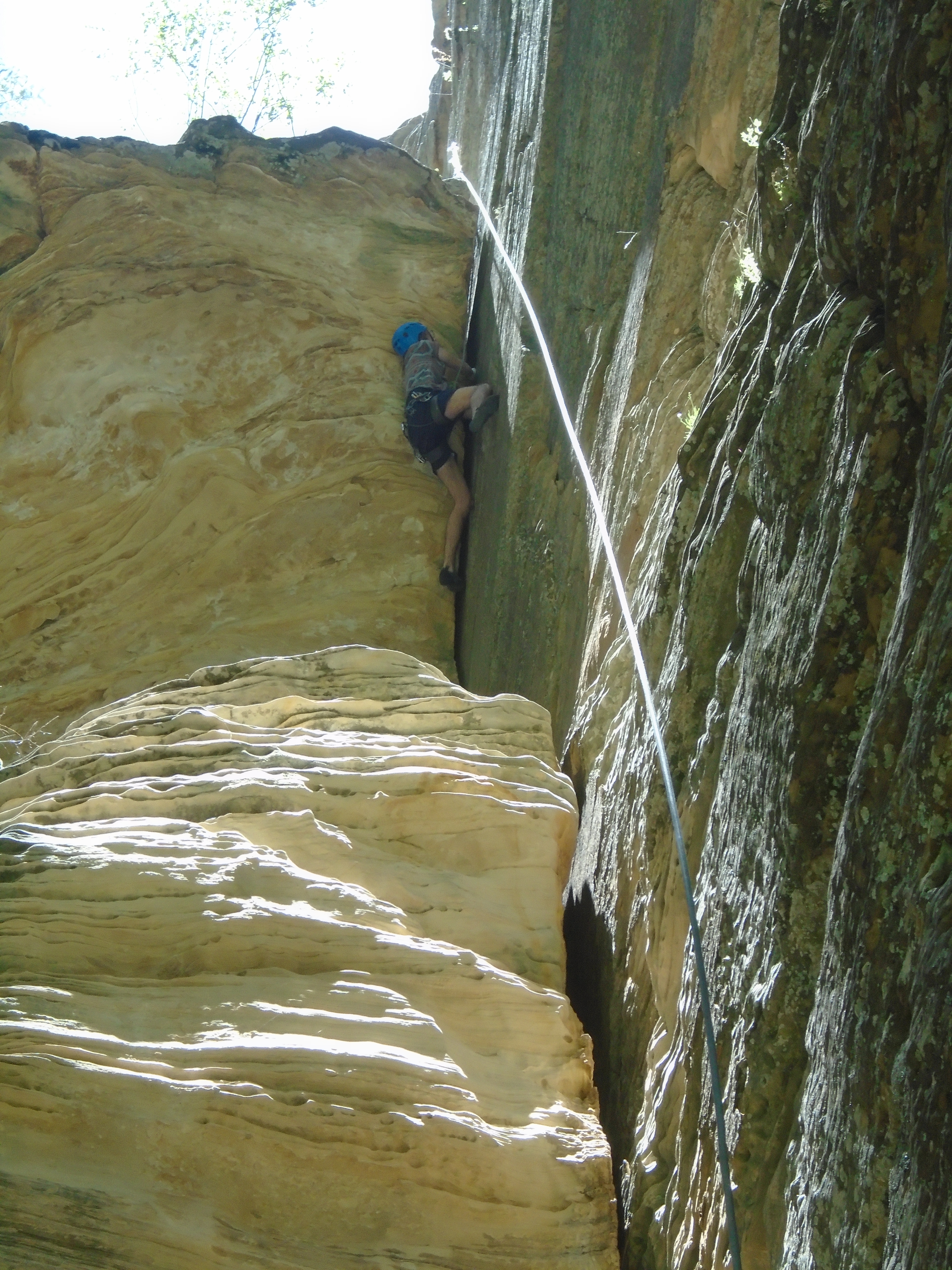
We have climbed several long routes together. We have looked up, down, and out from ledges in the middle of those routes and soaked in the lessons: however precarious the position, what falls to us is to pass the water around, check the system, and find our way through the next rope-length of terrain; trust your partners as you trust yourself; no matter how cold, hot, tired or thirsty you are, the beauty of the sky and landscape remain; achievement, i.e. ‘ticking the route’, doesn’t really matter – it is only a means to get you to the ledge.

In taking them on those climbs, my hope was to offer them a way of life which put making a living in perspective, rather than telling them that making a living would put everything in perspective for them.

A different vignette illustrates my point:

     Cook Ding was cutting up an ox for Lord Wenhui. At every touch of his hand, every heave of his shoulder, every move of his feet, every thrust of his knee — zip, zoop! He slithered the knife along with a zing, and all was in perfect rhythm, as though he were performing the Dance of the Mulberry Grove or keeping time to the Jingshou Music.
“Ah, this is marvelous!” said Lord Wenhui. “Imagine skill reaching such heights!”
Cook Ding laid down his knife and replied, “What I care about is the Way [“Dao”], which goes beyond skill. When I first began cutting up oxen, all I could see was the ox itself. After three years I no longer saw the whole ox. And now, now I go at it by spirit and don’t look with my eyes. Perception and understanding have come to a stop and spirit moves where it wants. I go along with the natural makeup, strike in the big hollows, guide the knife through the big openings, and follow things as they are. So I never touch the smallest ligament or tendon, much less a main joint.”
“A good cook changes his knife once a year — because he cuts. A mediocre cook changes his knife once a month — because he hacks. I’ve had this knife of mine for nineteen years and I’ve cut up thousands of oxen with it, and yet the blade is as good as though it had just come from the grindstone. There are spaces between the joints, and the blade of the knife has really no thickness. If you insert what has no thickness into such spaces, then there’s plenty of room — more than enough for the blade to play about it. That’s why after nineteen years the blade of my knife is still as good as when it first came from the grindstone.”
“However, whenever I come to a complicated place, I size up the difficulties, tell myself to watch out and be careful, keep my eyes on what I’m doing, work very slowly, and move the knife with the greatest subtlety, until — flop! the whole thing comes apart like a clod of earth crumbling to the ground. I stand there holding the knife and look all around me, completely satisfied and reluctant to move on, and then I wipe off the knife and put it away.”
“Excellent!” said Lord Wenhui. “I have heard the words of Cook Ding and learned how to nurture life!”
— Zhuangzi, chapter 3 (Watson translation)

I do not see the current generation as sissified hedonists, any more than previous generations. The hypersensitivity, the passivity, the absorption (self and otherwise) all look like symptoms of a bunker mentality. They see what’s in store for them and they don’t like it, but they don’t seem to know how to resist.

A Sasse-type message has gotten through. The citizenry coming of age does think that it must learn to embrace a social role (little worker, little voter, little contributor) wholeheartedly in order to fully mature, and it just can’t bring itself to do so. The instinct is right. Kids growing up in this era are being asked to pursue a sort of faux-maturity which involves merely “giving up childish things”, and the achievement of that state will leave them empty and utterly dependent on a structure which deals with them on the basis of a flawed methodology.

They need a little less Ben Sasse, and a little more Cook Ding, when it comes to advice about how to grow up. Because maturity means dealing with your situation – not just endorsing it – and dealing with it artfully. It means getting over being The Cobbler, The Christian, The Cobbler-Christian, or even The Cook.

In Sasse’s terms, I have laid out the Romantic counter-argument to his Realist argument regarding the nature of the individual’s relationship to civilization. But I reject that characterization to some extent. There isn’t an inherent conflict between the individual and the civilization. We are stuck with our civilization. It lies before us like the carcass of a great ox, and it is just as indifferent.

We get chopped up in our interaction with it, but our own hand is on the knife. And I agree with Ben Sasse here,  maturity is the solution. Not the faux maturity which the senator espouses, which is just a form of selling out, but actual maturity which sets limits and carves its own way, not towards some magical future, but like the cook’s knife, in the present where we all reside.
IMG_3666

Tagged , , , , , , , , , , , , , , ,

What is the magic of the third point?

Subscribe to continue reading

Subscribe to get access to the rest of this post and other subscriber-only content.

Tagged , ,

The Heat of a Separate Logic

Sometimes, I catch my wife watching out of the corner of her eye while I cram my feet into climbing shoes. The process entails a good deal of whining and swearing, which will continue throughout the subsequent training session. She usually keeps quiet about what she sees, but sometimes she can’t help but ask, “What is it that you like so much about climbing?”

I tell her that I like it because it’s war, except that, as opposed to war, if everything goes right, nobody dies. My answer is a bit hyperbolic. For one thing, I have never even been near a war, much less participated in one. What I mean is: the attractive thing about climbing is the same as what those who have fought wars say is the attractive thing about war.

Though it is difficult to put a finger on the source of our attraction, we humans are undoubtedly enamored of war. Our literature enshrines it. It has a permanent place in our culture, in the form of holidays and memorials, but also in practices like the martial arts.

The studios can always sell us another war movie.

It isn’t just a fascination born of fear either. We associate warfare with all kinds of positive moral qualities, like courage, loyalty, and determination. Even the Prussian general, Carl von Clausewitz, implicated valor as a reason for the normal individual to volunteer for war. This from the man who said that war has its own grammar, but not its own logic.

Von Clausewitz clarified that position on the nature of war in what is now a famous aphorism: war is politics by other means. Practicalities drive us to war. That can’t be the whole story though. If it were, all armies would be conscripted, and no war would last as long as every war has lasted. We fight well beyond pragmatic exhaustion.

That’s because Von Clausewitz was wrong. War does have its own logic. If we listen to war’s participants, we hear about the struggle to survive their circumstances, and to put an end to the struggle itself by overcoming their opponents. We hear about the moral obligation to protect one’s comrades. The politicians may have pursued their policies into war, but once the war gets going, the fighters fight for other reasons entirely.

If we take logic to mean a description of consistencies between meanings, then we have to conclude that war does have a logic of its own. It is a logic which supersedes all the extrinsic reasons for going to war. Maybe that’s why war persists. Because it is easy to think about getting in to a war on the basis of von Clausewitz’s pragmatism, but once the fight is on, the other logic takes over, and not only gives us a reason to see the war through to some conclusion divorced in principle from political practicalities, but also gives us stories about all those positive moral qualities which the participants find in their quest to come through the catastrophe.

The other logic is always dangling out there. It is the same logic that drives me to climb, and others to fly wing suits, race motorcycles, and ski out of bounds. Any useless activity involving uncertainty and inherent danger will have the same enticing, overpowering consistencies between meanings. There is no practical reason to jump out of a functional airplane. There is no material gain in clawing your way up some obscure cliff face. Even the motorcycle racers and sponsored skiers don’t do it for the pay.

This sort of pursuit challenges us to engage, because once we engage, the other logic, which is the logic of survival, determination, and commitment, takes over and cooks off all the other, weaker, practical logics. For the duration, everything is clearly in its place.

Clarity is not a requirement. In our age, nobody really considers going to war on such a vision quest (we gave that up with the end of dueling). You don’t hear the participants in a battle wax nostalgic about the smell, the cacophony, or the sight of dismembered bodies. At best, the practical details of war just serve as props for the exhibition of the other logic. So often the story goes: I didn’t want to be in a war, but since I was, I tried to take something good away from it, and this is what it was – loyalty, determination, commitment.

Those stories are good ones, maybe even necessary ones. Still, they are an attractive nuisance. They don’t get us into war, but they contribute to a kind of permissive state in our collective psyche. Political practicalities appear more convincing. Our own participation in conflict feels easier to justify, sometimes to such a degree that those who should know better (historian Stephen Ambrose) express regret for never having their courage tested in combat.

That’s what it is about climbing. It’s a way in to the crystal sphere of the other logic. It’s also an admission that I want to live as much as possible in the sphere, though it is impractical. I think that that admission is key. It is the bit of insight which separates an attraction to useless, uncertain and inherently dangerous sports from an attraction to war. So maybe there is one generally useful thing to be had from dangerous sports. If we can cultivate in the larger society, an insight into our own motives for pursuing impractical, uncertain and difficult peril, we might be less susceptible to war’s appeal.

Tagged , , , , , ,

The Auto Belay Auto Da Fe

“Even if it is certain that you will lose, retaliate. Neither wisdom nor technique has any place in this. A person of character does not think of victory or defeat, but instead rushes recklessly towards an irrational death. Do this and you will awaken from your dreams.”

-Yamamoto Tsunetomo

“If you die climbing, you negate everything else you’ve ever done in the mountains”

Don Whilans

“The nature of fencing is defeating an enemy in a fight, nothing more”

Miyamoto Musashi

Once upon a time on the Iberian Peninsula, the three Abrahamic religions tried to live together. Of course, they were no better at peaceful coexistence in antiquity than they are now, so the whole thing fell apart and then got nasty.

And as usual, when it came time to persecute the Other, Christians took the lead. The whole anti-comity campaign which ensued is known as the Inquisition. The name is genius. It captures every aspect of the project, while offering an implicit defense of its acts.. The Church was simply asking questions, of the society and of the individuals who professed a different faith.

The inquisitors wanted to know what the society was willing to do in the name of Christian purity. Of the individuals, the officers of the church finally wanted the answer to a single question multifariously – what are you willing to do to keep us from torturing you to death?

The answer to both of the church’s questions was the auto-da-fé. The words themselves mean “act of faith”, by which the perpetrators wished to indicate a demonstration of repentant zeal on the part of the evangelized. In practice, the act of faith meant participation in an elaborate show trial, in which the accused were broken of their prideful resistance, and then paraded to the grounds of judgment dressed in humiliating costumes representative of their particular crimes. Upon arrival, officers of the church meted out sentences and administered punishments. Some of the penitents were burned in effigy. Some were burned alive. Some were simply tortured a little bit. And some were pardoned, just to keep everyone guessing. The whole thing was a great object lesson regarding the power of the Church, and a big hit as public entertainment.

The Inquisition is long gone, but the spirit of auto da fe survives in odd corners of society. The climbing world, for example, has preserved it by means of a device called an “auto belay”. An auto belay is a locking carabiner attached to a spring-loaded spool of nylon webbing, which is further equipped with a clutch mechanism. The whole thing hangs from the top of an artificial climbing wall and allows a climber to ascend the indoor crag without the need for another person to hold a safety line. When the climber comes off of the wall, the clutch mechanism engages and lowers them gently back to the ground.
The whole setup resembles a giant, upside down yo-yo. For many people, it is the only partner they will ever know. It allows the curious to experience climbing with almost zero skills in their toolbox. Once a gym employee has properly fit them in a harness, a tourist to the sport merely needs the capacity to open and close the gate on a carabiner, and they can get themselves 30 to 40 feet off the ground and back down in safety.

Despite an orientation which includes a demonstration of the auto belay’s effectiveness, the majority of first-time climbers cower below the top of the wall for a few minutes before mustering the courage to wager their spinal column’s integrity on the reliability of a length of yellow nylon tape, and whatever it is in the round plastic box tethered to the ceiling. Some are simply unable to carry out the act of faith, and require staff to rescue them.

An auto belay makes indoor climbing accessible to the uninitiated, but they are not the only ones who use it. Experienced devotees also clip into the device. For them, employing the auto belay is an act of faith as well, but more along the lines of the original auto da fe. In the same sense, it is a desperate act.

A committed climber who attaches themself to an auto belay may object that they are in need of conditioning rather than just desperate to climb. Climbing on auto belay is a kind of training. It is just not very good training. Equipment such as the hang board builds finger strength better. Likewise with campusing, which also improves arm strength. Climbing outdoors yields vastly superior improvements in technique. The “training excuse” for using an auto belay needs its own excuse.

There is no excuse though, only a bit of the truth. And the truth is that a committed climber using the auto belay is much like poor Tsunetomo, who never fought a battle or lived to enjoy an irrational death. To endure the misfortune of his birth into an age of peace, he contemplated the edifying nature of combat and loyalty to one’s commander. He wore the vestments of a warrior, and scrupulously practiced a warriors rituals. A climber on auto belay is no different. Their movement over a route devised by a technician is a pitiful homage to a real course charted across natural features. It is a weak gesture of devotion to the thing that it imitates.

Like the confessions extracted in the auto-da-fé, climbing on auto belay is hollow, and doing it means that you share the desperation (though likely to a lesser extent) of those poor bastards marching towards an uncertain fate along a dusty Spanish road. Yet there was another aspect to the inquisition’s ritual humiliation and forced confession. Taking the point of view of the persecuted, a real spiritual test lay beneath the cynical choreography.. The persecuted were faced with a question bigger than the church’s inquiries: can you get through this? They received the same unsettling revelation as did Musashi, who survived 60 duels. Once you make the choice to be a fighter or a survivor, all the rest – technique, appearance, profession – becomes subservient. In that way, the auto da fe was an act of faith, just not the faith which the church wanted. It was not a faith in God, but a faith in chance. For the penitent marching towards the grounds of judgment, living just a little bit longer meant that there was still a chance of coming through the whole ordeal, to better chances on the other side. Wear the costume. Accept the accusations. Endure the beating. Each deprecation is a little more time and another chance. If you have chosen to survive, you’ve committed to taking those opportunities.

Using an auto belay mirrors the inquisition’s act of faith in this too. Because, clipping into that yellow webbing requires a confession. The penitent has to look at the painted plywood crag with its harlequin plastic holds and the upside down human yo-yo hanging over them and conclude that it is all still climbing and that, as a climber, they will climb, rather than not climb.

In what must be history’s strangest convergence, both Tsunetomo and Musashi ended their days in monastic contemplation, Musashi because he could no longer justify the killing, and Tsunetomo because he was ultimately betrayed by his own devotion. His master forbade him to commit ritual suicide in honor of the Masters death, which would have been the definitive act of faith, and a very irrational death.

Though they came at their problems from opposing starts, both of the samurai seem to have come to the same conclusion as they contemplated their lives. They both stopped thinking about their accomplishments, or lack thereof. They both stopped worrying about the meaning of death. In their final state, it is easy to imagine either one of them standing in front of the auto belay, shrugging their shoulders, and clipping in.

Tagged , , , , , , , ,

Taking Pictures

Wyoming is a Banana Republic. That is, very few of its residents craft any products, or add value to pre-existing items. Instead, they survive by selling off the state bit by bit. The major industries are mineral extraction and tourism. Reliance on those commodities creates a vicious cycle, because the state’s fortunes rise and fall with mineral prices and popular whimsy. To live through the fluctuations, politicians skimp on the state budget so that they can put enough money in the bank to survive the next economic lull. A few lonely prophets call for investing those funds in economic diversification, in the interest of breaking free from the cycle of feast and famine. The politicians repeatedly acknowledge that diversification is a good idea, but can never bring themselves to actually commit to it. It is just too risky.

So, the state carries on in its bumpy ruts, booming and busting. Decades on this road have had socioeconomic consequences. The path has led to a land of Manors and mobile homes, housing those who own the mines and the lovely land and their servants respectively.

No place in the state epitomizes this case study in Marxist historical analysis better than the town of Jackson. A ring of expensive houses surrounds a ring of expensive condominiums which surrounds a cluster of expensive restaurants, galleries, and boutiques. And that is Jackson. Though Jackson is fancy enough in any season, its exclusivity shines brightest in winter. In summer, the dirtier class of tourist drives through town on its way to Yellowstone. In winter, the only reason to be in Jackson is to patronize one of the ski resorts or to serve the patrons.

Although, there is one other, statistically insignificant reason to be in Jackson in the winter. For several years, that reason compelled me. I wanted to climb the grand Teton in full conditions. There is no reasonable explanation for that compulsion. I just feel a perverse attraction to isolated, windswept places. For instance, when I topped out on California Ice in the Bighorns, I sat on a rock and looked across from Hell Roaring plateau to Froze to Death plateau and was filled with a rare sensation, a feeling of fearsome loneliness, and profound contentment along with it. I can’t offer any better excuse.

When the idea first came to me, I sought out a friend who had done a lot of climbing in the Teton range. Sure enough, he had attempted a winter ascent. He got close, but after a day of skiing through waist deep powder, he and his partner had to bivouac short of their goal. They were well prepared, but the night was so brutally cold, that they were beaten by the next morning and decided to ski down. They fell into chest deep powder on each turn. My friend’s partner lost his mind. He took his skis off and tossed them, javelin style, down the snowfield. He then swam after them over the loaded slope, cursing and spluttering, until he could get his hands on the traitorous bastards and chuck them again. Though he came back to his senses eventually, the trip marked an end to their partnership..

Despite that tale, and others warning of frostbite and avalanche, I still thought I could pull it off, and I still wanted to pull it off, maybe even more than before. It wasn’t a solo adventure though, and to my surprise and frustration, I had difficulty convincing anyone else to come along.

Finally, I persuaded my friend Jim that it would be a good adventure. I’m not sure if he ever really believed that we would climb, but he believed in the adventure part and that was good enough for him. We set up base camp at the Motel 6 down the road from the main town.

Over the next week, we made a few forays up past the tree line, but the avalanche forecasts were always bad, and the peak was socked in with clouds and blowing snow besides. Nobody said anything; we just gave up one day. We got up late, and Jim suggested that we might go up to Teton Pass and do some tele skiing.

Now it was my turn to cash in on the adventure itself rather than the intrinsic joys of the activity. I knew how skis worked, theoretically. But until that day, I had only used skis to get somewhere with a pack on. My technique was purely pragmatic, and rudimentary. To go downhill, I left the climbing skins on the skis. I then skied across the slope, stopped and turned to face the other direction. I repeated that process to the bottom of the hill.

When we got to the top of the pass, the skins came off the skis. Jim gave me some tips on turning without stopping, and then we were off. Again and again I nosedived into the unconsolidated powder. Jim was soon out of sight. I began to suspect retribution. I felt like I owed him at that point though, so I sucked it up and ate a little more snow while he carved track after track in the slope. When we had had enough, we went into town and wandered around.

Winter tourists milled around the square. Most were dressed to ski, with lift tickets still clipped to their coat zippers. A few were dressed as cowboys in Stetsons and shearling coats. The famous antler arch was busy with group after group documenting the fact of their visit to Jackson Hole with a picture under the strange sculpture of bone.

There was not much for us around the square. We stood outside a couple of the bars and debated going in for a drink. They seemed too crowded though, and we decided against. We stopped by the mountaineering shop, which at this point in its evolution had basically become a Patagonia outlet, to chat with an old friend of Jim’s. We didn’t go in to any of the other establishments, but we did stop for a while in front of a photo display. Though neither of us was in the market for an expensive print, Jim had a professional interest in the product.

Jim was a photographer, but not the kind of photographer who had a gallery in downtown Jackson Wyoming. Jim was an artist who scraped by on grants and museum patronage. He took pains to draw a distinction between what he did, and what a commercial photographer did. Yet he radiated a little glow of resentment as we stood in front of the spotless plate glass. The gallery inside was all polished wood. If there was an attendant, he or she was politely hidden in the back.

The well lit pictures were all of wildlife. Most depicted charismatic megafauna. The photographer seemed particularly fond of bears. Jim glanced over most of these offerings in a second, and then paused for a bit in front of a family of polar bears. He wore a discomforted expression.
“What do you think?”, I asked.
I expected to catch him off guard, and I was halfway teasing with the question, but he shot back right away.
“It’s too didactic”
I was caught off guard.
“What do you mean by that?”, I asked.
“It looks like a photograph,” he said.

I didn’t exactly know what he meant. However, I could see that there was something different about the pictures of wildlife in that gallery, and his pictures. There was one photo of his in particular, taken at Lac Du Flambeau, which stood out to me. The subjects were two members of the tribe, a man and a woman. He was looking into the distance with an expression of anger or determination, it was hard to say which. She stood behind him, maybe in contact with him, wearing that same, mysterious expression, but she was looking at him. She was standing still. He appeared prepared to stride off towards whatever it was the distance. He was silent. She was speaking.

Clearly, his photo was something other than the picture of the polar bear family. I understood the gist of it then, but it would be years before I could put that distinction into words. It is the difference between pictures of polar bears, and polar bear pictures. Pictures of polar bears could be pictures of the whole bear, but also could be photos of a patch of fur, a black nose, or a white dot in the distance. Polar bear pictures could depict whole bears too, but include stick figures, polar bear paintings, pictures of men in polar bear suits, or black eyes, a black nose and a red mouth on white canvases.

Pictures of polar bears document. Polar bear pictures represent. By representing, polar bear pictures evoke all the relative connections which comprise our categories, and therefore the sense of our experience.

The picture in the gallery was a picture of polar bears. It was as documentary as the tourists’ snapshots under the antler arch. The photograph of the man and woman at Lac Du Flambeau was representational. There was something about human relationship, emotion, and the interpretation of expressions in the photo. But the really brilliant thing was: the photo primarily represented something not present in the image itself.

The predominant impression was the churn of excitement and uncertainty which occurred in the beholder. It was a class of sensation which bound subsequent viewers to the original viewer in its momentary intensity.

Jim has been gone for some years now. I can’t even find that picture in the supposed eternity of the Internet. I don’t need to, because I can remember it in every detail by the feeling it represents. The feeling is the same as my excuse for wanting to climb the Grand in winter, and I think it also explains why Jim would throw in on my crazy project.

There is no gallery for such things.

Tagged , , , , , , , ,

The Overhanging 5.9 Hand Crack

The fates have determined that, from time to time, I will dine with royalty. And I have determined that, on those rare occasions, I will not pass up the opportunity to say something stupid.
While waiting for the food at a wilderness medicine conference banquet with my friend Andy, our table-mate, Dr. Hornbein, politely inquired as to our post-meeting plans.

I casually replied, “Oh, we’re headed off to climb the Grand.”
It was February.
To his credit, he blinked once and said, “Well, good luck.”

After sharing grilled chicken and carrots with Jack Tackle, Andy and I asked him what he thought about 2 possible routes for the next day.
He said that he liked the first route well enough. It was clean, with consistent climbing, and little loose rock.
The 2nd climb had some bad rock and mediocre climbing down low, but had an overhanging, 5.9 hand crack for most of a pitch in the middle.
“So,” I asked, “do you think that 2nd route is better?”
He stared at me blankly for a couple of seconds and replied, “It has an overhanging, 5.9 hand crack.”

In the light of subsequent experience, I get it. But at the time, I thought that I wanted to climb 5.12, so the 5.9 rating tarnished anything to which it was affixed. I worked pretty hard towards the goal of climbing 12’s, and I climbed a few 5.9 hand cracks along the way. I got there, barely.
The effort wasn’t worth it though. Working the routes endlessly, with creaking tendons and crushed toes, just did not justify the final victory. It was like winning World War I: a victory, sure, but an atrocity nonetheless.

I think I understand why other people are enamored of more difficult climbs – and yes, I recognize that 5.12 is the basement of “difficult” rockclimbing. For one of my ‘hard’ routes in particular, getting the clean ascent was like making a friend. I became so familiar with every little edge and crystal, that I’m sure I could regurgitate the beta for the route to this day, decades after I touched the rock last.

Working harder routes on rock can be painful and tedious. I don’t think it is the suffering and frustration that turn me off, though. I liked the more difficult mixed climbing that I did, and I was highly motivated to climb grade 6 or harder ice. I obsessively studied and salivated over those ice routes in the same way that some sport climbers I’ve known would microscopically analyze their projects. I trained for hard ice until I thought my forearms would pop.

I think the difference may be in the proprioceptive aesthetic of the climbs. The way a climb feels to the touch and the body position it demands get less attention than the way it looks and the puzzle it poses. The proprioceptive aesthetic is the last to be appreciated.

But the proprioceptive aesthetic leaves the most profound mark on me. It’s always front and center in ice climbing. The appreciation of touch flows from the essential circus trick at the heart of ice climbing: extending one’s consciousness from fingers, toes, wrists, and ankles into the pointy bits of metal attached to those natural appendages.
Maybe that appreciation of touch naturally gets tamped down the harder you crimp and lock off.

Or maybe, this is all just sour grapes. I don’t think so though. Given the choice of magical elixir which would allow me to climb as hard as the best climbers on rock, or a map to a thousand foot, clean, sandstone, overhanging hand crack, I’m certain that I would pick the map without a 2nd thought.

Tagged , , ,

The 6 Stages of Grief

My neurologist tells me that I have a chronic progressive neurodegenerative disease. I assume that all the repetition is for emphasis. The double-down does help the rest of his news, “but it is treatable”. He says the last bit enthusiastically. I suppose you don’t get to say that very much in neurology, and I don’t blame him for taking advantage of the opportunity.
But I know what treatable entails too. In medicine generally, but especially in neurology, it means things will go downhill in a way that we control. I understand how that might count as a win, because I’m going through the 5 stages of grief as I begin a long goodbye to climbing. Passing through the stages of grief, like controlled deterioration, may seem like a process to which winning and losing should not apply. However, I have access to a secret. I know about a transformational 6th stage to the process.

For those who are unfamiliar with the stages of grief model, some background is in order. Unfortunately, adequate understanding requires a foray into the underbrush of academic psychology. The incursion will be brief and relatively painless.

Psychologists have a penchant for stages of this and that. They use the terminology to craft formulas explaining the psyche, much like chemistry and physics employ formulas to describe their domains. Some may have heard of Maslow’s pyramid of needs.

There’s a similar model for addiction. And then there are the stages in the cycle of abuse. With the exception of some models of learning, psychological formulas are of little practical use. They can’t tell you what to expect when you mix Clorox and ammonia (look at the chemical formulas; you shouldn’t do this). They can’t tell you what you’ll need to enter low Earth orbit.
All that psychological models can tell you is what happened before, based on what other psychologists think they saw happen before. This dubitable power is supposed to offer emotional comfort.

For example, when a bereaved friend is sitting in his room mute and motionless, a counselor can reassure all the concerned onlookers that this is expected. The bereaved is going through the phase of denial. When that friend screams in anguish and throws a lamp at the wall, the counselor can maintain calm in the living room by reassuring everyone that their loved one is simply experiencing the stage of anger. He is overheard beseeching God for mercy? Don’t worry, bargaining is the next stage in the model. He is crying now? Meet depression. At last he emerges, drying his eyes and taking a deep breath. Now he has reached the stage of acceptance, and we are through.

Certainly, certain people feel reassured by these expositions. I’ve observed that the same people would probably feel reassured by a certified professional reading Jabberwocky in a calm voice, under the same circumstances. I’ve also observed that any reassuring effect following from the formulaic explanation of a psychological phenomenon currently in process, occurs in the observers. For the one actually experiencing a stage of something, explaining to them that they are merely experiencing a stage of something tends to breed resentment instead.

Like other, similar psychological models, the stages of grief formula does not do much work., That is, unless you add the 6th stage. Because, unlike any other stage in any other psychological formula, the 6th stage in the stages of grief is inherently action-guiding.
I call it the stage of Alpine acceptance. This stage actually occurs only intermittently, mostly to those in the know, and when it does occur, it can pop in at any point in the process.

To permit a complete understanding of this unique stage in the model, we must briefly explore the source of the terms once again: in this case, the practice of alpinism.

First off, I want to be clear that people don’t actually agree on what alpinism means. I don’t mean on a metaphysical level. I mean nobody agrees on what constitutes alpinism. Some say it is climbing a route on a mountain. Of course, that statement begs the question. Some say alpinism is climbing to the summit of a mountain by any route harder than the easiest route. Many climbers would call most of the routes encompassed by that definition “mountaineering”.

This definitional mess is further complicated by the fact that almost any climbing route, can be ascended in Alpine style, which means climbing with just what you can carry with you on your back. To expand on the implications for a moment, on any big climb, one frequently wishes for more equipment than one can carry. The reason that the practice of traveling dangerously light gets called “Alpine” style rather than “big wall” style or “mountain push” style is because one always wishes for more equipment than one can carry on an Alpine route. That is because these routes often wander over steep, half frozen, crumbling rock and unconsolidated snow which would realistically require a 12 pound electric hammer drill with spare bits and batteries along with 50 pounds of expansion bolts to ascend safely, and which actually permits a 25 pound pack, inclusive of survival gear, given the strenuous nature of the climbing.

Despite the definitional vagaries, there is little dispute regarding the Alpine nature of individual routes, and even less dispute regarding who is practicing Alpine climbing.

I hope it is clear, based on the above, that the Alpine climber risks it all (and often at kind of bad odds) to experience the inexplicable and perhaps to achieve the undefinable. This doesn’t always work out well.

Sometimes, alpine enterprises end definitively, and in the worst way, with the death or serious injury of one or more persons. However, the incidence of definitive endings is astonishingly low. Because those who undertake such improbable ventures are (or quickly become) quite canny. They can smell when things are getting rotten, and when that scent hits the nose a singular psychological process begins, to a much different end.

It is a way of giving up and carrying on at once, and it defies a clear and simple explanation. I will attempt an illustration with a summary.

The following is based on actual conversations, both internal and between partners:

“The rock quality is really deteriorating I don’t know if I can climb this,” said as he climbs it.

“Yes, this is really bad. What does it look like for the next pitch?”

“No better. This anchor isn’t the best either, but we could rap from it.”

“Maybe we should bail. Let me just try this crack over here. I think I can aid through the overhang.”

The crack can’t be climbed.

“Are you sure you can’t aid it?”

” Yeah, I can’t reach the next placement. Let me take a look around the corner”

“How does it look?”

“50° slab with gravel on it – somehow.”

“Damn, maybe we should go down”

“Let me try the crack again”

The crack still can’t be climbed.

“Maybe the slab isn’t that bad?”

“Let me take another look”

The slab has not changed.

“I can’t make it go. Do you want to try it?”

“No, we have to go down. I mean, conditions looked good from camp, but obviously this is in no shape for climbing. But now we know what to look for.”

“Yeah. You want to try the crack?”

“No. What are you doing next week?”

The above conversation is typically followed by retreat to camp where the whole endeavor gets painstakingly analyzed, until all parties are satisfied that no other outcome was possible. Then everyone goes home, regroups, and begins planning on coming back, maybe just to wait in bad weather at a campground for a month. If the weather is good though, the aspirants may convince themselves again that the route looks to be in great shape from camp, which inevitably leads to another effort, ending at the same impassible terrain that scuttled the last one.
The remarkable thing is that deep down, everyone knows that the climb doesn’t go. Throughout the futile efforts there are no recriminations, tears, or tantrums.
And that is Alpine acceptance. At a certain point, regardless of all the anger, depression, bargaining, etc. – all of which simply leaves you back where you started – the only way to succeed is to be sure that you fail completely. That is always an achievable goal, and it often proves the only way forward.

Tagged , , ,

Body and Soul

“You can kill my body, but you cannot kill my spirit.”

 - Bo Diddley

I love that song. I play it on the way home from every big day, whether I have succeeded or failed.

Today I failed. I didn’t even make it to the crag. Something is happening to me, and I am not sure what it is. I shake. My back is in pain. My muscles lock up. All these things happen in the course of normal activity. If I can just get to the stone, and put my hands on the holds, everything gets better. I get back fluid movement.
But I can’t get to the stone. The course of normal activity is in my way.

I fear that I may end up like Fred Becky. He lived to climb, and did hundreds, if not thousands of first ascents in the Cascades, and all over the world. He continued to climb until he was in his 80s. In the final years, he made backcountry forays in mountain ranges all over the world. He often struggled to get to the base of climbs, and for the most part, he did not end up climbing. Nevertheless, he dragged his bones back to the mountains again and again. Video footage of some of these endeavors exists, and it is clear from the images that he was struggling, and suffering all the way.

I used to think that his efforts were heroic. Now, I think he exemplified an element of the human condition which our old poets referenced in the tales of Prometheus and Sisyphus.
Fred couldn’t help himself any more than those mythical figures could help themselves.
The problem, for Prometheus, Sisyphus, and Fred was, of course, that the spirit can die.

The eagle eating your liver isn’t the real issue. The real issue is that your liver keeps growing back. The rock rolling down the hill isn’t the truth. The truth is your own, inescapable compulsion to push it back up.

The spirit dies with each peck and each bound of the boulder. Unlike the body, it is easy to kill. It will die over almost nothing. The catch is: it keeps coming back. It snaps back in an instant and sends you back to the bottom of the hill and prepares you for the eagle’s next visit.

I will drive back home. I will wake up tomorrow morning without having asked for it. I will do some pull-ups and climb on plastic as if I were training for something. Some onlookers may think this is admirable, others may think it is sad. From the inside, it just is.
The religions are wrong about what we go through. There is no heaven. There is no hell. There is no samsara. Those are views from the outside.
Maybe next weekend, I will get my hands on those holds. But I will act just the same, between now and then, as long as I live.

Tagged , , ,

Realism in the Time of Covid

I walked down the broad, sandy track, distracted. The path was built for motorized traffic, so it required no attention to route finding, and my mind could wander elsewhere, in places far from plagues and Gumby revolutions. But I did not stray for long. Behind me, I heard barking. The noise was the sort of high-pitched yap which a dog makes when something frightening, yet fun, is in progress.

I had assumed that a dog made the sound, but I began to doubt as the yammering grew closer at an unnatural rate and became accompanied by a growl that fluctuated in uneven gasps. I stepped off the track, waiting nervously. But of course, no extraordinary monster appeared around the last bend. What did roll into sight was a standard, biomechanical amalgamation. The dog, a German Shepherd mongrel, sat lashed to the vehicle frame up front, shaking and yelping. Behind the mutt, a lumpy man in a down coat steered the buggy from the comfort of its silver roll cage. He gunned the engine over little rises, and coasted around the curves. He gave a little smile and a wave as he passed me. A small American flag fluttered from the apex of his sun-shade.
The commotion rapidly faded, and I turned my attention back to the walk, and the granite towers at the walk’s end. I could see the formations now. Poking up from the slopes of the Little Valley, they were squat spires, the color of the sand beneath my feet. Most were not monoliths, but stacks of huge blocks, each brick 40 feet or more on a side.
At the apex of a small rise in the trail, a single, rhomboidal flagstone, and a small prickly pear with three leaves marked the turnoff to my objective. They looked as if they had been placed there, but they were no more intended for my purpose than the track of hoof prints which led away from the landmark towards the climb. A dotted line, stamped in the sand by deer and elk, and punctuated with mounds of pellets along the way, wove through the Manzanita until it intersected with a line of Cairns leading to a gigantic stack of boulders.
I dropped my pack at the base. I could not tell if the staging area had been manufactured or not, but it was a perfect little patch of dirt, sheltered by cypress and laurel. I fished the rope out from the bottom of the pack and donned harness and helmet. I carried no more gear, because my goal for the day was not to climb the 4 inch wide crack above me from the bottom up. My goal was to find out if I was still a climber, and if so, to begin to claw my way back to a respectable condition. To those ends, I would crawl through gaps between the blocks above, anchor the rope to a pair of unseen bolts, descend the rope, and climb back up to the bolts as many times as I could.
With the rope tied to my back, I made my way around the side of the formation until I could tunnel through the cracks. The way led down and across to a small alcove. A scraggly alder tree grew there, apparently supported by a very shallow bowl of sand alone. In retrospect, it had made a mistake. Though the spot was secure, the soil was too shallow, and the tree’s highest leaves could only catch sunlight for a couple of hours every day. It could never thrive, but it was a pleasant decoration for the time being. From the alcove, a short, awkward squeeze led to a hidden ledge, and the anchor. I secured my rope to the two bolts.

After descending back to the base, I loaded my self-belay device and began to climb. I moved methodically, not at all like I would climb with a partner belaying from the base. I used a single device for fall protection. This was on purpose. The set up relied on hands and feet as my first line of protection, with the rope and device as backup only. Having a second chance put an edge on the whole project which was lacking in the case of third chances and single chances alone. With a third chance in play, the focus shifted to the equipment and allowed for some slop in the climbing. Committing to one chance only demanded fatalism, and fatalism shifted the focus to the mental equipment needed to accept one’s fate, at the expense of free movement.
I climbed through the route, slowly convincing myself that I could still move smoothly. The effort meant ignoring the grind my left shoulder when I loaded it in extension, and the stiffness in my leg on the right when I tried to step high.
I made it through an acceptable number of laps and pulled the rope. The sun was now as high as it would get in midwinter, and it illuminated a small tuft of leaves poking from the alcove between the boulders above.
I turned my back on the formation and wandered down past the Cairns, the elk pellets, the rhomboidal rock, and the three-leaf pear. With the full warmth of the sun on the Little Valley, the trail was now bustling. A grade school child teetered over a bump on his motorbike. A parent followed, riding a matching cycle nearly on the kid’s back tire. Groups of people, some wearing facemasks, some not, nodded to me politely as I stepped off the trail to let them by.
As usual, I could gauge my distance from the trailhead by the age and attire of passing hikers. I first passed those kitted out with boots and daypacks, then the sneakers lot with their coats tied around their hips, then the shorts and flip-flops crowd. By the time that the expensive homes which flanked the start of the trail were visible, the vast majority of passing travelers wore boat shoes and elastic waistbands and would plainly go only a few more steps beyond the gate. What they sought by this activity, I could not imagine.

The parking area had filled up since my departure, and in the usual fashion. When I had arrived in the morning cold, the only other cars parked in the lot were a dated Subaru and a Toyota truck. The Subaru had a Sierra Club sticker on the back window. The truck was covered in dust. Between morning and afternoon, cleaner vehicles had filled in the rest of the parking spaces. A few of these had American flag decals, and one of the flags was blue with a prominent blue line through the middle of the stripes. One rear window bore a red white and blue “Q”.
I wondered who belonged to those stickers. Nobody on the trail looked crazy. Certainly, nobody looked like a revolutionary, and if my fellow travelers that day really were the sons and daughters of the Revolution, then the revolution would be over as soon as the propane and Slim Jim’s ran out.
I had them entirely wrong, though. What a person trusts depends on what a person wants. What a person wants depends on the depth and breadth of their perception. The revolution was against the untrustable unseen. They revolted against rumors of an invisible pathogen. They revolted against the idea of murky social, political, and personal depths. Most of all, they revolted against a start in the cold and dark which they had somehow been convinced that they were entitled to avoid.

Tagged , , ,

Welcome to the Aftermath

“Show me a good loser, and I’ll show you a loser.”

  Vince Lombardi

“There only three sports: bullfighting, motor racing, and mountaineering; all the rest are merely games

Ernest Hemingway

“The ideal form of government is democracy tempered with assassination.”

 Voltaire

The difference between Hemingway’s sports and games is, of course, a matter of winning. In games, winning really is the only thing. In those other endeavors, winning is nothing.
Simply engaging in sport yields the maximum voluntary experience. Engagement delivers everything on the spot, whether or not the participant comes out on the other side, and certainly regardless of winning and losing.
Trophies, money and ribbons only serve to dress sports up by equating them with games. The civilization must thereby disparage sporting ends, since it strives constantly to the opposite goal.
The civilization turns out to be really good at window dressing though. Its props and costumes create a realistic illusion in which games are wholesome and sports are pathologic. Maybe that is why we now live in an age of games and gamesmanship. Our culture has created a situation where Lombardi is right.
Excessive trappings have made sports and sportsmanship not only unrecognizable, but incomprehensible.
Subsequently we have the rise of the consummate gamesman: Trump. To him, there are only winners and losers. Failure to engage and success in shifting the cost define the gamesman’s method.
Allowing him to operate so at the controls of our society has given the whole thing a gamy taint.
To clean it up, we need to make things a little more sporty, though we might not need to make politics quite as sporty as Voltaire suggests.
Perhaps it would be enough to replace the inauguration ceremony with a bullfight.

Tagged , , , , ,