Category Archives: philosophy

Cult of the Range-Fed Turtles

When my best childhood friend grew up, he decided to become an archaeologist. During his graduate training, he was in charge of  a dig in the Mississippi river valley which unearthed an odd structure. In the midst of the native people’s dwellings, was found a circular enclosure made of closely spaced wooden posts and containing a large pile of turtle shells. The undergraduates were eager to speculate about the purpose of the structure, but my friend cautioned them against it.

“We can’t be sure of its use,” he said”, and we can’t just guess based on what we might use an enclosure like that for today. We can’t just assume they were running a turtle ranch here. Why would they do that with a river full of turtles just a quarter-mile away? We have to put it in context of the surrounding village and the environment of the time, look for other examples and see if there are any modern structural analogs. Then we can make a guess, but it will still just be a guess.”

The next day the professor in charge of the dig came around on a rare site visit to see how things were proceeding. The students were eager to show him the mysterious ring of posts with its pile of shells.

Upon seeing their find, the professor remarked without hesitation, “Huh, must have been a turtle pen,” and promptly resumed his walking tour of the dig.

I don’t know if archaeology has an excuse for this kind of thinking, but medicine does:

Life is short. The art is long. Experience is difficult.

– Hippocrates

We can be forgiven for resorting to teleological assumptions now and again in medicine. With limited time and incomplete information, we must sometimes act on hypotheses which attribute function to structure and purpose to processes. Lucky for us, there’s plenty of slop in the system, so even if we’re wrong at the start, we usually get a second chance. We are trying to get away from teleology, though. “Evidence based medicine” and “scientific medicine” are the names that we have given that effort.

We are trying to get away from teleology because we have been burned by it. We thought that the body made pus to fight off bacterial infections, so for years, when we saw people with respiratory illness cough up phlegm with pus in it, we gave them antibacterial medications. We were wrong, not just about the purpose of pus, but in attributing a purpose to pus. Again, it was an understandable mistake, given the long history of debate regarding the merits of pus. Was it a good sign, or a bad one? Should we encourage or discourage its formation? It turns out we shouldn’t have been focusing on the pus at all, but on    the outcome of our purposeful intervention in the underlying process that produces the pus.

Purposeful results and final causes apply prospectively to human endeavors alone, and even there it’s often difficult to tell whether, when our actions are associated with the desired result, the outcome is due to our actions or simply due to fortuitous circumstances. Applied retrospectively or to processes and structures beyond our control, teleology is a sure mistake.

When we assign an endpoint to a process, we presume causation and correlation must be proven. Humans are notoriously bad at that. In systems which we can’t duplicate or control, we can always tell a causal story (I’m looking at you evolutionary psychology, intelligent design, cosmological fine tuning). But those stories are just interesting rationalizations, sharing the merits of a fairy tale in that they reveal more about us than the subject matter. Our fairy tales are harmless when they are about the universe, the origin of life, turtle ranches or anything else beyond our control. When we tell teleological stories about processes we do seek to influence (and can) we court tragedy.

The practice of bleeding was based on one such tale: the story of homeostasis. We still tell it today, but we tell it as metaphor instead of fact. The story is based on the simple observation that, when a person becomes ill, they go through a series of changes in their physical state which ultimately ends in either the restoration of their previous state, or death. Having observed other systems, the Greeks thought that the process of illness looked like a disequilibrium. Having observed associated changes in fluids which emanated from the body, they attributed the disequilibrium to an imbalance in those fluids. We can hardly blame them for the limits of their observations. We can’t fault their hypothesis. However, we can fault their method.

They didn’t just postulate an imbalance in the humors as a cause of illness, they presumed a balance of the humors as a state the body sought. The difference in these two points of view is subtle, but crucial. If  the balance of fluids is seen as descriptive  then restoring health by balancing the fluids remains a working hypothesis. It admits that other factors may determine the observed equilibrium. It leaves open the possibility that the observed flux of humors is a secondary phenomenon. Most important, it leaves physiologic equilibrium as a simple description, instead of presuming that it is a purpose with causal powers.

Given a description and a working hypothesis, physicians would look at their efforts to balance a patient’s humors with a critical eye. As a teleological assumption, with equilibrium as a “final cause” under Aristotle’s system, the idea creates an entirely different viewpoint. With  humoral balance rooted in the body’s design, variances in expected observations must be due to inadequate methods or incomplete knowledge of the humors. For this version of the “balancing the humors” hypothesis, failure is not an option.

Now, the ancient Greeks may have weathered this kind of assumption better than their heirs. They loved to fight with each other. In the face of inconsistent outcomes from humor-balancing interventions, they were likely to call Aristotle and Hippocrates idiots or just ignore the under-girding theory of causes altogether in favor of their own pet theory. Definitive statements naturally took a healthy beating in the Greeks’ intellectual environment. The Romans, and the Europeans who came after them, were much more pious.

As a result, no one questioned the teleological assumption, out of reverence for its sources, and the vital fluids persisted in medical thought owing largely to the idea of homeostasis by design. No matter how apparent the flaws in our understanding of the blood, bile and phlegm, they were somehow attached to the homeostatic goal of the body. As long as physicians saw that equilibrium as the body’s goal, they could reconcile any discrepant observations with the over-arching story and persist in practices such as bleeding. It fell to investigators outside of the medical profession to discover the secondary nature of the humors. Only then did the practices aimed at balancing the fluids truly begin to fade.

But long after bleeding and the balance of fluids fell by the wayside, the tale of homeostatic purpose continued to plague medical science. Physicians continued to view physiology as directed toward an end. For example  the heart was seen not to pump blood, but to be a pump. Therefore, medical students were instructed to never administer medications called beta-blockers to patients with heart failure.

Beta-blockers stick to proteins in the membranes of  heart cells called beta receptors, which normally bind adrenaline. Via the beta receptor proteins, adrenaline stimulates the heart to pump faster and with more force. In heart failure, the heart can’t contract forcefully or fast enough to keep up with the volume of blood returning to it from the veins. If the heart is a purpose-built pump, beta blockers should be anathema in the setting of heart failure. But in reality, when given to stabilized heart failure patients, beta blockers reduce long-term mortality by about one-third.

We don’t yet know exactly how these medicines achieve such a feat. We do know why they are not inevitably detrimental in heart failure. It is because the heart pumps, but it is not a purpose-built pump. The heart is instead a group of cells which inhabits a specialized niche in a system of many cells all with complimentary and competing characteristics, existing in a state of equilibrium which, in deference to tradition, we call homeostasis.

Our physiology doesn’t try to maintain homeostasis any more than erosion tries to form a natural arch. The arch forms (rather than crumbling like the sides of a stream-bed) because it is geometrically stable given the geology. The arch persists because it is geometrically stable, and so we frequently see natural arches where the climate and geology allow. Nobody marvels at this, speculating about a conspiracy between sandstone and weather patterns. Then again, few people have an emotional stake in natural arches. The same is true of our physiology, minus the low stakes. There is no overall homeostasis sensor or hormone in the body. There is no homeostasis conspiracy.

So, we have abandoned the notion of purpose in physiology, and that simple maneuver has allowed us to discover things like the survival benefit which beta blockers produce in heart failure. This move is the principle behind the randomized, controlled clinical trial. All along, it wasn’t ignorance holding us back, but the project of rationalizing our knowledge to traditionally understood, teleological models.

Of course, the questions driving evidence based medicine don’t start from nowhere. Scientific medicine asks questions based on the results of previous investigations and hypotheses derived from basic science discoveries regarding the components of physiology and their relationships. Some of these hypotheses are even most easily stated in terms of purpose. But those statements are now understood as metaphor, rather than bare fact.

Beyond the fecundity of this change in method, the move away from teleology finally brings some redemption for poor Hippocrates. Rather than using it as an excuse, we can understand his aphorism, “Life is short. The art is long. Experience is difficult “, properly again – as an admonition about method. Be skeptical. Remember that your viewpoint is limited. Watch out for overarching narratives. Good advice, and not just for medicine, but for all those turtle-ranch theorists out there (I’m looking at you intelligent design, cosmological fine tuning, evolutionary psychology…).


Tagged ,

The Prelife

I have resigned myself to die many times over, but I have been lucky. I wasn’t shot in Paris. I didn’t fall off the North Ridge variation. I wasn’t killed by rock fall, or struck by the falling body. The avalanche didn’t push me over the cliff. I recovered from my pneumonia and I stopped rolling before I went under the car.

I have known others who had similar experiences and the same good fortune. One guy fell from the top of an ice climb and punctured his lung. When he got out of the hospital, he sold all his gear and quit climbing. Another locked the back brake on his motorcycle at 60 mph to slip behind the car he was passing. In doing so, he avoided a head-on collision with a truck, and barely kept his machine upright through the ensuing fishtail slide. After he pulled off the road and dismounted, he never climbed back on a bike again. On the other hand, another guy I know survived altitude sickness on Denali, came down and bought a para-glider  Then there was the friend who took fall after fall, and each time climbed farther from his protection than the last, until he began to eschew the rope altogether.

The first group, those who escaped a close call and chose to hoard the life that might remain to them, were wrong. Time kept in a vault sustains nothing in the end, it simply perishes. However, the second group, those who saw themselves as survivors specially blessed by fortune, were also wrong. No such privilege exists. Of all the people I’ve encountered who confronted death, the only ones who seemed to get it right every time were those who died.

I have seen a lot of people die. On the road, in the snow, in bed and on gurneys, the people I have seen die have done so in quiet, while the people around them wept and wailed. I think that arrangement reflects the truth more than any other set scene we might devise to frame the end of a life. Those remaining mourn for themselves; they are the ones who have lost something. The dying become quiet because they return to the prelife

The prelife is an individual’s condition before they come to be conscious, when their heritage and senses have yet to generate the identity necessary for experience. No one recalls the moment they pass from prelife to life any more than anyone recalls the exact moment that they fall asleep. No one fears or laments the time before they first woke any more than they fear the moment that they go to sleep, when they come to it (even if they are the worst insomniac existentialist).

It is easy for us to accept the necessity of our preconditions. It is more difficult for us to accept the necessity of our post-conditions, though they are actually much the same as the circumstances that conspired to bring us about, except of course, for the fact that we have been.

So, we make up bedtime stories for ourselves about afterlives. Stories of this kind are necessary to get us through the uncertainties of childhood when we lack the experience to allay our anxiety about the unknown. In those stories though, the dead are truly lost to us, as their lives become a token of their true existence at best. Worse, each person is lost to themselves from the start, as they are, in the end, separated from the determinants and contents of their lives as a whole and are left with a remnant, and a stagnant one at that, if we believe the claims of eternity in those yarns.

Read through from a mature perspective, the accounts of paradise sound more like dark, German fairy tales than lullabies. A ghost condemned to wander a pleasant meadow will be just as miserable as one who haunts a swamp. Lucky for us,  afterlife stories are only a class of fiction. We won’t be condemned to an endless disassociation. We may expect instead to return to the prelife when we die.

Tagged , ,

There’s a Pill for That

While waiting for labs with me in the ER yesterday, a younger colleague made an offhand comment about quitting medicine. She felt frustrated because, instead of helping people get over their health problems and get on with their business, she spent her time treating public health problems in the clinic and emergency room. Even worse, she had begun to feel complicit in the distortion. I didn’t know whether to offer congratulations, condolences, or both. Most medical professionals never get that far. They continue to feel good about encouraging dialysis for blind, depressed diabetics with one remaining limb and prescribing cholesterol-lowering medication to nonagenarians. Thereby, only the superficial dissatisfactions of their jobs remain.

I don’t think that doctors should feel guilty about the public health problems confronting them in clinics. Nobody planned for our society to fail us. We spent so much of our history working so hard to make life easier and more certain that we just didn’t notice when we started working harder and harder to make life easier than we needed. The illusion of increasing certainty helped us zoom past the point of diminishing returns. Once enough surplus accumulated to ensure against starvation, twice the surplus seemed to offer twice the insurance against shortage, but the excess would only mold and spoil the lot. Our surplus is spoiling in us now, clogging our blood vessels and glycosylating our nerve fibers.

A solution to the problem lies beyond the scope of clinical medicine. The only solution may be time and economic dissolution. The furor over limiting soft-drink sizes in New York City does not bode well for self-conscious alternatives. But medical professionals can feel bad about their complicity in the whole scheme, because our business is to tell people that there’s a pill for all that.

We tell the public that we can “treat” and “manage” diabetes, coronary artery disease and heart failure. The proper terms would be “attenuate” and “temporize”. The proper terms would imply a lack of control however, and a sense of control is what we’re selling as much as medication or surgery. We keep the illusion of control on offer in the name of comfort. We want our patients to feel free from anxiety about their health. They should feel empowered, and they do, which is good since they will still be physically ill under treatment, just a bit less so than when they consulted us.

I guess there really is a pill for surplus-mold, at least on a psychological level, but it will cost those who take it a lot of money, and the motive to seek out the roots of their ailment. Besides, it will keep the doctors feeling good about something they shouldn’t be doing. It may appear to buy some time, but it won’t cure anything.

Believe It or Not

In the November 16, 2012 edition of the New Republic, Alvin Plantinga reviews Thomas Nagel’s book, Mind and Cosmos: Why the Materialist Neo-Darwinian Conception of Nature is Almost Certainly Wrong. It isn’t so much a review as it is an editorial on the incoherence of monist naturalism and the shining clarity of theism. I understand; I can’t pass up an opportunity to go on about pet subjects either. In the middle of his exposition, Plantinga makes a very interesting statement.

Is the idea that the world is intelligible only if there is some important property that houses, horses, hawks, and handsaws all share? What kind of property?

Second, how much plausibility is there to the claim that this sort of unity is required for intelligibility? Clearly, we cannot claim that Descartes’ dualism is literally unintelligible – after all even if you reject it, you can understand it. (How else could you reject it?)

As usual, Jaegwon Kim is way ahead of the game. He anticipated these very questions in his paper, “Lonely Souls: Causality and Substance Dualism”.

But does this conception of a person, as something made up of two radically diverse components, a body and an immaterial soul, make sense, whether the body is made up of ordinary matter or some mysterious ethereal stuff? One contention of this paper is that there is reason to think that such a conception of a person is ultimately unintelligible. My arguments will be principally based on considerations of causation – specifically, I will try to undermine the idea that immaterial souls can causally interact with material bodies, therefore forming a “union” with them. If I am right, it is an idea that we cannot make intelligible.

He is right. Even Descartes could not make sense of it in the end. The alert reader of Descartes’ works may have already suspected as much when Descartes turned his discourse from the nature of consciousness and perception to the activities of the pineal gland.

Supporters of substance dualism raise several objections to Kim’s argument. He anticipates a couple of these, the best being:

…some people say that we could simply take the concept of the mind’s “union” with the body as a primitive, and that it is simply a brute, unexplainable fact, perhaps divinely ordained, that this mind and this body are integrated into a proper union that is a person.

This is not a bad point and it is interesting for a reason beyond its specific content. The structure of the objection exemplifies the creeping realism in regard to concepts present in so many supporting arguments for substance dualism. Some concepts do seem to be basic, our ideas of color being the most famous (and least controversial) examples. However, these basic concepts can be located in context. They enter into dependency relationships with other parts of our interdependent world and that is why we ascribe some reality to them even though they defy analysis. For supernatural objects, the method is to say what they do not depend upon. This appears to let their advocates locate supernatural concepts in context. As the negatives build up, the supernatural object appears to creep into reality. In reality, the creep represents the photo negative of the trouble with verification in logical positivism ( if you are going to say that all swans are white because all the swans we see are white you’d better have taken a look at all swans – those that are, were and will be).

Kim says it better than I ever could:

But I find such an approach unhelpful. For it seems to concede that the notion of “union” of minds and bodies, and hence the notion of a person, are unintelligible. If God chose to unite my body with my mind, just what is it that he did? I am not asking why he chose to unite this particular mind with this particular body, or why he decided to engage in such activities as uniting minds and bodies at all, or whether he, or anyone else, could have the powers to do things like that. If God united my mind and my body, there must be a relationship R such that a mind stands in relation R to a body if and only if that mind and body constitute a unitary person. Unless we know what R is, we do not know what God did. Again, we are not asking how God managed to establish R between a mind and a body – as far as we are concerned, that can remain a mystery forever. We only want to know what God did.

Not how but what. Dr. Kim wants to know if the relationship in question is describable and thus knowable to us as we know other things. He frames his question in terms of a “pairing problem” to lay out how we think of causation. We must somehow be able to “locate” or identify events and objects in relationship to each other to establish a cause and effect relationship between them. He concludes that our understanding of causation requires some shared context. Space-time provides such a relational context for physical objects, but what of the immaterial, wholly separate divine substance? It cannot be preserved as such while functioning as a cause as we understand causes. Again, Kim says it better than I ever could:

I have tried to explore considerations that seem to show that the causal relation indeed exerts a strong, perhaps irresistible, pressure toward a degree of homogeneity over its domain, and, moreover, that the kind of homogeneity it requires probably includes, at a minimum, spatiotemporality, which arguably entails physicality. The more we think about causation, the clearer becomes our realization that the possibility of causation between distinct objects depends on a shared spacelike coordinate system in which these objects are located, a scheme that individuates objects by their “locations”. Are there such schemes other than the scheme of physical space? I don’t believe we know of any. This alone makes trouble for serious substance dualisms and dualist conceptions of personhood – unless, like Leibniz, you are prepared to give up causal relations of substances altogether. Malebranche denied causal relations between all finite substances, reserving causal powers exclusively for God, the only genuine causal agent that there is.

Just as the advocates of verification are plagued by the mere possibility of a black swan, substance dualism is in trouble not if the substances in question must interact across all their properties, but across any of their properties. Then they share a property, enter into a dependency relation and, by our lights become a system, a unity. The point is that this is just how we understand ordinary objects, including ourselves. Philosophers like Dr. Kim are interested in establishing whether or not substance dualism is a fruitful philosophical enterprise. He wants to know if we can give a coherent, comprehensive account of human experience from a substance dualist standpoint. We cannot. It is a philosophical dead-end.

At this stage, if it is fair to ask what it is that god does it is also fair to ask what the philosophers do. Why bother with an account such as the one Kim seeks? Plantinga asks as much:

And third, suppose we concede that the world is genuinely intelligible only if it displays this sort of monistic unity: why should we think that the world really does display such a unity? We might hope that the world would display such unity, but is there any reason to think the world will cooperate? Suppose intelligibility requires that kind of unity: why should we think our world is intelligible in that sense? Is it reasonable to say to a theist, “Well, if theism were true, there would be two quite different sorts of things: God on the one hand, and the creatures he has created on the other. But that cannot really be true: for if it were, the world would not display the sort of unity required for intelligibility”? Won’t the theist be quite properly content to forgo that sort of intelligibility?

A reasonable position – depending on what one thinks the philosophers are about. I think they do two things at two levels. One thing and its level are more apparent: they tell stories that help us remember what we are about when we act, like every story every person has ever told. Like all utilitarian explanations, though, this explanation at this level begs the question of what their activity depends upon, of where it is located in context. On this second, murky level, what they do is genetic expression, by biological analogy and by the plain abstract meaning of those two words. At neither level is Plantinga’s conclusion satisfying. Satisfaction itself is antithetical to the entire project at any level.

But which dominates, the storyteller’s end or the thinker’s means? If it is the means, is it the only means? These are questions which Nietzsche asked. He concluded that philosophy was a means to an end – the definitive occupation of essential self-expression active at the murky level, which he termed “will to power” – and he concluded that it was but one of several means to that end. These conclusions lead him to a rather severe and chaotic viewpoint, but one that accommodates substance dualism as a potentially fruitful religious means rather than a philosophical one.

Is Malebranche’s concept any less wild? If we cannot know a separate substance as we know the familiar one, how could we, how must we, know it, if it were truly “there”?

I did not derive it from the senses, it did not at any time come to me unexpectedly, as normally happens with the ideas of sensible objects when those objects affect (or seem to affect) the external sense-organs; and it is not my own invention, for I can neither add anything to it nor subtract anything from it. So it can only be innate in me, just as the idea of myself is. – Descartes, 3rd Meditation.

I’d quibble with the last bit, but overall it turns out Descartes was doing pretty well just up to the point he decided to bring in the pineal gland.

For since he does not, as it were, produce himself or derive his concept of himself a priori but only empirically, it is natural that he obtains his knowledge of himself through inner sense and consequently only through the appearance of his nature and the way in which his own consciousness is affected. But beyond the characteristic of his own subject which is compounded of these mere appearances, he necessarily assumes something else as its basis, namely, his ego as it is in itself. Thus in respect to mere perception and receptivity to sensations, he must count himself as belonging to the world of sense; but in respect to that which may be pure activity in himself (i.e. in respect to that which reaches consciousness directly and not by affecting the senses) he must reckon himself as belonging to the intellectual world. But he has no further knowledge of that world. – Kant, Foundations of the Metaphysics of Morals, 3rd Section.

The knowledge of a separate substance could only be a direct knowledge. It must be a thing out of context, unextended. . Anything we can know about it is thus available only through “revelation”, “faith”, “intuition” – whatever you want to call pure, non-contingent experience, if such a thing exists, and so, as Kant says, our awareness of the other stuff’s existence must be the full extent of what we know about it. I don’t think we have a claim to such knowledge, but the reality of it does not matter for me or for those who believe they experience god’s presence. Real or not, as far as the pursuit of such a thing as a means goes, it works as well for all those snake handlers, dervishes and Zen practitioners. They all have it right,too. You can organize the world around the idea of such a thing, but you can’t understand the thing itself by the organization of the world. Because one can’t “make sense” of such knowledge, the outlook of those who pursue it must be personal and self-effacing in the most cruel sense. People who pursue it as a means must become either madmen or overmen, like Fred said. There are simply no other choices. This is the proper end of substance dualism; as a means.

So why does a certain brand of apologist continue to pursue the untenable project of substance dualism as a philosophical end? Maybe it is fear of snakes and the wild uncertainty that goes with pursuing the idea as a means, but maybe also a desire for control, for the perpetuation of religion as control. Back to Plantinga’s review:

Now you might think someone with Nagel’s views would be sympathetic to theism, the belief that there is such a person as the God of the Abrahamic religions. Materialist naturalism, says Nagel, cannot account for the appearance of life, or the variety we find in the living world, or consciousness, or cognition, or mind—but theism has no problem accounting for any of these. As for life, God himself is living, and in one way or another has created the biological life to be found on Earth (and perhaps elsewhere as well). As for the diversity of life: God has brought that about, whether through a guided process of evolution or in some other way. As for consciousness, again theism has no problem: according to theism the fundamental and basic reality is God, who is conscious. And what about the existence of creatures with cognition and reason, creatures who, like us, are capable of scientific investigation of our world? Well, according to theism, God has created us human beings in his image; part of being in the image of God (Aquinas thought it the most important part) is being able to know something about ourselves and our world and God himself, just as God does. Hence theism implies that the world is indeed intelligible to us, even if not quite intelligible in Nagel’s glorified sense. Indeed, modern empirical science was nurtured in the womb of Christian theism, which implies that there is a certain match or fit between the world and our cognitive faculties.

Abandon your exertions. Here is comfort and here are easy answers. No fasting or flagellation here, of the body or the soul. Cain made a similar mistake, didn’t he? This is the religion that Nietzsche hated. This is what killed that revelatory impulse that he saw as a manifestation of will to power. This is what his Madman meant when he said, “What are these churches now if they are not the tombs and sepulchers of God?”

But Fred was a pessimist on this account, both on the fact that he got it right about our expressive needs and on the ease with which they could be suppressed and their manifestations turned to the ends of social control and a destructive sort of self-control. Obviously, apologists feel the need to go on stabbing this particular means to our end, but I take that positively. To me it means not that the true idea is dead and some just want to make sure it doesn’t twitch and ruin the edifice they’ve built upon it, but that it is yet to be subjugated despite the wounds it has suffered.

Tagged , , , , ,

Supervenience and Rambo (2)

Cardiopulmonary arrest is not a legitimate cause of death. This often comes as a surprise to the lay public since it is highly counter-intuitive. Nevertheless, if a doctor writes that on a death certificate, the vital statistics office will return the paper with a nasty-gram demanding clarification. The problem is not that cardiopulmonary arrest is not the cause of death, in a certain sense. The problem is that cardiopulmonary arrest is always the cause of death, in a certain sense.

Of course, the main reason for excluding it from the death certificate is justification for the epidemiologists’ jobs. They can’t very well have a single column of data year after year titled “Cardiopulmonary arrest” and hope to keep their line in the public health budget. Plus, they would be forced to repeatedly present to the public and government officials a mere dismal reminder that everybody dies and there really isn’t anything anybody can do about it. Beyond those practical motivations, though, they actually have got  it right in principle.

Cardiopulmonary arrest is an epiphenomenon. It is a summary  description of  a crucial juncture in a process, but it is not really part of that process. It is an epiphenomenal, or apparent, cause of death, but not the actual cause of death. At this point, some CPR survivors may be jumping up to disagree. Good for them, but those survivors represent the population of people with treatable heart rhythm problems and choking victims, not the population of cardiopulmonary arrest victims (though they will someday join that group, by whatever means). The state of pulselessness and apnea supervenes on an underlying pathological chain of events in every case. The precise sequence of events is unique to each individual, so it may seem incoherent, or at least superfluous, to even talk about cardiopulmonary arrest at all. That is a mistake as well.

The underlying process in each death, if traced back through the microscopic processes  determining the outcome, is so byzantine that it appears random. Though those processes are the really real truth of the pathologic mechanism in each case, such an explanation is not really available to us and so it fails just at the point where a person collapses in the shopping mall. Then the idea of cardiopulmonary arrest shines, for in a few, indiscernible cases, immediately replacing the function of the heart and lungs specifically by employing the techniques of CPR, will allow correction of the underlying process which set the person on their fatal trajectory.

So cardiopulmonary arrest turns out to be an epiphenomenal cause and useful as such, but not as a truth. To prevent premature onset of cardiopulmonary arrest we need a more precise, truthful representation. Thus the epidemiologists demand a description of the fatal process more proximal in time and specific in detail. They need something closer to the bare truth, even though they must still deal in epiphenomena. Except perhaps in cases of  vaporization, the acceptable causes of death are still summary descriptions reducible to more basic causes, but they are all we need at the level of public health. The acceptable causes are real enough. This interplay of epiphenomena is how our understanding of the world works in general anyway. Just look at how we come to appreciate cloud elephants and Jesus toast.

When someone sees an elephant in a passing cloud or the figure of Jesus on a piece of toast, the image supervenes on their knowledge of elephants or Jesus in conjunction with some prosaic neurological mechanisms. The image is unique in each case and without prompting, an observer may not immediately identify a line-up of cloud elephants as belonging together. The grouping of shapes may seem irrational. Once cued to the basal relationship however, most will nod and can even start picking out details of trunks, ears, legs and tails. The images cause nothing other than amusement, and even then as epiphenomenal causes (the amusement comes from recognizing the image – the process of seeing it – subsequent viewings are less and less entertaining).

Now, some may claim that Jesus is on the toast on purpose. Nobody claims that the cloud is shaped like an elephant on purpose, and nobody claims that the shape on the toast gives them their primary idea of Jesus or that the shape of the cloud gives them their primary idea of elephants. Still, it is rational to see elephants in clouds and Jesus on breakfast foods. Though the various arrangements of contrasting shades that evoke the image are different (the figure of Jesus or an elephant is multiply realizable) they are related in their causes, they share a base, and so are not incoherent. The mental objects are the rationalizing story themselves.

These relationships between causes and their explanations, between reduced phenomena and what we experience, finally beg the question of the truth of our ideas about causation. We have good reason to doubt those ideas. We cannot understand very small things or very large things, though we can model them with mathematics. Therefore, somewhat predictable relations exist at these extreme scales; they may just defy our notions of causation. Too bad, we are stuck with the limits of our perception. Despite the potential limitations of the picture we derive from analysis, the story of the mental supervening on the physical is the best we’ve done so far and its consistency suggests that we’re headed in the right direction. Think of what lies in the other direction, where the physical begins to supervene on the  mental. Things quickly start to resemble the situation in the movie Rambo 2.

Actually, movies in general provide a case where the physical supervenes on the mental. The story that the director wishes to tell determines the objects and events on-screen. Rambo 2, particularly during the helicopter sequences at the end of the film, is just one of the best examples of what comes of this supervenience relation.

As the denouement begins, the bad guys prepare to drop a bomb on Rambo. The bomb has to be big and scary, so we fear for Rambo’s survival and so we understand what a superhuman feat his survival would represent. There must not be objects attached to the helicopter, like rocket-pods, that would detract from the visual impact of the bomb slung beneath the fuselage.  Once Rambo has dodged the explosion (and we are prepared to accept further superhuman acts from him, such as leaping from the water to commandeer the helicopter) he needs to kick ass. He can’t do that properly in a helicopter without rocket- pods, so rocket-pods appear just before he takes possession of the aircraft. He needs to wreak righteous vengeance on the POW camp where his comrades have been held and tormented, but if he wipes out the thirty or so guards that mustered out in an earlier scene, he might look like a bully and the quantity of  righteous vengeance delivered would be unsatisfying besides. He therefore kills three or four times that number, taking a massive amount of ground-fire all the while. The pattern continues as guns on the helicopter switch sides when needed, a rocket launcher acquires an emphatic handle and trigger, and a hole in the chopper’s windshield appears and disappears  as necessary.

These inconsistencies are called continuity errors. Sometimes that name fits, but often it does not. Often, the inconsistencies are there because the story demands it or the director thinks he can sneak them by the audience in scenes where consistency would be costly or inconvenient. This is the kind of thing we should expect with physical supervenience on the mental. These continuity errors reflect the “queerness of the mental” – the consequences of things like bias toward pattern recognition and inborn attentional preferences, the very things that allow directors to slip continuity errors by us. In real life we don’t see rocket-pods flickering in and out of existence or any other continuity errors of the sort we should expect with a “bare truth” variety of mental causation. Rather we see mental objects as causes like cardiopulmonary arrest is a cause of death or the scorch-marks on a piece of bread are a cause of an image of Jesus – just true enough for us to handle.

Tagged , , , , ,

On Being Struck in the Face by a Large Rock

The single purpose of the present moment.

The Diamond is the upper half of the East Face of Long’s Peak in Rocky Mountain National Park. It gets its name from its shape, but the name also fits it from a climbing perspective. The vertical to overhanging plate of granite is striped with cracks from the width of a fingertip to the width of a basketball. It is a jewel, and irresistible even for sport climbers from Chicago like me and Jim were.

In our defense, we were not sport climbers by choice. Living in Chicago severely limits a person’s options. Despite our circumstances at the time, both myself and Jim, had extensive experience in the mountains, including long routes in the Tetons. Our experience meant that we were not complete fools to think we could climb the Diamond in the first place, but it also meant that we should have picked up on a few clues that things might be off track before the incident.

The line of evidence goes all the way back to the contemplation phase. When I was thinking about a big trip in those days, I always tried to run the idea by my friend Tim. He was a veteran of Ama Dablam and the Cassin Ridge on Denali as well as a living, intact paraglider pilot, so I figured he must know something about risk assessment. He was also a model pagan skeptic of Swedish heritage, born and bred in a factory town in upstate New York.   He soft-pedaled nothing.

“What?” he said, “the Casualty Route?”

He shook his head. When I corrected his assumption that we intended to climb the Casual Route (the easiest and so most popular route on the Diamond) he  dialed back the distaste a single click.

“Yeah, well,” he said, “the whole place is a god damned zoo. Good luck.”

I ruminated on his comments just exactly up to the moment I looked at the picture of the Diamond in the guidebook again. Then I forgot about them until the trip back from Colorado.

The scene at the registration office should have refreshed my memory sooner. It was climber Babel. There were kids and old people, dirtbags in flannel shirts with frayed ropes slung over tattered backpacks and teams of smartly dressed outdoorsmen lugging huge, spotless haul-bags. We got one of the last remaining permits to sleep in the boulderfield below Mills glacier at the base of the East face. When we arrived at the bivouac site, the sun was setting and the slopes, speckled with headlamps, looked like a reflection of the Denver suburbs far below.

The North Chimney was not the best approach to the Diamond, but it was expeditious and that was important in a race. As the first light of morning touched Long’s summit, the dash for positions on the ledge atop the lower East face was already well underway. Several of the wiser teams crept up the snow slope at the far edge of the glacier. Others descended ropes from the plateau on the other end of the precipice. One group had chosen to climb the shield of rock in the middle of the lower face, and daylight found them hauling a fully assembled portaledge up their route, the frame of the collapsible sleeping platform bumping along like a kite stuttering across the ground in a high wind. One group was ahead of us on their way to the chimney. Another trailed us by just a few minutes.

The North Chimney was not the best approach to the Diamond because it was not a climb and it was not a walk, it was a scramble – easy hand-and-foot climbing. As such it was easy for a climber to ascend without a rope – a little less so lugging a heavy pack and even less again wearing hiking boots. In other words, it was fast, loose and dangerous.

The party ahead of us was well out of sight and, we justifiably assumed, probably clear of the chimney when we started up. I was in the lead, about twenty feet above the gap between the top of the glacier and the base of the lower East face at the moment that they yelled, “Rock!”

On hearing that warning cry, a climber has two choices: look up in hopes of dodging the missile or hug the rock and rely on the strength of one’s helmet. I was in poor position to dodge, supported as I was by hands and feet on a steep bit of the scramble, but the ominous sound of what was coming convinced me that the helmet might not suffice. I did manage to head-shuck the first , cantalope-sized chunk, and ducked the next, slightly larger stone as it bounced over me. The third one wasn’t bouncing; it was too big. It grated along in light contact with the face, striking sparks. I leaned back to get out from under it.

As the block cleaned me off my stance I slipped into a certain clichéd state which I’ve only rarely experienced. Time slowed down. I felt myself tipping back, the heavy pack dragging my shoulders down faster than my hips. I felt my partner’s hand on the bottom of the pack and though it was physically impossible ( my helmet had been pushed down over my eyes and the broken edge forced through the end of my nose by the impact) I saw him trying to keep me from flipping over. I couldn’t right myself. I didn’t have enough leverage against his outstretched arm. However, the force was just enough to let me twist and face out from the wall, reversing the pull of the pack. My new position felt better, but looked worse. From beneath the broken rim of my helmet, I saw the long sweep of glacier below, lying at the angle of a ski run and now strewn with debris. At the top of the slide was a black moat between the rock face and the ice. A narrow ledge projected into the shadow a few feet below the lip of the ice. I aimed my heels at the ledge and put my forearms out in front or me.

The impact must have hurt, but I have no recollection of it. I might as well have settled like a feather balanced on the edge of the ice. Immediately, I was fumbling around in real-time again, trying to pull the pack over my neck as the tail end of the rockfall pummelled my back and legs.

I’ve often wondered what was going on in those first moments. How could I have a memory of seeing my friend spotting me when I couldn’t possibly have seen him? How could I make decisions in the span of time I had to react? I think the Hagakure  may hold the answer.

“Even if  one’s head were to be cut off, he should be able to do one more action with certainty.”

Quite an odd notion on the face of it. The idea is sound, though. Newborns show a visual preference for faces at nine minutes of age, and this too is an odd notion. We have inborn comparators against which our identity is a reference point and we refine and build on those comparators as we grow. That constant process comparing current state versus prior state versus anticipated state is the root of consciousness itself. Pre-reflective consciousness, our direct, subjective experience, is not pure perception. It is beautifully impure. The mind maps the present onto the past and future by the moment. It is only in moments of utmost need that we lay down enough memory to see the process at work. So the mind, if it has the right set of references at the fore, might seem to carry out one more anticipatory action, in death or in life, such as putting out a hand as if to spot a partner’s fall.

What good is this understanding? Yamamoto Tsunetomo’s most beautiful thought answers:

“There is surely nothing other than the single purpose of the present moment. A man’s whole life is a succession of moment after moment. There will be nothing else to do and nothing else to pursue. Live being true to the single purpose of the moment.”

Sadly, we cannot escape reflection and live the dream the author sketches in this passage. We have to face the horror of war that comes with the joy of battle. However, we can hope to keep the two straight, the reflective and the pre-reflective,  and that is what understanding is good for – holding onto memories without bending them into trinkets or icons.

That’s what I walked away with from the base of Long’s Peak, having been smashed in the face by a large rock. That, and the knowledge that the Diamond is indeed a god damned zoo at the end of August. And the realization that I should pay more attention to Tim’s opinions. And four tiny, blue, Kevlar threads lodged in the end of my nose.

Tagged , , ,

Inverse Apologetics

My best friend from Medical School firmly believes that I’m going to hell. He is a brilliant and thoroughly decent person, and though I have only maintained a tenuous contact with him over the years, if he needed a kidney from me, I wouldn’t hesitate. It doesn’t trouble me that he thinks I’m going to hell. It doesn’t bother me that he believes there is a race of invisible creatures living alongside and sometimes interacting with us (the djinn). I do not think less of him for believing these things. I understand how and why he believes as he does, because I was raised a Southern Baptist, and I held many similar beliefs. I began to abandon those beliefs when I was 14 years old. It started with hell, and led on, via a process of inverse apologetics,  to where I am now – accepting of those beliefs in others, though I no longer subscribe to them myself.

I don’t know what got me started thinking critically about the concept of hell. Maybe it was too much Hesse, too early.  My first concerns did arise at about the same time I was reading Steppenwolf. Anyway, I one day realized that I could not personally condemn another creature to eternal suffering. Kill, torture for a bit maybe, if the transgressor had done something odious enough, but not watch another suffer interminably. If petty, finite me couldn’t do this, I didn’t see how a wiser, smarter, personality could.

Nor could I see how god, if he had the power to prevent it, could allow another to suffer eternally based on a mistake. Perhaps he didn’t have the power. If so, he was simply a grander creature beholden to a natural law beyond our ken; different from us in magnitude, but not in principle. If he chose to allow eternal suffering, it must be in pursuit of  justice for crimes against the eternal which our finite minds were not equipped to appreciate. I could not see how this last explanation was possible assuming his motive was justice through retribution. As finite creatures, we would never be able to appreciate eternal punishment either. If we did not go mad, we would always have some uncertain expectations of the future, some hope, even if it was only the hope to endure the next moment. Of course he could change us upon death to make us understand, but then he wouldn’t be punishing the same people. God as a personality was an inconsistent bully.

If the whole scheme were to hold up, I had to conclude that god was ineffable. All his thoughts and actions were beyond human understanding. Then, however, all scripture was erroneous, assuming it was given from god. He could not use words, symbolizing human experience, to convey an understanding of his intent. Knowledge of god was not truly possible. The whole scheme, with god as our template personality and hell and sin in the bargain, couldn’t hold up. If there was a god he was impersonal and we couldn’t be sure what he was about. From the human perspective, he was either a force like the weather and other natural phenomena, or a warm refuge after the grave. The warm refuge theory seemed attractive. It let god’s actions occur in the past and so covered up with changing circumstance the interaction problems with substance dualism. It also allowed him to be benevolence personified, so he could still be a guy, kind of, even if we only saw a slice of him, the way we might see a four-dimensional sphere.

Thomas Aquinas disabused me of the warm refuge or “guy in the sky with a pie where you fly when you die” option. This substance dualist view was already on shaky ground for me. No one could say how it was that god acted in the world, at whatever point, without being part of it, without time or space or quantum fields or some other, as yet unknown material property inhering in god. A god-matter system seemed necessary and god was thus relegated to the role of super-weather. The only alternative which preserved god as a truly separate substance and allowed him to thus retain his guy-with-pie-ness was an extreme form of idealism. The substance dualist view held up if it technically relinquished its dualism.  Then, we were all really brains in god’s vat and all our perceptions of material reality were an illusion. Of course, were that the situation,  we could never know about the vat or what was outside the vat. Even if god chose to tell us directly about the vat, there would be no way for us to distinguish that information from the information of our programmed illusion, and the information would be of questionable  relevance besides. Aquinas preserved some relevance and role for god by making him a sort of universal substrate.

Tom may have been onto something, because some other guys had come up with the same idea independently. The idea of a universal substrate, a kind of meta-property, is the basis of Taoist philosophy. The Taoists thought about this kind of property dualism a bit harder than Saint Tom, though. The Taoists realized that a truly universal substrate cannot have a hierarchical relationship with its constituents, since the one-way dependency put the system at risk of an infinite regression. If the sub-units rest on the substrate’s carapace, then the carapace must extend in some way. Otherwise one must say that events at once do (in the determined sub-units and in the causal determination of the sub-units) and do not (in the immutable substrate) occur in the context of the whole. Another contextual carapace is implied and bingo, it’s turtles all the way down. In the Taoist version  of the idea, the property and the objects which exemplify it mutually determine each other (the whole can be viewed as an event), and mutual determination is the closest one can ever get to describing such a property.

This is weird and seems to escape the regression problem on a technicality, which led many of the Taoist’s contemporaries to question the utility of this explanation of the world. It seemed to imply a lack of meaning in its rejection of conventional causal relationships. The Taoist response was that their description of the world questioned the validity of overall meaning or the lack thereof. They considered talk of purpose an error. “What is the meaning of life?”, is simply a wrong question, and moral discourse, a circular futility. This is the more likely destination for a property dualist description of the world. It shares common qualities with the endpoints of other approaches. The more consistent the picture, the less momentous the implications and the weirder the image. Tom turned off before he got to the end.

To be fair, the same road was never open to Aquinas in the first place. The Taoists were engaged in purely philosophical inquiry. They wanted to puzzle out a consistent description of the world to the extent that such a thing was verifiable. Aquinas was engaged in philosophical inquiry and apologetics at the same time, the latter being the rationalization of a given description. Being an apologist for the Middle-Eastern monotheistic religions ultimately demands rationalization of  guy in the sky, substance dualism.This given endpoint for all reasoning leads to a creeping realism when it comes to concepts.

An innocuous example of a concept is in order before observing the creep. Consider “blueness”, the belief about certain objects: that they are blue. A host of constituent factors determine how we experience blueness, from the make-up of the spectrum, to our genetic heritage, to the color’s cultural and personal associations. These things that make up our experience of blue may be the whole story. In that case blue is just a good description of that whole bundle of stuff; there is nothing inevitable about blueness. Or blue could be made of the things it’s made of because some properties inherent in the constituents of blueness cause them to fall together that way. Here, blue may not be inevitable, but it is an arrangement the universe likes, so it may make sense to speak of it as a proper thing, even though it doesn’t really do anything. Finally, blueness could be a property inherent in the underlying condition of everything, which causes the constituents, in conjunction with their own properties or not, to fall into line. In that case, blueness is inevitable.

For someone bent on establishing substance dualism, this last bit is irresistible. Logic, reduction and a little bit of acceptable evidence from experience can get a person there. With one more little step –  moving all properties out of the constituents – the path can lead back to substance dualism. However, the situation is now no different from strict idealism once again, where we are brains in god’s vat, living out his virtual reality experiment. Analysis, in this scenario, yields no information. Parts of concepts may seem to cause things to happen to other parts, but the truth is that the parts must behave as the law of the concept dictates, all else is mere appearance. “Things are as they are” is all we can rightly say.

The various forms of the question “Why is there Something rather than Nothing?” help illustrate this sort of thinking. Nothing, taken as a real thing, is an error of language, an equivocation of the customary meaning with a concept that is inexplicable and has no explanatory power. Nothing customarily means zero or the null set. With that meaning in place, the correct phrasing would be, “Why are things the way they are and not some other way?”, or more succinctly, “Is all this in any way necessary?”.  The question in this form is probably not answerable, but worth considering, since it offers two potential viewpoints without compelling reasons to prefer one over the other and with slightly different implications depending on the choice. In other words, the question demands some humility, which helps us avoid errors that stunt us.

The questioners set on blazing a trail to substance dualism mean to persist in the error. They wish to discuss a real nothing. Not zero as defined by the absence of any number, or the null set, bounded by all other sets, but an absence of all including potentiality. Unfortunately for them, that would include the potential of absence. To get around the error, they claim that if some concepts may be a bit more than just descriptive, then we may allow that we think about things that we can’t fully explain, and so why can’t we just as reasonably talk about something we have no explanation for at all. Of course, this maneuver is why they wish to persist in the error in the first place. In a grand equivocation, they make room for all sorts of claims, from a working understanding of the nature of singularities (to paraphrase a couple of renowned physicists – saying that you understand singularities is the best indication that you do not understand singularities) to the guy with the pie.

The larger error in insisting on speaking of  a real nothing is that all the other things – qualities, beliefs, properties – which lead to the proper version of the question, “Why is there something rather than nothing?”, at least have some explanatory power, if only as effective labels. All sorts of concepts are possible without that minimum requirement, but taken as real, they amount to the assertion, “Things are as they are”, stated in a more sophisticated way. Maybe that is true; it certainly looks like an endpoint description. If it is, then there is no room for further statements – not descriptive and certainly not prescriptive.

My friend chooses to stick with the simple statement, “Things are as they are”, in regards to cosmology and takes the consistent approach to it. He eschews apologetics. Things like god and god’s reasons for sending me to hell are not comprehensible to my friend or anyone, and that’s the end of my friend’s business with those given facts. He feels that the assertion is true and knows he must live with the fact that it can never be verified, especially if it really is true.

For the available knowledge, he answers the question “Is all this in any way necessary?” with an affirmation. I’m prone to say, “probably not”, based merely on parsimony. Though the source differs, we share an underlying appreciation of our limited understanding and live by Edward Whymper’s admonition to climbers, “Do nothing in haste, look to each step, and from the beginning think of what may be the end.”. Hopefully, we thereby keep from falling into error and suffering its limitations. This is what philosophy, as opposed to apologetics, is good for, no matter your conclusions.

Tagged , , ,

Commitment

In the climbing culture , there is an ongoing dispute about who is a “real climber”, who is a poser, and how the two may be differentiated. The distinction between real climbers and posers is stark in some cases. Most of the folks on reality TV shows about Everest expeditions are posers. Most of the suburbanites dangling from top-ropes at the climbing gym are posers. Yet, even these most benighted dabblers are at constant risk of becoming real climbers.  The only thing separating them from real climbers is commitment, and even in the gym or on the snow slope, given time, a moment of commitment will come. Then, provided they don’t simply turn away, the basest poser may get real.

The addiction to commitment is what distinguishes all real climbers. Addiction is normal for humans. By the broadest definition, we are addicted to all sorts of pleasant things, from food to companionship. We are not normally addicted to unpleasant things, like commitment. We tend to see people’s repeated forays into piercing or swimming in frozen lakes as borderline pathological. Nevertheless, some folks are addicted to these things too, and the climber’s addiction to commitment belongs in the same category.

Now, religious types and other defenders of the social order may object to the characterization of commitment as unpleasantness. They are wrong, of course. Commitment presumes change and uncertainty. The psychology literature is clear on the effect of change and uncertainty on a person’s stress level, and the effect is not salutary. What makes commitment in climbing addictive is the same thing that makes other unpleasant things addictive: commitment moves us toward reconciliation of our core contradiction.

The sense that we are conscious undergirds everything we think and do. Many definitions of this essential quality exist, with some of those definitions occupying volumes of text. A simple, adequate definition is possible though. Consciousness is the perception of identity. We say we are conscious when we perceive ourselves as distinct from other perceptual objects. But we can never directly experience our identity, we can only perceive it as we perceive other things inside and outside of us. As we gain experience, we see our identity change, not spontaneously, but by means of interaction with other perceptual objects. We begin to suspect that our identity is contingent on history and relations with other objects, while our consciousness still tells us that our identity is necessarily independent. We have a central contradiction growing in us from the moment we first see ourselves.

Seeking out unpleasant experiences is rebellion against our core contradiction. When we hurt ourselves a little bit, we deny the preciousness of identity, and so relieve a little bit of the tension between what we actually experience and what our consciousness is telling us we experience. The more so when we make a commitment, especially in climbing. To commit to a difficult move or a difficult climb, we have to write off our future and make a dispassionate assessment of our past and the capabilities which our history reflects. We are committing to the climb, and also committing to the notion that our identity is not independent, precious or permanent. The resolution of our essential tension has nothing to do with wholesome exercise or achievement, but it lurks just behind those inviting, pleasant aspects of climbing, waiting to snare the unwary poser and make them a real climber.

Tagged , , , , , ,

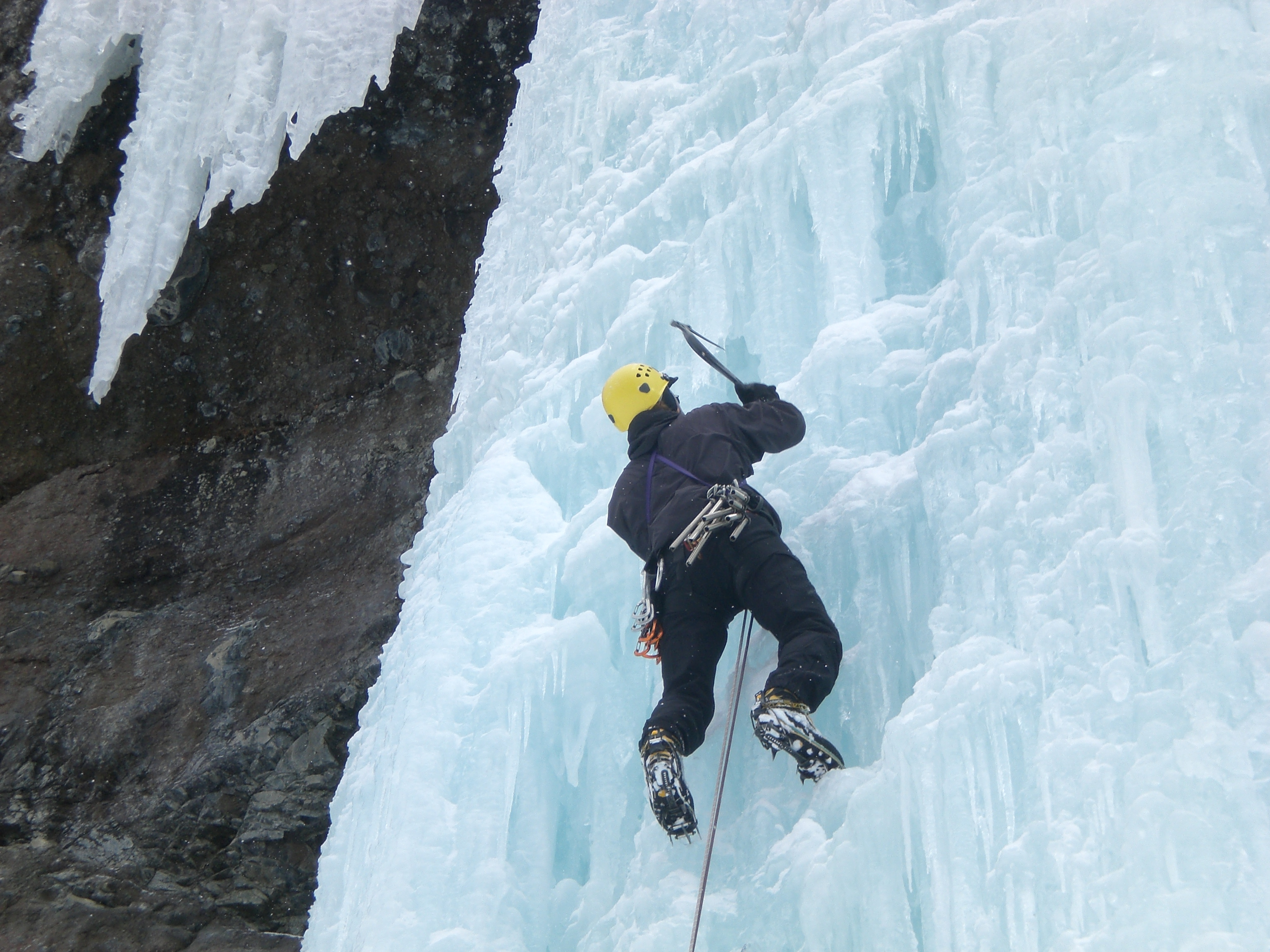
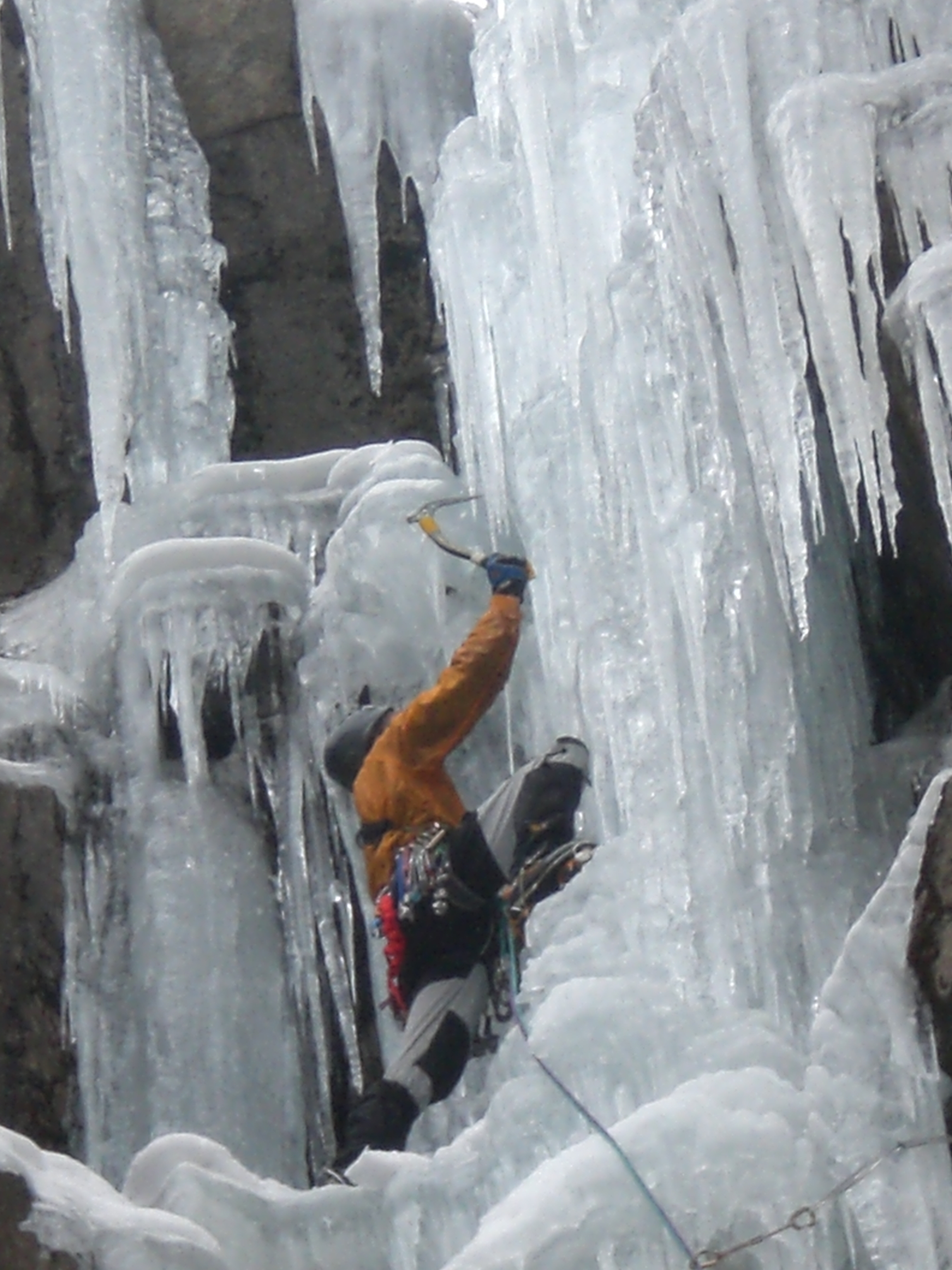
Can Demon Possession Make You a Better Ice Climber?

I’ve been wanting to sell my soul for a while now, but I just can’t find the right buyer. I’ll admit I didn’t think it through before I started looking, but who does? This sort of transaction has such a history, it’s hard not to slip into the ruts, and I did. The first buyer I considered was the Devil.

It turns out that he has already had a pretty extensive background check, and is not considered a good risk. Even though a seller knows that the Devil is the embodiment of dishonesty, it is almost impossible to devise an effective means to circumvent that fact. A whole lot of very smart people have evaluated deals with the Devil, and the consensus is that even if you get what you want, you won’t get it in the way you want, which, unfortunately, is crucial.

Having rejected what the Devil had to offer, I next considered God. Dealing with an all-powerful, benevolent entity takes care of the reliability problems which confound deals with the Devil, but I had to reject a deal with God as well. As an all-powerful being, he can be very picky about what he offers, and as a benevolent being, he’s only going to offer what’s best for you. Trouble is, what’s best for you isn’t necessarily what’s good for you. He offers one package built around guarantees of immortality and eternal pats from the hand that holds it all, including ultimate reassurance. Your satisfaction is guaranteed, and there is the problem. If you make the sale on those terms you will be satisfied with what you get, and stop wanting whatever it was that prompted you sell in the first place. In that case, the crusaders had it right. Once you settle, it’s best to find some helpful fellow to kill you quick so you can get to the goods and avoid running afoul of  contractual conditions.

With the conventional choices eliminated, I decided to go with eccentric, so instead of scrolling through the Saints or Old Testament demons, I investigated Laplace’s Demon as a possible buyer. Laplace’s Demon is part of a thought experiment about determinism. The Demon is a perfect calculator who, knowing the initial conditions of the universe, can figure all future conditions. A critical few cast aspersions on my inquiry, saying that the Demon was a purely imaginary creature. However, during my background check of God I had encountered the Ontological Argument, which said that if I could imagine a perfect being, the only way it could really be perfect was if it was real as well as imaginary, so a perfect imaginary being must also be a real being. I had received a reassuring number of reassurances from the keepers of the Lord’s earthly franchise that this metaphysical maneuver actually detected a real  quality of the universe via an indirect examination of the nature of our minds and didn’t just ignore the dependency of imaginary objects. It seemed I was on the right track. Sadly, the complete examination of Laplace’s Demon ended in disappointment as well.

I have to back up for a moment here to clarify my motivation for marketing my soul in the first place. It is a modest ambition, really: I thought I might be able to trade my soul for something that would make me a better ice climber. You see, I am very dissatisfied with the method and means of improvement available to me currently. The method is learning through practice and progressive challenge. The means is critical appraisal of what it is ‘like’ to properly swing and weight an ice tool. The means part is the real problem; I could live with the method if I didn’t have to deal with the vagaries of the means.

Swinging an ice tool isn’t like juggling or jumping rope. Once you know the technique, you don’t just get better by repetition, up to your physical limits. You have to know what a good swing feels like so you can know whether the pick has set well in the ice, and if it hasn’t, just how badly it has set. Everything else – the energy you expend for each foot of upward progress, the security of the protection you place, the speed of your ascent – follows from what each swing is like. By the same token, the quality of a swing depends on a huge bundle of factors beyond the alignment of the elbow and timing of the wrist-flip. The quality of my swing follows from the appearance and feel of the ice, my level of mental focus, my level of physical responsiveness, the accuracy of my estimation of my physical responsiveness, etc..

It’s an impossible set of variables to track, but all together, they feel a certain way when they fall together right. To get better,  I can match every swing against the memory of that right swing until they begin to cluster closer and closer to that theme. There’s a hidden bonus in this means of progression, too. I can use the information I get from what a swing is like in combination with the same kinds of themes regarding body position, balance, and ice structure to sort out an entire climb, both before I start and as the climb unfolds. Though it’s a slippery and imprecise means, my mind, anybody’s mind,  can use it to manipulate otherwise intractable sets of details, albeit by proxy, which brings me back to why the Demon can’t help me.

To have the reductive knowledge that he does, the demon must rely on one simple trick: he ignores time. Since events are multiply contingent upon other events in an ultimate reduction (or even in an incomplete one) the resulting structure, with all events completed and with all the chaotic processes gamed out, is a web of converging and diverging causal chains. From the Demon’s viewpoint, it makes no sense in sequence, any more than it makes sense to say an unmarked map has a beginning or end rather than boundaries. Given his quirk, the Demon can help me in one of three ways. First, he can jump in and yell, “Stop!” when I approach a point where a bad swing exists. That may only make things worse. Second, he can take over and guide my arm, but to realize each step to a good swing in sequence is likely to take ages in lining up, or proceed in fits and starts as he makes adjustments to jump from path to path, neither of which I can afford. Third, he can show me where I am in the interlocking mass of causal connections relative to a good swing, but then the information is only approximate until I actually swing (or close enough) and that’s just the kind of situation I’m trying to escape.  Laplace’s Demon is no more helpful than the Devil himself. I can’t use either of them to cheat the world out of another degree of freedom. I’m stuck feeling my way through with qualities and beliefs about qualities.

The worst part is, I suspect I am taking advantage of the means I have about as well as I can, as is the rest of the species. Our brains are quality having, belief generating, story telling organs. The stories our brains make are good enough that we can’t say for sure where the stories end, and where their causes begin. I don’t think beliefs or qualities cause anything, but maybe they do capture something about the way the world works that reduction misses. They seem like way points on the Demon’s map of causal relations, marking time. Even so, I can’t say for sure that qualities and beliefs aren’t real things, determining the actions of their constituents. That would require an external perspective, like the kind a perfectly knowledgeable Demon could give me. Hmmm – What does the Ontological Argument say about contacting a perfect being, and whether or not I can get an hourly rate?

Tagged , , , , , , , , ,

It’s No Good

Zhuang zi is my favorite moral anti-realist. A millennium or so later, and nobody has been able to say it better.

The invention of weights and measures makes robbery easier. Signing contracts, setting seals, makes robbery more sure. Teaching love and duty provides a fitting language with which to prove that robbery is really for the general good. A poor man must swing for a belt buckle, but if a rich man steals a whole state he is acclaimed as statesman of the year.

Hence if you want to hear the very best speeches on love, duty, justice, etc., listen to statesmen. But when the creek dries up, nothing grows in the valley. When the mound is leveled, the hollow next to it is filled. And when the statesmen and lawyers and preachers of duty disappear, there are no more robberies either and the world is at peace.

Moral: the more you pile up ethical principles and duties and obligations to bring everyone in line, the more you gather loot for a thief…By ethical argument and moral principle the greatest crimes are eventually shown to have been necessary and, in fact, a signal benefit to mankind.”

The translator, Father Merton, does not exaggerate the sarcasm in his interpretation. The use of the word ‘crimes’ , for example, is intentional, not a slip into moral terminology – moral realism leads to the definition of an act as a crime, as it leads to the facile redefinition of the same act as good when situations change.

Good isn’t an intention. It isn’t about any specific thing, at least independent of circumstance or for very long. Good isn’t a quality. To speak of it, we need to make it dependent on a subject. If we reverse that arrangement, we end up with Kantian contradictions – we must tell the axe-murderer where his quarry is hiding because telling the truth is objectively good.

Good is, as any moral notation, a place-holding modifier. These words allow us to avoid the confusion of re-explaining to ourselves what we’re about before we do anything. They are very useful, so we shouldn’t get rid of them, but we must not make the error of treating them as real things. Otherwise, the crimes pile upon crimes, until we smother.

Tagged ,