Category Archives: politics

Cutting Up an Ox

IMG_1312

Ben Sasse fears for our youth.

He is a U.S. Senator, and therefore he is a very busy man with little time to spare for side projects. Yet, so great is his concern for our kids’ predicament that he has taken the time to write a book about it. It is not a bad book, even if you disagree with what it says. You will have to trust me (or not) on the exact contents, because, “You may not make this e-book public in any way”, is all I will quote directly from it.

His thesis is laid out in the book’s title, The Vanishing American Adult, and he has summarized the gist of his prescription in the subtitle, Our Coming-of-Age Crisis – and How to Rebuild a Culture of Self-Reliance.

In the text, he depicts a generation afflicted by aimlessness. They have been stunted by coming up in the shade of social media and cultural relativism. Deprived of the harsh choices and bright lessons that come with social responsibilities and traditional rites of passage, kids have grown passive. They lack the ‘grit’ to sustain our society.

I won’t quibble with his depiction. Social media is a blight. The current generation operates on the assumption that ‘someone will take care of it’. Giving up is always an option for them.

I do disagree with his diagnosis and prescription, however. He seems to think that helplessness and hollowness result from a deficiency of citizenship. The correction would then involve a big shot of citizenship. He is completely mistaken. In fact, emptiness is the natural outcome of citizenship, and helplessness is just a reactive symptom.

On the most basic level, citizenship is a position in which one gets told that one’s life is fungible. One’s time, attention, motivation, and psyche can be chopped up and traded for goods to satisfy certain needs. Of course, Sasse recognizes this situation. He mentions “development of the individual” on a couple of occasions as a worthy pursuit, but only if it is pursued to certain ends (becoming responsible, self-sacrificing, ‘gritty’ – in other words, all those things that make a solid citizen). As far as I can tell, only the ends distinguish healthy developmental activities from selfishness, in Sasse’s estimation. And in a shocking coincidence, healthy ends are those for which the goods of citizenship come in handy.

“Why won’t my blood sugar go down?”

Maybe my analysis is unfair. Sasse contends that we are all a little defective, and our institutions may be a little defective, too. We should not expect a perfect synergy between man and social machine, even though the basic program is sound and actually the best that we can do.

But I hear differently all the time.

“I’m doing all those things that the diabetic educator told me to. I have changed my diet. I am walking every day. I am taking my medications like clockwork. So why is my blood sugar still high?”

This person is in my office every day, wearing a different, outfit, a different ethnicity, or a different gender. Yet they are the same person. They have a sit-down job, or two, in which they spend 40-60 hours per week dealing with an incestuous dataset – something so about itself, whether it is driving a cab or processing claims, that it demands attention to automatisms rather than any  particular skill. To ensure that their attention does not waver, an overseer tracks their activities and rates their efficiency. Their extraneous physiological and psychological functions are regulated by the employer as distractions.

The citizen in my office sleeps 6 hours per night, or less. They drink energy drinks to keep going, and eat foods which the package or the vendor says are healthy, because they haven’t the time or energy to prepare their own food. They are too exhausted to exercise properly.

As a result, they are obese, diabetic and hypertensive. As a result, they now require one of the goods for which they can sub-divide themselves: medical care.

Which brings us to where the defense of citizenship as a natural-born fertilizer for human development, breaks down. The trouble with the whole thing is not the palate of goods on offer, their costs, or the means of valuation. The trouble is the chopping, because the roots of experience (attention, motivation, responsiveness, etc.) can’t be cut up for a purpose, especially for delayed gratification of a specific need. The very notion mistakes the nature of needs and the relationship between our needs and our activities. Here, Sasse may have been better served by spending a little more time reading Nietzsche, and a little less time reading Rousseau and the Bible.

For an organism’s needs can’t really be parsed. The motivations underlying our activities are merely aspects of a single motive which Nietzsche labeled ‘will to power’. Even when we try to perform an isolated act of attention, we feel something about it, our neuro-hormonal system responds to it, and it tires us globally.

But Sasse seems to think there’s a neat way around the problem of dividing the indivisible.

Life on the Farm or 8 Pitches Up?

In the latter half of the book, Sasse talks about how he sent his daughter to work on a ranch. The idea was to teach her how to enjoy work – not any particular task, but work itself. Basically, he sought to teach her how to thrive as an instrument. It’s pretty clever, really.

He explains the strategy in a vignette:

Martin Luther met a man who had just become a Christian and wanted to know how best to serve the Lord. He asked Luther, “How can I be a good servant? What should I do?” He expected Luther to tell him that he should quit his job and become a minister, monk, or missionary.

Luther replied with a question, “What do you do now?

“I’m  cobbler. I make shoes”, the man answered.

“Then make great shoes”, Luther replied, “and sell them at a fair price – to the glory of God.”

In other words, find integrity in being a good instrument. I think the flaw in this reasoning is obvious: Why not make great shoes to the glory of Satan? It’s the devotion part that really matters, right? This notion of the human lost at heart and essentially in search of a set of rails (any rails) undergirds fascism through the ages, and it works superficially, so long as the social venue is stable.

But I took another path with my kids, because I learned more from sitting on a ledge, than I ever did from a job.

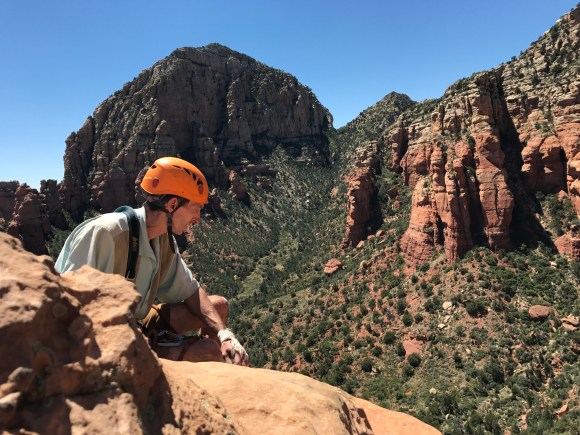
We have climbed several long routes together. We have looked up, down, and out from ledges in the middle of those routes and soaked in the lessons: however precarious the position, what falls to us is to pass the water around, check the system, and find our way through the next rope-length of terrain; trust your partners as you trust yourself; no matter how cold, hot, tired or thirsty you are, the beauty of the sky and landscape remain; achievement, i.e. ‘ticking the route’, doesn’t really matter – it is only a means to get you to the ledge.

In taking them on those climbs, my hope was to offer them a way of life which put making a living in perspective, rather than telling them that making a living would put everything in perspective for them.

A different vignette illustrates my point:

     Cook Ding was cutting up an ox for Lord Wenhui. At every touch of his hand, every heave of his shoulder, every move of his feet, every thrust of his knee — zip, zoop! He slithered the knife along with a zing, and all was in perfect rhythm, as though he were performing the Dance of the Mulberry Grove or keeping time to the Jingshou Music.
“Ah, this is marvelous!” said Lord Wenhui. “Imagine skill reaching such heights!”
Cook Ding laid down his knife and replied, “What I care about is the Way [“Dao”], which goes beyond skill. When I first began cutting up oxen, all I could see was the ox itself. After three years I no longer saw the whole ox. And now, now I go at it by spirit and don’t look with my eyes. Perception and understanding have come to a stop and spirit moves where it wants. I go along with the natural makeup, strike in the big hollows, guide the knife through the big openings, and follow things as they are. So I never touch the smallest ligament or tendon, much less a main joint.”
“A good cook changes his knife once a year — because he cuts. A mediocre cook changes his knife once a month — because he hacks. I’ve had this knife of mine for nineteen years and I’ve cut up thousands of oxen with it, and yet the blade is as good as though it had just come from the grindstone. There are spaces between the joints, and the blade of the knife has really no thickness. If you insert what has no thickness into such spaces, then there’s plenty of room — more than enough for the blade to play about it. That’s why after nineteen years the blade of my knife is still as good as when it first came from the grindstone.”
“However, whenever I come to a complicated place, I size up the difficulties, tell myself to watch out and be careful, keep my eyes on what I’m doing, work very slowly, and move the knife with the greatest subtlety, until — flop! the whole thing comes apart like a clod of earth crumbling to the ground. I stand there holding the knife and look all around me, completely satisfied and reluctant to move on, and then I wipe off the knife and put it away.”
“Excellent!” said Lord Wenhui. “I have heard the words of Cook Ding and learned how to nurture life!”
— Zhuangzi, chapter 3 (Watson translation)

I do not see the current generation as sissified hedonists, any more than previous generations. The hypersensitivity, the passivity, the absorption (self and otherwise) all look like symptoms of a bunker mentality. They see what’s in store for them and they don’t like it, but they don’t seem to know how to resist.

A Sasse-type message has gotten through. The citizenry coming of age does think that it must learn to embrace a social role (little worker, little voter, little contributor) wholeheartedly in order to fully mature, and it just can’t bring itself to do so. The instinct is right. Kids growing up in this era are being asked to pursue a sort of faux-maturity which involves merely “giving up childish things”, and the achievement of that state will leave them empty and utterly dependent on a structure which deals with them on the basis of a flawed methodology.

They need a little less Ben Sasse, and a little more Cook Ding, when it comes to advice about how to grow up. Because maturity means dealing with your situation – not just endorsing it – and dealing with it artfully. It means getting over being The Cobbler, The Christian, The Cobbler-Christian, or even The Cook.

In Sasse’s terms, I have laid out the Romantic counter-argument to his Realist argument regarding the nature of the individual’s relationship to civilization. But I reject that characterization to some extent. There isn’t an inherent conflict between the individual and the civilization. We are stuck with our civilization. It lies before us like the carcass of a great ox, and it is just as indifferent.

We get chopped up in our interaction with it, but our own hand is on the knife. And I agree with Ben Sasse here,  maturity is the solution. Not the faux maturity which the senator espouses, which is just a form of selling out, but actual maturity which sets limits and carves its own way, not towards some magical future, but like the cook’s knife, in the present where we all reside.
IMG_3666

Tagged , , , , , , , , , , , , , , ,

Five Seconds That Will Live in Infamy

I love pbs! It sells what nobody wants to buy. From the documentaries to the pundit panels, it delivers the 10,000 ft view of any topic imaginable. Most of the time, it also tries to entertain, lightly. Even when they tackle the heavy topics they don’t rush through or sensationalize. They stay serious but steady. At the end of the article the journalist has you feeling like it is bad today, but this too shall pass.

Nobody is better at maintaining a calm and informative flow than the folks at NewsHour. Everybody has the mood in mind, whether they are in front of the camera or behind it. The set designers and builders avoid any distracting graphics. The clothing and makeup people don’t enforce an artificial fashion code on the presenters1. All the zoom calls look like Zoom calls.

All of the journalists work diligently to make the news informative and sympathetic to the range of viewers who might tune in from any spot in America, but no one works harder on it, and no one is better at it than Geoff Bennett. He is the anchor of NewsHour, and one of the few people remaining in TV journalism who truly merits that title. He is the embodiment of unflappability.

He can steer a politician’s Ideological cruise boat away from the muddy reefs which call to those vessels inexorably. He knows how to navigate a soliloquy on the secret project known to everyone which has the Chinese Communist Party and its real leader, George Soros, passing out visas and voter registration cards to the horde of slavering migrants stampeding toward Brownsville. He knows how to keep a light touch on the tiller as he sees us through a report on US policy toward Costa Rica.

He doesn’t simply change the subject. He offers the guest an opportunity to make themselves understood, first to him, and then by the transitive property of Television exposition, to the rest of their fellow citizens.

It’s clear, from the beginning of every interview, that nobody’s going to get him riled. He will not raise his voice, gesture emphatically, laugh, or talk over the guest.

His performance during the Trump era’s mass psychosis helped alleviate my heartburn. Geoff’s steady tone and incisive questions exposed the populist neofascist face of Trump’s movement. The political operatives all suffer from hubris and profound incompetence exacerbated by their competitive hankering for Trump’s perianal flavor. Geoff’s conversations with these snarling purse dogs allowed them to demonstrate that incompetence. He has given them the rope that they have asked for, while resisting the temptation to help them with the knot and the tree limb. After listening to them respond to his questions, I figure on just letting them sell NOAA to Exxon and eliminate FEMA before the next hurricane season, try to safely, inexpensively, and effectively round up 16 million people and deport them, and have somebody like Matt Goetz stand up at morning briefings to tell Federal prosecutors and law enforcement that he’s the new sheriff in town and here are all of his well-considered and professionally informed plans for the agency’s future.

Lately, I have started questioning my odds of a worry-free future again. I’m having doubts because they broke Goeff. I know I shouldn’t be surprised. Everyone has their limit. There’s just that one, last, dumb shit comment that pushes things over a person’s line. We all start off hopeful when we engage in adversarial discussions. Despite all the absolutisms tossed about in the course our disputes, we all hope that at the end, we will be able to say that the opposition was misguided, but even so, gave a respectable argument for their position.

We don’t become dejected when an opponent offers up a logical fallacy or bogus statistic in the course of an argument. What kills a person’s spirit is insistent incoherence delivered from beneath the protective umbrella of a time limit, or in such a massive load that it will strain the attention of any sane person to see the argument thoroughly dismantled.

On November 13th, 2024 at 49 minutes and 55 seconds into the PBS NewsHour, the cameras captured the very instant when Geoff snapped.

You can see it coming. The guest throws out cryptic negativity about Covid vaccines, then ramps it up with some free-floating homophobia. Then for the finisher, he throws out abortion on demand with no restrictions and no restraint. The next glimpse of Geoff’s face reveals his thoughts as clearly as spoken words.
‘This? This again with two minutes left in the interview? I can’t. I know I should swat this down, but I am so tired. I’m just going to ignore it and move on.’

I sincerely hope that Geoff recovers. He looked a lot better by the end of the episode, but that kind of hit can result in a relapse. Please get well soon Anchor Man. I don’t think I have it in me to start worrying about Matt Goetz doing the same thing to the FBI.

Okay, there is that one pink pantsuit that keeps coming back. I imagine there’s a story behind that, because I can’t imagine that nobody said anything. I consider it an isolated incident.

Tagged , , , , , , ,

This again?

“Life! Don’t talk to me about life!”

Marvin the robot

My day began with a woman on the radio proclaiming a great victory for life. For the first time in a long time, a world in which no unborn child got murdered looked to her like a real possibility. Her statement contained a pile of red hot words, resting on one simple word: life. Let us be as clear as possible about the definition of life, because those who have adopted the label “pro-life” will not be. When they talk about life, they don’t mean to talk about biochemistry, they mean to talk about the soul. They mean to talk about all those little souls, bearing some indefinite relationship to little bundles of cells. Via that bond, the soul somehow sanctifies an embryo, while remaining completely uninvolved with biochemistry. What follows are the familiar discontents of substance dualism.

Like most of the pro-life crowd, the woman on the radio barged past the interaction problem and its implications with loud assertions. I got the sense that she may not have fully appreciated those implications herself, and so the rhetorical bum rush may have been a means of self defense as much as it was an offensive tactic.

Poor insight is no excuse though. She deserves the heap of scorn coming her way. Yet she doesn’t bear sole responsibility for her inconsistency. She no doubt labors under the influence of a defective definition of biology. In school, she probably learned a series of rhetorical tautologies (life is organism, organism is metabolism plus reproduction) in her biology classes which amounted to saying, “life is what biologists study”. Nor is biology unique in that regard. All of the sciences have backfilled their metaphysics.

Yet, the associated metaphysics is what really interests us. Though it is fantastic to know about the microscopic structure of the wood in the ship of Theseus, what we really want to know is not the composition of the planks, but the defining relationships of those boards in context. The planks are the ship of Theseus because they floated around the Aegean trod upon by Greek heroes, not simply because the boards consist of a cellulose polymer capable of floating around the Aegean while being trod upon by Greek heroes.

Life is not the Krebs cycle or the DNA in a blastocyst’s nucleus, and it is certainly not some vital substance wafting about, indefinable in principle, and opaque in its activity. Life is what sustains defining change across circumstances. In other words, it is the fulcrum of a dynamic equilibrium. Consider a bacterium in a nutrient broth. Energy from the broth translates into new molecules like the molecules which came before in the cell wall, ring chromosome, and cytoplasm of the bacterium. Having built up enough substrate, bacterium divides, relaying its balance point on through time and space. Then someone drops an antibiotic into the broth. Energy from the broth stops flowing into new substrate and shifts to the activation of efflux pumps. That’s life.

If the organism is overcome, it becomes adrift in its circumstances. Once its equilibrium gets tipped too far, it cannot make its way through the broth or the antibiotic exposure with its causal explanations intact.It’s molecules react with surrounding molecules based on ambient energy states. It cedes all its explanations to whatever is floating around with it in the broth. It is dead.

Beyond this stark boundary between life and death, lies an expansive liveliness. There is life that sails almost where it will (humans), life within life (Portuguese man of war, bees, lichen), and life explicable only in context (prions, chlamydia, embryos).

Embryos live strictly within the lives of their mothers. Embryo explanations require mothers. Embryo explanations do not require souls. Until someone comes up with an effective description of the soul and its relationship to a little ball of cells latched onto the endometrium, the soul remains an inert addition – an epiphenomenon at best. This is a problem which the pro-life fools can’t shout down or blow past. Because the problem with epiphenomena is that there is nothing really tying them down. They don’t do anything, so they can fill in wherever. The unknowable nature of the zygotic soul can justify whatever, from bombs to prayers. It’s a wonder that something so flimsy could ground a social movement of such size. The truth is though, it doesn’t.

The target of the pro-life movement has always been the women, as one might guess given the nature of trans placental relationship.

The vacuous nature of pro-life rhetoric needs exposure, so that we can get to the real purpose of that rhetoric, which is control. People in the pro-life movement are not really interested in the biology of human development, or even bioethics. Instead, they are interested in other people’s stories. Because their own narratives, jumbled as they are with souls, sins, and angels, are so weak, the pro-lifers see divergent narratives as invalidating. Accordingly, they try to curtail divergent narratives wherever they can.

That is the motivation behind the pro-life movement. I doubt that this motive is ever articulated within the ranks. I suspect it is held more as a feeling, which makes it even more dangerous. A stated policy can be confronted, criticized, and torn down. Opposition to a feeling is personal. Furthermore, feelings tend to take on lives of their own. Clarence Thomas is already telling us what comes of persistent, unleashed insecurity. Listen to him, and the rest, and then call them out.

Tagged , , , , , ,

What about my rights

A society has two basic means to regulate its members’ behavior. It can either entrust them with rights, or restrict them with rules. Each approach has its downside, and most societies use a mix of the two. In China, there are all sorts of rules regarding what you can say and where you can go, but citizens have the right to engage in quite a few economic activities as they see fit. In the United States, you can do what the hell you want, and the law comes knocking after the fact, for the most part.. The problems with rules seem quite obvious, at least to those of us who grew up in liberal Western democracies. Rules are stifling. and the utilization of rules assumes the worst of humans.

Implicit in law, policy, and custom is the notion that people respond best to fear or avarice, and therefore need punishments and rewards. Left to their own devices, they will be unruly. There is a grain of validity in the rule-makers attitude, but it is also the case that people live up to expectations.

The problems with rights are less obvious to us. There are a couple of problems though. A relatively small one is the superficial flaw noted above in regards to how laws function in the United States. A society based on rights assumes that citizens can be trusted with those rights. Those who trust, risk getting burned. The trusting soul can fall back on rules, but only as deterrence via the threat of retribution, not as direct prevention.

And there is a deeper problem with rights besides, because there is a lazy way of possessing a right. The ideal right-recipient is someone who values the right, and is therefore motivated to understand what the right demands of them, where the right stands in regards to other rights, and what consequences may follow from exercising the right. Being an ideal right holder is a hassle. It’s much easier to stow your rights in your pocket and go do as you like, pulling out the right only when the need arises to ward off relevant trouble.

Certain pathognomonic signs accompany rights laziness. The shiftless typically speak of their rights like an extra appendage. They don’t hold a right; the right is one with their flesh. Following from that characterization, lazy right holders behave as if there is no wrong way to exercise their right.

Driving provides the best example of this mentality. For the lazy, anyone in their way is infringing on their right to drive as they please. The traffic cop is a purveyor of injustice. Judges who restrict drivers licenses are the real criminals, since they violate not just someone’s property, but their very person.

The US, being a rights-based society, has showed those signs of laziness from the very beginning. Its founding documents speak of rights as inalienable, and endowed by the Creator. Eyes and teeth are that kind of thing. Gifts and treasures are not. From the beginning too, Americans have exercised their rights like teeth and eyes, which do not demand accounting, rather than like gifts or treasures, which do.

The archetypical tale of American right-laziness is the tragedy of Kyle Rittenhouse.

By all accounts, he was a 17-year-old boy with very typical issues. He seemed to be searching for an identity along with some validation. He wanted to be a cop or an EMT. In other words, he wanted to do something which came with some power and control as well as the admiration of others. He wanted to do something moral. He had taken a CPR course and put together a jump bag like paramedics carry. Plus, like many if not most 17-year-old boys, he wanted a gun. He probably wanted it for the same reason that many if not most other 17-year-old boys wanted a gun. A gun was a badge of adulthood. It offered instant validation. It compensated for any awkwardness in the bearer. Besides the psychological attractions, it made a lot of noise and smashed stuff.

Unfortunately, he was not old enough to own one himself. Apparently, he prevailed upon an older friend and another adult to purchase and keep the gun for him. The arrangement was against the rules, but might not have been a problem, had the adults not been lazy in the exercise of their right to own a gun. They seem to have treated the gun like it was one of the boys appendages. When he decided to take the weapon with him to try out his identity as an EMT/cop at the site of a real-life conflict, they let him and the rifle go.

When he arrived, he met other people with guns, exercising the right granted them by the Second Amendment to the Constitution. By all accounts, they offered him a task, but no advice, and no further guidance. After a while, he wandered off, looking for someone to help. He soon ran into situations that he could not handle. He lacked the experience. In the end, he shot and killed two people, and permanently maimed a third.

He bore his right like an appendage, but he did not understand the consequences of carrying a gun like he understood the consequences of having an arm or leg. He could not come by an understanding of his right naturally, he had to learn it. But there was no one to teach him. Apparently, the other arms-bearers that he met along the way did not feel like it fell to them to tend to their right as this kid exemplified it.

As a society, we are getting lazier with our rights by the day, and the signs and symptoms show. Nobody knows what to do with their speech. Nobody knows how to meet amicably. Nobody knows how to be armed responsibly. The anxiety that comes with uncertainties is growing, day by day, and each day we become more anxious for rules to dispel the uncertainties.

Authoritarians have begun to pop up in response. They will be happy to provide us with all the rules we want, and then some. They will even sweeten up the rulemaking medicine for us by telling us that they are actually taking rules away, “deregulating” as a means of concentrating power. A set of rules constraining our behaviors (to the advantage of the ruling family) is our fate, unless we stop merely exercising our rights and begin to tend to them.

Tagged , , , ,

The Heat of a Separate Logic

Sometimes, I catch my wife watching out of the corner of her eye while I cram my feet into climbing shoes. The process entails a good deal of whining and swearing, which will continue throughout the subsequent training session. She usually keeps quiet about what she sees, but sometimes she can’t help but ask, “What is it that you like so much about climbing?”

I tell her that I like it because it’s war, except that, as opposed to war, if everything goes right, nobody dies. My answer is a bit hyperbolic. For one thing, I have never even been near a war, much less participated in one. What I mean is: the attractive thing about climbing is the same as what those who have fought wars say is the attractive thing about war.

Though it is difficult to put a finger on the source of our attraction, we humans are undoubtedly enamored of war. Our literature enshrines it. It has a permanent place in our culture, in the form of holidays and memorials, but also in practices like the martial arts.

The studios can always sell us another war movie.

It isn’t just a fascination born of fear either. We associate warfare with all kinds of positive moral qualities, like courage, loyalty, and determination. Even the Prussian general, Carl von Clausewitz, implicated valor as a reason for the normal individual to volunteer for war. This from the man who said that war has its own grammar, but not its own logic.

Von Clausewitz clarified that position on the nature of war in what is now a famous aphorism: war is politics by other means. Practicalities drive us to war. That can’t be the whole story though. If it were, all armies would be conscripted, and no war would last as long as every war has lasted. We fight well beyond pragmatic exhaustion.

That’s because Von Clausewitz was wrong. War does have its own logic. If we listen to war’s participants, we hear about the struggle to survive their circumstances, and to put an end to the struggle itself by overcoming their opponents. We hear about the moral obligation to protect one’s comrades. The politicians may have pursued their policies into war, but once the war gets going, the fighters fight for other reasons entirely.

If we take logic to mean a description of consistencies between meanings, then we have to conclude that war does have a logic of its own. It is a logic which supersedes all the extrinsic reasons for going to war. Maybe that’s why war persists. Because it is easy to think about getting in to a war on the basis of von Clausewitz’s pragmatism, but once the fight is on, the other logic takes over, and not only gives us a reason to see the war through to some conclusion divorced in principle from political practicalities, but also gives us stories about all those positive moral qualities which the participants find in their quest to come through the catastrophe.

The other logic is always dangling out there. It is the same logic that drives me to climb, and others to fly wing suits, race motorcycles, and ski out of bounds. Any useless activity involving uncertainty and inherent danger will have the same enticing, overpowering consistencies between meanings. There is no practical reason to jump out of a functional airplane. There is no material gain in clawing your way up some obscure cliff face. Even the motorcycle racers and sponsored skiers don’t do it for the pay.

This sort of pursuit challenges us to engage, because once we engage, the other logic, which is the logic of survival, determination, and commitment, takes over and cooks off all the other, weaker, practical logics. For the duration, everything is clearly in its place.

Clarity is not a requirement. In our age, nobody really considers going to war on such a vision quest (we gave that up with the end of dueling). You don’t hear the participants in a battle wax nostalgic about the smell, the cacophony, or the sight of dismembered bodies. At best, the practical details of war just serve as props for the exhibition of the other logic. So often the story goes: I didn’t want to be in a war, but since I was, I tried to take something good away from it, and this is what it was – loyalty, determination, commitment.

Those stories are good ones, maybe even necessary ones. Still, they are an attractive nuisance. They don’t get us into war, but they contribute to a kind of permissive state in our collective psyche. Political practicalities appear more convincing. Our own participation in conflict feels easier to justify, sometimes to such a degree that those who should know better (historian Stephen Ambrose) express regret for never having their courage tested in combat.

That’s what it is about climbing. It’s a way in to the crystal sphere of the other logic. It’s also an admission that I want to live as much as possible in the sphere, though it is impractical. I think that that admission is key. It is the bit of insight which separates an attraction to useless, uncertain and inherently dangerous sports from an attraction to war. So maybe there is one generally useful thing to be had from dangerous sports. If we can cultivate in the larger society, an insight into our own motives for pursuing impractical, uncertain and difficult peril, we might be less susceptible to war’s appeal.

Tagged , , , , , ,

The myth of the free range human

… Is a myth that I, as much as anyone, wish were true. My dream is to have a little place in the middle of nowhere, off the grid, with a couple of greenhouses, a composting toilet, a 12gauge loaded with rifled slugs, and a pair of vicious dogs. The truth is though, the only way to realize my dream involves relying on things made on the grid. Even after I am established, I’m going to need things from town – in other words, from other people – to maintain my little homestead.

One might argue that my situation is artificially contrived. Nobody asked me to begin in the middle of a civilization, I was just born here. I had no part in constructing it, and I am quite justified in feeling that the whole thing could’ve turned out a lot better than it did. But that would be wrong too. We are all stuck with something like what we’ve got. It’s inscribed in our genome. When my children were born, I did not have to give them any special instruction in speech and language. I simply talked to them, and soon enough, they began to speak. That’s because they have special structures in their brains which are receptive to language learning. We are social animals, and there’s no getting around that.

We are stuck with a duality. We are fully individual, but we can only realize our individuality by way of our social nature. There are no arts, sports, or academics without other people. And as social creatures, we direct our communal effort towards the full expression of individuality. From the isolated point of view of the collective, arts, sports, and academics are a waste of resources, yet we pursue such things as a group because of their benefits to the individual participants.

The dialectic of the social individual permeates all of our institutions, even medicine. Medical professionals treat patients one by one, but on the basis of the statistical effectiveness of each treatment. In fact, our most effective treatments – interventions involving nutrition, sanitation, and immunization – purely play collective odds to benefit an individual patient’s health.

By the same token, our best treatments are not things done to the patient by the physician. Our best interventions require the participation of the individual, and the exercise of individual virtues like patience, generosity, and courage. The current pandemic is a perfect example. Public health institutions aim to immunize the population, in the hopes of preventing individual tragedies.

Libertarians object to such collective efforts, in defense of individual integrity. But this is where the dialectic flips. To exercise individual virtues, and so maintain individual integrity, each person should participate in the treatment. The failure to do so does not demonstrate rugged individualism, but mean spirited cowardice.

In defense of individual integrity, our society allows meanness and cowardice. Nobody is going to hold someone else down and give them a shot. But neither is anyone obliged to give credence to all the excuses and objections expressed when measures are taken to mitigate the collective effect of failed individual character.

Tagged , , , ,

Realism in the Time of Covid

I walked down the broad, sandy track, distracted. The path was built for motorized traffic, so it required no attention to route finding, and my mind could wander elsewhere, in places far from plagues and Gumby revolutions. But I did not stray for long. Behind me, I heard barking. The noise was the sort of high-pitched yap which a dog makes when something frightening, yet fun, is in progress.

I had assumed that a dog made the sound, but I began to doubt as the yammering grew closer at an unnatural rate and became accompanied by a growl that fluctuated in uneven gasps. I stepped off the track, waiting nervously. But of course, no extraordinary monster appeared around the last bend. What did roll into sight was a standard, biomechanical amalgamation. The dog, a German Shepherd mongrel, sat lashed to the vehicle frame up front, shaking and yelping. Behind the mutt, a lumpy man in a down coat steered the buggy from the comfort of its silver roll cage. He gunned the engine over little rises, and coasted around the curves. He gave a little smile and a wave as he passed me. A small American flag fluttered from the apex of his sun-shade.
The commotion rapidly faded, and I turned my attention back to the walk, and the granite towers at the walk’s end. I could see the formations now. Poking up from the slopes of the Little Valley, they were squat spires, the color of the sand beneath my feet. Most were not monoliths, but stacks of huge blocks, each brick 40 feet or more on a side.
At the apex of a small rise in the trail, a single, rhomboidal flagstone, and a small prickly pear with three leaves marked the turnoff to my objective. They looked as if they had been placed there, but they were no more intended for my purpose than the track of hoof prints which led away from the landmark towards the climb. A dotted line, stamped in the sand by deer and elk, and punctuated with mounds of pellets along the way, wove through the Manzanita until it intersected with a line of Cairns leading to a gigantic stack of boulders.
I dropped my pack at the base. I could not tell if the staging area had been manufactured or not, but it was a perfect little patch of dirt, sheltered by cypress and laurel. I fished the rope out from the bottom of the pack and donned harness and helmet. I carried no more gear, because my goal for the day was not to climb the 4 inch wide crack above me from the bottom up. My goal was to find out if I was still a climber, and if so, to begin to claw my way back to a respectable condition. To those ends, I would crawl through gaps between the blocks above, anchor the rope to a pair of unseen bolts, descend the rope, and climb back up to the bolts as many times as I could.
With the rope tied to my back, I made my way around the side of the formation until I could tunnel through the cracks. The way led down and across to a small alcove. A scraggly alder tree grew there, apparently supported by a very shallow bowl of sand alone. In retrospect, it had made a mistake. Though the spot was secure, the soil was too shallow, and the tree’s highest leaves could only catch sunlight for a couple of hours every day. It could never thrive, but it was a pleasant decoration for the time being. From the alcove, a short, awkward squeeze led to a hidden ledge, and the anchor. I secured my rope to the two bolts.

After descending back to the base, I loaded my self-belay device and began to climb. I moved methodically, not at all like I would climb with a partner belaying from the base. I used a single device for fall protection. This was on purpose. The set up relied on hands and feet as my first line of protection, with the rope and device as backup only. Having a second chance put an edge on the whole project which was lacking in the case of third chances and single chances alone. With a third chance in play, the focus shifted to the equipment and allowed for some slop in the climbing. Committing to one chance only demanded fatalism, and fatalism shifted the focus to the mental equipment needed to accept one’s fate, at the expense of free movement.
I climbed through the route, slowly convincing myself that I could still move smoothly. The effort meant ignoring the grind my left shoulder when I loaded it in extension, and the stiffness in my leg on the right when I tried to step high.
I made it through an acceptable number of laps and pulled the rope. The sun was now as high as it would get in midwinter, and it illuminated a small tuft of leaves poking from the alcove between the boulders above.
I turned my back on the formation and wandered down past the Cairns, the elk pellets, the rhomboidal rock, and the three-leaf pear. With the full warmth of the sun on the Little Valley, the trail was now bustling. A grade school child teetered over a bump on his motorbike. A parent followed, riding a matching cycle nearly on the kid’s back tire. Groups of people, some wearing facemasks, some not, nodded to me politely as I stepped off the trail to let them by.
As usual, I could gauge my distance from the trailhead by the age and attire of passing hikers. I first passed those kitted out with boots and daypacks, then the sneakers lot with their coats tied around their hips, then the shorts and flip-flops crowd. By the time that the expensive homes which flanked the start of the trail were visible, the vast majority of passing travelers wore boat shoes and elastic waistbands and would plainly go only a few more steps beyond the gate. What they sought by this activity, I could not imagine.

The parking area had filled up since my departure, and in the usual fashion. When I had arrived in the morning cold, the only other cars parked in the lot were a dated Subaru and a Toyota truck. The Subaru had a Sierra Club sticker on the back window. The truck was covered in dust. Between morning and afternoon, cleaner vehicles had filled in the rest of the parking spaces. A few of these had American flag decals, and one of the flags was blue with a prominent blue line through the middle of the stripes. One rear window bore a red white and blue “Q”.
I wondered who belonged to those stickers. Nobody on the trail looked crazy. Certainly, nobody looked like a revolutionary, and if my fellow travelers that day really were the sons and daughters of the Revolution, then the revolution would be over as soon as the propane and Slim Jim’s ran out.
I had them entirely wrong, though. What a person trusts depends on what a person wants. What a person wants depends on the depth and breadth of their perception. The revolution was against the untrustable unseen. They revolted against rumors of an invisible pathogen. They revolted against the idea of murky social, political, and personal depths. Most of all, they revolted against a start in the cold and dark which they had somehow been convinced that they were entitled to avoid.

Tagged , , ,

Welcome to the Aftermath

“Show me a good loser, and I’ll show you a loser.”

  Vince Lombardi

“There only three sports: bullfighting, motor racing, and mountaineering; all the rest are merely games

Ernest Hemingway

“The ideal form of government is democracy tempered with assassination.”

 Voltaire

The difference between Hemingway’s sports and games is, of course, a matter of winning. In games, winning really is the only thing. In those other endeavors, winning is nothing.
Simply engaging in sport yields the maximum voluntary experience. Engagement delivers everything on the spot, whether or not the participant comes out on the other side, and certainly regardless of winning and losing.
Trophies, money and ribbons only serve to dress sports up by equating them with games. The civilization must thereby disparage sporting ends, since it strives constantly to the opposite goal.
The civilization turns out to be really good at window dressing though. Its props and costumes create a realistic illusion in which games are wholesome and sports are pathologic. Maybe that is why we now live in an age of games and gamesmanship. Our culture has created a situation where Lombardi is right.
Excessive trappings have made sports and sportsmanship not only unrecognizable, but incomprehensible.
Subsequently we have the rise of the consummate gamesman: Trump. To him, there are only winners and losers. Failure to engage and success in shifting the cost define the gamesman’s method.
Allowing him to operate so at the controls of our society has given the whole thing a gamy taint.
To clean it up, we need to make things a little more sporty, though we might not need to make politics quite as sporty as Voltaire suggests.
Perhaps it would be enough to replace the inauguration ceremony with a bullfight.

Tagged , , , , ,

For Anyone

…who believes that, “we have more cases because we have more testing”.

Testing for an infectious disease is like counting the number of balloons in a dark room by tossing darts through the doorway. Say you throw 10 darts in the room and hear two pops. There is still a good chance that a number of balloons remain uncounted. But if you throw 40 darts in the room and hear two pops, the likelihood of a two-balloon scenario soars. When the rate of pops drops below a certain proportion, you can be sure that you have counted most of the balloons in the room. A low percentage of positive tests is what you’re after.
Once you have established the adequacy of your testing, you can sort out what the results reveal about containment. The raw numbers don’t tell you that much. In the case of national case counts, it is reasonable to expect a country with a large population to experience higher numbers than a country with a small population given similar degrees of disease containment. A true measure of containment is cases per population, or in our analogy, how crowded the room is with balloons.
So when a pinhead like Trump says that we have more cases because we have more testing, that standalone statement is pure bull shit. What’s worse, it’s a distraction from what really indicates the adequacy of our understanding of the outbreak’s extent and the effectiveness of our efforts to contain it: percent positive tests and infections per population.

How is the US doing?

Top of the heap with >15,000 cases/1 million persons (European Centers for Disease Control)

Percent positive tests: 7.9 (an adequate percentage is less than 5%)

Tagged , ,

H plus or minus the A

Wee Donnie loves his Plaquenil. He says that hydroxychloroquine may be a game changer. He is not a doctor, and he is certainly not an academic, but he says that he has common sense to guide him. His common sense tells him that the drug might have some beneficial effect in Covid-19 infections, times are desperate, and so why not give it a go – what do you have to lose?

Of course, common sense is what tells us that the earth is flat and the sun goes around it. Shockingly, common sense is just as dependable when it comes to bio-statistics. Trump has no idea what he is talkiing about (as usual). Let me heap a fair helping of scorn on his contentions. To do that, Donnie’s argument has to be split into its two components; otherwise, the load would collapse the full-length argument before even a third of the deserved disparagement were dispensed.

Part one concerns the effectiveness of hydroxychlororquine for corona virus. There are a couple of observational studies from China suggesting that moderately ill people given the drug may have been less likely to progress to severe illness. There are also in vitro studies of viral replication which show hydroxychloroquine to be inhibitory. Finally, there is a study examining viral shedding in patients given the drug versus patients not given the drug. This last study is open label, not randomized, and examines a surrogate endpoint – what we want to know is whether the medicine makes people get better, not whether it makes their nasal swab get better.

All of this evidence generates a hypothesis (that hydroxychloroquine may improve clinical outcomes in coronavirus infection) but doesn’t yield any conclusions at all.  To illustrate how this can be so, witness research on the use of this very same drug for influenza treatment. Because, hydroxychloroquine inhibits replication of the influenza virus as well, in vitro. When given to patients in a randomized, controlled trial however, it didn’t make anybody any better, any faster.

But why let the perfect be the enemy of the good? We can go on hope and the possibilities implicit in the observational studies. The med is safe, right? Just give it. To clarify the consequences of such proposals, lets say that the putative cure for Covid-19 is not a Q/T – prolonging antimalarial. Let’s say, it’s a chocolate brownie. The instructions are: chocolate brownies cure corona. That’s it; that’s all we know.

Now, some people are going to take a tiny pinch of brownie, and secure in its protection, head off to the church picnic. They will get the virus and wind up in the ICU.

Other people will eat 5 brownies per day, sending their triglyceride levels through the roof. Those in this group who are also taking certain medications, will develop pancreatitis and wind up in the ICU (drug-drug interaction).

Some will go beyond the 5 brownie dose, to 7 per day. Among this lot are bound to be some latent diabetics who will subsequently land in the unit with hyperglycemic hyperosmolar non-ketotic coma (drug -disease interaction).

Finally, a few true believers will bump the dose to 10 brownies daily. They will experience nausea, vomiting, and diarrhea with subsequent dehydration and acute kidney injury, buying them an ICU bed right beside the Covid patients (adverse drug effect).

The point is: common sense sees no farther than its own nose and is blind to all these eventualities. Scientific method is not, largely because it admits that we can’t know all the eventualities. That’s why good clinical trials measure hard endpoints, like death or time to hospital discharge, and not surrogate markers, like the presence of virus on nasal swabs.

Don’t rely on that nitwit shyster Trump, his toadies, and their common sense. Rely on scientific method instead.

Tagged , , , ,