Tag Archives: experience

Cutting Up an Ox

IMG_1312

Ben Sasse fears for our youth.

He is a U.S. Senator, and therefore he is a very busy man with little time to spare for side projects. Yet, so great is his concern for our kids’ predicament that he has taken the time to write a book about it. It is not a bad book, even if you disagree with what it says. You will have to trust me (or not) on the exact contents, because, “You may not make this e-book public in any way”, is all I will quote directly from it.

His thesis is laid out in the book’s title, The Vanishing American Adult, and he has summarized the gist of his prescription in the subtitle, Our Coming-of-Age Crisis – and How to Rebuild a Culture of Self-Reliance.

In the text, he depicts a generation afflicted by aimlessness. They have been stunted by coming up in the shade of social media and cultural relativism. Deprived of the harsh choices and bright lessons that come with social responsibilities and traditional rites of passage, kids have grown passive. They lack the ‘grit’ to sustain our society.

I won’t quibble with his depiction. Social media is a blight. The current generation operates on the assumption that ‘someone will take care of it’. Giving up is always an option for them.

I do disagree with his diagnosis and prescription, however. He seems to think that helplessness and hollowness result from a deficiency of citizenship. The correction would then involve a big shot of citizenship. He is completely mistaken. In fact, emptiness is the natural outcome of citizenship, and helplessness is just a reactive symptom.

On the most basic level, citizenship is a position in which one gets told that one’s life is fungible. One’s time, attention, motivation, and psyche can be chopped up and traded for goods to satisfy certain needs. Of course, Sasse recognizes this situation. He mentions “development of the individual” on a couple of occasions as a worthy pursuit, but only if it is pursued to certain ends (becoming responsible, self-sacrificing, ‘gritty’ – in other words, all those things that make a solid citizen). As far as I can tell, only the ends distinguish healthy developmental activities from selfishness, in Sasse’s estimation. And in a shocking coincidence, healthy ends are those for which the goods of citizenship come in handy.

“Why won’t my blood sugar go down?”

Maybe my analysis is unfair. Sasse contends that we are all a little defective, and our institutions may be a little defective, too. We should not expect a perfect synergy between man and social machine, even though the basic program is sound and actually the best that we can do.

But I hear differently all the time.

“I’m doing all those things that the diabetic educator told me to. I have changed my diet. I am walking every day. I am taking my medications like clockwork. So why is my blood sugar still high?”

This person is in my office every day, wearing a different, outfit, a different ethnicity, or a different gender. Yet they are the same person. They have a sit-down job, or two, in which they spend 40-60 hours per week dealing with an incestuous dataset – something so about itself, whether it is driving a cab or processing claims, that it demands attention to automatisms rather than any  particular skill. To ensure that their attention does not waver, an overseer tracks their activities and rates their efficiency. Their extraneous physiological and psychological functions are regulated by the employer as distractions.

The citizen in my office sleeps 6 hours per night, or less. They drink energy drinks to keep going, and eat foods which the package or the vendor says are healthy, because they haven’t the time or energy to prepare their own food. They are too exhausted to exercise properly.

As a result, they are obese, diabetic and hypertensive. As a result, they now require one of the goods for which they can sub-divide themselves: medical care.

Which brings us to where the defense of citizenship as a natural-born fertilizer for human development, breaks down. The trouble with the whole thing is not the palate of goods on offer, their costs, or the means of valuation. The trouble is the chopping, because the roots of experience (attention, motivation, responsiveness, etc.) can’t be cut up for a purpose, especially for delayed gratification of a specific need. The very notion mistakes the nature of needs and the relationship between our needs and our activities. Here, Sasse may have been better served by spending a little more time reading Nietzsche, and a little less time reading Rousseau and the Bible.

For an organism’s needs can’t really be parsed. The motivations underlying our activities are merely aspects of a single motive which Nietzsche labeled ‘will to power’. Even when we try to perform an isolated act of attention, we feel something about it, our neuro-hormonal system responds to it, and it tires us globally.

But Sasse seems to think there’s a neat way around the problem of dividing the indivisible.

Life on the Farm or 8 Pitches Up?

In the latter half of the book, Sasse talks about how he sent his daughter to work on a ranch. The idea was to teach her how to enjoy work – not any particular task, but work itself. Basically, he sought to teach her how to thrive as an instrument. It’s pretty clever, really.

He explains the strategy in a vignette:

Martin Luther met a man who had just become a Christian and wanted to know how best to serve the Lord. He asked Luther, “How can I be a good servant? What should I do?” He expected Luther to tell him that he should quit his job and become a minister, monk, or missionary.

Luther replied with a question, “What do you do now?

“I’m  cobbler. I make shoes”, the man answered.

“Then make great shoes”, Luther replied, “and sell them at a fair price – to the glory of God.”

In other words, find integrity in being a good instrument. I think the flaw in this reasoning is obvious: Why not make great shoes to the glory of Satan? It’s the devotion part that really matters, right? This notion of the human lost at heart and essentially in search of a set of rails (any rails) undergirds fascism through the ages, and it works superficially, so long as the social venue is stable.

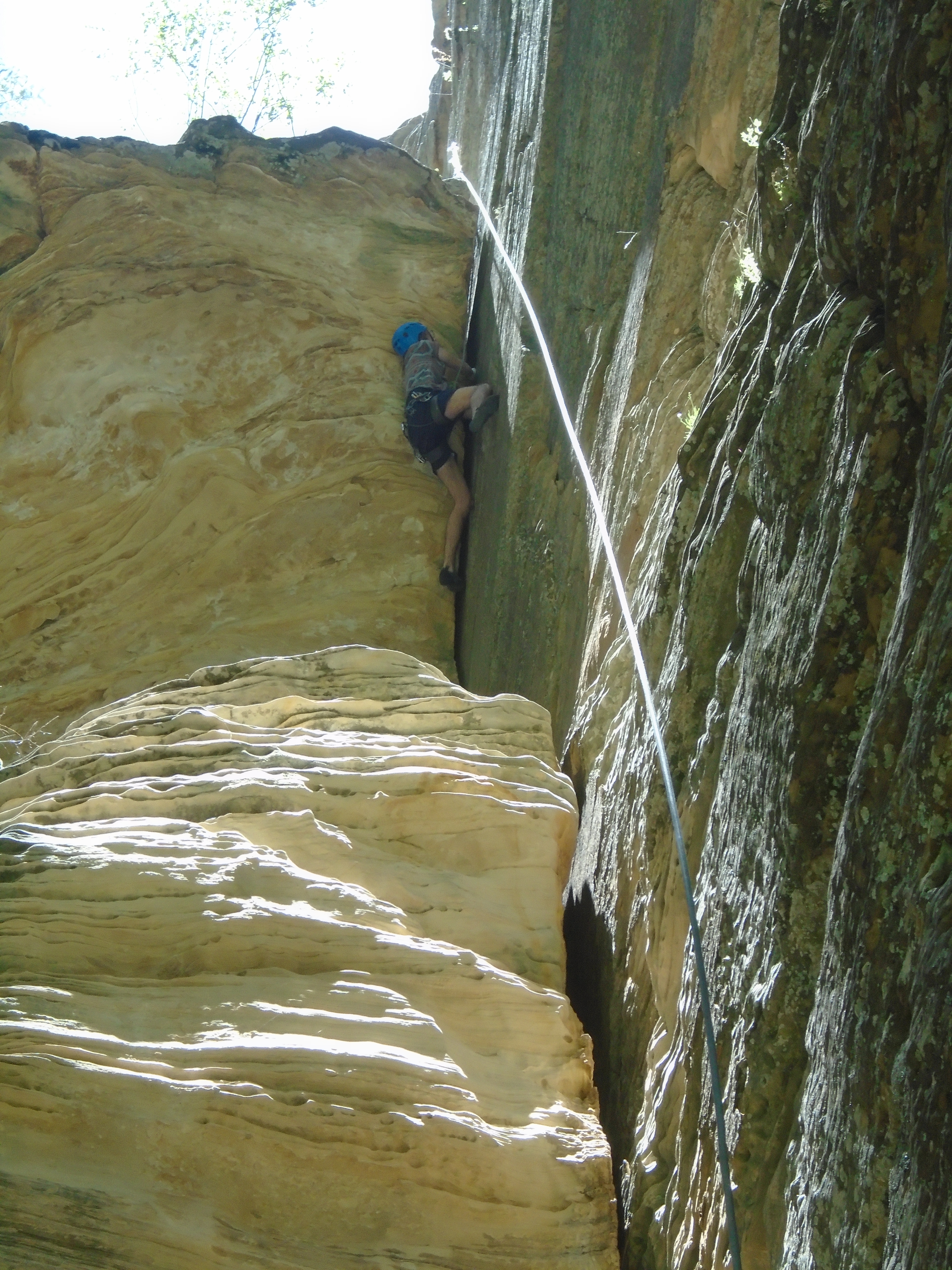
But I took another path with my kids, because I learned more from sitting on a ledge, than I ever did from a job.

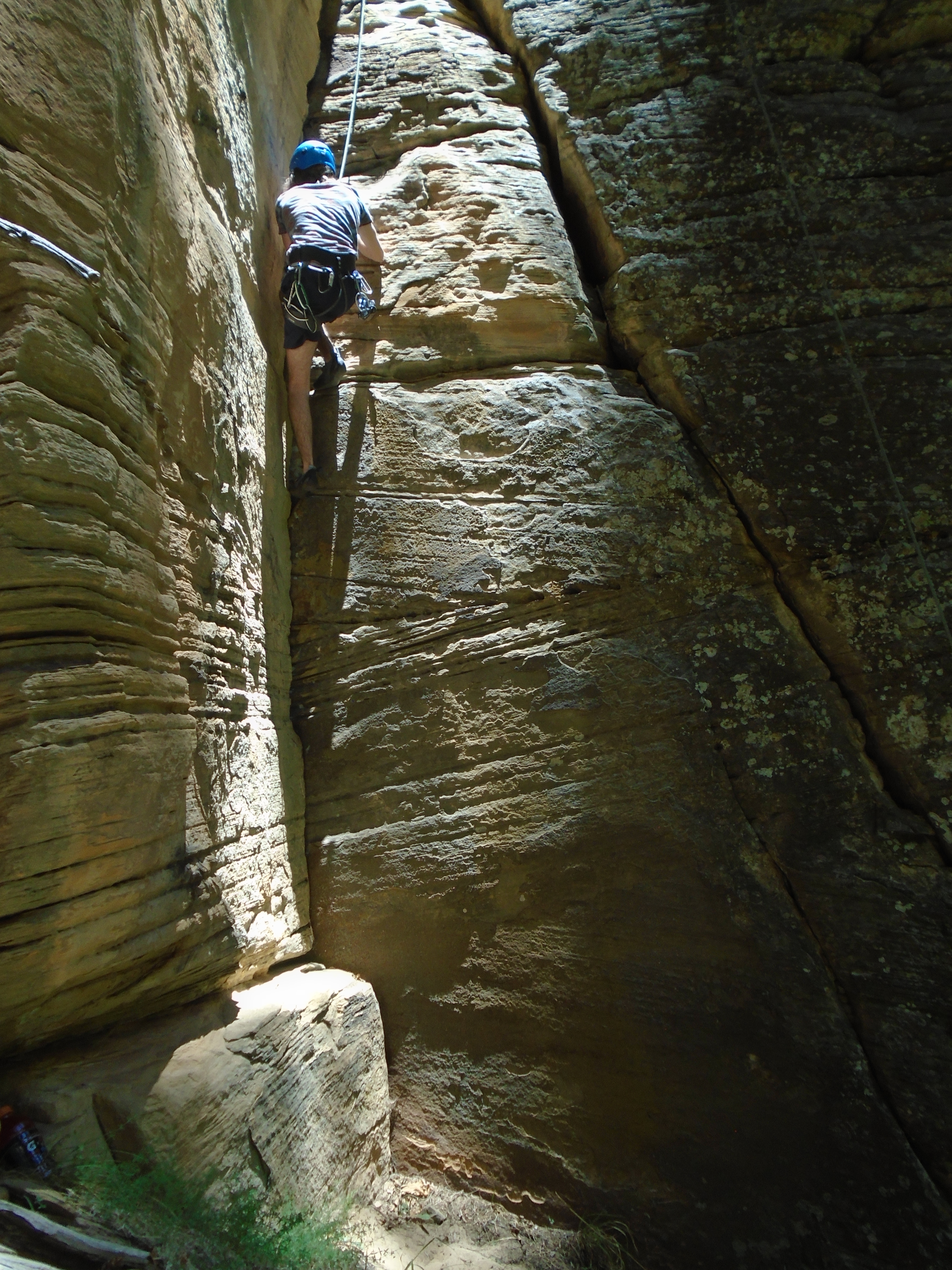
We have climbed several long routes together. We have looked up, down, and out from ledges in the middle of those routes and soaked in the lessons: however precarious the position, what falls to us is to pass the water around, check the system, and find our way through the next rope-length of terrain; trust your partners as you trust yourself; no matter how cold, hot, tired or thirsty you are, the beauty of the sky and landscape remain; achievement, i.e. ‘ticking the route’, doesn’t really matter – it is only a means to get you to the ledge.

In taking them on those climbs, my hope was to offer them a way of life which put making a living in perspective, rather than telling them that making a living would put everything in perspective for them.

A different vignette illustrates my point:

     Cook Ding was cutting up an ox for Lord Wenhui. At every touch of his hand, every heave of his shoulder, every move of his feet, every thrust of his knee — zip, zoop! He slithered the knife along with a zing, and all was in perfect rhythm, as though he were performing the Dance of the Mulberry Grove or keeping time to the Jingshou Music.
“Ah, this is marvelous!” said Lord Wenhui. “Imagine skill reaching such heights!”
Cook Ding laid down his knife and replied, “What I care about is the Way [“Dao”], which goes beyond skill. When I first began cutting up oxen, all I could see was the ox itself. After three years I no longer saw the whole ox. And now, now I go at it by spirit and don’t look with my eyes. Perception and understanding have come to a stop and spirit moves where it wants. I go along with the natural makeup, strike in the big hollows, guide the knife through the big openings, and follow things as they are. So I never touch the smallest ligament or tendon, much less a main joint.”
“A good cook changes his knife once a year — because he cuts. A mediocre cook changes his knife once a month — because he hacks. I’ve had this knife of mine for nineteen years and I’ve cut up thousands of oxen with it, and yet the blade is as good as though it had just come from the grindstone. There are spaces between the joints, and the blade of the knife has really no thickness. If you insert what has no thickness into such spaces, then there’s plenty of room — more than enough for the blade to play about it. That’s why after nineteen years the blade of my knife is still as good as when it first came from the grindstone.”
“However, whenever I come to a complicated place, I size up the difficulties, tell myself to watch out and be careful, keep my eyes on what I’m doing, work very slowly, and move the knife with the greatest subtlety, until — flop! the whole thing comes apart like a clod of earth crumbling to the ground. I stand there holding the knife and look all around me, completely satisfied and reluctant to move on, and then I wipe off the knife and put it away.”
“Excellent!” said Lord Wenhui. “I have heard the words of Cook Ding and learned how to nurture life!”
— Zhuangzi, chapter 3 (Watson translation)

I do not see the current generation as sissified hedonists, any more than previous generations. The hypersensitivity, the passivity, the absorption (self and otherwise) all look like symptoms of a bunker mentality. They see what’s in store for them and they don’t like it, but they don’t seem to know how to resist.

A Sasse-type message has gotten through. The citizenry coming of age does think that it must learn to embrace a social role (little worker, little voter, little contributor) wholeheartedly in order to fully mature, and it just can’t bring itself to do so. The instinct is right. Kids growing up in this era are being asked to pursue a sort of faux-maturity which involves merely “giving up childish things”, and the achievement of that state will leave them empty and utterly dependent on a structure which deals with them on the basis of a flawed methodology.

They need a little less Ben Sasse, and a little more Cook Ding, when it comes to advice about how to grow up. Because maturity means dealing with your situation – not just endorsing it – and dealing with it artfully. It means getting over being The Cobbler, The Christian, The Cobbler-Christian, or even The Cook.

In Sasse’s terms, I have laid out the Romantic counter-argument to his Realist argument regarding the nature of the individual’s relationship to civilization. But I reject that characterization to some extent. There isn’t an inherent conflict between the individual and the civilization. We are stuck with our civilization. It lies before us like the carcass of a great ox, and it is just as indifferent.

We get chopped up in our interaction with it, but our own hand is on the knife. And I agree with Ben Sasse here,  maturity is the solution. Not the faux maturity which the senator espouses, which is just a form of selling out, but actual maturity which sets limits and carves its own way, not towards some magical future, but like the cook’s knife, in the present where we all reside.
IMG_3666

Tagged , , , , , , , , , , , , , , ,

What is the magic of the third point?

Subscribe to continue reading

Subscribe to get access to the rest of this post and other subscriber-only content.

Tagged , ,

The Brain Is the Stupidest Organ

It can’t do anything on its own. But give it just a little bit to go on, and it will make your damn world reliable.

Tagged , , , ,

The Door in the Very Back

Freedom’s just another word for nothing left to lose

Janis Joplin

Attachment is the root of suffering

Buddha

We live in Scottsdale, an outpost latched to the Sonoran Desert like a tick on the back of a bony mongrel. It calls itself a city, but it is not. Cities are permanent settlements which arise spontaneously from commercial roots. A city has some external basis for its existence, like a navigable river, a mineral deposit, or rich surrounding farmland. Being based on a natural utility, a city bears the confidence of legitimacy coupled with the discipline of responsibility. Take a port city for example, which grows a superstructure founded upon its waterfront. Though they may grumble about their tax bill, no citizen of the port need wonder why the city government spends money on building docks and dredging the harbor.

Scottsdale has no such foundation. Instead, it is an amenity for its amenities. The city provides an airport so that wealthy snowbirds can migrate to the desert when the first frosts make their hometowns uncomfortable. There are golf courses soaked in stolen water from the Colorado where executives do business in information technology and professional players entertain resident retirees. Many districts are zoned to allow restaurants and shops mixed with apartments and office buildings. The resulting environments have adopted the label “live/work” for themselves. Metaphysically, it is radioactive and I blame exposure to its rays for my wife’s parasomnia.

She does not sleepwalk, nor does she exhibit signs or symptoms of any other ordinary sleep disorder. Her affliction may even be unique, since I have found no record of similar cases in the literature.

This is how it manifests: as I am falling completely asleep, she grabs my shoulder and shakes me.
“How long did you say it would be until humans go extinct?”, she asks.
“About 100,000 years,” I answer.
“Really?” she exclaims” Then what is the point of all this if humans are just over someday and nobody will remember any of us or anything we did?”
“Well,” I say “that question is just bad. Asking an existential what’s-the-point-question is like asking why isn’t round, green. Separate things entirely.”

“Well,” she persists, “I don’t see why we try so hard to accomplish all these things that will be completely forgotten in the end.”
“It is just who we are,” I offer.
“I still don’t see why we try to do anything at all,” she says.
” Try not doing anything at all, and remember, sitting home eating ice cream is doing something,” I say.
There is silence now from her side of the bed.
“Say,” I ask, “do you want to go to Walmart tomorrow?”
“Yeah,” she replies, “that will be fun.”
She settles back and goes to sleep then, but I know she’s unconvinced. We will have this same conversation again, on another night in the near future, in the few minutes before sleep overtakes us.

The trip to Walmart will buy us a couple of peaceful nights. She loves Walmart, like most of us do. The store has a broad-based appeal, as evidenced by its presence in the middle of upscale Scottsdale. Our local Walmart typically has as many BMWs as it has Chevys in the parking lot. It took me a long time to figure out why we find Walmart so attractive. It isn’t the items for sale. Everything in Walmart is available someplace else. Buying the same goods over the Internet is generally more convenient and may be even cheaper than going to the store. The physical environment isn’t the draw either. The aesthetics of Walmart’s interior design leave much to be desired, and practically, it is a maze crammed with items that are sometimes poorly marked.

The ingenious curation of items is the key to Walmart’s appeal. Everything on the shelves serves its purpose up to the highest level manageable by a layman. When a shopper walks through the front door with a certain need, intent on a particular item which they have calculated most likely to fulfill that need, they may or may not find the object of their intent. But, they are almost guaranteed a solution amongst the goods in stock.

Say a shopper comes in looking for a dovetail saw, because they want to cut thin plywood and figure that they need a saw with a straight, self-supported blade. What they find on the shelves at Walmart is a variable speed, electric reciprocating saw. As they consider the electric saw, they realize that they really don’t know anything about the dovetail saw, other than the fact that it has a straight blade which is self-supported. Maybe, they think, they were about to get in over their head by buying a dovetail saw. The electric saw looks like it will do the job, and is guaranteed to be manageable for an amateur like them. All the items in Walmart are instructive in this way.

When I first grasped the secret of Walmart’s draw, it seemed like magic. But it turns out to be something less. In fact, I think the Magi in the back room of corporate headquarters sorted out their strategy by watching beavers. At first glance, beavers seem to be brilliant little creatures. Their dams and dens look like masterful feats of engineering. But in truth, all the beavers do is put sticks where they hear flowing water. The dam is just a manifestation of accrued impulse.

The Magi understand that humans are just the same as the beavers. Everything man-made is a manifestation of accrued impulse. Instead of reacting to the sound of water flowing, we respond to an urge to preserve. Our impulse to save the status is expansive, and pertains not just to personal existence, but to the entire infrastructure of personal identity. Wherever we hear a trickling leak of currency dripping into memory or memory into oblivion, our species hustles over to plug things up again. To get the job done, we will use anything that we can get our hands on: monuments, literature, culture, or personal possessions.

Over the centuries, we have built up dams made of dams to preserve us. In a room in the very back of corporate headquarters at Walmart, the Magi have a model of the whole thing. They can see what sort of patch will fit a particular defect in the barrier. The dam of dams model shows them exactly what kind of jersey to put in the men’s athletic wear section: A tank top which recalls the shirts of famous players long retired, without naming names, yet a garment current enough in its design to acknowledge present stars. This sort of insight is just too perfect to attribute to anything less than informed and premeditated action. It requires a model of the dam.

On occasion, right after I am shaken awake to answer existential questions, I fantasize about taking my wife to corporate headquarters, where we will find the the door in the very back of the complex. I could then show her the full extent of the dam. I wouldn’t say a word. I would let the monstrous complexity of the model speak for itself.

But when I awaken the next morning, I never get up to pack the car for a road trip. Rested and little more sober in the light of day, I suspect that a peek at the whole structure will not cure her sleep disorder, anymore than my reasonable words. I think that she will need to see what the dam contains, and not the dam itself. That stuff is transparent and liquid to the touch, though. It will be dangerously easy for her to dismiss the stuff of identity, even if she were able to dip her toe in it. I doubt that the Magi have gone so far in the name of realism as to fill the reservoir behind their model. They don’t really need that part of the simulation anyway.

It doesn’t really matter. I can survive a little lost sleep. My answers to her questions remain adequate, even if she does not find them conclusive. Besides, in a few decades, the desert will shrivel and the Colorado River will be sucked dry. The city of Scottsdale will flop over with its legs curled in the air. The rest of everything humanity has built will follow shortly, in geologic time. No one will recall her metaphysical sleep disorder. I think I will not keep thinking about a cure. It is a unique experience after all. And there is always the solace of a shopping trip the next day.

Tagged , , , , , , , , ,

Postcards from Rivendell

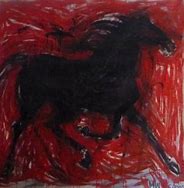
Picture of a black horse

This is a picture of a black horse. It symbolizes nothing. It is a record of an aspect. In other words, it does not identify black horses, much less a particular black horse, because it does not refer to the structure of aspects which constitutes black horses or Daisy the black horse.

Black-horse picture

This is a black-horse picture. It symbolizes black horses, and therefore refers to the entire structure of aspects identifying black horses. Though this one does not, such pictures may refer to a particular structure of characteristics identifying Daisy the black horse.

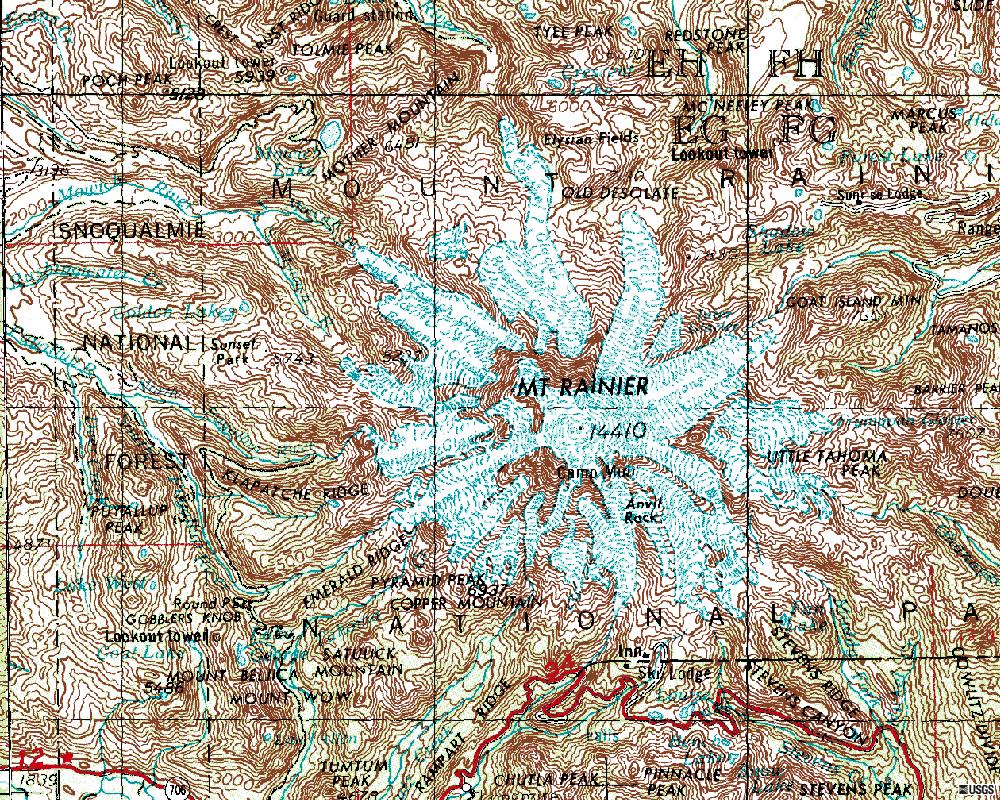
Mount Rainier

This is a topographic map of Mount Rainier. It is a record of an aspect (relative prominence). Therefore it is necessarily a picture of Mount Rainier. It also refers to the entire structure, from the chemistry of volcanic rock to the origins of the volcano’s name. Therefore, it is necessarily a mountain picture, a volcano picture and a Mount Rainier picture.

Any map which is a map has these features: it presents a viewpoint in reference to the global structure of viewpoints on its subject. The name superimposed on the map’s collection of contour lines directs the user to a European nobleman in whose honor a Pacific Northwest volcano was named. Knowing now that the map in hand is a map of a Pacific Northwest volcano, one can guess, based on geologic and physical chemistry aspects of those peaks, what the climbing might be like on the steep, North face of Mount Rainier.

In addition and necessarily, if I travel to a certain longitude and latitude on the map, I will know what sort of ground I will be standing on: rock or ice, steep or flat. Because, I have a picture of that ground on the map.

Maps constitute our reality, if we wish to speak of anything as real. It is an interdependent reality, not an independent reality, and especially not a mind independent reality. The idealists can postulate archetypical forms for everything under the sun. Dualists can insist on a mental substance. Yet, the world maps the same without these outside props. Bishop Berkeley could be right; God could be making it all up as he goes along. But, when we stub our toes on a rock, our consciousness conjures a map featuring the stone’s painful hardness, without reference to any divine-creative aspect. At best, the activities of the deity are notations on the border of a chart which is already complete.

We employ cartography across the board, charting all things, from Northwest volcanoes to attitudes. Sometimes, we even use fictional maps in our depictions of sentimental features of our experience. A map of Middle Earth, for instance, does not record any aspect of anyone’s experience. It does provide a background of relationships upon which various categories of experience are charted. The landscape’s precipices, snowfields and swift waters sketch out fear, endurance, and fidelity.

Features on the map of middle Earth fictionalize geologic structures as building blocks for a depiction of interpersonal relationships and personal attitudes. To be successful, the fictional features need to reference our maps of geology just enough to bring along the emotional content. The Misty Mountains must seem cold and treacherous. Rivendell must feel like an old growth forest. Done well enough, an arrangement of fictional elements can make us wonder what truly separates the constructed world from the world of primary experience.

There are hundreds, if not thousands, of images depicting Rivendell. But of course, there are no pictures of Rivendell. There are not even Rivendell pictures, as there is no structure of aspects to reference regarding Rivendell’s locality. What the artist does when they depict Rivendell is a reconciliation. Images of Rivendell constitute an attempt to match up the artist’s motive with the elements of the artist’s experience. Tolkien simply acts as a guide. He lays out the emotional manifestations which the topography must encompass.

The reason for fictions like the diverse images of Rivendell, should be obvious. When we examine our motive, we confront a brute fact. Our methods, which aim to explain, suddenly fail, and we are forced to construct a proper narrative instead. Such is the case with artistic fictions, and such is the case with moral fictions as well.

We move from one psychological state to another without understanding how we arrived at the start or why we left it. So, our reflections prove reactive, and our notions of introspection are fallacies at heart. To reconcile motive and experience, we must fall back on our depictions of Rivendell, and our moral narratives.

The method of our psychological cartography yields a much different product than we get from our geographical cartography. Our map of Mount Rainier provides a record of an aspect in reference to a global structure of aspects. Our depictions of Rivendell suggest emotions which record our psychological motion through the landscape. Our psychological cartography necessarily gives us something secondary: the structure of experience resulting from motive expressing itself, as it flows freely or is thwarted by the cliffs, streams and woodlands on the page.

Because we can explain the sensations, whether the depiction of Rivendell makes us feel warm or cold, sad or inspired, we find it easier to speak of those sensations as primary. We say that the depiction moves us to the attitude in question. That is not accurate. We move and our sensations constitute the wake of that motion. The generative element of our experience is not responsive. Even our wistful feelings upon viewing the ancient trees of Rivendell are not responses, but results.

All talk of morality is a Rivendell picture.

It looks like a place, in other words, a suitable cartographic subject. But, as Hume and Moore pointed out, our moral depictions lack the associated structure of aspects required. Moral depictions are secondary representations, just like Rivendell, which is a secondary representation of interpersonal relationships and personal attitudes. Instead of precipices, snowfields, and rushing streams, moral pictures sketch out a desirable motivational ecosystem. And because of the opacity of motive, moral pictures always remain flawed in their representation, though they represent their secondary subject as well as any art might.

It is no great error to talk about a moral sense, or human thriving, or the tally of global well-being. These things represent the aspiration of our expressive impulse. We can use such terms consistently, as long as we do not begin to mistake those depictions as proper cartographic subjects.

Tagged , , , , , ,

All It’s About Is What It’s All About

Every morning, Joseph walks out of his apartment building and breathes in the aroma of fresh bread from the bakery next door. It is a complex odor, which Joe thoroughly enjoys. He likes it so much that he is motivated to investigate what makes it so wonderful. Through reading chemistry texts and papers about the neurology of smell, he discovers so much more going on in the smell than his quaint scent experience, or at least that is how it appears.

He learns that the aroma of freshly baked bread consists of a mixture of 6 to 8 volatile chemicals which interact with his olfactory receptors, sending a distinctive set of signals to his brain. Understanding the structure of the aroma makes it even more wonderful for Joe. Most days, he simply smells the smell and never thinks about the 6 to 8 volatile chemicals or the neurons, but the background conditions his experience nonetheless.

One day, Joe opens his door, and as the fumes from the bakery wash over him, he has a powerful sense of déjà vu. It turns out, on that particular morning, the concentrations of the 6 to 8 chemicals, the state of his neurology, and the humidity in his nasal cavity are precisely the same as they were on the previous Tuesday.
He thinks to himself, “This is exactly the same smell as I have smelled before.”
But then he stops to think again and realizes that if the experience were identical, he would never know it. Only an aspect is identical, and only an aspect could ever be identical. The whole smell is much more, as much more as can be, a totality.

Sadly, Joe has only a few more mornings with the smell of baking bread. He contracts leprosy and moves to an institution where he can receive care for the disease. He is not completely bereft however. In the garden of the leprosarium, he finds a beautiful statue of a horse. He goes into the garden to appreciate it each morning. The horse becomes his fresh-baked bread. Even when his eyesight is affected by his disease, as it is early in the course, he finds that he can still appreciate the features of the statue by touch.

The nerves in his fingers are affected as well however. His touch discriminates less and less of the statue’s detail as time passes. It is just as well, as it turns out that the statue is made of a soft stone which wears away under Joe’s habitual palpation, leaving only the vague shape of the horse after a couple of years. Happily for Joe, the erosion makes no difference. His sense of touch keeps pace in its own deterioration, and as he moves his arms about the vague shape which stands where the detail of the horse’s features once stood, the interaction still brings to mind the beauty of the original statue, as much as his fingertips used to do.

Consciousness is consciousness of something. The orientation of anything else is derivative of that orientation in consciousness. This condition is pervasive, and so any realist claims are also conditional, and the question is: Is a conditional realism still realism?

Tagged , , , , ,

The Other Senses

We humans have a visual bias. Experiments have demonstrated our preference for sight, but there is no need for experiments. “The proof of the pudding is in the eating,” not the tasting, but “Seeing is believing,” they say. Whenever we want to illustrate something, well, we illustrate it. Our language and culture reify vision. Even our metaphysical discussions are rife with visual references: consider Mary the color scientist, spectrum inversions, and Gettier problems.

Our belief in seeing privileges our sense of sight relative to our other senses, and we are likely to take its instruction more seriously. We wave off any perceptual conundrums arising from our other senses as foibles of inferior organs. But we should take our nonvisual phenomena more seriously, for they have lessons for us if we do.

Those lessons start at the bottom, with our sense of smell. Though it is our crudest sense, and arguably the one sensory modality that we could most do without, the structure of smell has weighty implications. Olfactory neurons each bear a single kind of receptor. The odors we experience are mediated by activation of a set of receptors entirely. The number and distribution of that activation determines everything about a smell: its intensity, favorability, and motivational power. An odor is something which can be described, but not named. There is no equivalent to “red” in our odor palette. However, there are good and bad smells, and as with moral qualities (supposedly), smells are intrinsically motivating on the basis of their goodness and badness.

That motivational power lies in the smell itself. A chemical in a test tube which smells like a steaming pile, produces the same revulsion as the smell of a steaming pile itself. It is tempting to say that the odor of the chemical in the test tube is just an olfactory misrepresentation of crap. The common scent is supposed to smell just as it does, though. The smell is a conjunction linking an aversive mood, and things to be avoided. The smell and the mood are about a broad landscape, stretching over memory, history coded in our genetics and cultural instruction, all mediated by a particular pattern of receptor activation.

A similar sort of two-directional representation occurs in our auditory experience. The organ which generates auditory nerve signals, the cochlea, is tuned to the range of the human voice. The structures at the auditory end of the line are primed to respond directly to voices and music, and indirectly, to stimulate an emotional response to voices and music. As with smell, when hearing evokes a mood, it builds a memory of itself and its circumstances on a broad and sturdy base. A good framework improves the recollection’s relevance, and therefore its odds of survival. Here is another temptation. Fans of evolutionary psychology and divine teleology may see the beginnings of a good story in this structure. But those sorts of stories are unnecessary, and far beyond the point, which is: our hearing shapes the map of our experience in terms of words and music, as much as it recognizes musical and linguistic experiences.

The other senses break down the uni-directionality of representation, but even further, they blur the internal/external division itself. Taste receptors give us the sensations of sweet, salt, sour, bitter, and umami. Our conscious experience of taste locates those sensations on the tongue. But there are taste receptors for bitter and sweet in the pharynx, and sweet taste receptors throughout the intestinal tract. Those sweet receptors attach to neurons which do not reside in the central nervous system, but instead, lie in the intestinal tract itself, and the pancreas. Though these sense organs have no direct connections to the central nervous system, they still contribute to conscious experience. They simply do so via the adjacent somatosensory system.

Our somatic senses are a bit of a jumble. As a whole, they are the thing that represents our status. Though there are a few specialized sense organs in the system, it mostly relies on bare nerve endings and chemical signals built in to the tissues surrounding the nerve endings. This sense tells us where our limbs are, and what each appendage is doing. The somatosensory system lets us know when our gallbladder is on the fritz, and, indirectly, when we are hungry or full..

Though they are rarely the center of our conscious attention, our somatosensory experiences are always present in our conscious states. If I interrupt Dr. Penrose’s visualization of a 5 dimensional object, he will immediately be able to tell me whether he is standing or sitting, feeling hungry, feeling warm or cold, fit or tired. Somatosensory experience serves as the shade tree, grass, and sky in the painting of our phenomenal picnic.

Of all the senses, our somatic sense most effectively dissolves the boundary between what is internal and what is external. Because, our hunger is apparently our hunger. Our cold is our cold. These are things that seem to incorrigibly belong to us, just like our thoughts or our moods.

The thought that any of these things belong to us is a bit off anyway. Words and music, hunger, thought, and mood are constituents, but there is no separable “us” to which they may belong. We come by this error regarding identity via our most favored sense. Because we rely so heavily on vision, we confer an unmerited degree of independence to our visual experiences. We conceive of sight as purely received information, which given the limitations of the medium, naïvely represents an unconditioned reality. The plain truth gets transmitted through our optic nerves, into the dark room behind our eyes for the viewing pleasure of a little man in front of his little screen – the real us. Visual realism leads to other mistakes in its turn, regarding what is real and what is not. We begin to believe that numbers may be real because our eyes see objects as very discrete. Geometric shapes may seem real because we are able to depict them visually. A separate observer made up a separate stuff must sit behind our eyes to validate the reality of our visions. Our other senses beg to differ. They give as good as they get. Their contributions to our experience only make sense in reference to our global experience itself and do not rest on some outer, hard surface. Our world may be a ship sustained by the tension of its own spars, but it works for us – better than a brittle realism would.

Tagged , , , , , , ,

Taking Pictures

Wyoming is a Banana Republic. That is, very few of its residents craft any products, or add value to pre-existing items. Instead, they survive by selling off the state bit by bit. The major industries are mineral extraction and tourism. Reliance on those commodities creates a vicious cycle, because the state’s fortunes rise and fall with mineral prices and popular whimsy. To live through the fluctuations, politicians skimp on the state budget so that they can put enough money in the bank to survive the next economic lull. A few lonely prophets call for investing those funds in economic diversification, in the interest of breaking free from the cycle of feast and famine. The politicians repeatedly acknowledge that diversification is a good idea, but can never bring themselves to actually commit to it. It is just too risky.

So, the state carries on in its bumpy ruts, booming and busting. Decades on this road have had socioeconomic consequences. The path has led to a land of Manors and mobile homes, housing those who own the mines and the lovely land and their servants respectively.

No place in the state epitomizes this case study in Marxist historical analysis better than the town of Jackson. A ring of expensive houses surrounds a ring of expensive condominiums which surrounds a cluster of expensive restaurants, galleries, and boutiques. And that is Jackson. Though Jackson is fancy enough in any season, its exclusivity shines brightest in winter. In summer, the dirtier class of tourist drives through town on its way to Yellowstone. In winter, the only reason to be in Jackson is to patronize one of the ski resorts or to serve the patrons.

Although, there is one other, statistically insignificant reason to be in Jackson in the winter. For several years, that reason compelled me. I wanted to climb the grand Teton in full conditions. There is no reasonable explanation for that compulsion. I just feel a perverse attraction to isolated, windswept places. For instance, when I topped out on California Ice in the Bighorns, I sat on a rock and looked across from Hell Roaring plateau to Froze to Death plateau and was filled with a rare sensation, a feeling of fearsome loneliness, and profound contentment along with it. I can’t offer any better excuse.

When the idea first came to me, I sought out a friend who had done a lot of climbing in the Teton range. Sure enough, he had attempted a winter ascent. He got close, but after a day of skiing through waist deep powder, he and his partner had to bivouac short of their goal. They were well prepared, but the night was so brutally cold, that they were beaten by the next morning and decided to ski down. They fell into chest deep powder on each turn. My friend’s partner lost his mind. He took his skis off and tossed them, javelin style, down the snowfield. He then swam after them over the loaded slope, cursing and spluttering, until he could get his hands on the traitorous bastards and chuck them again. Though he came back to his senses eventually, the trip marked an end to their partnership..

Despite that tale, and others warning of frostbite and avalanche, I still thought I could pull it off, and I still wanted to pull it off, maybe even more than before. It wasn’t a solo adventure though, and to my surprise and frustration, I had difficulty convincing anyone else to come along.

Finally, I persuaded my friend Jim that it would be a good adventure. I’m not sure if he ever really believed that we would climb, but he believed in the adventure part and that was good enough for him. We set up base camp at the Motel 6 down the road from the main town.

Over the next week, we made a few forays up past the tree line, but the avalanche forecasts were always bad, and the peak was socked in with clouds and blowing snow besides. Nobody said anything; we just gave up one day. We got up late, and Jim suggested that we might go up to Teton Pass and do some tele skiing.

Now it was my turn to cash in on the adventure itself rather than the intrinsic joys of the activity. I knew how skis worked, theoretically. But until that day, I had only used skis to get somewhere with a pack on. My technique was purely pragmatic, and rudimentary. To go downhill, I left the climbing skins on the skis. I then skied across the slope, stopped and turned to face the other direction. I repeated that process to the bottom of the hill.

When we got to the top of the pass, the skins came off the skis. Jim gave me some tips on turning without stopping, and then we were off. Again and again I nosedived into the unconsolidated powder. Jim was soon out of sight. I began to suspect retribution. I felt like I owed him at that point though, so I sucked it up and ate a little more snow while he carved track after track in the slope. When we had had enough, we went into town and wandered around.

Winter tourists milled around the square. Most were dressed to ski, with lift tickets still clipped to their coat zippers. A few were dressed as cowboys in Stetsons and shearling coats. The famous antler arch was busy with group after group documenting the fact of their visit to Jackson Hole with a picture under the strange sculpture of bone.

There was not much for us around the square. We stood outside a couple of the bars and debated going in for a drink. They seemed too crowded though, and we decided against. We stopped by the mountaineering shop, which at this point in its evolution had basically become a Patagonia outlet, to chat with an old friend of Jim’s. We didn’t go in to any of the other establishments, but we did stop for a while in front of a photo display. Though neither of us was in the market for an expensive print, Jim had a professional interest in the product.

Jim was a photographer, but not the kind of photographer who had a gallery in downtown Jackson Wyoming. Jim was an artist who scraped by on grants and museum patronage. He took pains to draw a distinction between what he did, and what a commercial photographer did. Yet he radiated a little glow of resentment as we stood in front of the spotless plate glass. The gallery inside was all polished wood. If there was an attendant, he or she was politely hidden in the back.

The well lit pictures were all of wildlife. Most depicted charismatic megafauna. The photographer seemed particularly fond of bears. Jim glanced over most of these offerings in a second, and then paused for a bit in front of a family of polar bears. He wore a discomforted expression.
“What do you think?”, I asked.
I expected to catch him off guard, and I was halfway teasing with the question, but he shot back right away.
“It’s too didactic”
I was caught off guard.
“What do you mean by that?”, I asked.
“It looks like a photograph,” he said.

I didn’t exactly know what he meant. However, I could see that there was something different about the pictures of wildlife in that gallery, and his pictures. There was one photo of his in particular, taken at Lac Du Flambeau, which stood out to me. The subjects were two members of the tribe, a man and a woman. He was looking into the distance with an expression of anger or determination, it was hard to say which. She stood behind him, maybe in contact with him, wearing that same, mysterious expression, but she was looking at him. She was standing still. He appeared prepared to stride off towards whatever it was the distance. He was silent. She was speaking.

Clearly, his photo was something other than the picture of the polar bear family. I understood the gist of it then, but it would be years before I could put that distinction into words. It is the difference between pictures of polar bears, and polar bear pictures. Pictures of polar bears could be pictures of the whole bear, but also could be photos of a patch of fur, a black nose, or a white dot in the distance. Polar bear pictures could depict whole bears too, but include stick figures, polar bear paintings, pictures of men in polar bear suits, or black eyes, a black nose and a red mouth on white canvases.

Pictures of polar bears document. Polar bear pictures represent. By representing, polar bear pictures evoke all the relative connections which comprise our categories, and therefore the sense of our experience.

The picture in the gallery was a picture of polar bears. It was as documentary as the tourists’ snapshots under the antler arch. The photograph of the man and woman at Lac Du Flambeau was representational. There was something about human relationship, emotion, and the interpretation of expressions in the photo. But the really brilliant thing was: the photo primarily represented something not present in the image itself.

The predominant impression was the churn of excitement and uncertainty which occurred in the beholder. It was a class of sensation which bound subsequent viewers to the original viewer in its momentary intensity.

Jim has been gone for some years now. I can’t even find that picture in the supposed eternity of the Internet. I don’t need to, because I can remember it in every detail by the feeling it represents. The feeling is the same as my excuse for wanting to climb the Grand in winter, and I think it also explains why Jim would throw in on my crazy project.

There is no gallery for such things.

Tagged , , , , , , , ,

The Overhanging 5.9 Hand Crack

The fates have determined that, from time to time, I will dine with royalty. And I have determined that, on those rare occasions, I will not pass up the opportunity to say something stupid.
While waiting for the food at a wilderness medicine conference banquet with my friend Andy, our table-mate, Dr. Hornbein, politely inquired as to our post-meeting plans.

I casually replied, “Oh, we’re headed off to climb the Grand.”
It was February.
To his credit, he blinked once and said, “Well, good luck.”

After sharing grilled chicken and carrots with Jack Tackle, Andy and I asked him what he thought about 2 possible routes for the next day.
He said that he liked the first route well enough. It was clean, with consistent climbing, and little loose rock.
The 2nd climb had some bad rock and mediocre climbing down low, but had an overhanging, 5.9 hand crack for most of a pitch in the middle.
“So,” I asked, “do you think that 2nd route is better?”
He stared at me blankly for a couple of seconds and replied, “It has an overhanging, 5.9 hand crack.”

In the light of subsequent experience, I get it. But at the time, I thought that I wanted to climb 5.12, so the 5.9 rating tarnished anything to which it was affixed. I worked pretty hard towards the goal of climbing 12’s, and I climbed a few 5.9 hand cracks along the way. I got there, barely.
The effort wasn’t worth it though. Working the routes endlessly, with creaking tendons and crushed toes, just did not justify the final victory. It was like winning World War I: a victory, sure, but an atrocity nonetheless.

I think I understand why other people are enamored of more difficult climbs – and yes, I recognize that 5.12 is the basement of “difficult” rockclimbing. For one of my ‘hard’ routes in particular, getting the clean ascent was like making a friend. I became so familiar with every little edge and crystal, that I’m sure I could regurgitate the beta for the route to this day, decades after I touched the rock last.

Working harder routes on rock can be painful and tedious. I don’t think it is the suffering and frustration that turn me off, though. I liked the more difficult mixed climbing that I did, and I was highly motivated to climb grade 6 or harder ice. I obsessively studied and salivated over those ice routes in the same way that some sport climbers I’ve known would microscopically analyze their projects. I trained for hard ice until I thought my forearms would pop.

I think the difference may be in the proprioceptive aesthetic of the climbs. The way a climb feels to the touch and the body position it demands get less attention than the way it looks and the puzzle it poses. The proprioceptive aesthetic is the last to be appreciated.

But the proprioceptive aesthetic leaves the most profound mark on me. It’s always front and center in ice climbing. The appreciation of touch flows from the essential circus trick at the heart of ice climbing: extending one’s consciousness from fingers, toes, wrists, and ankles into the pointy bits of metal attached to those natural appendages.
Maybe that appreciation of touch naturally gets tamped down the harder you crimp and lock off.

Or maybe, this is all just sour grapes. I don’t think so though. Given the choice of magical elixir which would allow me to climb as hard as the best climbers on rock, or a map to a thousand foot, clean, sandstone, overhanging hand crack, I’m certain that I would pick the map without a 2nd thought.

Tagged , , ,

What Does It Mean to Be a Disembodied Mind?

Really, we should go to the source for a self-report.

We immediately confront a problem, then. Where do we look?

That is to say, if we are to establish communication with the disembodied mind, then we must somehow individuate it. It must be a candidate for intentional inexistence if we even hope to take heed of it.

Yet individuation is precisely the psychological consequence of embodiment.

Look at it from the other side. What if the disembodied mind wants to talk to us poor saps wallowing in bodies?

Mustn’t it make it make the subject-object distinction first? And if it does, hasn’t it wiped out any hope of qualitative distinction from the rest of the body-wallowers?

It is merely a prettier critter, after all.


Tagged , , , , , , , , ,