It had a periodicity to it, but not like anything man-made. Instead, it was like a geyser. As it rose to the surface it swirled chaotically around hidden shelves and side-channels, so its interval was uneven. The uncertainty contributed to our tension, the nephew’s most of all.
“Yeeeeeeeeeee!” she screeched, then closed her mouth and relaxed again.
Between screams, she looked as peaceful as a Buddha. Perhaps, her caretakers speculated, the discomfort of prolonged immobility or some occult infirmity drove the screaming. We had given her increasing doses of pain medication, to no avail. Perhaps she somehow had enough consciousness remaining to experience the dislocation of facing the present without access to the immediate past, not knowing moment to moment how she got in the bed, why she felt like she did, whose arm lay at her side, whose mouth was screaming. We had given her anxiolytics and she just kept screaming. Perhaps she was bedeviled by visions. We gave her our best potions against inner demons and her timing did not falter.
“This is Hell,” said the nephew, “She is in Hell. I want this to stop.”
She had chosen well, or someone had. Sometimes, the decision about who would oversee the death defaulted to hereditary proximity, geographic factors, and availability. This nephew had some connection to her beyond practicality. Of course, he spoke for himself. No one knew what her vocalizations signified. We had taken our best guesses and come up short. What he wanted now was not a treatment. He wanted a cure for it all. To be clear, it was not euthanasia he was requesting. He wanted us to ablate whatever remained of her consciousness. He wanted oblivion, or at least its appearance.
It wasn’t killing, but it was taking something away from someone who appeared to have so little. We were always wary of treating extrinsic things, of giving medications to fix a person’s bad relationships or discomfort with herself. It was different for the dying though.
Everything was becoming extrinsic for her. She couldn’t be crying out for something. That time had passed. At best, her screams expressed something which we could not know, but something which was less specific, less relevant to anything inside, as she came closer to death.
He was right. The screams meant what he said: this is Hell; I want this to stop. I had an obligation to her and no choice in the matter. Of course he spoke for himself.
“I will do as you wish,” I said.
Dedicated to the Game
Climbing and other disturbing things.

Author Archives: keithnoback
Finding True North
[Note: this post builds on 3 previous posts, Jesus Christ: Error Theorist, Men, Mores and Mimbos: The Strange Case of Moral Fact, and Chaos Theory]
People talk a lot about meaning and purpose. Most consider those two things quite important. But for concepts held so dear, most people have an ill-formed notion of meaning and purpose. That most hold the two ideas to be roughly equivalent is testament to the squishiness of the concepts. Meaning and purpose are quite different things overall, but they do have one thing in common, and their one commonality may account for much of the confusion between the two and otherwise.
The feature which they share is that each idea can be held as a tautology. Actually, that’s about it for purpose, because purpose is the action of an intent. Talk of purpose assumes intent. So, reasonable talk of purpose is local. It can’t fly far from the source of intention without losing its power. For example, if I give you a morphine tablet for your pain from a broken leg, the purpose of the morphine tablet leaves my hand with the pill. As the pill drops into your palm, your intention is imported and so is your purpose. It is entirely possible that you will save the tablet to get high when you’re feeling better. This importation of purpose is the source of much of our sense of agency. It is also a thready link to meaning.
Meaning can be taken as what can be represented – a tautology. That’s a little cheap. Meaning is locality. There, that’s better; it no longer begs the question. ‘The red book’ means paper, ink spots shaped by interlocking sets of purpose (the writer’s, the publisher’s, the printer’s), the space it occupies among colored books, books I know about, other red things, etc. on and on.
Here’s the meaning-purpose link. Meaning shapes our intention. Our location gives us the things to be about. Our location is what we are all about and is all about us.
So, the meanings are relative, but not free-floating. They are not unmoored from space, time or history. We can map them – represent them – like the North pole. In fact, true North is a perfect example of the relations in question.
True North is kind of a convention. We don’t need it, we have satellites and radio receivers. There’s no logical necessity to true North. True North has a meaning behind it though. It is located, and not just on the earth. Because it has location, it also has a vicinity – surroundings which create its boundary conditions. Considered in terms of the point where the axis of the earth’s rotation meets the planet’s surface, declination means something, as does Polaris – and vice versa. The specificity of meaning constrains the intention it shapes and the scope of action available to that intention. It’s subsequently tempting to see the representation of that meaning as independent and efficacious Form. But true North is finally a relative location, not a mark on a map. It is made of stuff as far down as we can dig, and in every direction. So are all our representations, down to our self-representation.
There is a final question which people like to ask of this state of affairs: Is the lattice-work self-supporting, or is there some truer North? Is all this in some way necessary? That’s something buried too deep for the tools with which we are equipped. The only answers we can give are a priori assumptions (not presuppositions) whose relevance is questionable to us dwellers in the world of representations. But believers in a truer North don’t want or need an answer, I think. The assumption serves well enough, and I have to agree with Dostoyevsky about what would happen should someone show up one day with an answer to put an end to all projection. The question for the believer is: do you think this is an indictment of your faith, or a good reason to hold it?
New Moon
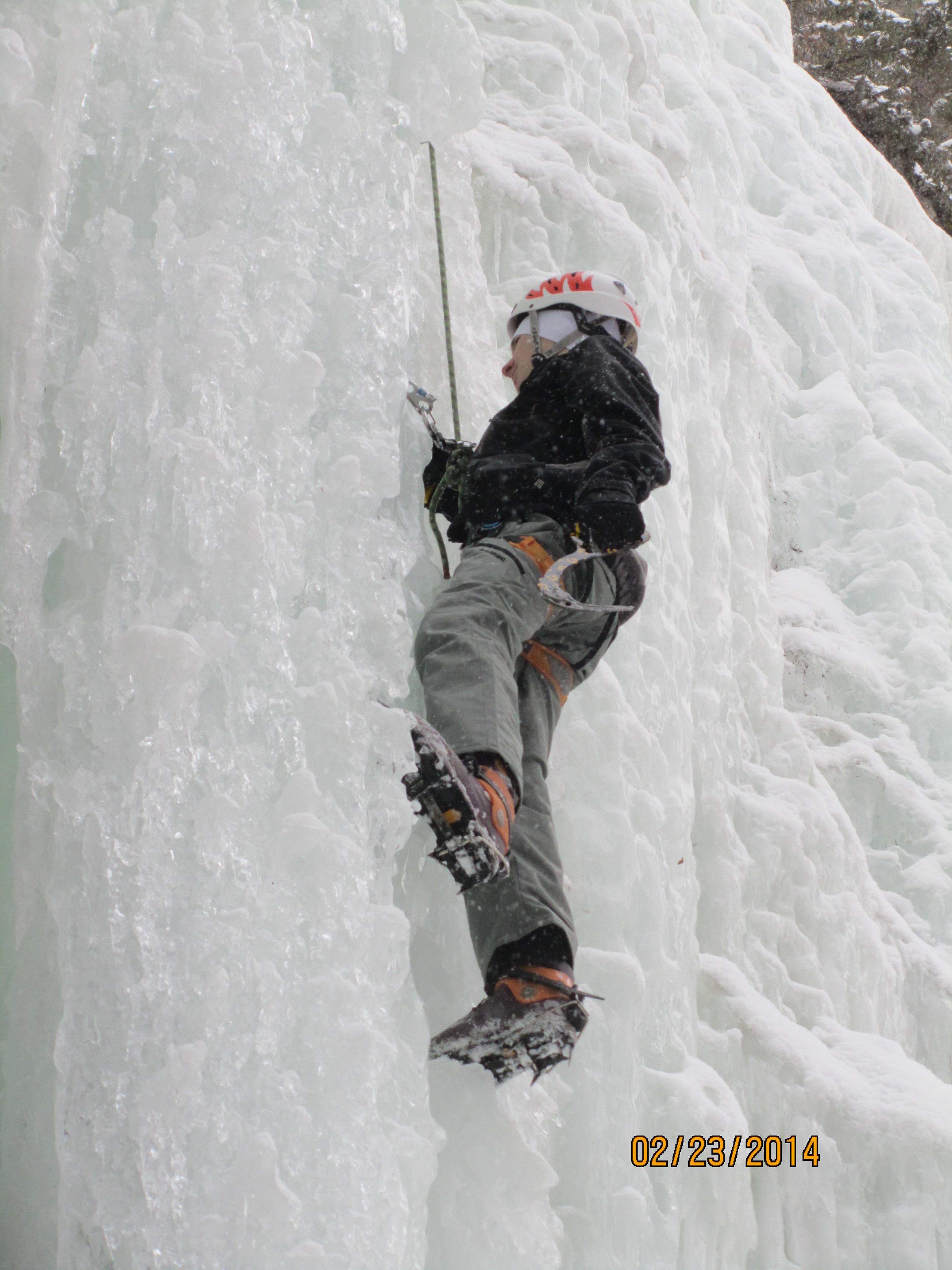
“Do you want to do the top half?”, I asked.
“Yes!”, he insisted.
He was offended that I’d doubted his motivation. For him, this was the advantage of climbing with his dad: he needn’t feign disaffection.
“OK,” I replied.
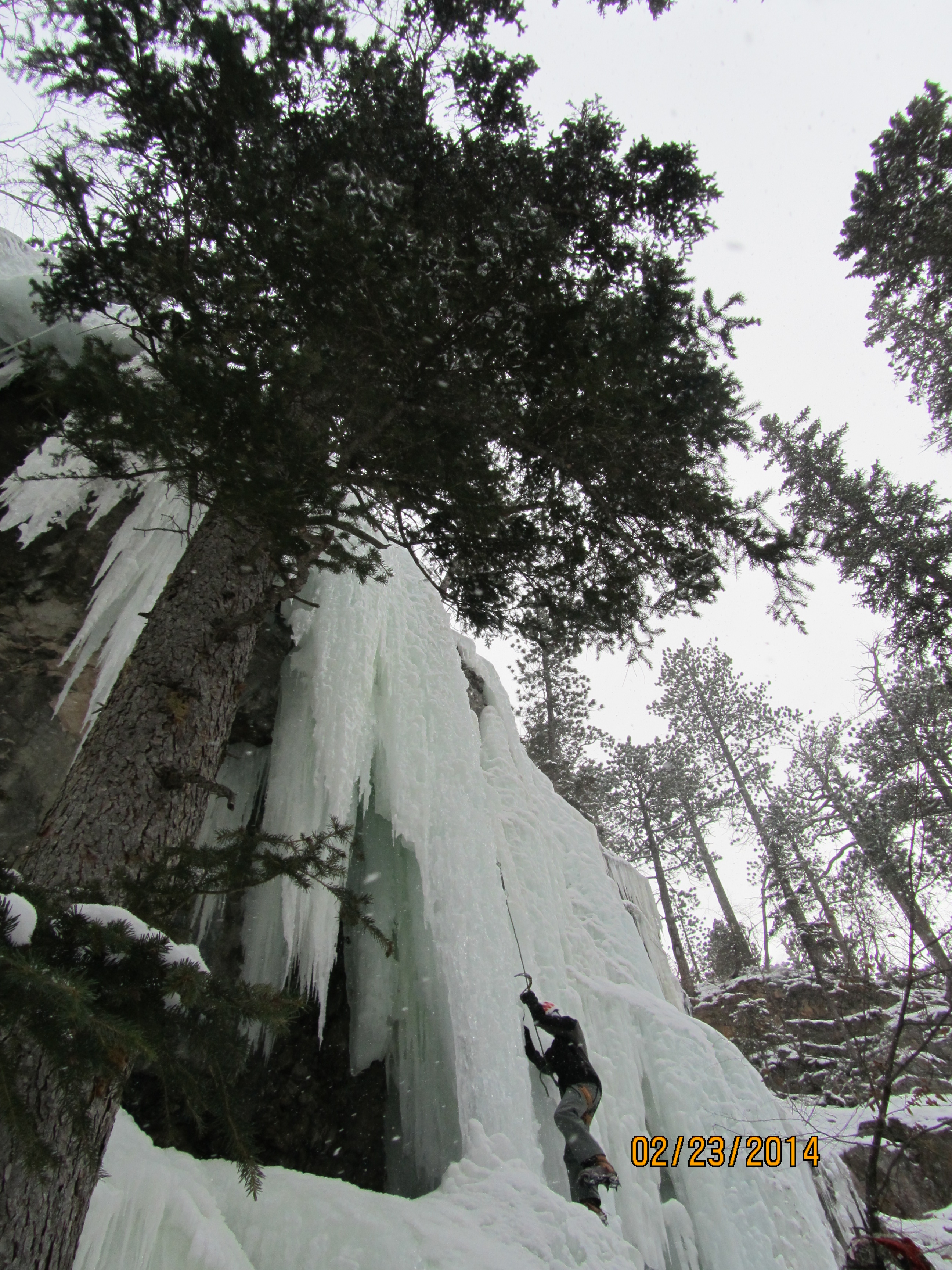
I kept my tone as flat as possible, but I had my doubts. I could dumb down the next 30 meters, but only to a point. The easiest line was still grade 4+ – vertical, more or less. He wasn’t too worried about whether or not he could get up it. He was not a child anymore, but he was not an adult yet, either. He still subscribed to the quaint notion that, whatever happened, dad would sort it out. Actually, he was right in the case at hand. I wouldn’t have suggested that he continue without a back-up plan in mind. I could manage things if he quit in the middle, but it would be a real pain in the ass.

I placed quite a few screws on the way up, in part to keep him on the easiest line, in part to keep him out of the way if I had to come back down and sort it out should he fail. But he didn’t fail. He didn’t even make any whiney noises, only one curse at a slight slip. Besides that curse, the only sound from him was the measured, heavy breathing of the highly determined.
“Kind of overkill on the ice screws, dad,” he remarked at the top, “What is this climb called?”
“Leigh Creek,” I answered.
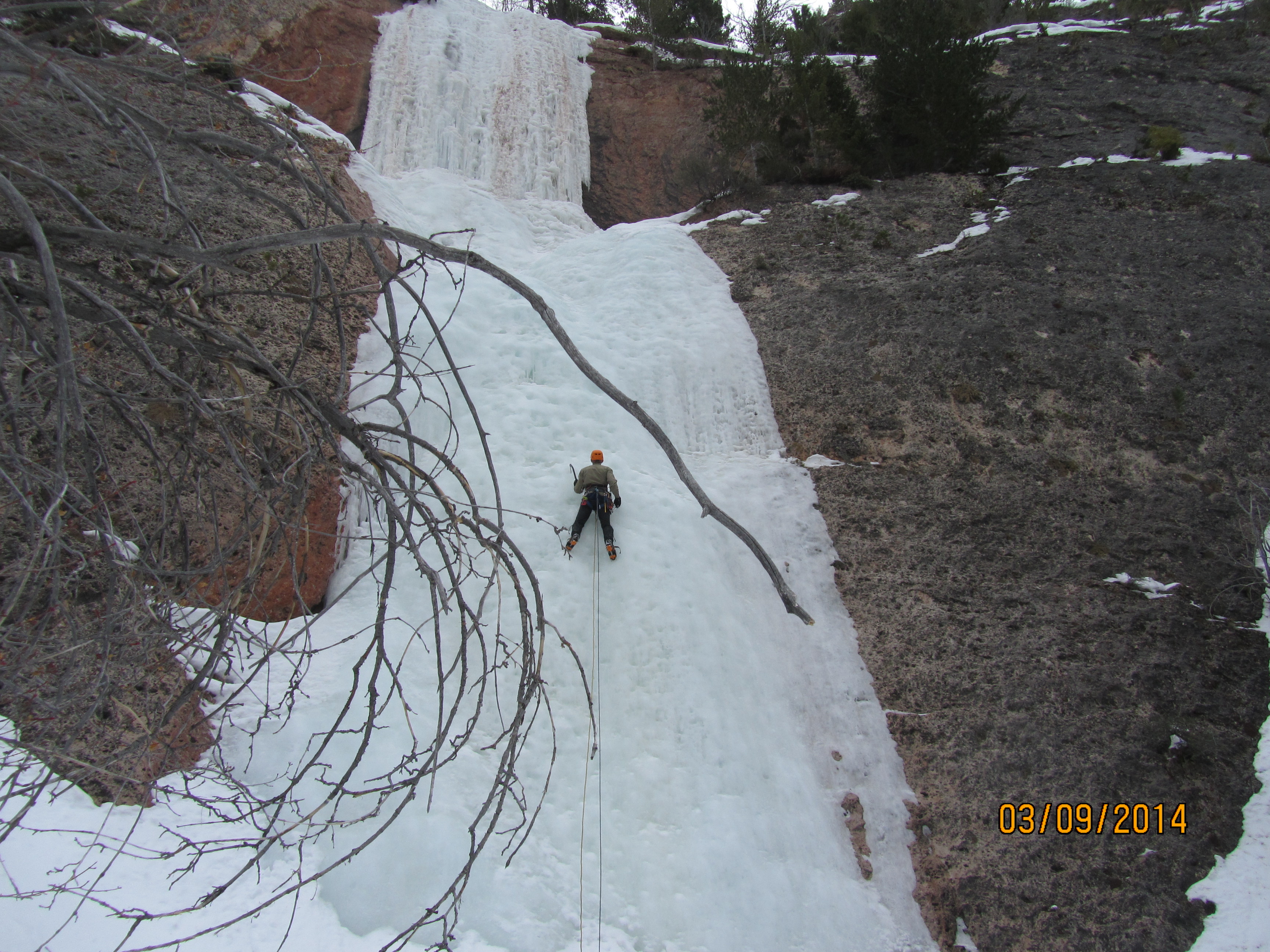
He never asked about names or ratings last year. He’d exhibited some ambition. It was a sure sign of lycanthropy. I envied him in a way. I remembered the transformation well – the ravenous fixation on routes, the immunity to adversity, the anticipation of new phases building to the next big climb and its fearful, all-consuming fury.
I also remembered the frustrations of hiding an identity which others found strange, frightening and repulsive.
“What,” I asked family and friends, “you want to go to the beach in February? Well, that’s a very bad time for me. It’s the busy season at work and I’m likely to be so irritable as to be indisposed.”
“May? I’m scheduled to be in Canada in May,” I’d object, “and you’d hate to see what happens if I don’t make that appointment.”
“The city in August? With all those people?” I’d demur, “Could be a little, ah, dangerous at that time, I think. I tend to be in a bit of a ‘mood’ then. Best not.”
There was a downside, but for the afflicted there was no cure. I set up the ropes to descend. He stood by with a hint of a smile on his face and a hungry look in his eyes.
“Can we go to Cody next year?” he asked.
I looked him up and down. He was getting meaty. Soon he’d be heavy enough to belay me without a bottom anchor. I felt my lips creep back over my teeth.
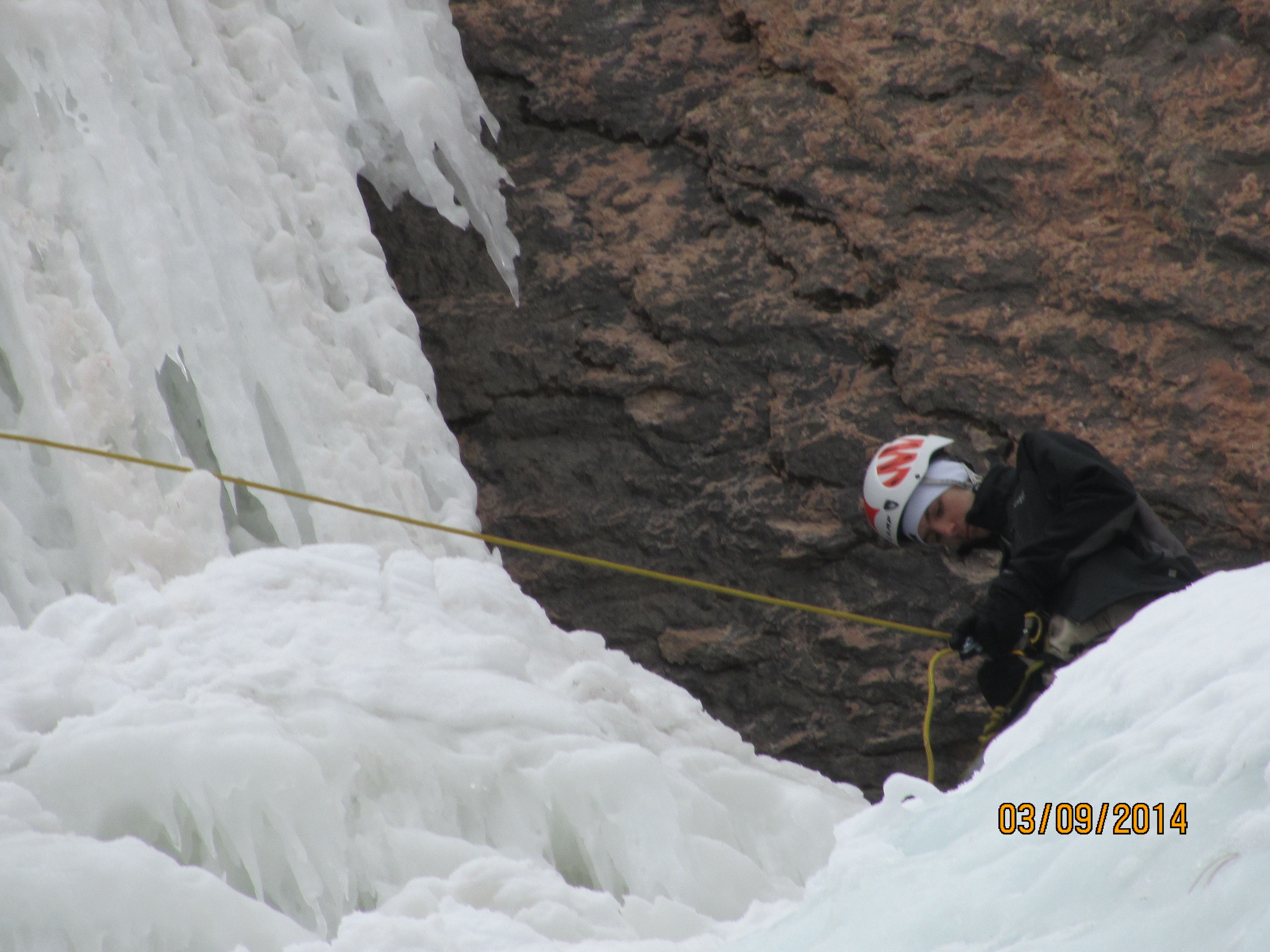
“Sure,” I said, “We’ve got this Summer to get through, but yeah, we’ll go to Cody next season, if you’re still up for it.”
Tabula Rasa
As far as we know, a man blind from birth does not dream of colors. But how could we know if he did? More important, how could he know if he did?
This Winter and Spring have been cold, and I have been skating. I don’t mean the sequins and blades kind of skating, I mean snow skating. Skis take the place of metal runners, and the action is something else. I find it hard to describe. It has a smoothness to it, a chain of movement like climbing. It has a mental feel which is different than climbing’s though, a shifting attention with underlying focus. When it’s going well, I feel like I could close my eyes and never crash. I like it, but I think some people might not. That’s because they are who they are and not me. I like the feeling of skating because of my background, the kinds of activities I’ve learned to appreciate and the position which skating occupies in that pantheon of activity. I couldn’t explain to anyone else what I feel when I’m gliding uphill. I couldn’t make them feel what it’s like for me and therefore what it’s like to like it. I couldn’t accomplish a transfer of appreciation for skating anymore than I could explain a dream of red things to a blind man. It is something personal, mine to have.
The feeling of gliding with a constant effort is unique to skating. The association is unique. I am not sure that the feeling is unique. I’m not sure that the feeling is anything. Yes, it is the feeling of skating, but I’m not sure it is independently identifiable. Without the sensation of weight shifting over the lead ski, acceleration, and pole-push recovering the trailing ski, the feeling I like about skating might be about screaming down a trail on a mountain bike, swinging an ice tool, having a shot of good Scotch or anything else I enjoy. Take away my enjoyment, and I wouldn’t know what to make of the feeling.
Maybe this line of thought seems bizarre, but I am not to blame for it. I have been influenced to pursue it by reading philosophy. I’ll admit, most of the reading was voluntary. The preoccupation with the nature of subjectivity however, comes from the philosophers and their corrupting thought experiments, in this case one called “spectrum inversion”. Spectrum inversion proposes a flip in qualitative experience of color. Imagine that, when I see green things, I have a red experience. When you see green things, you have a green experience experience. It could be happening right now, and we would be oblivious to the fact(?). As long as you and I have no gap in our spectrums, the difference in our experience cannot be detected empirically. You call the stop-light red; I call the stop-light red. I call the grass green; you call the grass green. The point is, when I see a green thing I know something about it (its red appearance) which is not explicable on the basis of function or structure – my own or that of the green (red?) thing.
There are two problems with the moral of this story. One is a problem with philosophers. If philosophers were birds, they would be gob-smacked about their wings, and would puzzle endlessly about what it meant that they could fly. Without an acceptable theory, i.e. a complete theory, they are unhappy. They chose color for this thought experiment because people have a strong intuition about the reality of colors. The intuition probably owes something to a degree of a priori knowledge of color. Color perception is ‘baked in’ to us, probably with some pre-set associations. It may not be the best research subject in an investigation of qualitative experience in general. Our credulity gets in the way, doubly so for the philosophers among us.
The other problem is deeper. It is the blind man’s problem. My inability to describe a dream of blood, or stop-signs to him is merely a symptom. He cannot consider a theory of color perception – the consistencies of colors, their place among our other experiences, their rules and regularities. He needs an explanation first. He must be able to say, for himself, what he is to make of the quale in his hand. That explanation is a prerequisite to our discussion of blood’s appearance. Otherwise, his putative color experience refers to nothing; it is there, perhaps, but it pertains to nothing but himself and remains unremarkable, a tabula rasa, a point of order in the conscious process.
The status of qualia may seem a curiosity, but I think it’s a bit more. I think so because I didn’t start out skating because I knew I’d like it. I started out skating because I was sad.
Have you never heard about Lin Hui, the man who fled from Chia? He threw away his jade disc worth a thousand measures of gold, strapped his little baby on his back, and hurried off. Someone said to him, ‘Did you think of it in terms of money? Surely a little baby isn’t worth much money! Or were you thinking of the bother? But a baby is a great deal of bother! Why then throw away a jade disc worth a thousand measures of gold and hurry off with a little baby on your back?
Lin Hui replied, ‘The jade disc and I were joined by profit, but the child and I were brought together by Heaven. Things joined by profit, when pressed by misfortune and danger, will cast each other aside; but things brought together by Heaven, when pressed by misfortune and danger, will cling to one another…
-The Complete Works of Chuang Tzu by Burton Watson
“You know how it is with you and your brother, out of sight out of mind,” my sister-in-law says.
For her, attachments subsist on their assigned meaning. They have a third-person ontology. Without constant refreshment and revision of their rules and regularities, attachments lose their meaning as circumstances pass them by. People must constantly find new reasons for their loves and loyalties, lest the sentiments be forgotten.
She made that comment because she was annoyed with a lack of active communication within the family and based on her observation of our response to our parents’ deaths. When my mother died, my father took her ashes to an unnamed place and scattered them. When he died, his sons did the same for him, and have spoken of it, and of their father, rarely since. From the outside, the silence may look like disinterest or even amnesia. But it is not. The attachment in question just can’t be corralled by words, memorials, or funeral rites. A jade disc cannot represent it, because no theory of value explains it. The attachment is part of our personalities, and though it changes with us, it persists. Attempts to push it into orbit around our persons would lead to misunderstanding at best, bitterness at worst. Master Sang-hu continues:
The friendship of a gentleman, they say, is as insipid as water; that of a petty man, sweet as rich wine. But the insipidity of the gentleman leads to affection, while the sweetness of the petty man leads to revulsion. Those with no particular reason for joining together will for no particular reason part.
‘Particular’, in Master Sang-hu’s statement, should not be mistaken for ‘specific and isolated’. He means personal, particular to the individuals. The attachments formed by petty men are outside of themselves and adhere by the stickiness of their emotional quid pro quo. The alternative is to give up on the boundaries of one’s identity. So the petty man may be forgiven; he’s got something to lose. Most people are not petty, or at least not entirely so. For instance, at some point, many will ask, “But why do you love me?”. However, even those who pose the question early in their lives don’t persist in the practice, and learn to beware the question themselves.
I don’t think my sister-in-law is being petty in her dissatisfaction with my and my brother’s behavior. There is another use for her third person ontology of attachment, besides its potential as sticky treacle. It is filler. It buys time for adjustment and reorientation in the face of change. It insulates against anxiety, pain and sadness, which are the true corrosives, time and change being guilty merely by association. With that understanding in place, she’s miffed about us not playing along properly, rather than disparaging us for simply lacking true attachments. Her way of using a theory of attachment is the way most of us use such things – as a buffer for our weaknesses. They remain grossly utilitarian, but are second order rather than primary.
Right after my wife died, I got some similar encouragement to play along. I couldn’t bring myself to participate in memorials or ceremonies. There is a core of dishonesty in those events. They claim to honor the deceased, but they really serve to push the person into orbit around the survivors, where the dead can’t hurt us. Worse yet, memorials and funerals are opportunities for certain parasites of death to pedal whatever bizarre spiritual beliefs they feel the world can’t do without. Functionally, death rituals are filler for the living. I could skate, that was filler enough and a more honest variety.
For the same reason, I turned down grief counselling, which is a more modern ritual to the same end. I actually have some data to back me up on that decision. A meta-analysis presented at The 2008 ADEC (Association for Death Education and Counselling – a cheery lot, no doubt) conference showed no benefit in universal counselling for those who had experienced loss. For those who had the most traumatic losses, such as the violent death of a child, counselling provided a brief benefit with no improvement in long term outcomes.
The only people who consistently benefitted were people who were referred, by others or by themselves, for trouble adjusting, especially those who experienced signs and symptoms of depression.
I think the last finding is most telling, for depression reflects a falling out of context. Depression is more than being sad, even very, very sad. In depression, the sufferer ceases to feel this way or that about experiences, and begins to experience the world in the light of sadness. Depression is the philosopher’s take on subjectivity taken seriously. Sadness, for the depressed person, is not made of anything; it is something identifiable and effective.
But sadness as a thing cannot make sense. It only works if something makes a person sad, and the person must contain the necessary elements to be made sad. The depressed person is constantly at work constructing those elements. A person in the grips of depression exists in a self-perpetuating cycle of justification which cannot succeed in finding an acceptable answer for the person’s sadness.
Because, just plain sad is an undifferentiated stake in the field of consciousness, and we are charitable to name it. It cannot be grasped anymore than love, or redness or the feeling of skating, and the mind groping after it must fail. That’s the danger of taking qualitative aspects of our world seriously; they cannot deserve it. If we do take them seriously, we may, in effect, mistakenly strap jade discs to our backs instead of our children, holding the byproducts of our attachments dear, though nothing adheres to redness, love or sadness – not even treacle.
Out of sight, even out of thought, but not out of mind, lost and distant relations remain. They cause love and sadness, but love and sadness do not explain them. Eventually, they leave love and sadness behind. When Winter returns, I will start skating again, and not because I am sad. I’ll do it because I like to skate. It’s my fate, in a sense, like it was my fate to love my wife, my parents, my children and my friends. No taint of sadness will cling to the snow, the skis or my limbs. No sadness will drive me over the snow. Turns out, it never did.
Dr. Van Helsing Does Not Practice Primary Prevention
As recommendations for treatment of hyperlipidemia become broader and more generic, drifting toward the poly-pill conclusion, I can’t help but think of Dr. Van Helsing’s predicament in Dracula. In the story, though he has information which suggests the possibility of primary prevention, he practices secondary prevention. It is only after the symptoms appear – Lucy’s mysterious anemia and the rash of similar cases following her death – that the doctor suggests putting garlic around the windows. He has to wait. He’s in a story, so he knows the horrible truth all along, but he can’t reveal it without his patients sending him packing. Every doctor understands Van Helsing’s predicament. Few can see his patients’ logic however. It is one thing to indulge a crazy old man’s belief in vampires. It is quite another to indulge a crazy old man’s belief that a vampire has moved into the old mansion down the street and has begun to prey upon the household.
When doctors tell patients to treat public health problems, like cardiovascular disease prevention, on an individual basis, the patients take it as if they were being asked to put garlic around their windows because there have been vampire sightings in their neighborhood. They are slightly incredulous. And, the patients are right.
If we medical professionals are to treat asymptomatic individuals based on a 10 year risk calculated from epidemiologic data, for a disease which they have may or may not have started to develop, we must be honest with them. We have to admit that medication is the best that we can do, ask for their help, as a group, and then make it easy for them to help. Doctors don’t like to treat populations, though. Individualized care and patient centered care are the current watch words. But the greatest successes of medical science have been the opposite sort of effort. Nobody thinks that we should stop immunizing people for pertussis and move to an individualized prevention program with regular swabs for the pertussis bacteria and antibiotics for every runny nose. The approach is ostensibly patient centered, and it really is in a way, just like Dracula’s interest in Lucy and Mina is patient centered. Looking down from the established high ground, it’s easy to recognize the shift to an individualized strategy for preventing whooping cough as impractical and myopic. Medical professionals are clever enough to avoid bad moves from the general to the specific. However, decisions to move from a dysfunctional individualized program to a population based program can trip up anyone, even though the determining factors are the same.
The problem is Van Helsing’s problem. At the level of the vampire hunter’s interest, garlic around the windows is garlic around the windows. He’s like Dracula that way, for whom young ladies full of blood are young ladies full of blood. Dracula and Van Helsing are at risk of availability bias, cognitively and practically, as are all the physicians with lipid profiles, risk calculators and statistical correlations at their fingertips. There is a insidious, vampiric class of maneuver from population-based conclusions to individualized care. But the patients’ motivations lie outside of the action’s focus, and that focus is therefore myopic. It does matter to patients whether the doctor is asking them to deck the sills in order to cut down on the incidence of vampire attacks or because they should fear the vampire staring at them through the window. The latter request involves adopting an astringent manner of thought and behavior, the stuff of anxiety disorders. The former is an appeal to solidarity and public safety. We shouldn’t be surprised when the same people we’ve been instructing to fear the vampire outside their window come in demanding that we do something about the pale figure lurking behind their cough, in their prostate, or under their nipple. Having ceded the high ground, we’ve no credible response.
What Dies on the Sharp End
As children, many of us were cautioned not to judge another person until we had walked a mile in their shoes. This simple aphorism is meant, and taken, in two ways. For those with a literal bent, it means that we should withhold judgment until we have the all the relevant information. For those with a more philosophical inclination, it means we should understand that our judgments about others are always bound to be a little off. The latter interpretation is more accurate, because we cannot walk in another’s shoes. Beside them or in their tracks we can experience their walk, but not in their shoes or their skin. To do so would demand abandoning our own identity. In light of the latter interpretation, the implication of Mom’s trite admonition becomes apparent. We aren’t limited by our subjectivity – the statement is nonsense – our subjectivity makes us. Like so many things which children must learn to get straight, it marks a snag in our understanding which trips the most carefully considered philosophies.
Let’s see how philosophical problems regarding mind fare under the heat of our kindergarten lesson. With no subjective experience of subjectivity, philosophical zombies – hypothetical creatures which exhibit behavior without experience – take a shot to the brain, not because we cannot conceive of behavior which does not entail qualitative experience, but because we cannot conceive of qualitative experience divorced from activity (after all shouldn’t something which is a property of experience rather than a product of it show some sign of life for itself?). Rigid designators – necessary identities – hold for representative entities in logic, but not for the objects from which the logical entities derive (would that it were otherwise; think of the savings on auto repairs and trade-ins alone, not to mention the safety benefits of “the red car turning left in front of me” being true in fact as well as in theory). Determinism becomes an analytical curiosity. There is no quantity of happiness, suffering, or human thriving calculable. There is nothing that it’s like to be a bat – or a human.
Philosophies stumble because most of them have not been field-tested. This state of affairs is understandable; field testing is a grim business. The best contrivances fail in unexpected ways, leaving us deflated and puzzled. Trying to break a precious invention in the course of it’s intended use admits to some basic pessimism, but it is vital. Yet how do we test an idea of how the mind works in the world? What we need is something other than the sort of post-game analysis which always concludes that the contest turned out as it did because one team managed to “execute” and one didn’t, that one managed to fit the criteria of our post-hoc definitions and one did not. We need to know what happens, what falls away, what persists and the shape of the relationship between the whole lot.
Fortunately, we don’t have to go to the trouble of designing a test for philosophies of mind. The sort of test in question happens naturally on the sharp end of a rope. Every rope in use has a sharp end, attached to the lead climber, and a loose end, secured by the belayer. As soon as the leader finishes his knot, things begin to fall away. The belayer is a person who pays attention or not, who arrests a fall or not. He may be a Saint, or he may have walked out of prison that morning; it doesn’t matter. Likewise, the leader is a person who falls or not, who puts the belayer at risk or not. The relationship is quite specific and pertains to the subjects and the salient features, the valuable points, of the situation, as do all the relations and values which fall away. But the test extends beyond the mind-to-mind relationship. In the leader’s experience our ideas about the nature of mind itself get tested, because the leader is the one who grasps the holds. Looking at a hold creates a shaped perception of it. The hold has size, conformation, anticipatory feel, relevance to body position, distance and even strategic utility. But that hold is not the hold which the finger touches, and the leader knows the hold in hand by a different means.
Here is where another important set of ideas breaks down. Contact with the hold demolishes the mental theater. The hand and mind know the hold by assimilation. They know the edge as a hold by becoming the hand and mind which grasp it. The meaning of the feature’s heat, slipperiness, sharpness and adequacy are immediately apparent, because all those remake the first person in the moment of contact. The hand and mind know the feature as a hold because that is how they are capable of knowing it and the situation could not be otherwise in the revised individual. The subject doesn’t transcend the moment by discovering some permanent and essential nature realized in the experience, but by diving in, taking in and being taken into the meaning of the hold.
So what dies on the sharp end is transcendence, permanence, and commitment in the abstract. But these are no losses at all, because we can see that, all along, those defunct ideas were merely mistaken shaped perceptions of engagement, persistence, and understanding of change. With the death of its bearers, on more thing must fall and break in our field-test: meaning as a graven image – of God’s will, nature, humanity or whatever other imagined necessity. Meaning is revealed as, like us, the property of the present moment. The edge on the face of the stone is many things, we think, possibly, but with fingers on it, it is a hold – and that fact accounts for all valuation, all confusion over minds and bats, and the limits of footwear exchanges. This is not mysticism; it is much, much smaller. It is just what we know.
The Word from the Land of Absolute Relativism
“Look at all this shit!”
He waved the stack of envelopes at me.
“Look at this one.”
He held up the letter on top. It was from another hospital and marked, ‘Important: Do Not Discard’.
“These are the ones you have to be careful to discard.”
He threw it in the wastebasket, and followed it with the rest of the unexamined mail. I was far enough into my training not to be shocked by this sort of thing. I’d weathered surgeon’s tirades and soaked up jaded, callous humor in the emergency room. Still, my experience with this psychiatrist had me believing for years afterwards that, in his specialty, like sought like.
“This kind of clutter is the enemy,” he continued, opening the top drawer in his desk.
He scooped out a handful of keys.
“Look at these! I don’t know what this is for,” he said, holding up a sturdy door key. Into the bin it went.
He tossed a few more, then dumped the remainder back in the drawer with an expression of disgust.
“We’ve wasted enough time,” he declared, “better show me the case.”
I handed him the chart, with my history on top. He lingered on the assessment at the bottom of the page. Residents sometimes began to sweat when attending physicians paused too long in their documentation review. I did not in this case, because the assessment was not mine in the first place; the patient brought her diagnosis with her from the last admission. He grunted and moved on to the ancillary notes, containing the comments from psychiatric nurses who had evaluated the patient.
“Jesus Christ! Did you read this?”
Now I began to sweat. I hadn’t read the nurse’s notes. He handed me the chart with a shake of his head. I’d gotten lucky; the question was rhetorical. Curiosity displaced my anxiety and I began to read with interest. Immediately, I realized what he was on about.
At the bottom of the page, several of the nurses (a cabal?) postulated that dark forces were at work in the patient’s life. The assessment dwelt upon the young lady’s practice of witchcraft, not as an expression of alienation in a personality dangerously adrift, but as an activity with sinister efficacy. I looked up at him as I finished reading.
“How can we hope to do anything for the patients when we’re up against this kind of stupidity from the staff? Borderline,” he stated, returning to my assessment, “Do you really believe that?”
I shrugged. She had the black nail-polish sign, which every trainee knew was pathognomonic for borderline personality disorder.
“There are some people that fit the bill, but mostly the term is an epithet applied to people who we don’t like because they are frustrating. It’s the DSM used as a cudgel, and it justifies our bringing these people into the institution when their community becomes too frustrated with their behaviors. They come in for a few days or a few weeks until they’ve cooled off, then they go back out with the same problems, to the same problems. So this kind of inpatient treatment is like firing into the tree line: it’s good for keeping the enemy’s head down, but it’s not good for hitting anything.”
His words were familiar in structure and reference. At home that evening, I poured through my memory and my boxes of books, and I eventually placed them. They recalled an image from Heart of Darkness.
Once, I remember, we came upon a man-of-war anchored off the coast. There wasn’t even a shed there, and she was shelling the bush. It appears the French had one of their wars going on thereabouts. Her ensign dropped limp like a rag; the muzzles of the long six-inch guns stuck out all over the low hull; the greasy, slimy swell swung her up lazily and let her down, swaying her thin masts. In the empty immensity of earth, sky and water, there she was, incomprehensible, firing into a continent. Pop, would go one of the six-inch guns; a small flame would dart and vanish, a little white smoke would disappear, a tiny projectile would give a feeble screech – and nothing happened. Nothing could happen. There was a touch of insanity in the proceeding, a sense of lugubrious drollery in the sight; and it was not dissipated by somebody on board assuring me earnestly there was a camp of natives – he called them enemies! – hidden out of sight somewhere.
The image stuck and grew stronger over the years until I ceased to see my preceptor as chief among madmen and came to see him as Marlow on the boat. He was the lone relativist in a wilderness of absolutists who considered borderline personality more than a label on a charge sheet (it is that at least, for the Diagnostic and Statistical Manual which codified the term is a tool intended to itemize mental illness for billing). For his fellow wardens of the institution, there existed a borderline personality fact about certain people, caused by borderline personality pathologies and amenable, potentially, to borderline personality treatments. He saw them firing into a continent. He did not, of course, live in the land of absolute relativism, where everything is an onion made of layer upon layer of motives and relations with no pertinent core. He believed in borderline personality as a country over yonder. It recognized certain commonalities, but those commonalities arose in the villages. They accrued; they did not come down from on high.
He cared about how seriously the nurses, psychologists and patients took diagnoses, not because relativism was true. He cared because absolutes did not obtain. Worse, absolutes destroyed. On occasion, bullets fired into the tree line did hit something, and that something was an enemy by definition. Over his career, he’d seen victory declared over schizophrenia and the state institutions emptied onto the street. He’d seen the profession take a pass on intractable diagnoses, like personality disorders. He’d heard from his predecessors about neurosurgical solutions considered quite successful in their time. It wasn’t that relativism was true, it was just that truth didn’t work that way. It wasn’t diagnosis-friendly, and the truth about psychology all the less so.
Are You Gonna Talk, or Are You Gonna Fish?
Claude Ledbetter and the Game Warden. I don’t think this is where Jerry Clower was headed with the story, but it fits so well:
Claude was the only one in the community catchin’ any fish. Folks was goin’ and they wasn’t catchin’ nothin’. Old Claude Ledbetter, he’d come with a pickup truck loaded down. So the State Game and Fish Commission of Mississippi decided they’d go fishin’ with Claude, just see how he was catchin’em. Claude told ’em – popped off – said, y’all don’t know how to do it. Y’all ought to just go with me and watch me.
Well, the game warden got in the boat with him and they took off out in the middle of the river.
The game warden said, “Alright Claude, I’m gonna see how you catchin’ all these fish when cain’t nobody else catch none.”
Claude raised the lid on the boat seat, got a big, long stick a dynamite. Lit the fuse on it. Let it go down kinda short, then drawed back and chucked it. Boom! Them big catfish come turnin’ they belly up, whoopin’ it outa that water, and Claude was just gettin’em by the tub full.
The game warden said, “Boy, that’s against the law, you cain’t do that. Don’t you know you’re breakin’ the law?”
Well, Claude done lit another big stick a dynamite, handed it to the game warden; it goin’ phsssssh!
The game warden took that stick a dynamite and said, “You idiot! This is against the law! You cain’t do this!”
Claude said, “You gonna set there and argue, or fish!”
The game warden has a coherence theory of truth, and it gets him pretty far. It gets him to Claude, into the boat and out on the river. It even survives one explosion. But it breaks down just about the time Claude hands him the second stick of dynamite, because, like all coherence theories, the game warden’s coherence theory of truth about fishing admits to one bit of correspondence at heart: its own enforceability.
Claude’s correspondence theory doesn’t serve him perfectly either. We all expect it will fail spectacularly once he gets back to shore with the warden. Yet it’s about all that does work for a man with a stick of dynamite in his hand, just as long as he doesn’t take it too far.
This Is Going to Feel a Little Weird
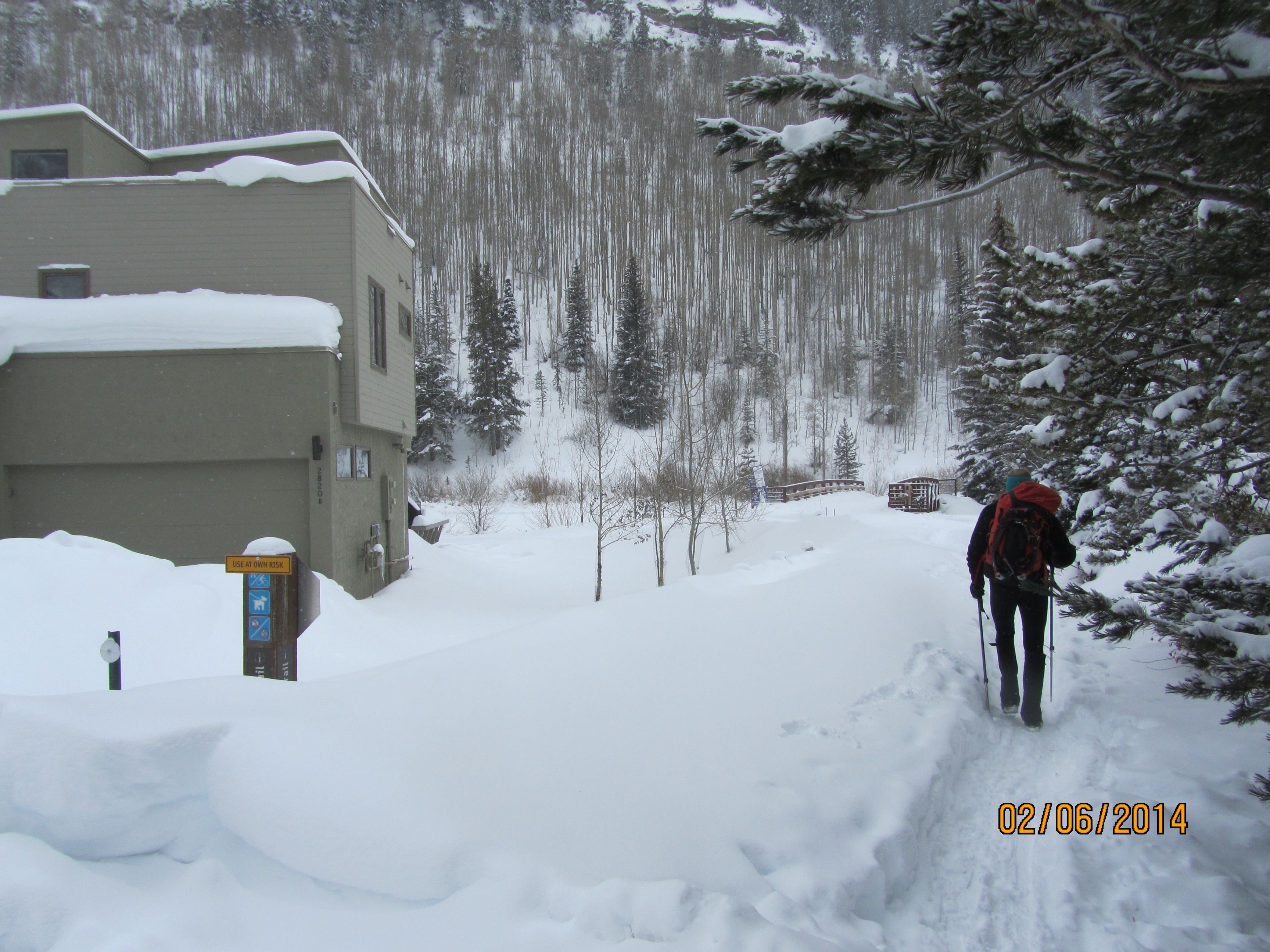
No parking on any street. Fee area. Do not walk on the ski trail.
“This belongs to Charlie,” I thought, “and Charlie sure don’t surf.”
But Charlie owns the guys who write the tickets and pack the wheel boots. My friend Tim got a ticket the last time we were in Vail. I remember it because the fine made him swear – and he’s an orthopedic surgeon. I parked where the signs told me to park, and learned to hate Colorado just a little more. I’d come back to climb, though. I had to grudgingly admit that the climbing was good enough to make the Hippie/Richie Redneck ecosystem survivable.

I had a little more hatin’ to do as we crossed the ski trail. I was a terrible skater, but I left better tracks than those, over drifts and deer tracks no less. They needed a little de-grooming. But then we got the nice boot packed trail to the Designator amphitheater. It was worth it. The Rigid Designator was a pitted, overhanging hook-fest up the middle, but had a nice line on the left.
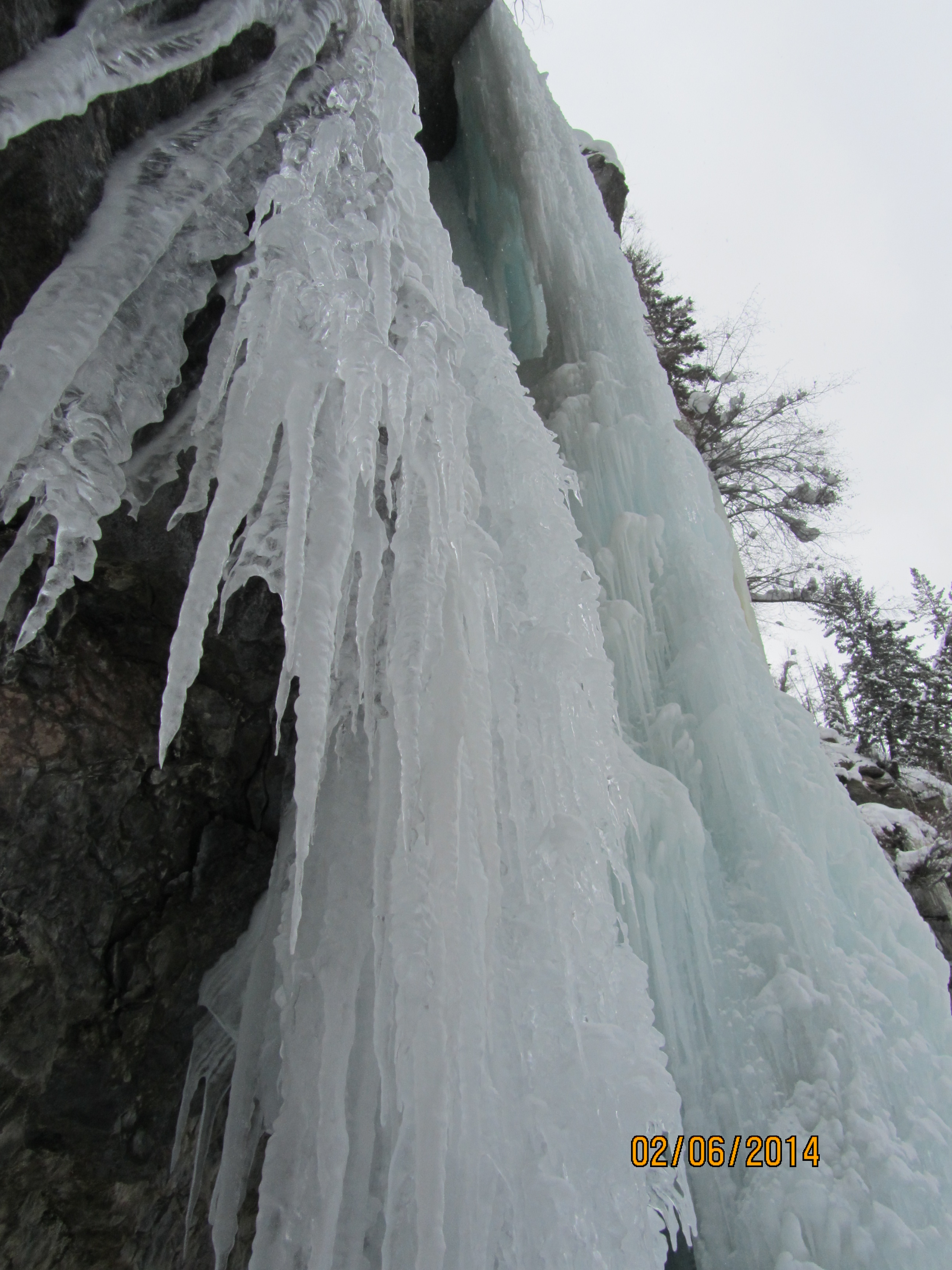
Left side of the Designator
Just before we finished our second lap on the climb, I got a call from my oldest son. Cell service at the base of the ice – another Colorado aberration.
“We’re done and we’re standing at the Hotel where the gondola starts and we’re cold. Come get us.”
He is still learning the new way of things.
“Take the shuttle back to our Hotel,” I replied, “You have the key and I have food for you in the room. Do you remember which bus to take and the room number?”
“Yeah,” he answered with renewed confidence, “OK.”
He is almost there; soon I will be wishing he really needed me again.
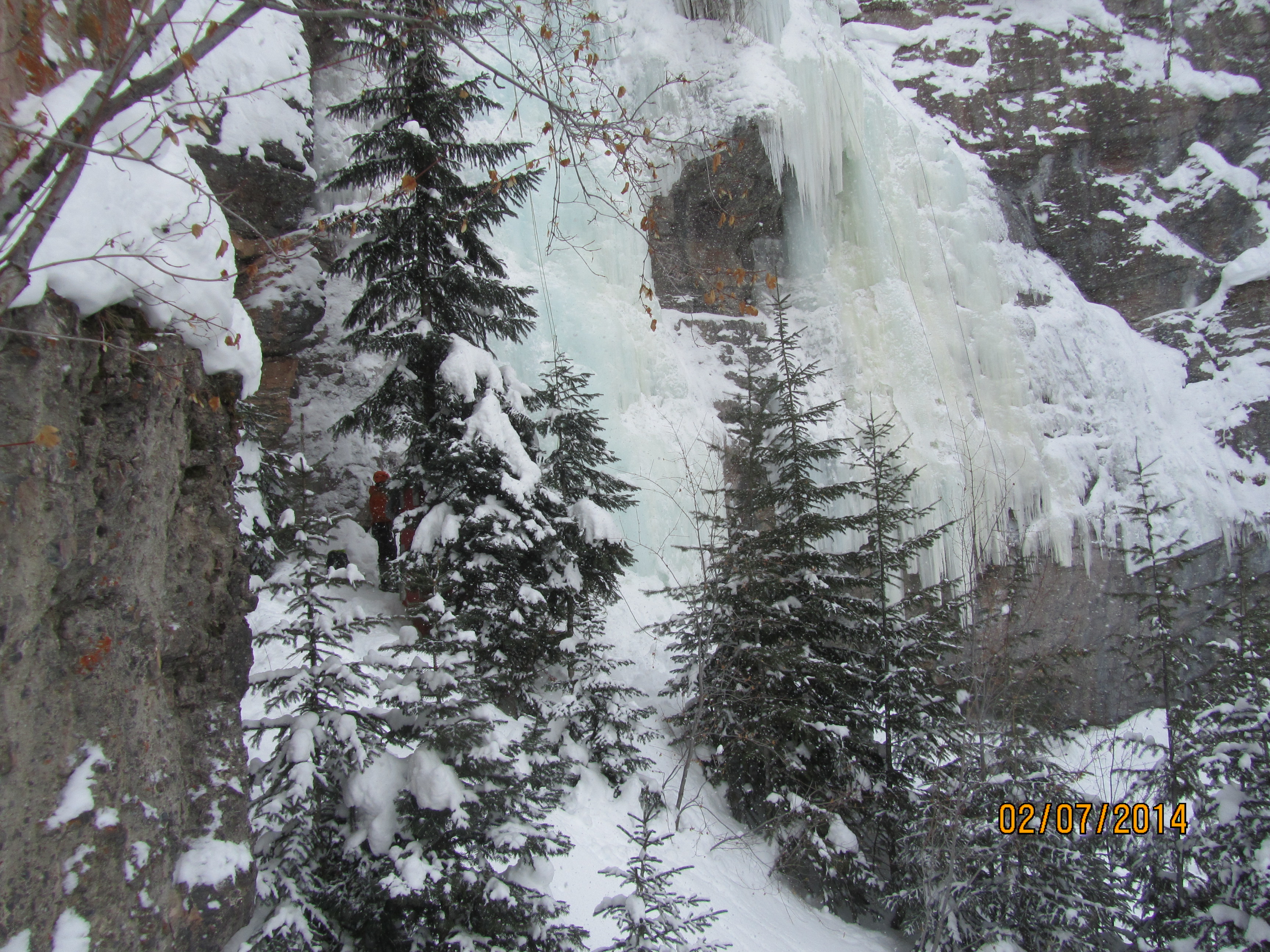
Firehouse area
Rich was a very good sport about it all. We packed up after the second lap and headed back to town.
The next day we went to the Firehouse area for some easy ice and mixed. With the rope through the anchors, however, our eyes began to stray to the scratch marks below the roofs and smears of ice. We didn’t come to Vail to top-rope, but we did it anyway despite the damage to our arms. At least hanging out in a practice area gained us some information. Rifle was in, said the guide belaying down the way.
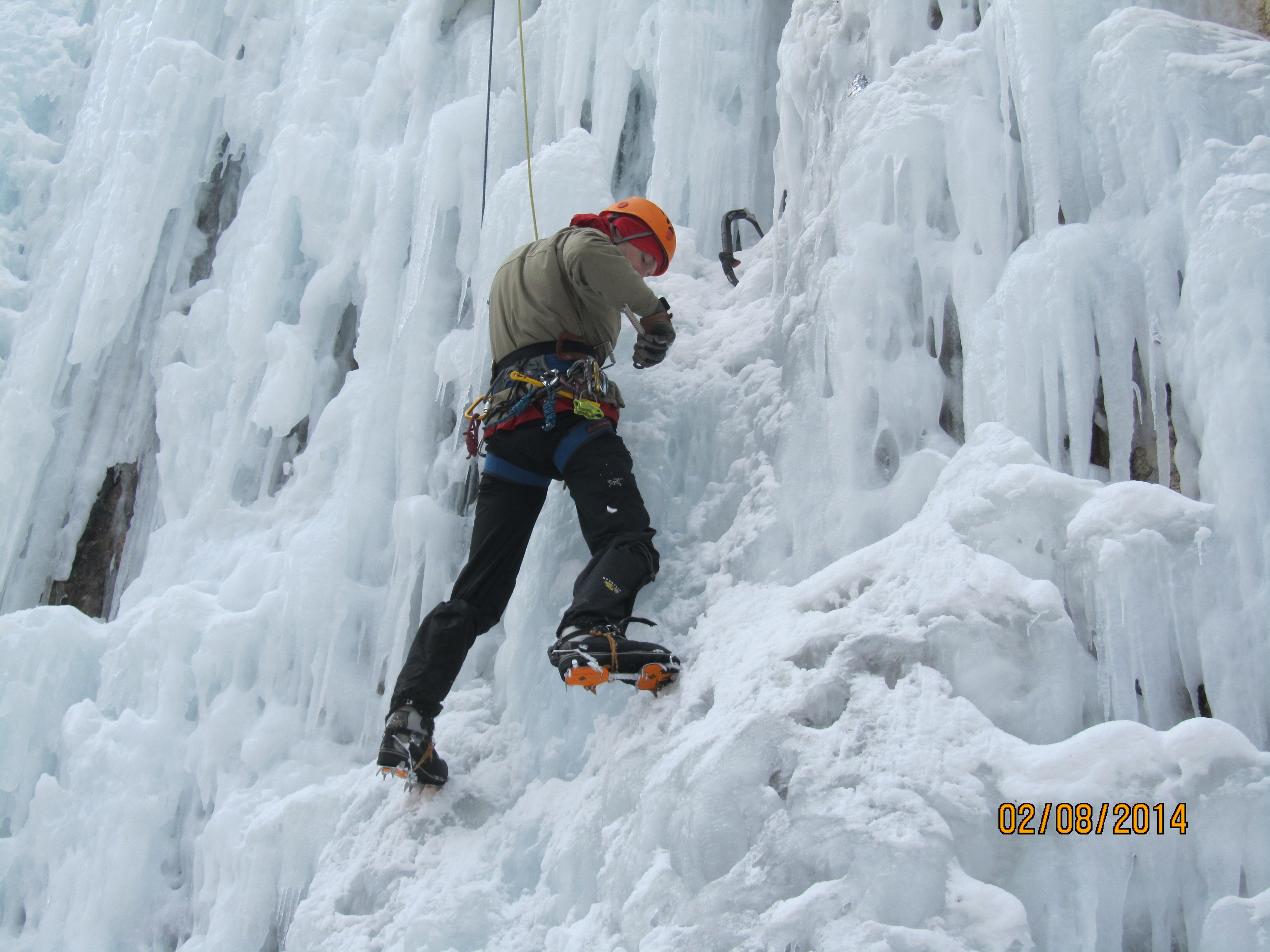
A sample of the Rifle photo-doc.
Rifle was a bit of a drive. It made me too nervous to leave the younger boy on his own while we were climbing over an hour away. Lucky for us, he had had enough snowboarding for the time being (When his legs get sore, he stops. We should probably bring him along more often.). He agreed to be our documentarian for the day.
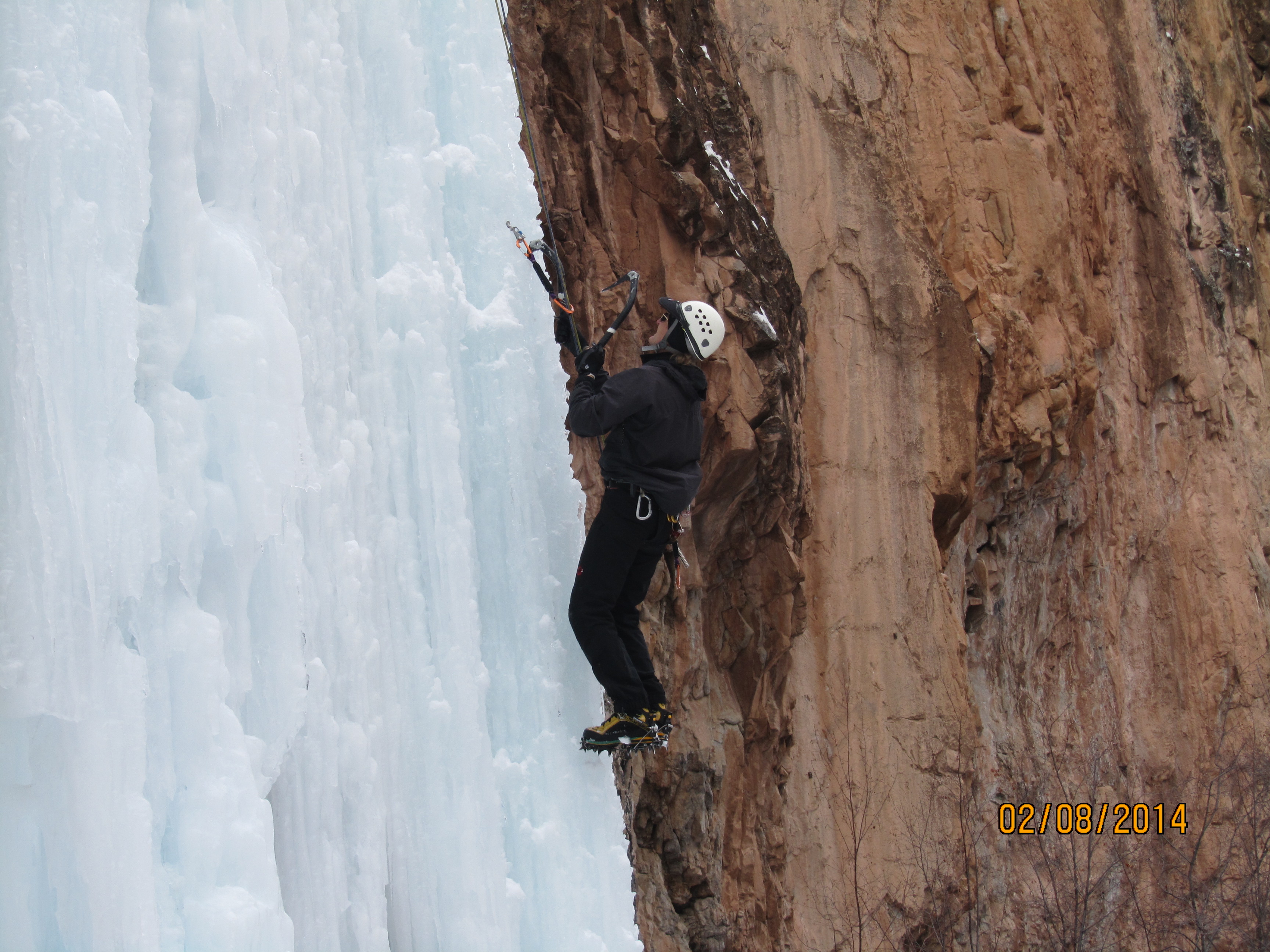
Final Curtain, Rifle
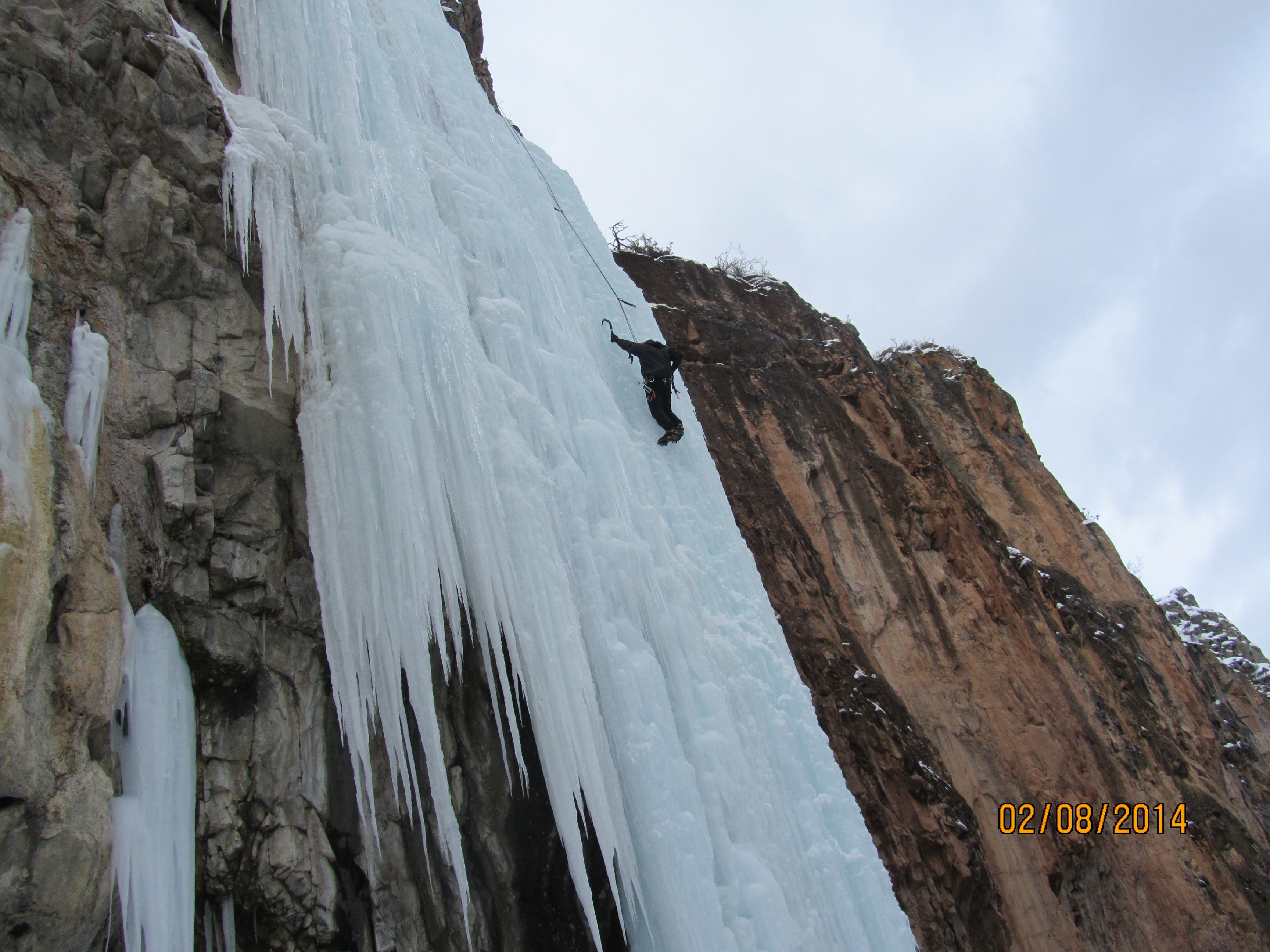
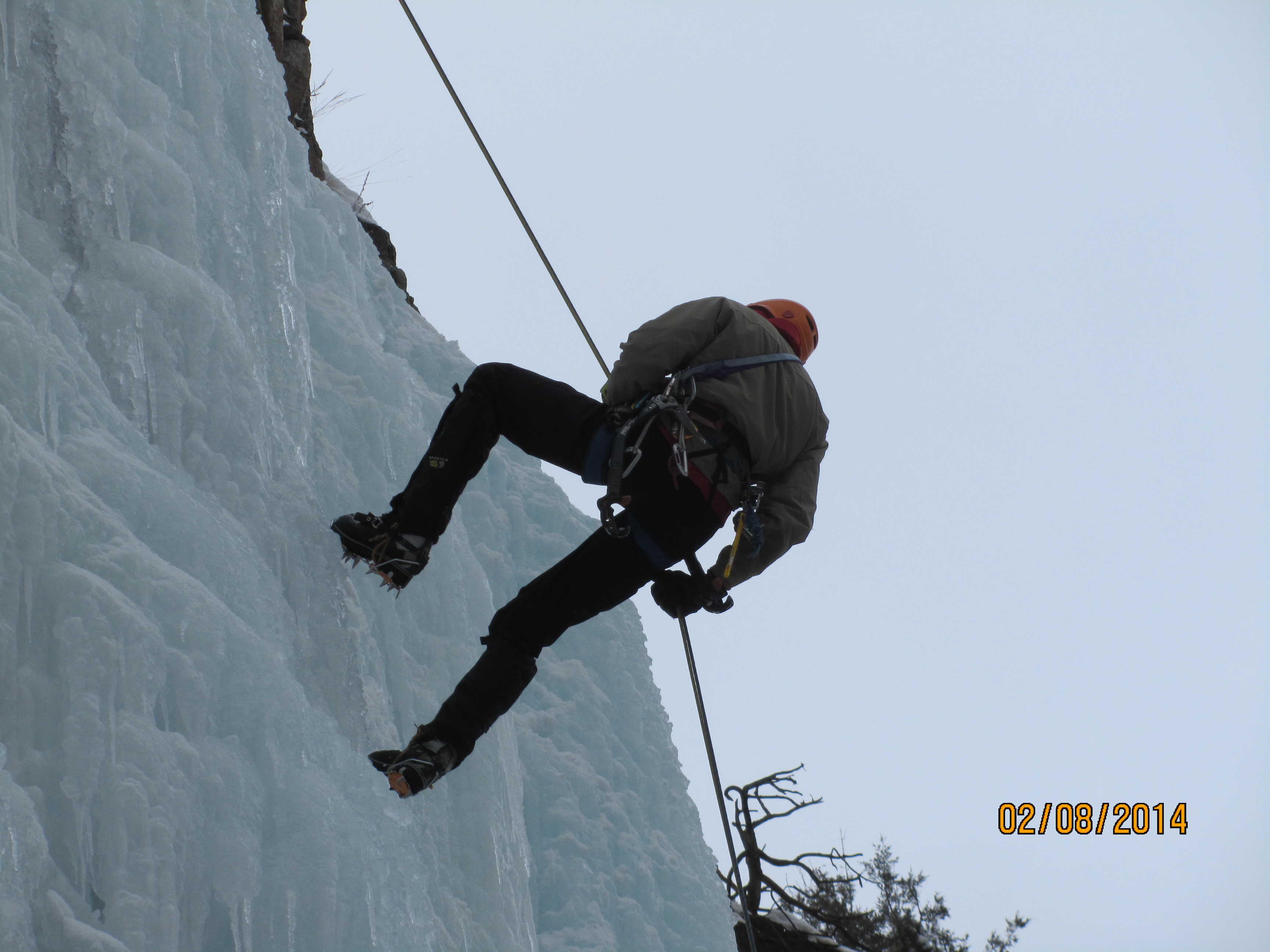
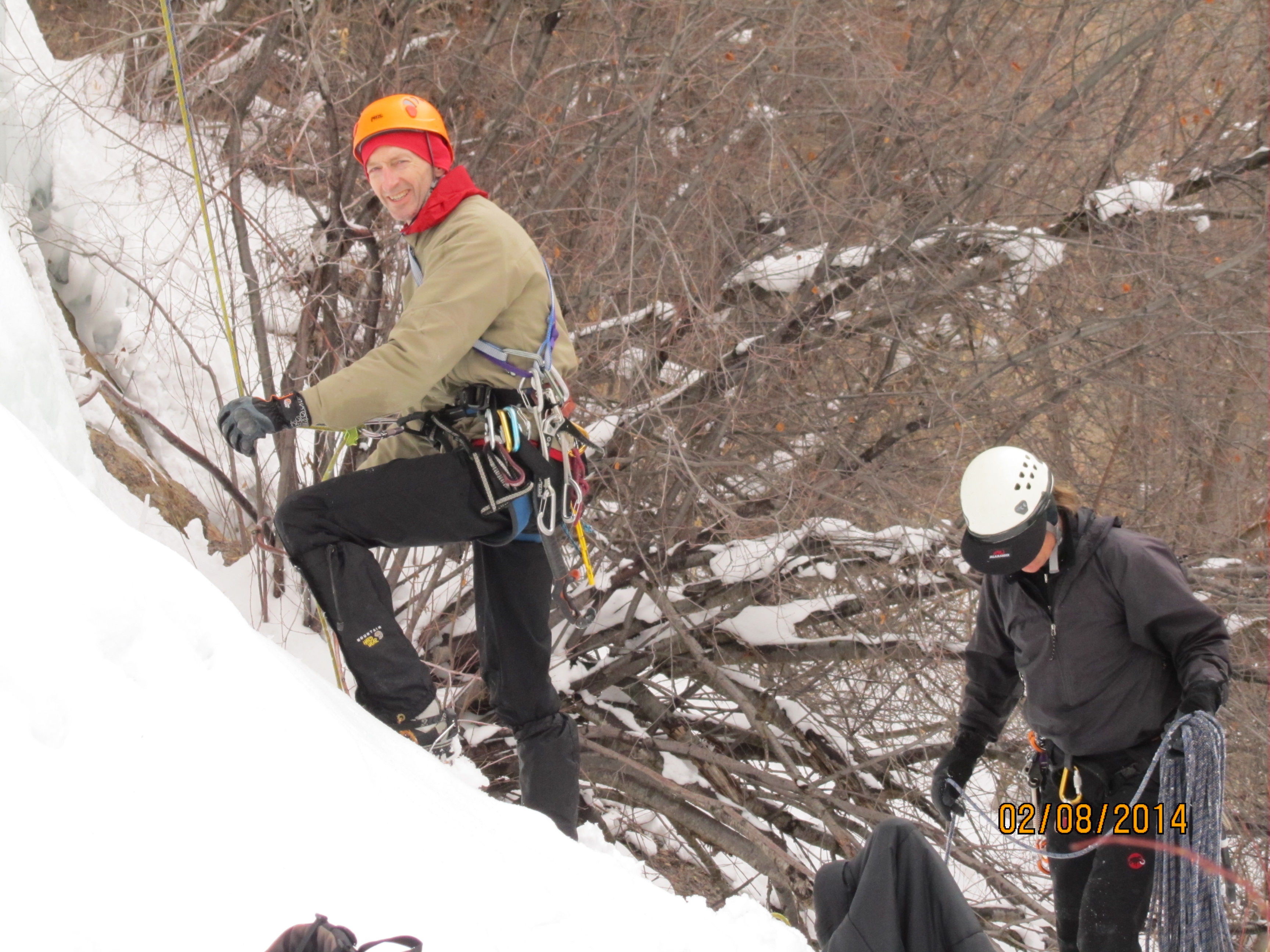
Preparing to climb Stone Free. I felt the route offered some good potential for action shots, but the photographer disagreed. Plus he was working on a new high score in Temple Run.
Having climbed out Rifle, we were back to the amphitheater for the big blow-out. Rich was set on the Fang. I had no interest. It was too damned wet. I wouldn’t be short of alternatives anyway. The lads had been busy while we were away. The last time I’d been standing behind the Fang, it had been easy to sort out the clip-ups on the cavern wall. Amphibian was the one on the right and the other one was Fatman and Robin. Now we had to ask the college kids who walked up behind us, which was which. Even so, I’m not sure what I climbed. I’d always wanted to do Seventh Tentacle, since I’d climbed Frigid Inseminator during my last visit. It was kind of a Robert Frost thing – “Two routes diverged on the crappy rock..” and I always wondered what the other one was like. Whatever it was, it was steep and led to the dry, left side of the hanging ice.
Up to that point, I’d remained unaffected by my single-parenthood. But the ice was brittle and my arms were tired from the day before. My swing was just sloppy enough to shatter large plates in the ice instead of driving the pick in cleanly. Normally, I’d need three ice screws to feel like the upper section was a sure thing. I was down to my last one with about twenty five feet to go.
Right after my wife died, I promised my boys that I would never voluntarily leave them. I could make no promises about objective hazards, but the subjective ones, I would avoid. I did have more screws, clipped to the rope below me. I down climbed to the last one which would prevent a ground-fall, pulled it, and climbed back up. I could feel the vibration of Rich’s teeth grinding, but he said nothing.
“Thanks for your patience,” I told him back on the ground.

The Fang
We took a run at Amphibian a bit later, but we were too whipped to get past the fourth or fifth bolt. I think we were just not very motivated either. Things had changed all around since the last time we were on the route. Our practice crag at Whitewood now had climbing just as hard or even harder. I can’t say we were disappointed, just a little wistful. That’s the way it is with climbing. Nobody gets an olympic medal. Maybe you win a Golden Ice Axe someday, but the next morning some punk kid will hike your prize route and then retro bolt it. And the rest of the world honors your achievement even less than that punk kid. But that’s how it should be. We’d be back to climb Amphibian for the enjoyment rather than the achievement. I knew we’d be back because I still hadn’t climbed the route down the way, Octopussy, and I wouldn’t be a real mixed climber until I’d climbed Octopussy…
 Dedicated to the Game