Author Archives: keithnoback

Jesus Christ: Error Theorist

A moral error theory is one form of moral anti-realism; it combines cognitivism with a failure theory, the belief that moral claims, despite their being truth-valued, are none of them true – Richard Garner

Two questions have always puzzled me: How and why was Jesus born? I don’t mean birthed by Mary, I think I understand how that happened (at least the last bit). I mean divided from the father. Something must have prompted this ultimate schizoid break; Jesus is clearly depicted as the son of god, and physically or metaphorically, the single defining characteristic of a child relative to a parent is coming after. The impetus had to come from outside of the father, as events, such as procreation, must occur in time and not strictly within the timeless deity. It is impossible to be sure, but I believe I may finally have the solution to this mystery. I believe Jesus was born of god in response to a human error concerning morality. Jesus was then born to woman to correct that error – man’s moral realism.
Morality was subjective from the start in the Christian narrative. I don’t see how god could coexist with objective moral entities. When we speak of objective moral terms, we do so in terms of obligations, whether those are obligations to carry out certain moral acts or to bring about certain morally right conditions. In other words, “good” and “evil” are real entities and morality is the set of conformist obligations which the existence of good and evil entails. I don’t see how god could be beholden to something external, if he is eternal and universal. Even if we say he created these principles, I don’t see how he could be obligated to them. As humans, our creations may demand things of us, but they do so on the basis of our identifying limitations and the relations which those limits entail. For instance, I’m obligated to be a good parent by, at minimum, the history I share with my children, my parents, my culture and my species. Good parenting is something I can learn about, and something for which I am responsible only after I have children, even if I have some nascent moral sense demanding that I be a good parent. The obligation is circumstantial. An eternal, universal entity can have no such obligatory relationships. There is no venue in which to have them. There can be no history of an eternal, universal god; he is it.
If we want to preserve objective moral terms then, we must place them within the deity. But now the situation is indistinguishable from moral subjectivity, with god being the singular subject of moral terms. By moral subjectivity, I mean the situation in which moral terms operate only in reference to a subject. To use J. L. Mackie’s language, moral terms operate “within the institution” of a subject’s identity, “such as to satisfy the requirements (etc.) of the kind in question”. In the light of moral subjectivity (with god as the singular subject), the biblical narrative begins to come together in a more coherent fashion, beginning with the Fall.
The tree had to be, if it represented the differentiation between what is, for the created, and what may be “within the institution” of god. When Adam and Eve ate the tree’s fruit, they did not learn the details of good and evil things which had surrounded them in the garden all along. They learned of the possibility of distinction, deficiency and failure. They were exposed to their own inadequacies, and were thereby exiled. The remainder of the old testament can be seen as a divine project of re-education, and a human project of reconciliation, aimed at herding the descendants of the first couple into the institution of man which apple-eating had created.
The initial formula had two elements: external focus (obedience) and right action (rules). The institution was defined. Even in the remedial program, god was pushing his followers toward an understanding of moral subjectivity. In the story of Abraham and Isaac, for instance, Isaac was spared from sacrifice. The lesson was obedience in principle, not simply reconciliation with good through right acts. If it were the latter, Isaac should have died. Instead, god delivers the message that sacrifices and the right actions which they represent will not avail Abraham, only devotion will. In taking his son off the alter, Abraham relinquished any hope of goodness through right actions, of conformity to an objective set of obligations to goodness. He began to act according to the requirements of personhood, fulfilling the requirements of personhood rather than those of the singular subject, albeit under direct supervision.
Despite all the talk of rules and obedience, the primary lesson of the rules-and-obedience program was that of devotion. Devotion focused the mind on one’s own business – the propriety of one’s own relationships and actions relative to those relationships. That was the point, and one which needed making before people could make the next step toward reconciliation. However, a project based on rules and obedience is easily corrupted. Rules invite arbiters and before you know it, a food chain of authority develops, as it did in the biblical narrative.
In the Christian story, the food chain was a preparatory element as much as was the devotional lesson, in the rules-and-obedience regime. Jesus would have had a much harder time making his point without the Pharisees, scribes, Sadducees, and all the other arbiters of duty-binding rules. The arbiters were used to represent a “do as I say, not as I do” vision of morality. This is in contrast to Jesus, who sought to lead by example. His entire project was aimed at demonstrating the principles of goodness within the institution of personhood. Here was the reason for the man/god chimera. The chimera was a means whose rationale lay in an understanding of morality as subjective, pertaining to individual subjects and their circumstances. To explain such a system, as opposed to one grounded in some objective moral terms, god couldn’t simply hand down edicts by way of instruction; he had to provide an example. But beyond bringing god’s followers around to a subjective system of morality, Jesus presented a moral error theory.
There is no “good”, there is only god. How else are we to interpret Jesus’ message of salvation through him and him alone (assuming his divine half is the one doing the saving)? When we speak of good within personhood as a ‘kind’, we actually refer to all those individual activities within their circumstances which satisfy the requirements (etc.) of, not divinity or creation, but personhood, which Jesus was supposed to exemplify. So when we make claims about ‘good’ simpliciter, none of those claims are true, as they refer to nothing in particular.
In the old days, disruption of the food chain by proposing this sort of error theory could get you killed. It still can get you killed (or at least marginalized) by the same lot who would have done the killing in the old days. For that reason alone, the story merits attention, from those who consider it allegory and from those who consider it fact, but especially from those who consider it fact. They are natural parts of the food chain and so are most at risk of being persuaded by the arbiters of morality that objective good exists. If they don’t get the message, they may be the soldiers in future pogroms, crusades and inquisitions carried out as obligations to good ends.

Tagged , , , , ,

Is Intelligent Design Distinguishable from Creation Science?

Yes, as horse shit is distinguishable from bull shit. ID is a deductive argument from analogy and teleology. As such, it is neither valid nor scientific. Both Creation Science and ID are based in the politics of religion, a genre which degrades both politics and religion, but ID is an attempt at subterfuge whereas Creation Science is at least an honest effort to advance an agenda.
Both are like unwanted attention from a belligerent drunk, but where Creation Science is like a shove, ID is like the question, ” What are you looking at?”. As with the shove or the question, one response is in order.

Tagged , , ,

Late Starts

There are morning people, and then there's this...

There are morning people, and then there’s this…

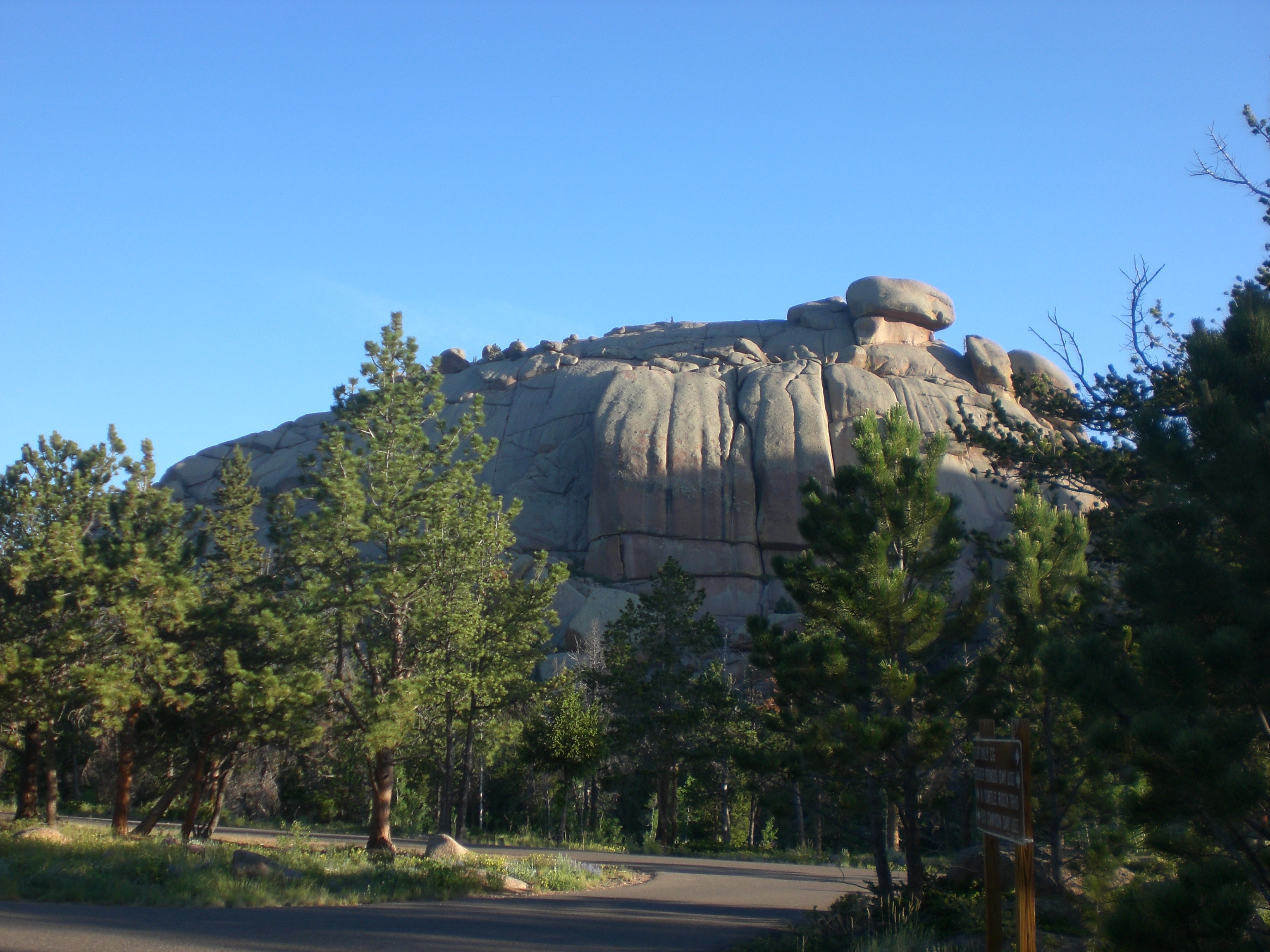
For various reasons, the rock season has started late this year. I wasn’t far ahead of the kids on our annual June trip to Vedauwoo. Despite its reputation for heinous off-widths, Vedauwoo is not a bad place to start.
Can't beat the view from the campground.

Can’t beat the view from the campground.

It has plenty of moderates, especially now that the kids’ idea of “moderate” is evolving. They are at the magic point in their climbing careers where they’ve begun to trust the rope and their knots and where they are habituated to exposure. They can focus on the movement alone, and a whole new aspect of the sport is opening up for them.

Spire Two.

Spire Two.

I’m not the only one starting slow this year. Back in the Needles, the gumby routes are swarming. But that is always the case, as one man’s hero is another man’s gumby right down the line – another beauty of the sport.

Tagged , ,

Blip! Intelligent Design Is Done Before It Gets Going…

I’m republishing this because I think it bears repeating in light of the ongoing activities of intelligent design advocates, and because I realized that I was wrong about something right at the beginning. The core errors in ID do power the evolution-bashing arm of creationism. I’ve noticed that the error of de-contextualization which characterizes the positive argument for ID forms the core of many people’s arguments against evolution. Obviously, I think that this is no accident. To many creationists, evolution is one rationalizing story among many. This would be true, provided one considered the theory of evolution out of historical context. But remember, the hypothesis was derived from observations of biological variation across environments. Then came the archeological evidence predicted, and later the genetic evidence predicted. That historical evolution is the difference between all proper scientific theories and mere rationalizing stories. So, one more time – I swore I wouldn’t get into this anymore. The intelligent design crowd keeps pushing this crap, though, and I have kids who are at risk. Beyond that, I suppose intelligent design’s sort of dishonesty just galls me. Don’t say I didn’t warn you.

I am about to give an argument by analogy. I do so with trepidation, because analogies are always in danger of going off in the wrong direction and have no deductive validity in the first place. However, I think this form is the only fair tool for the subject since I’m going to use this argument by analogy to critique another argument by analogy: intelligent design (ID). Rather, I’m going to critique the positive arm of the intelligent design argument. This is the withered limb compared to the evolution-bashing arm, but it is necessary to the whole and the negative argument is a morass. Since scientific knowledge is never complete, critics have available to them an endless list of objections. The positive side of the ID case is more a philosophical than a scientific argument, so it can be settled on that level.

The positive ID argument is as follows: when humans start with a purpose (a problem to solve) and devise a tool to serve that purpose, the end product looks a certain way. Biological structures have a similar appearance, so biological systems must result from the same sort of process. An immediate problem arises at this point. Since proponents wish the analogy between man-made objects and biological structures to be precise the argument commits the fallacy of the undistributed middle (Designed structures look like X, Biological structures look like X, therefore Biological structures are Designed structures).

The proponents of ID subsequently introduce a number of modifiers to try to alleviate this situation. Complex specified information is not only used to portray designed and biological structures as essentially similar, it is also used to try to pare down the middle by saying it is statistically negligible. Appeals to abductive reasoning serve the same purpose, suggesting that design is so far and away the “best guess” that there’s no need to worry about the logic. There are deeper problems than the modifiers and the middle but those are the simplest things to consider, so let’s go there first. Let me tell you how I built my son a mountain bike.

The bike came in a big box in a bunch of pieces with a couple dozen pages of instructions. The instructions were complex and very specific. In fact, if you read the instructions through, you would know that a mountain bike and nothing but a mountain bike would result from following those instructions, even without actually building a bike to find out. But, I didn’t read the instructions. I know how bike parts work, so I just eyeballed the problem and figured it out. So, even though the Complex Specified Information (CSI) in the instructions has all the qualities that the advocates of biological CSI wish it to have, it doesn’t have the necessary relationship to the endpoint that those advocates want from it. There are multiple paths through the middle to the mountain bike. There is still a way out for ID, though. I must have picked up on the CSI contained in the parts themselves. It’s true. When I looked at the parts, they fit together in certain configurations and orders of assembly best, as I expected. My expectations were key, too. Over the years, bike designers had shaped those expectations, in effect teaching me to read the information they put in the parts so I could use my abductive reasoning to make a really good guess about how the parts should go together.

I use this “best guess” faculty all the time, because it is a great shortcut and pretty reliable in familiar circumstance. Notice I said ‘pretty reliable’. Also note that I said I didn’t use the instructions, but I didn’t say I threw them away. Sometimes the bike makers come up with an innovation and then my abductive reasoning is worthless and I have to rely on the instructions again to tell me what to do about the new part. I get in trouble if I try to rely on that ‘best guess’ shortcut in clinical medicine, too. The causal history of a manufactured bike is well-defined because people decided to make it that way. If the causal history of a patient’s symptoms is well-defined for me, it’s because I have decided so. Used outside of a situation with known prior constraints on the variables, the ‘good guess’ becomes confirmation bias. So, the problem is with the complex specified information. In biological structures, to achieve ‘specification’ and thus make the ‘best guess’ inference to design, the causal history has to be constrained after the fact. Anything less leaves open those pesky intermediate paths through the middle. ID imposes that constraint by assigning purpose to all biological structures it considers. Assigning purpose is easy for us humans and we like to do it because it lets us use shortcuts like guessing. Attributions of purpose (intent) are so appealing that we have trouble keeping them in the realm of human behavior where they belong (and not even there without some confirmatory process to check the attributions). Who hasn’t said their car “worked hard” to get up a steep hill? It’s just as easy to say that E. coli intends to swim to new food sources with its flagellum. In fact, it takes just that sort of presumption of intent to wrangle an object’s causal history into CSI, resulting in a bit of a Cartesian circle (if the flagellum is made for swimming, then it has a complex history treading a narrow path to that endpoint, which shows that the flagellum was made for swimming). Still, we should be able to safely use this attribution of intent after the fact in limited circumstances, as long as we’re careful, right? For instance, it is surely accurate to say that the guys who designed my son’s bike did so from an original purpose. However, even that presumption of intent from the endpoint is not accurate, and the problem with the retrospective attribution of purpose/intent in such a case leads us back to the problem with intelligent design that predates any attempt to distribute or minimize the middle.

What do we know about design? We really just know what we do and what we do requires an agent (us), a purpose, and means. The problem is that the relationship between those three factors is not linear, nor is it even hierarchical. When considering bike design, for instance, we could go back to the origin of the means via the agent and examine the influence the means then had on the agent’s intent and subsequent development of further means. We could track back to the origin of the wheel in geometry, which is in turn based on observed properties of materials, which are in turn based on some basic laws of physics, all of which humans bothered to investigate and remember in the first place because, if you are a tool-maker, it’s easier to investigate and remember than to, um, ‘reinvent the wheel’. We could trace bicycle history back to the wheel and beyond, but let’s keep it brief and just consider the design of mountain bikes.

Mountain biking started when some California bike racers moved to the country. Their new environment confronted them with the problem of riding, and of course racing, on gravel roads. Their road bikes’ narrow tires were too unstable for that purpose, so they found some preexisting cruiser bikes with wide tires that would at least be ridable on the fire roads near their homes. The cruiser bikes were not perfect. They were heavy and hard to pedal, so the riders raced them downhill. Even that compromise lead to problems though. The brakes and bearings on the cruisers couldn’t survive that kind of abuse. The riders replaced the brakes and bearings with motorcycle and road bike components. The riders soon found that the revised cruisers, now possessing cassettes of gears with the road bike bearings, were capable of riding on rough trails as well as fire roads. Trail riding prompted further modifications to the bikes. These guys in rural California invented the mountain bike, but not all at once and not out of the blue. They worked through a progressive series of problems, each leading to the next, until they arrived at a relatively stable final design that did something very different from the structure they started with. The mountain bike evolved. Of course, this is microevolution; the mountain bike is just a tweaked cruiser bike. Neither the mountain bike nor the cruiser looks anything like an old penny-farthing with the giant wheel in front. The lineage is clear though, and bike development has proceeded by the same basic process from the wheel to the velocipede to the mountain bike. Moreover, the agents in this process acted as selective forces and were acted upon by selective forces – and not just physically. As designers altered the bikes, the bikes’ new capabilities altered their conception of where and why they might ride a bike and thus their purpose in the next set of modifications.

To fingerprint design as the ID scheme misrepresents it, we really must close that Cartesian Circle by presuming intent for any and all endpoints we wish to examine. Then the history of that point is seen separated from any branches or external contingencies. If the mountain bike comes from a mountain bike factory, surely the mountain bike factory holds the entire explanation for its structure. When defined after the fact like this, the history of a structure looks irreducibly complex; if you take away one part it is rendered meaningless because it is its own context. ID’s analogy between designed structures and biological structures not only fails to distribute the middle, it doesn’t even accurately depict design processes as we undertake them. People, the source of everything we know about design, don’t start cold from an undetermined purpose and design toward that purpose in an implacable, irreducibly complex chain of events. Replication may work a bit like that, but not design.

What this method really does is provide for a hierarchical relationship between presumed intent and biological structures, where the intent causes the structure. Such a relationship seems to allow for a supernatural cause. This is why ID’s advocates have gone through such contortions to make it work (or at least look like it might) – see the Wedge Document. Yet the intelligent Design model fails even as a portal for the supernatural. It offers no solution to the interaction problem in dualism. This is a real problem because, as far as I can tell, one tenant of ID is that the design process in nature is ongoing. To drag a spiritual being into the material world and have it start doing things, one has to explain how it does so without being in some way beholden to the same laws, and thus part of the same causal history, as the rest of matter. If there is no good explanation, then the spiritual being from another realm is just a bizarre, unexpected new part of nature. Though this may seem an obscure technicality at first glance, here is an example of just how sticky the problem really is.

Descartes tried to defend the independence of the mind from brain processes. He offered the analogy of a virtuoso violinist asked to play on a broken instrument. The listener would have no clue as to his true skill. Likewise the damaged, diseased, or intoxicated brain may just be a broken instrument unable to give voice to the intact mind which plays upon it. Unfortunately, this analogy raises the question: May the virtuoso be a virtuoso without a violin? Study of music theory or any other purely mental operation is insufficient. He must play a physical violin. Yet the skill he gains is a mental faculty which is subject to his creativity, religious concepts, and emotion. The brain and its adjuncts affect the mind. There is no escape from this problem in a world of two supposedly separate substances in active contact. Deism or a strict idealism offer the only outs (and Deism may just push the problem back in time). Either of these scenarios keeps the supernatural supernatural, but thereby makes it irrelevant to any practical understanding of nature/matter. This is why it is best for religion that science adhere to methodological naturalism. This is why intelligent design is insidious as well as invalid, for all concerned. It robs religion of any hope of philosophical integrity, just as it misrepresents biology. Reason enough for everyone to drop this bullshit for good.

Dear Ueli,

You know what this is about. It’s what everything has been about for – how long has it been – ever? I mean the little dust-up on Everest. Let me reassure you, I am writing as a great admirer and friendly correspondent. You are living the dream, and showing all us amateur climbers how to do it. We are all limited by what we think is possible, and you have made a career of crushing the limits. So I am not a critic, but I do have a concern.

I’m not so worried about the actual events on the Lhotse face. I don’t know shit about Sherpas or their culture, but I am a field observer of human psychology, as a hobby and in my job, and here is how it looks. It appears that the Sherpa crew on the face was pissed because you guys passed them and may have knocked a bit of ice down. As climbers, we know how frustrating it can be to have a stronger team pass us. We accept it as part of the game, though. It’s the same with ice fall; even the best climber is going to knock a little ice down, no matter how careful he or she is trying to be. However, the reaction you got didn’t come from climbers, did it? It came from technicians trying to get a job done.

I’ve tasted that flavor of hostile indignation before. The first time was from a Chicago cop. I used to run a route that took me past a housing project. Rain or shine, I did that run for a year and a half, until the cop stopped me. He didn’t yell or throw rocks at me, but he made it clear that I was not to run the route past the project anymore. Unpleasant legal consequences would follow, he implied, if I did not comply. Before my encounter with the cop in Chicago, I had the naïve idea that laws and cops were there to keep the peace and let the citizens get on with their business. Afterwards, I understood that laws and cops were there to prevent trouble for cops and the legal system. Seems like the situation is the same with the fixed lines on Everest and the people associated with them.

These people – the functionaries of the Big Expeditions to the Classic Routes on the Big Mountains – have a different view of risk than climbers. A climber’s view of risk is like a card player’s. He pushes the chips to the middle of the table and then does his best to get them back. These other people do their best not to have to play the game. Who can blame them? They have a job to do.

Which brings me to my concern. What do you want with mountaineering anyway? We all know that mountaineering is for those who can’t do anything else. Hell, in fifteen years or so, I know I’ll be trading in my tools for a piolet and begging my kids to drag me up some god-forsaken volcano (assuming I live that long). Of course, on Everest you were after the West Ridge, which is not a mountaineer’s route. No doubt you were motivated in part by the tale of the route’s first ascent. I have heard Tom Hornbein talk about the original climb. Even back then, he and Willie Unsoeld had to fight the mountaineering expedition mentality to get to their climb. That mentality is institutionalized now in the environs of all the prominent peaks, high and low. Did you hope to escape it in this day and age on the most prominent peak of them all?

I know you have a job to do too, and you are beholden to the weasels in marketing because of it. However, you shouldn’t feel compelled to stoop to mountaineering. You must realize that the weasels in marketing would rather not have you around. They would prefer an endless parade of reality TV celebrities coming off the summit of the world’s highest. Those wankers come much cheaper and are easier to liquidate. The climbing community would recognize the significance of a West Ridge ascent, but the rest of the world would see only the summit of Everest, and they would be glad that you had finally got there, after all your preliminary fiddling in the Alps.

You ratify the popular perception by adding an Everest summit to your resume, and in the process, you increase the value of wanker stock. To us climbers, you represent the consummate talent and discipline required to push the chips to the middle and reliably pull them back. To the summit industry, you represent recklessness bordering on assholery, by playing your game in their workspace. Even worse, when their stock goes up, yours goes down. As the notoriety of the high summit grows, lending credence to the wankers’ claim (explicit or implicit) that the high summit is the Grand Prize of climbing, the significance of soloing the North Face of the Eiger in a few hours, shrinks.

Don’t get me wrong, an artist like you should do what moves him without listening to anybody else, especially a duffer like me, and if you are moved to go back to climb the West Ridge of Everest, you should. Furthermore, you have nothing to be sorry for regarding the fight with the rope-techs on the Lhotse face. I’ve read all the anti-imperialist narrative and social justice analysis regurgitated in response to this incident. Sherpas attacking a bitchy client is a revolution. Sherpas attacking an independent team of climbers is just a good, old-fashioned turf war. So, I think there’s nothing to stop you from going back in principle, but please consider before you do: Is it good for business?

Tagged ,

Just Off Highway 212..

..in Southwest Montana, hard by the Crow agency, stands a  prominent hill with a monument marking a mass grave which holds the remains of members of the 7th Cavalry. On a sunny day in Spring, I stood on that hill and saw what happened to Custer and his command in the Battle of the Little Bighorn.

They lost it. They lost it long before the last of them died on the hill, though. The evidence, especially the fact that the last of the command did die on the hill, is manifest on the surrounding landscape. Markers dot the ridge and valley leading to the site of the ‘last stand’ indicating the spots where men died along the way, died while standing separate from the command, or fell trying to flee the hill. Nobody could really know what transpired that day, but anyone could know, just by standing there, that the hill was a terrible place to be.

The view from the hill was panoramic. All the  features of the terrain, including the perpendicular ridges which form the sides of surrounding gullies, were exposed. The commander of a military unit would naturally seek such a vantage point, due to both his training and a natural instinct to be able to see an oncoming threat. But even at the beginning of his maneuver to the hill, Custer had ceased to be the commander of a military unit trying to win a battle.

As his trained instinct to retreat and regroup was misplaced, so was his natural instinct to keep his enemy in view, for from an opponent’s perspective, anyone standing on the hill became a perfect target outlined against the sky. Any move to escape the hill could not be concealed. From the vantage point of those defending the command, targets seen from the hill had to be picked out from the background of grass and dirt on the slopes, if those targets were not completely hidden behind the perpendicular ridges. Custer’s maneuver to the hill was a mistake, but it was not the first such mistake in human history, nor the last. It was one of a surprisingly broad and common category of mistakes, which afflict the capable as easily as the bumblers among us.

Decades later, the pilots of Air France flight 447 experienced something very similar to Custer’s  retreat up the hill. Just as the pilots were maneuvering through a series of thunderstorms, the airspeed sensors on the outside of the airliner froze over. The plane’s computer then shut off the auto pilot to avoid the automated system’s reacting to invalid data from the malfunctioning sensors. Now in control of the plane and unable to make sense of the numbers anymore than the computer could, the acting pilot reverted to instinct and training. His instinct was to get out of the situation. The first bit of training which came to mind for escaping a bad situation was one which told him to add power and pull the nose of the plane up. He even tried to confirm his instinct with his fellow pilot, at one point saying, “I’m in TOGA, eh?” – an acronym for ‘Take Off, Go Around’, a maneuver used to recover from an aborted landing, for example, by adding power and climbing. All the while, the stall warning was screaming, indicating a problem which demanded everything but elevating the nose of the plane and climbing.

I have great sympathy for the pilot of flight 447, because I have done what he did, but I was luckier. I was on one of my first long rock climbs with an equally inexperienced partner. We set out on a warm, clear day amid the long days of Northwest Summer on a route well within our capabilities. We knew we could climb it easily in a day, so we left without jackets, headlamps and extra food. However, the route was longer and more convoluted than we had anticipated. By the time we peeped over the summit for a view across the range to the sea, we had to shade our eyes from the lowering sun. We knew it was late, but had no idea how late, since we had left our watches with the headlamps. As we descended, which we had planned to do mostly by climbing down, it got dark and we were forced to use the rope more and more often.

For those who are unfamiliar with climbing techniques, descending by use of the rope involves doubling the line through a loop of nylon webbing anchored to the rock, with or without a metal ring to hold the rope off of the nylon, then using a friction device attached to one’s seat-harness to slide down the two sides of the doubled rope at once. Typically, the descending climber holds one hand above the friction device for balance while the other hand is on the rope below the device, controlling the rate descent by increasing or decreasing tension on the free end of the rope. Before coming to the end of the rope, the descending climber must find a new spot to anchor another loop of nylon. The second climber then comes down the rope to the new anchor, the team pulls the rope through the original anchor, doubles the line through the new anchor and repeats the process.

In the growing dark, new anchor opportunities became harder and harder to find. We had to get down, because we planned to get down, because we felt an instinctive aversion to the prospect of being stuck on the face, and because my partner had to be at work the following morning. As I approached a wide ledge, I could not find an anchor. I swung back and forth across the face, letting a little more rope through my friction device on each pass to allow a wider and wider arc. Now past the ledge and increasingly desperate for an anchor point, I pushed back to the left one more time and felt the ends of the rope slip past my lower hand. My upper hand reflexively locked onto the rope above the friction device as the ends pulled free of the device. Luckily, my grip on the rope with the upper hand held and kept me from falling several hundred feet down the face.

Instantly, I forgot about the prospect of not finding an anchor, my partner’s missed work day, and the dreariness of being stuck out for the night. Climbing hand over hand back up the rope to the ledge, I was re-oriented to the situation. We were not racing to finish a successful climb or out of options because I couldn’t find an anchor by starlight. We were trying to descend a complex route in the dark, and had hit an endpoint. We would not die of cold or thirst or starvation that night. My partner joined me on  the ledge. We secured the rope ends to a bush and then curled around the stem of the small plant as if it could provide some warmth and shelter. We shivered the night away and by morning’s light, found a large flake of rock ten feet right of our little bush to tie off as an anchor. My partner lost a vacation day, but kept his job.

As I climbed more, I spent fewer unprepared nights out, partially because I learned the hard way, but partially because I learned the checklists that all climbers employ. There is a packing checklist, a checklist for use prior to climbing onward from an anchor, a checklist for use prior to descending the rope, a checklist to run before pulling the rope through a top anchor, etc. Checklists have saved me on many occaisions.

A checklist almost saved flight 447, though they did not know they were using one. When the senior officer arrived in the cockpit, the pilot and co-pilot were racking their brains trying to sort out what had happened, even as they acted to achieve what they knew that they must achieve – making the plane climb instead of descend. When they asked the senior officer what they should do, he replied, “I don’t know.” In effect, he performed the most vital step in any checklist – he stopped himself and began to pay attention to what was going on right then, in his own head as well as in the airplane. Unfortunately, by the time he’d helped his fellow officers clarify their mental states and reconcile their actions with the events at hand, the airplane was one and a half seconds from the ocean. Even Custer might have been saved if he’d had a checklist, despite the more complicated nature of his situation.Custer faced a special challenge because his opponents had a keen understanding of the psychological elements which make a checklist so useful.

One element in particular is the key benefit of checklists and the one which we are in constant danger of forgetting. Even in the definitive popular treatment of checklists, Atul Gawande’s The Checklist Manifesto, the key element gets only superficial treatment. He touches on it in his description of the engine failure checklist for single engine planes.

It is slimmed down to six key steps not to miss for restarting the engine, steps like making sure the fuel shutoff valve is in the OPEN position and putting the backup feul pump switch ON. But step one on the list is the most fascinating. It is simply: FLY THE AIRPLANE. Because pilots sometimes become so desperate trying to restart their engine, so crushed by the cognitive overload of thinking through what could have gone wrong, they forget this most basic task. FLY THE AIRPLANE.

The admonition in step one of his example could be generalized to the statement: Remain oriented to your situation. Gawande can’t be blamed for focusing on the other utility of checklists – their ability to help us prioritize the necessary steps in a complex task and thus break the task into manageable bites. After all, he is primarily concerned with the application of checklists to prevent errors in the relatively controlled, but complex, environment of the operating room. However, his focus risks neglecting the source of our potential disorientation, a mental flaw which Custer’s antagonists at the Little Bighorn understood as vital, and which the course of the battle illustrated so well.

As opposed to Custer and his command, the warriors camped along the river were not soldiers. They had experience with war, but operated as a group of individuals rather than a formal unit. They had leaders, but no commanders. Their only training in the cooperative use of force came from hunting buffalo. Yet they understood their position. Management of the warriors’ psychological state was the leaders’ primary task. The leaders had to direct their warriors by example and exhortation.  And from the buffalo hunts, they knew that if they could control their targets’ psychological state as well as their own, success was guaranteed. The assembled tribes had a method, but not a plan and part of their method was aimed at breaking all plans set against them.

When Custer moved against the encampment on the Little Bighorn, he had a plan. He planned to trap the band of wayward natives between the two elements of his command, preventing the Indians’ escape or forcing them to surrender and return to the reservation. His plan was one for a pursuing force, an aggressive force. It was a plan for a military unit, utilizing a military unit’s capacity for coordinated attack and maneuver. For a moment, it looked like the plan might work. The Indians were surprised by the force which crossed the river to attack from the South under the command of Reno. But the Indians had a larger contingent of warriors than expected. In the face of determined resistance, the Southern attack failed and the troopers fell back in disarray.

When the initial thrust of Reno’s force stalled, a number of the warriors still mobilizing in the camp stopped to perform ceremonial rites. Crazy Horse in particular took so long in ritual preparations for battle that the younger men following him became impatient. Perhaps the drama was part of his plan too, orchestrated to focus and rouse his entourage. At any rate, Crazy Horse’s rituals were vital for his own role in the fight. The preparations served as Crazy Horse’s checklist, to protect him from the very thing he would soon attempt to do to his enemies – turn them from men into buffalo. When he emerged from his lodge, he was ready to fight his way. During the subsequent action, he would ride back and forth in front of the enemy lines blowing an eagle bone whistle, drawing fire. He would cut through a line of moving soldiers and lead his band of warriors in among the enemy forces. His actions would serve to prevent concerted action by his foes and force them to fall back on the familiar and the comfortable – predictable instinct and the rote lessons of training.

Custer’s attack never really got started. Confronted by a large force rallied to face him, he seems to have had difficulty orienting himself to the new situation. He doesn’t even seem to have had that critical moment which flight 447’s senior officer provided when he said, “I don’t know.” Instead, he retreated toward the hill.  In a subsequent interview, Hollow Horn Bear, a warrior who witnessed the battle gave this description:

Interviewer: After the soldiers got to the ridge, did they keep together in one body, or did some of them make a stand to give the others a chance to select a position?

Hollow Horn Bear: Soldiers kept together all during the fight. The soldiers would shift positions, but no stand was being made to do so.

Another witness, a warrior named Two Moons, gave a more incisive analysis:

…Custer was a brave man. I give him credit for attacking a people that vastly out numbered his – but something was the matter with his men. They did not run nor seek shelter, but stayed right out in the open where it was easy to shoot them down. Any ordinary bunch of men would have dropped into a watercourse, or a draw, where they could have fought for a long time. They acted and shot their guns like something was wrong with them. They surely had too much of that whiskey. That bunch of men should have fought for a long time, but it did not take long to kill them all.

Most telling was the view from the perspective of the encampment, as witnessed by Julia Face:

Interviewer: Did the Indians reach the high ridge ahead of Custer, and did he at any time charge them and drive them off?

Julia Face: None of the warriors reached the high ridge ahead of Custer. The Indians acted just like they were driving buffalo to a good place where they could be easily slaughtered. Custer never charged.

Maybe Custer had no choices that day. But maybe the one critical step in any checklist, the pause to reorient, would have helped his command acquit itself better even if it could not have saved him and his men. Because that one step is the only thing that can save the human part of the mind from itself. Without the jolting stop at the start of a checklist, the part of us that thinks will dwell on its plans and motivations rather than wading into the delays and discomforts immediately before it. A pilot’s mind, focused on the goal of gaining altitude, will tune out the stall warning since it is not helping him achieve his desire. A climber’s mind will forget about the end of the rope since it is not helping him find the next anchor. Then, with the human part of the mind occupied with its own concerns, the buffalo mind is left to act in its place. According to its nature, the buffalo mind just does something. It reacts to the anxiety assailing it from within and the simple cues coming from the outside with a series of programmed behaviors which ignore the future and the immediate past. It functions as a behavioral “Hail Mary” when the thinking part of the mind has checked out. It may freeze in the face of an immanent threat and not fly the plane. It may run over the edge of a cliff to escape.  Even without encouragement, the buffalo mind, with its unselected, rote behaviors, will often lead us to a good place where we can easily be slaughtered.

Notes: Interviews are obtained from the books, Indian Views of the Custer Fight by Richard G. Hardorff, Lakota Noon by Gregory F. Michno, and Lakota Recollections of the Custer Fight by Richard G. Hardorff. Further information is available at the Custer Battlefield in South Central Montana via our wonderful, woefully underfunded National Park Service

Tagged , , , , ,

Oughto Elimination

CIMG4053“I ought to be able to climb this,” I thought.

My partner agreed. “You got it, man,” he called from the belay.

Of course, the problem was that I didn’t have it. If the helpful blob of ice for my left foot had been there instead of the mushy snow that was, I would have had it. If the sun had not already melted loose the key chunk of ice above my head, I would have had it. If there were a foot hold above the little bump of granite which supported one point of my right crampon, I would have had it.

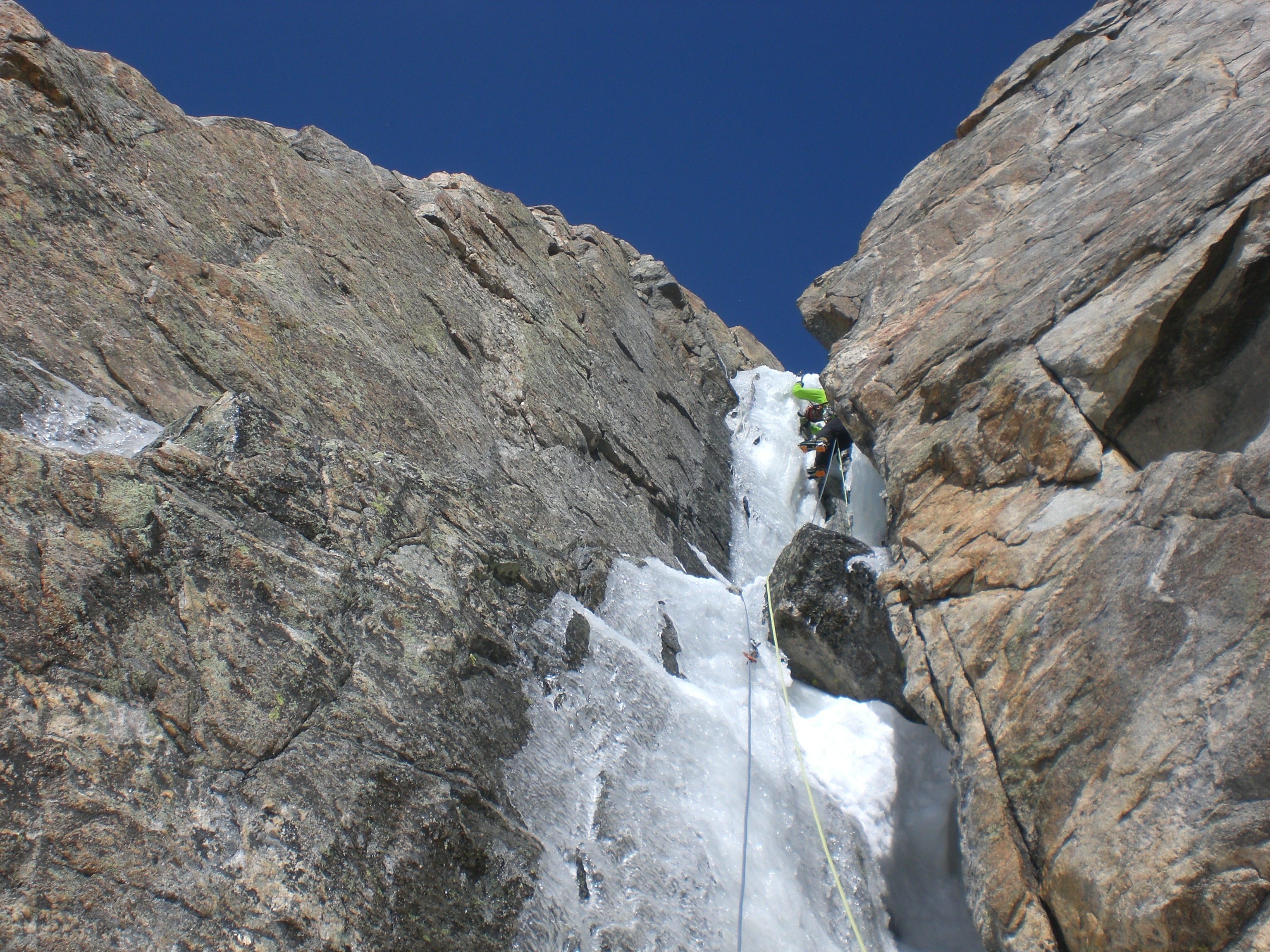
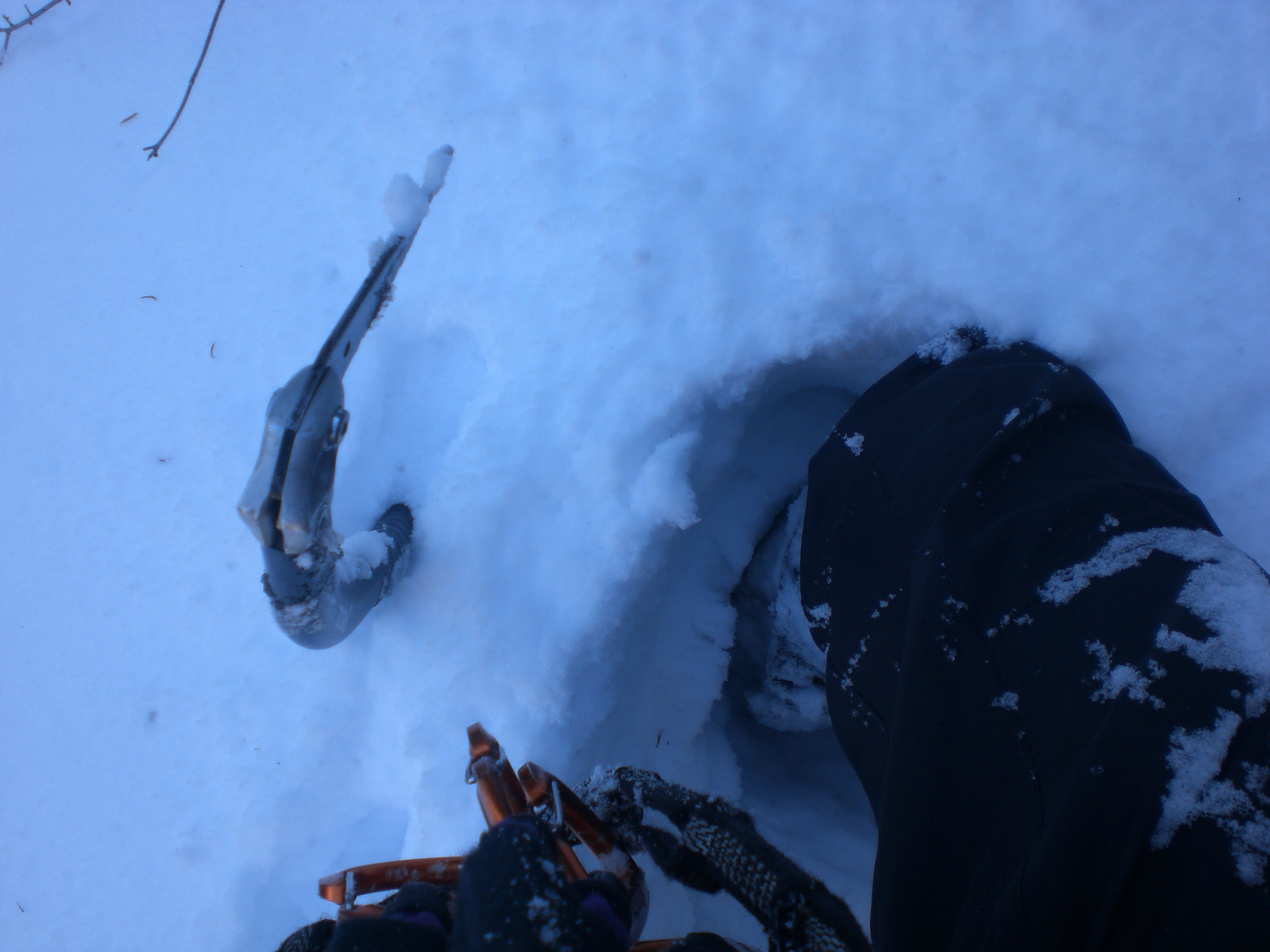
I pulled sideways on the quarter-inch, diagonal edge which provided the only purchase for the picks of my ice tools on the overhang which I was trying to exit. The ice having proven useless, I tried to clear it from the rock and then ratcheted my way up, fishing for an edge to latch onto with my left tool. Before I found one, my right foot popped off the little bump. My knee took up the counter-pressure before the pick of my right tool popped off the rock.

Pleasantly surprised to find myself still attached to the route, I lowered gently back onto the little bump. Ambition drove me up one more time, with predictable results.

“Not gonna happen today,” I said, “I’m coming down.”

CIMG4037

That attempt was my third on the route. We rappelled the three pitches below and descended avalanche debris to the floor of the cirque. As we coiled the ropes, a few tons of wet snow rumbled down a ledge system beside our abandoned line of ascent. We walked back to camp in silence, crawled into the tent and took our boots off.

“Well,” I offered, “we could always go climb at the Tower.”

CIMG4051

Few who climb remember the moment they started. The best most of us can do is to recall a time when we realized that we were climbers, but we were well into it by then. It sprouted as an inspiration regardless of the seed. As we acted on the landscape though, it changed our notions of what we could do and what we wanted to do. Aspiration took over from inspiration.

For most of us, ambition came close behind. Everybody’s had a list or project take possession of them for a stretch. In the worst case, our projects frustrated us, wore us down and made us quit, even if we finished them. In the best case, by the time we achieved our ambitions (or at last abandoned them), they had changed us so that the climbs to which we devoted ourselves no longer seemed so hard or so desirable as the routes we had discovered along the way.

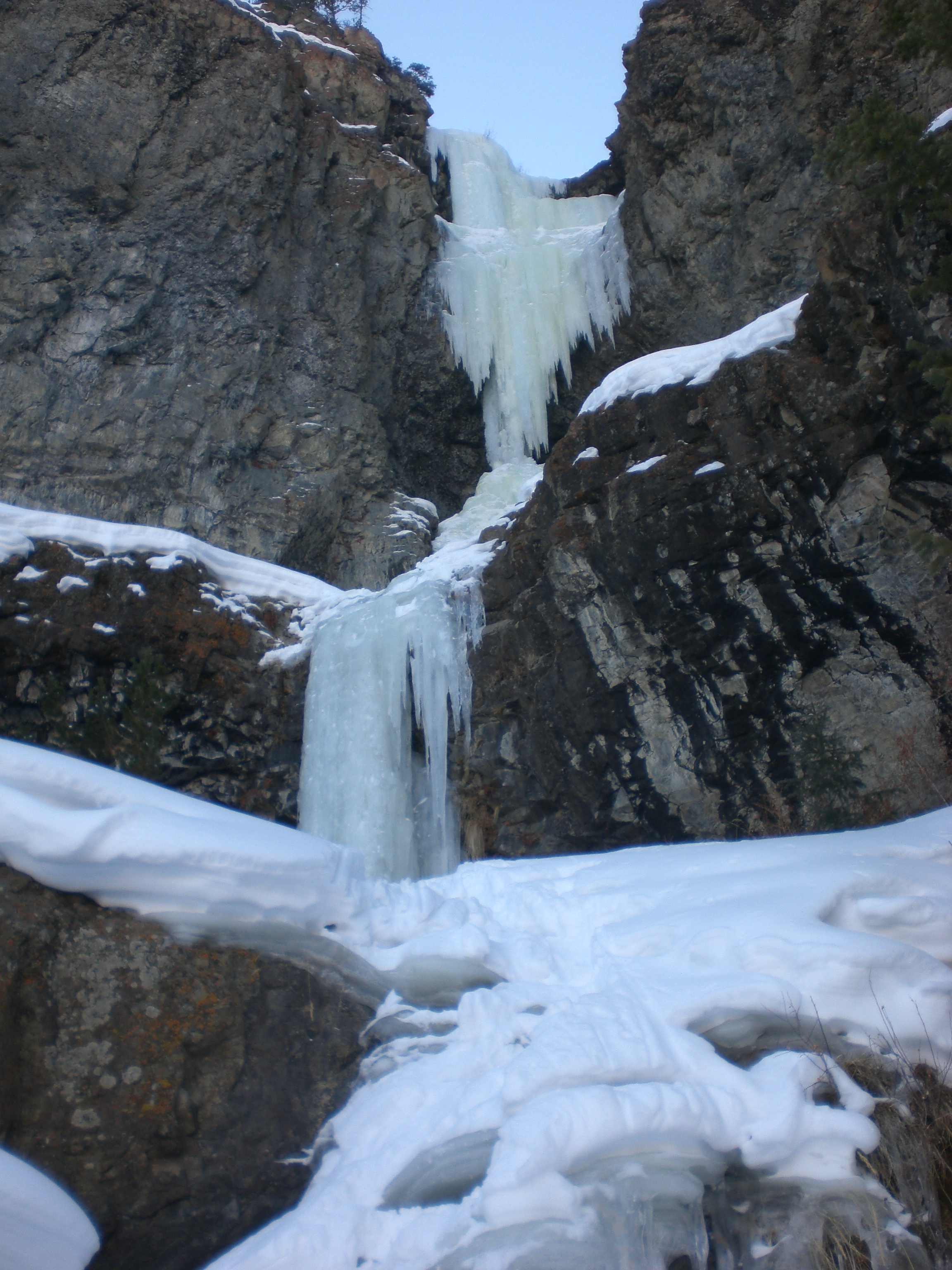
Two Winters ago, an old man began to frequent our local ice climbing crag. He was a person of some renown, with many first ascents to his name in the ranges of North America. But, he had never climbed the waterfalls in the South Fork Valley of the Shoshone. He was training for the Valley’s steep cascades with miles of rolling ice between them, by climbing at the little cave we had nicknamed “forty feet of fun”.

His equipment was antiquated, but he wielded it with an ingrained ability reflecting many years of focused movement over ice and snow.  Still, he was slow and the length of his reach and the height of his steps betrayed the effects of 70 years of mountain travel on joints and tendons. He must have known what he was doing, so he must have known that his chances of getting up any of the climbs in the South Fork were extremely slim.

Finally, I had to ask, “What do you plan to climb in the Valley?”

“I don’t know,” he said, “I’m just going to go and see.”

A puzzled smirk spread over his face as he spoke, and I began to suspect. I’d felt the same expression of bemusement on my own face on occasion, after pulling a hard crux, usually on a “project”, when I couldn’t recall the moves involved or even how hard they felt. Then I would walk around for the rest of the day with the fading suspicion that maybe I didn’t climb it, maybe I fell off and even died, but had lost the capacity to notice in the process. Maybe the old guy felt that way all the time now; I didn’t ask about it or anything else, and I never found out how his trip turned out.

CIMG4031

Back in the tent, both of us stared at the nylon floor for a few moments.

Then my partner lifted his head and replied, “You know, climbing at Devils Tower has been on my list for a long time.”

Tagged , , , , , ,

The All in One

Discussing the existence of a deity is fraught. Everyone on either side of the issue has profound emotional commitments to their position – profound enough, for some people, to merit a violent defense. Setting aside fanaticism, even the reasonable disputant’s motivation to understand the basic issues is weak. But I don’t think that shaky motivation is the primary source of acrimony. Some basic conceptual differences drive the dispute, and the emotional consequences of everyone’s intellectual positions make the dispute nasty. The classical arguments for the existence, or at least the possibility, of a god in the traditional, Western conception illustrate the schisms best. These arguments – the Cosmological, Contingency, and Ontological Arguments – share a basic set of notions, though I think that the Contingency Argument is by far the most important and interesting. Here is a mash-up of the three, courtesy of Jon Duns (and subsequent admirers) :

(1′) Whatever is possible is contingent or necessary.

(2′) A first cause is possible.

(3′) Therefore, a first cause is contingent or necessary

(4′) Any contingent substance is possibly actualized by another substance.

(5′) A first cause is not possibly actualized by another substance.

(6′) Therefore a first cause is not contingent.

(7′) Therefore a first cause is necessary.

I like this. It at once demonstrates the interesting part of the three arguments, especially the Contingency Argument, and the difficulties with their claims and with opposing claims. Stated in this form, the combo-argument gets right to the chewy bits.

Whatever is possible is either contingent or necessary.  This statement says so much. What does it mean to speak of a possible contingent thing? It means one of two things. First, it may be a thing to be considered in logical statements. This means it is a defined entity, a term of art. Our range of defined entities is extremely broad. It ranges from the non-controversial (the color black) to the fantastic (ghosts).  However, logic doesn’t mind. As long as there are rules to tell us where an object of our intention stands among its fellows, logic will apply, and our definitions provide us with those rules in each specific case. Give us the definition and we may say what is logically possible. Second, a contingent thing may be something which we may describe as well as define, in other words, rather than just sketching the rules of its identity we may  speak of it in terms of its composition and its relationship to other things.

When considered in light of the latter, contingent things form a set of entities defined by their dependence. They are dependent on and inseparable from, the conditions which preceded them. They are describable in a positive sense.  They have a composition. But do they also have a nature? Consider that most contingent of objects: the dog. The concept of  “dog” would seem to be a solid citizen of our conceptual society. But if called upon to produce the archetypical dog, can we? Mustn’t we instead depend on a pedigree, physically and metaphysically?

The dog-concept is instead entirely dependent on all the dogs, extant and historical, and in a very particular way. It is, in fact, an epiphenomenon, something which stands in for causally related entities, their appearance rather than their structure. The dog-concept is still real as much as the appearance of someone’s face is real. The dog-concept just doesn’t do anything in and of itself, any more than the appearance of someone’s face itself  “does” anything other than act as an intermediary between the mind of its possessor and the minds of those who perceive it.

At least that is one way to look at things. Another would be to say that there is some magnetic kernel of efficacy at the heart of the dog-concept – that dogness is a foregone conclusion, not just an implication of the circumstances of the universe, and if dogness wasn’t realized by wolf and man, it would have been realized by fox and man, or Tasmanian tiger and man.

These two ways of looking at things hold on a deeper level too, in regards to contingency itself. On the first view, the fact that the things we see derived from other things through time are interdependent must be taken as basic. The adherent to this perspective must say, “I cannot see into that interdependency itself to say whether it is itself the ‘really real’, efficacious thing about the world, whether it is a useful, “close enough” representation of what is ‘really real’ or whether it is an appearance with nothing more certain about its reality than self-consistency. I’m stuck with it. I can’t look at it without referring to it. I believe I’ll live with the uncertainty and move on.”

On the second viewpoint, the appearance of interdependency is due to something – a foregone conclusion which is not possibly an end-product dependent on our seeing it for its identity. This kernel of kernels remains a property; it is inert without associated objects to manifest it. However, the objects do manifest it rather than participating in its active creation. From this perspective, for example, each Chihuahua could be said to manifest “dogness” (sad though their efforts may be) rather than adding to the concept of  “dogness”. Here, by further analogy, the genetics are set and are the real cause of the dog, with metabolic processes and environmental inputs acting as accessories only.

The Contingency Argument could be seen as an explanation of the second viewpoint, but it goes beyond what is necessary for that viewpoint as the argument is used in apologetics. The plain, white rice version argues for a knowable thing. The identity of the non-contingent base relies, at least in part, on its relationship with the contingent things which exemplify it, just as genes are genes only in a biological context. But when the argument is used in support of theism, a hierarchy of dependency is claimed, with the non-contingent thing having the real causal efficacy, and so existential necessity,  in the end. The contingent things don’t dance to a tune or express genetic information, they move to the pull of their strings.  Interdependency is no longer possibly the epistemic basement, a thing-in-itself lurks below. This is a bold claim; bolder, I think, than stopping with a shrug at the top basement. It is even bolder than something like asserting the causal efficacy of dogness. It is bold because a thing with existential necessity must be opaque.

How, in principle might we come to know a necessary thing? How could we induce changes in it to divine its nature? How could it have discernible “parts”?  How could we hope to describe it? Any knowledge of it, even knowledge of its existence, must be as complete and undetermined as it is – given knowledge. This is not to say that such an assertion is necessarily irrational. Given the claim, we can use it in logical statements. In fact, given the claim, we can establish the definition of contingency as the sort of dependency relationship which the second viewpoint above requires, since the first cause, as a thing-in-itself, may not be a billiard ball, or cipher or any other causal entity as we know causal entities. All things we may know as such can be analyzed in some way.

So, if the necessary thing must remain something we propose based on our intuition, are we to believe that whatever is possible is either contingent or necessary? If the necessary thing in question is a logical necessity of a sort after all, rather than an existential necessity alone, would that allow it to be more than a postulate?  On the view of contingency which takes the interdependency of things as basic, logic is descriptive and so doesn’t have anything in particular to say about existential necessity. The situation in which logical necessity and existential necessity are equivalent is the situation in which the description of how we perceive cause and effect relationships is also a precise representation of those relationships. Only in that case can we be reassured that none of the definitions guiding our logical expositions are squirrelly. This leaves us with a particular kind of contingency –   a condition of dependence rather than interdependence, an open system rather than a closed one. But even granting such a viewpoint does not save us from the implications of the thing-in-itself.

Our perception of cause and effect is one of discrete objects interacting at objectively definable points in time. If our perception is the whole truth and nothing but the truth, then we are left with the caricature of determinism laid on naturalist philosophy. History is a network of falling dominoes, each with a discrete, fixed identity and falling across a fixed temporal landscape. “Where did it all start?”, becomes a vital question and the path to a first cause and a thing-in-itself opens up. But by the Cosmological path or the Contingent path the seeker ends up back at the monolith. Examination of the dominoes or the course of their falling can tell us nothing about what started their toppling cascade, whether it was an earthquake, a child’s finger, a gust of wind or a wayward beetle. By empirical inquiry and logical examination, the necessary entity must remain an enigma.

We are left with a mandatory agnosticism regarding the thing-in itself. However, the uncertainty leaves room for one more bold assertion, one about mind. The assertion involved should not be mistaken for the concept of mind in pan-psychism. Mind in the pan-psychist formulation is seen as a basic property, a sort of receptivity which explains the interdependency among objects which we observe, but it remains a property. Mind and consciousness are still “about” something, rather than standing alone as things-in-themselves.

A mind which has an independent identity is something else entirely. It is the object of its own intention independent of any comparators – a condition representing intention itself, which is a condition which can be defined, but cannot be described, except in terms of other indescribable (maximal qualities, self-causation, unmoved movement, etc.) Such a mind isn’t necessarily about anything, which, despite our occasional suspicions about some of our fellow travellers, is not a quality we observe in any mind around us, even our own. One could maintain that we suffer from known limitations on our perspective. Fair enough, but it still leaves us standing back at the monolith, facing an object which defies meaningful examination, though we arrive with an additional postulate.

So, the only reasonable claim to be made about the thing-in-itself is, “I feel it must be thus.” This is the proper jumping-off point for atheism, for an assertion has no more inherent validity than its opposite. A claim to intuitive knowledge is not unreasonable (we can make a logical argument based upon it), but it is an audacious claim. Sound explanations can be made without it, if one is prepared to accept a degree of necessary ignorance. The latter would seem the more cautious view, though it might have the appearance of denial to those convinced of the theist claim.

Either way, the advocate is left with an uncertainty beneath them, which is not a tolerable situation for most. So, people work at feeling  justified in their beliefs. The easiest way of achieving a feeling of justification is by expounding on the obvious lunacy of opposing positions. But that tactic is merely a distraction, and one that isn’t good for anyone’s better understanding; it is just good for relieving psychological discomfort. I’m not saying there isn’t anything worth fighting about in the realm of basic religious and philosophical inquiry, just that the things worth fighting about – dogmatism, self-indulgence, tribalism, coercion – are the things most people end up fighting for when they think or talk about basic beliefs.

Seven

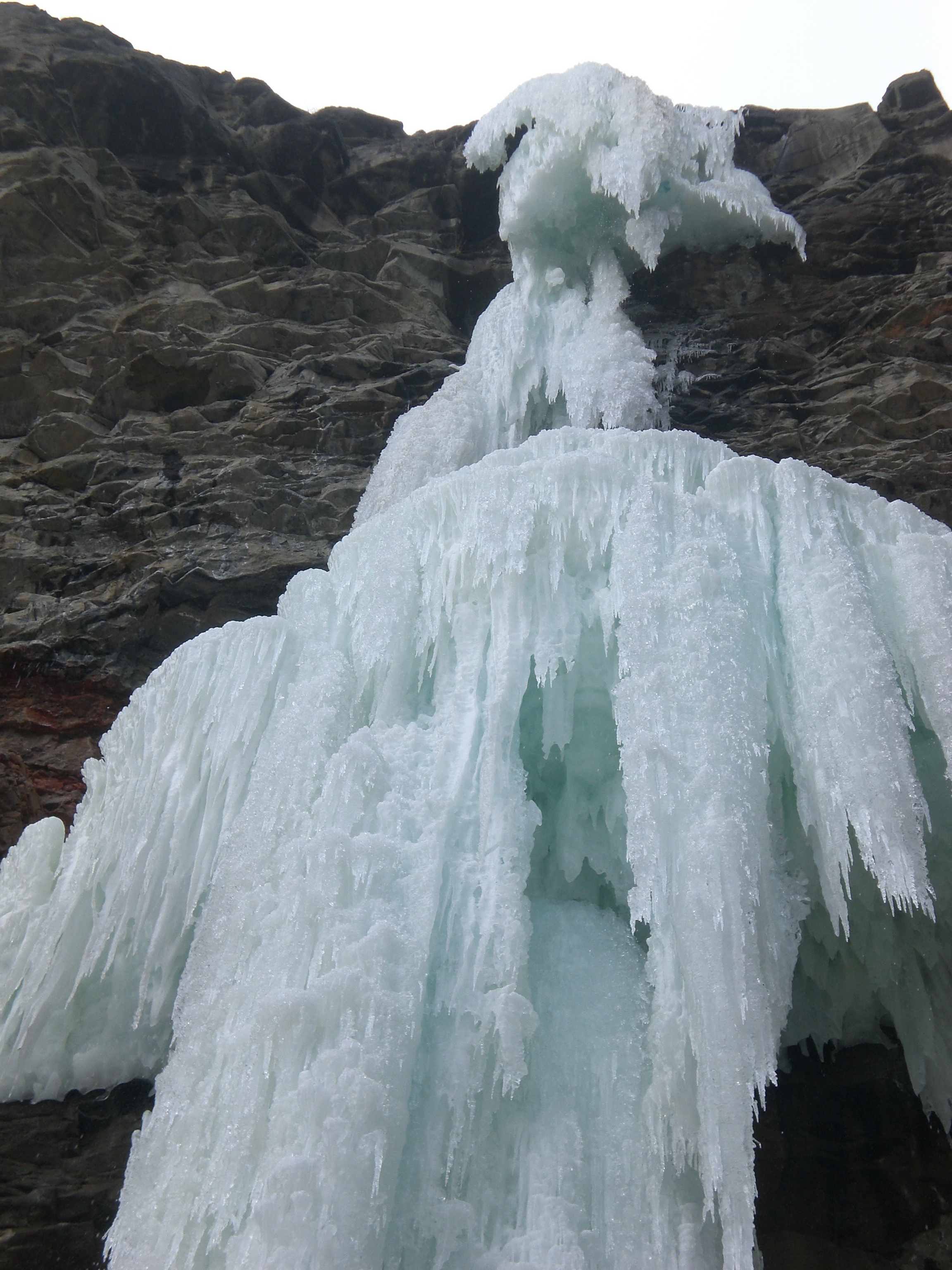
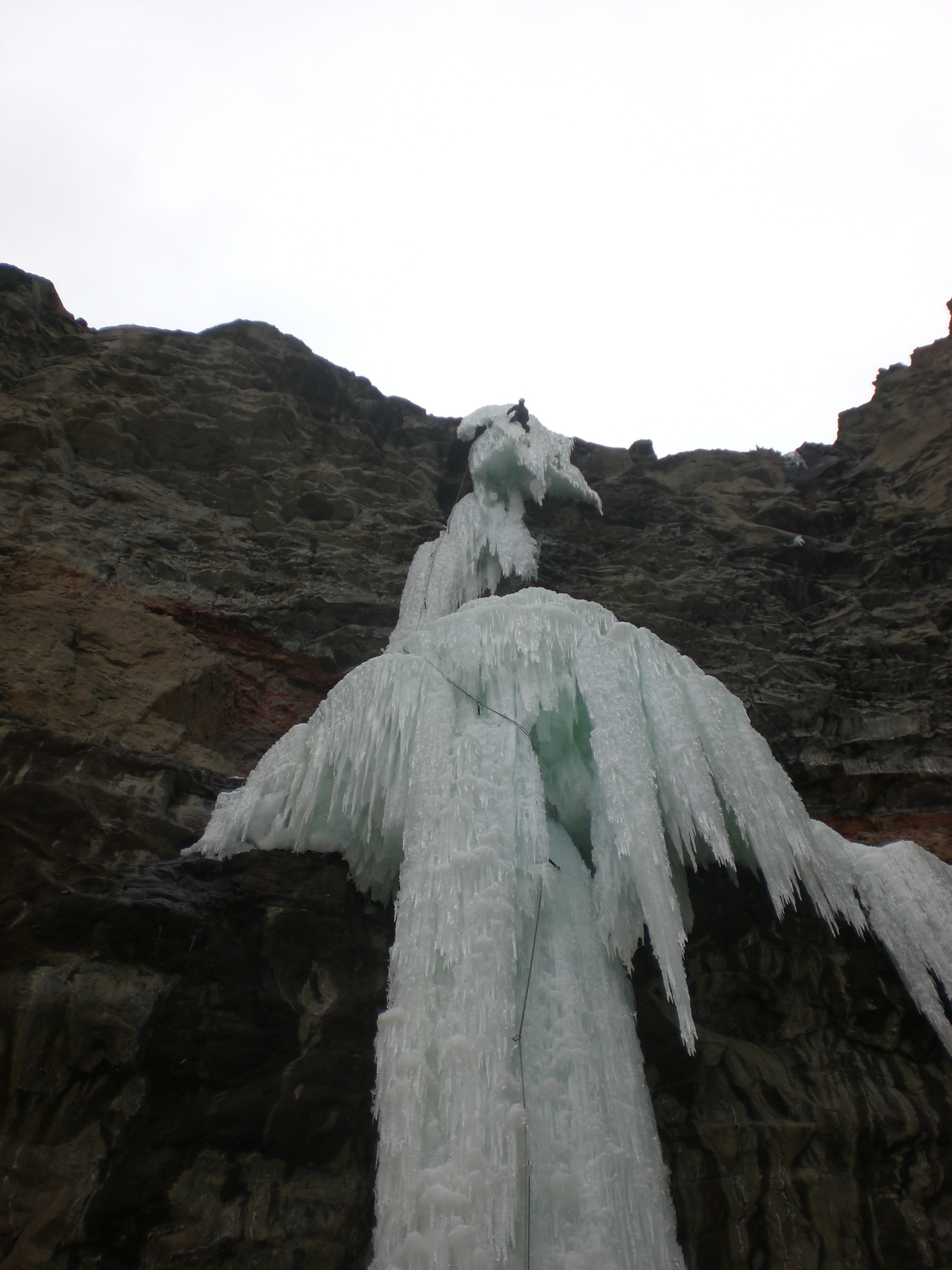
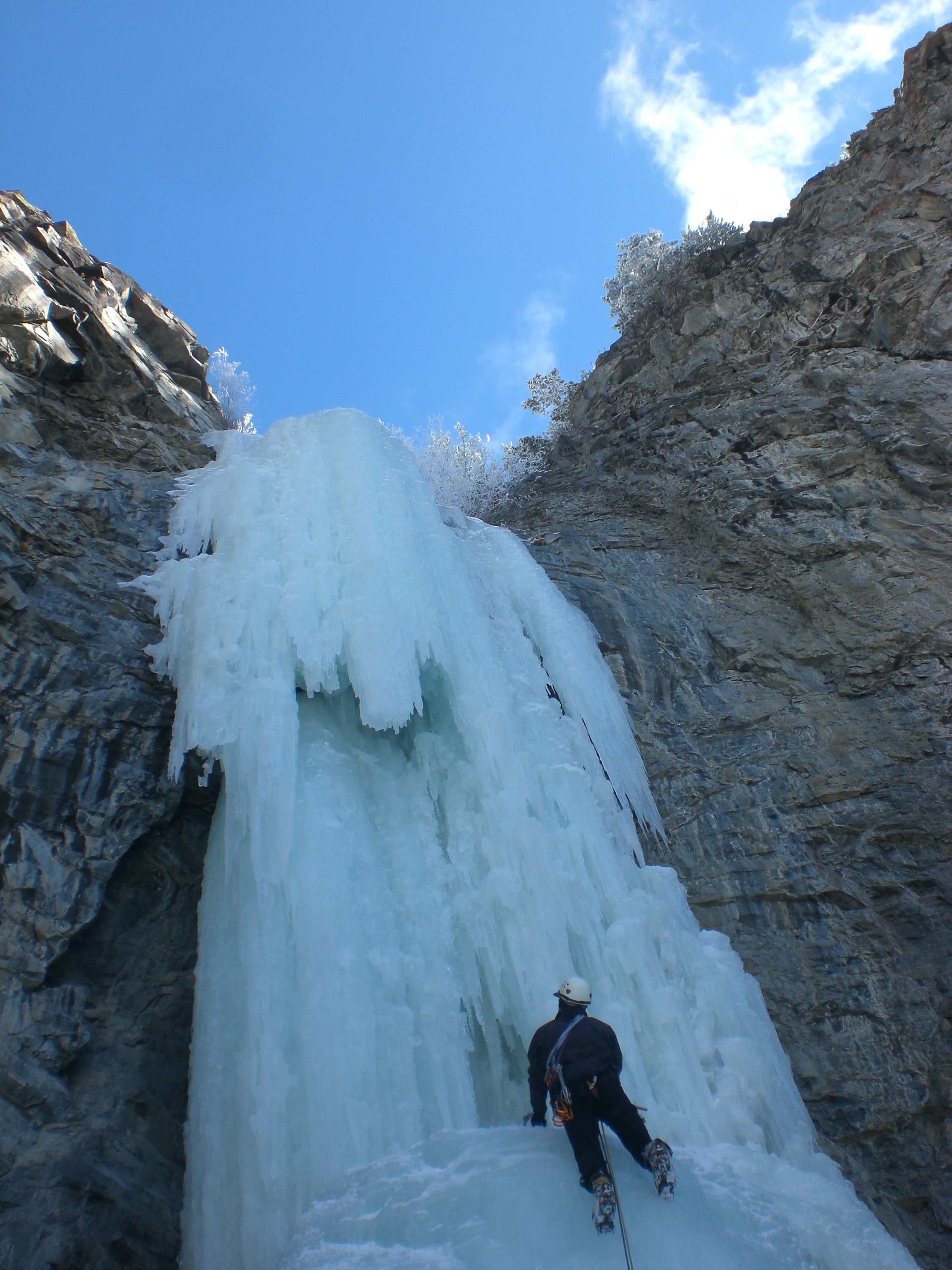
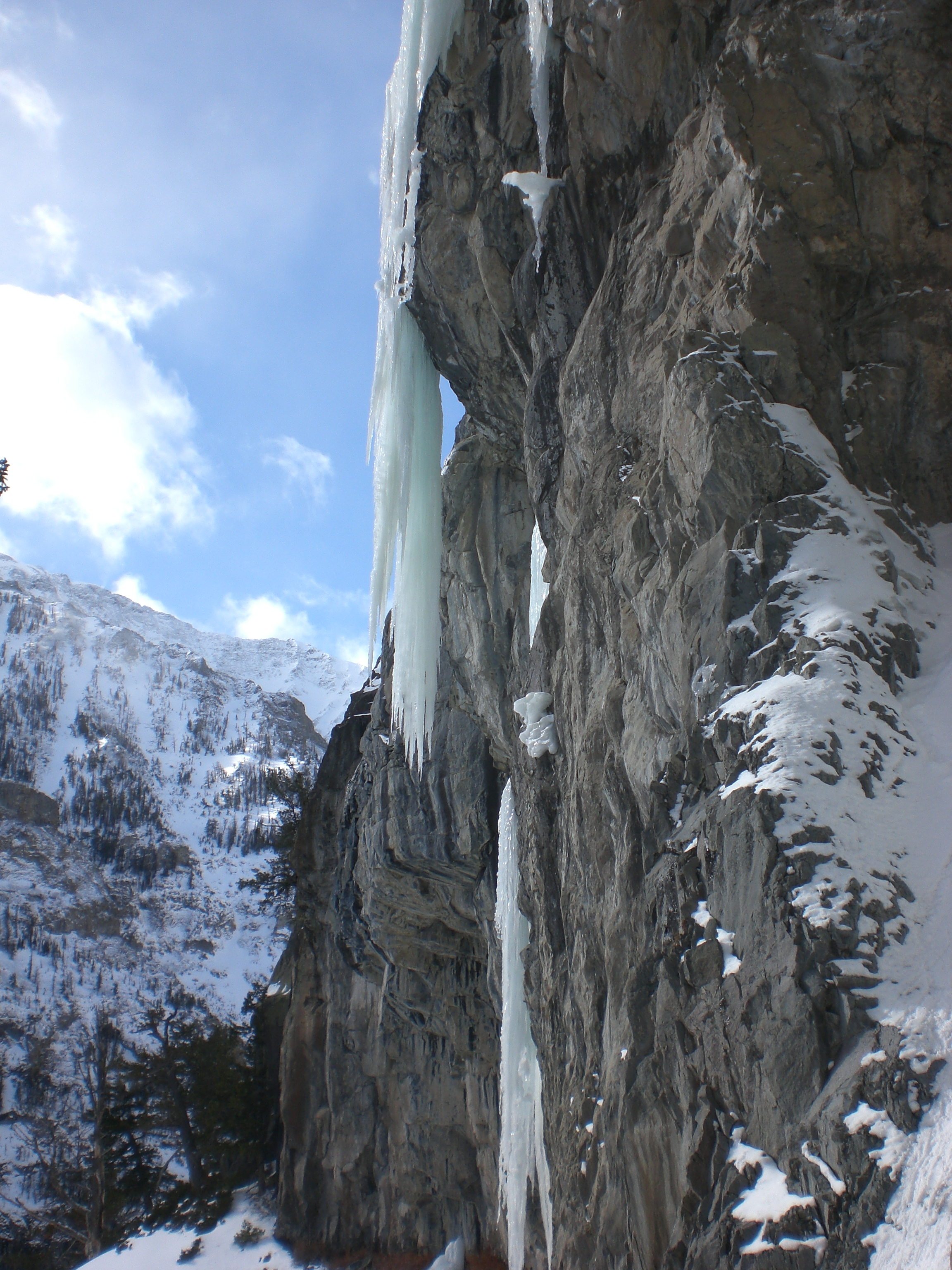
CIMG4015Seven is the number of pitches for Broken Hearts, one of the best climbs in the Southfork valley. The trouble is, those pitches do not often coexist in time. The upper tier of three amphitheaters waits for the Spring to grow its pillars. By then, the sun has eaten away the path up the ice that leads to the show.

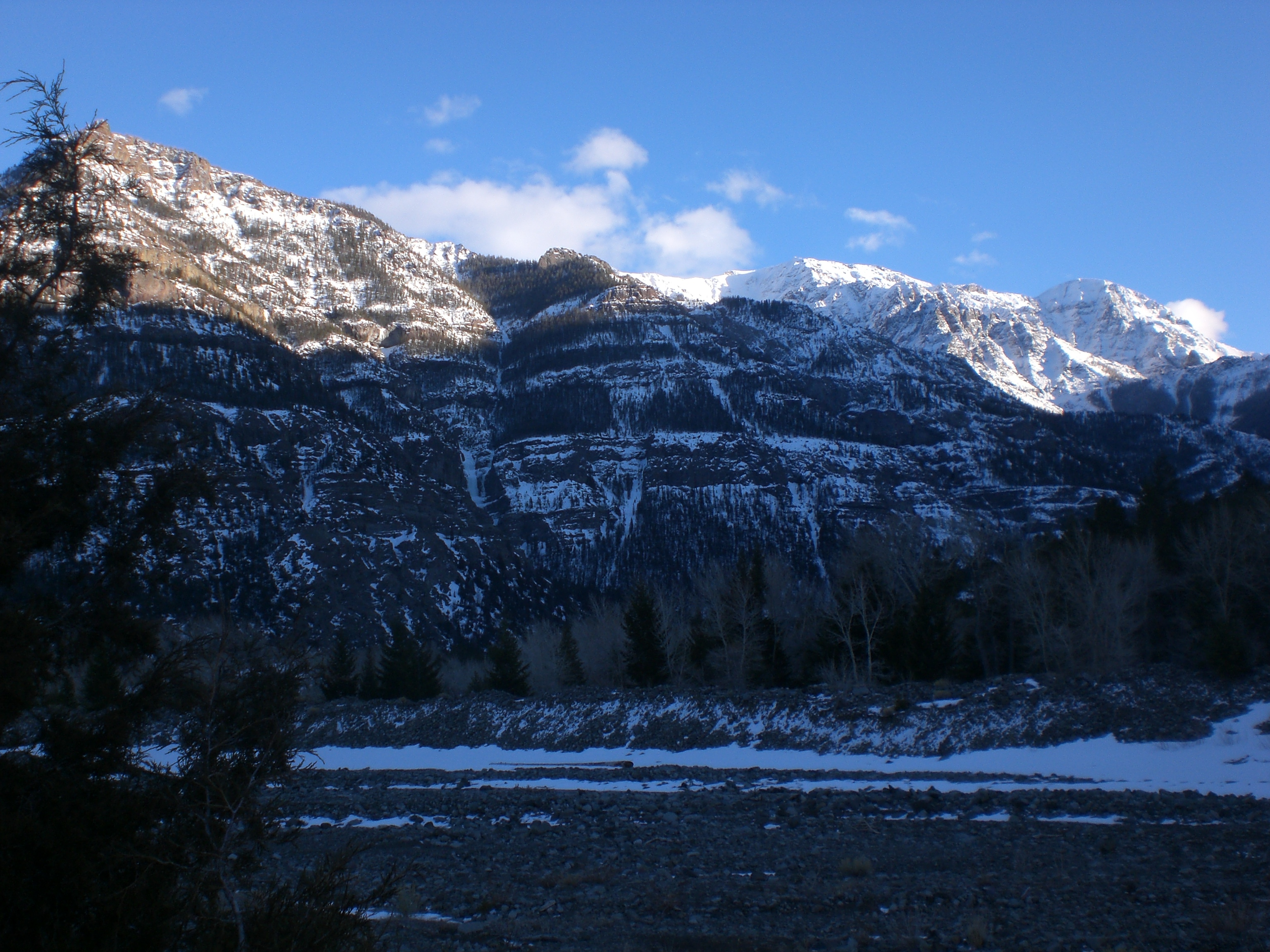
Looking back at the road from the half-way point on the walk up.

Looking back at the road from the half-way point on the walk up.

What a show it is, too. The final three pitches, along with Carotid Artery, are a different story from the lark in the lower drainage. But there is a price. To reach this venue in Springtime, when the lower pitches are missing, one has to walk up the walk-off.

Carotid Artery

Carotid Artery

Walking around on the valley walls in Cody is ill-advised in principle. The slopes are steep, loose and rocky, and it is easy to reach  a precipitous dead-end, resulting in grueling detours and back tracking. The course which skirts the lower canyon of Broken Hearts is better than most.As I plodded the solid hour of uphill however, I found myself making notes for the next time: “Remember, it is that bad, it is that bad, …”.

My Only Valentine

My Only Valentine

In the first of the three bowls, Carotid Artery was not formed. Some new fixed gear adorned the crack behind the hanging dagger, but the ice was too far out from the wall to make a mixed version feasible or safe.

Seventh

Seventh

The rest of the pitches were there, though. We knew from the start that the seventh belonged to Rich. We didn’t need to discuss it. He had been thwarted twice before, having to walk away from the climb due to conditions and time. Conditions were not perfect this time. A massive amount of water poured over the roof at the top. We were prepared for it this time, though.

CIMG4021

Like a character moving over landscape out of a Dr. Seuss book, Rich made his way up the twisting series of steps and columns. He was able to skirt the roof, though the climbing to do so was still past vertical.  As I swore away the barfies at the top, water dribbled from the velcro cuffs of my current hand-wear. I found myself making notes again: “Remember, gloves with gauntlets next time.”

Lap 2 on Pillar of Pain the next day

Lap 2 on Pillar of Pain the next day

By the end of it all we were wet, cold, miserable and exhausted. We would be the same way at the end of the day tomorrow. Ice climbing is just freaky like that, and if you aren’t too, you probably won’t keep doing it. I will. I found myself making more notes on the trudge back down: “Remember, it was worth it…”

The upper valley

The upper valley

Tagged , , ,

It’s an Ice Fest Every Time

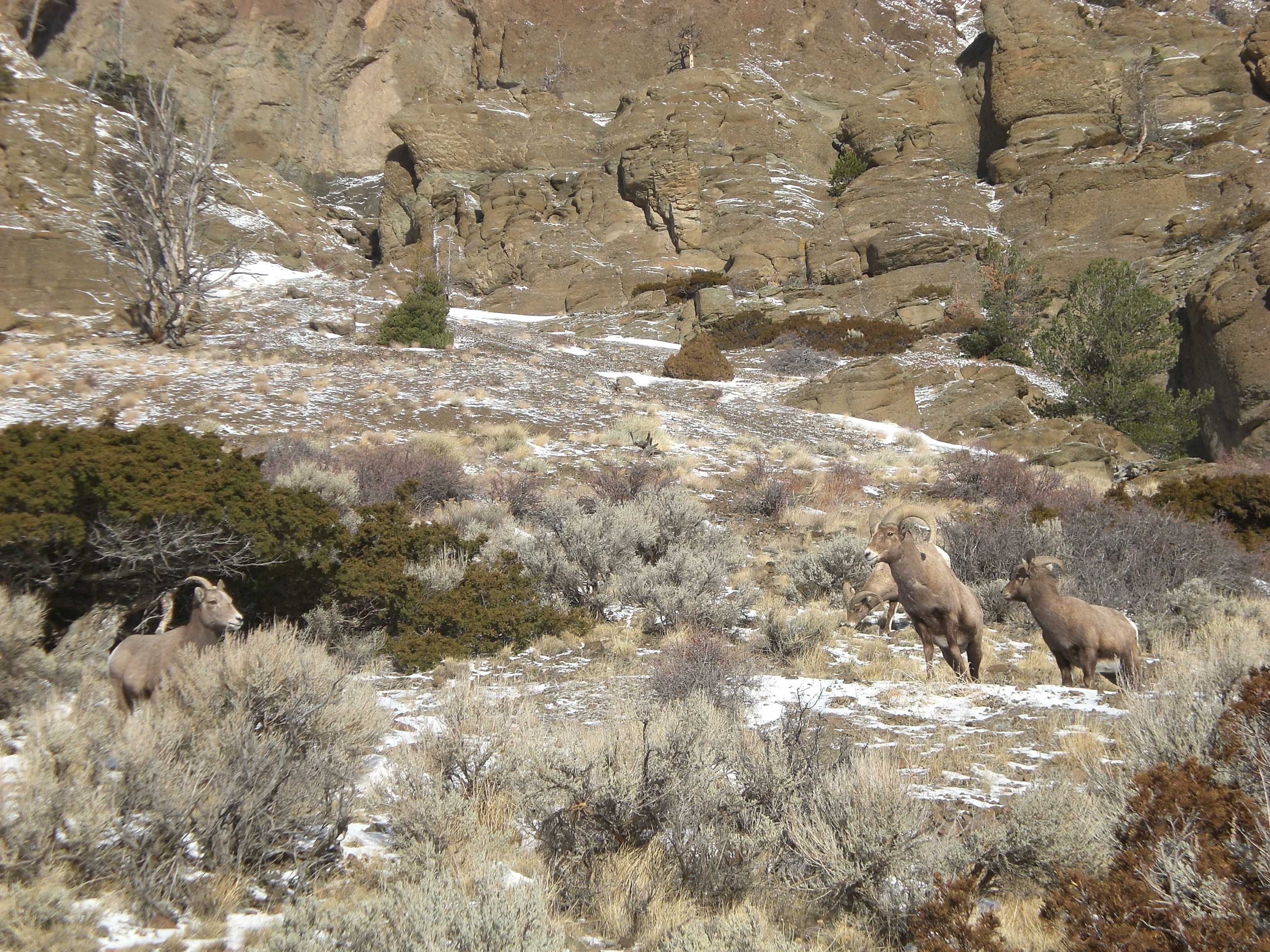
Sheep on Deer Creek

Sheep on Deer Creek

Rich made that comment while we discussed the merits of driving to downtown Cody to visit the Southfork Ice Fest. It would have been nice to see Aaron’s slide show, but we were kind of tired.

My kingdom for a Bosch! Mixed potential left of Bitch's Brew

My kingdom for a Bosch! Mixed potential left of Bitch’s Brew

Regarding the source of our amotivational state, Rich summarized as only he can, “Someday we’re going to bite off more than we can chew.”

Pitch 2, Bitch's Brew

Pitch 2, Bitch’s Brew

We always seem to end up in Cody on the Ice Fest weekend, but we never make it to the event itself. I think our efforts to dodge the “crowds” (this is the one weekend where you can expect to see other people during your day out on a route) sabotage us. We end up going to things like Illogicicle that are harder to access and farther back.

Steep ice on Who's Your Daddy

Steep ice on Who’s Your Daddy

This time it was Bitch’s Brew and Who’s Your Daddy. Bitch’s Brew is just across from Smooth Emerald Milkshake a couple of miles up, and I do mean up Deer Creek trail. The latter climb is a relatively popular moderate, so we figured some ambitious festivants would be breaking trail for us. We were wrong.

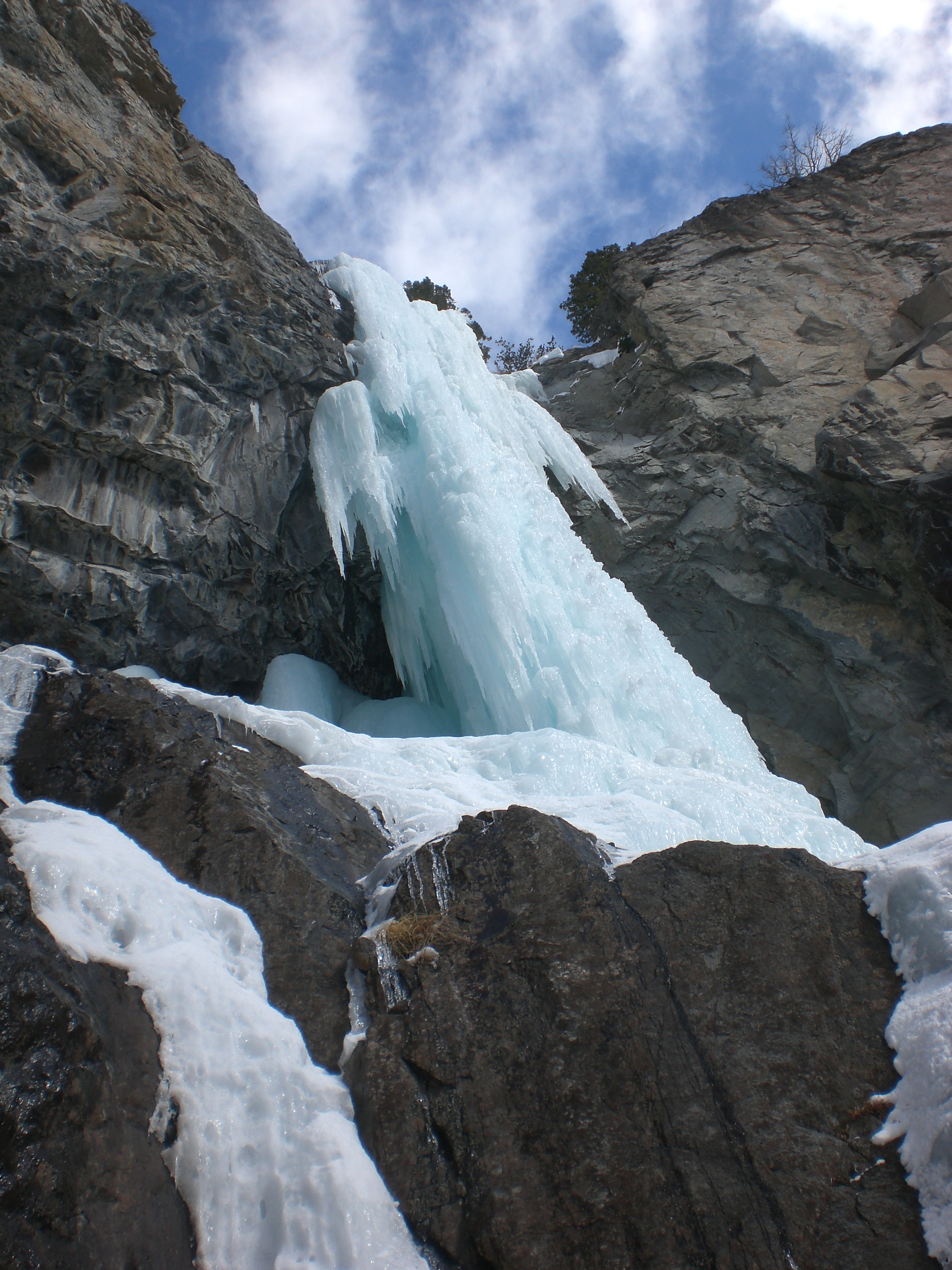
Fortunately, we only had a few pristine drifts to break through. The climb was worth it, as usual: one WI 4 , 65 meter pitch, followed by a pitch of wind-sculpted WI 5+, a short pitch of WI 5, and some grade 3 possibilities above. Did I mention it is in the nice warm sun all day?

CIMG4006

Who’s Your Daddy is the alternative to the first pitch of Ovisight. The approach was mercifully in good shape. The Legg Creek pitch was too. Where the whole drainage pours through a 2 foot wide slot, there was a solid, 6 inch wide strip of through the last 20 feet of climbing (it even allowed a good stubby ice screw). The trip up the last, left side-drainage was a slog.

3rd pitch

3rd pitch

The two, steep steps to solo combined with the thigh-deep snow burned up a good chunk of daylight. The three upper pitches delivered however, especially the third, which had an overhanging section in the middle. Here’s to good dental health.

Tagged , , ,