Category Archives: psychology

Creation…

…demands a creator. A creator is instrumental. In other words, a creator draws upon what exists to produce novelty. This state of affairs is true even if the creator engages in rote copy-work.

There is an ‘if’ hidden in all creation – otherwise, the created must simply remain the extant. Creation necessarily occurs in context.

So, do theologians really mean to call their gods creators? Maybe they mean something else, or maybe they  mean to achieve something other than explanation in attributing creative powers to their gods.

Tagged

More

IMG_1050

Damn, why won’t the rope move? Instinctively, I blame the belayer. Instinctively, but also because I know him as the kid who has a D in English because he’s bored with English and so doesn’t try to do well in English. He has already told me that he’s bored with belaying today.

I yell down, “Slack!”

“There is slack!” comes the answer.

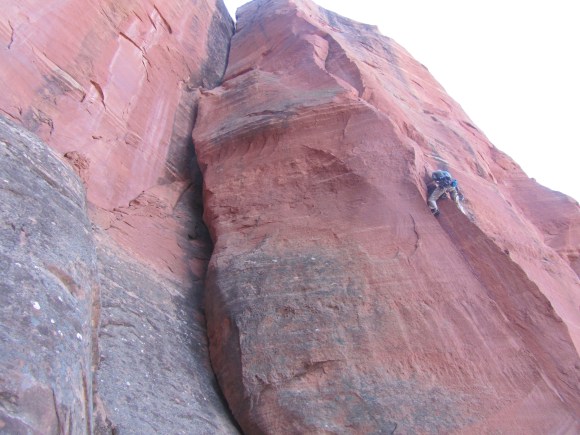
IMG_1053

Uh-oh. I pull on the rope again, and flip the cord hard a couple of times, all to no avail.

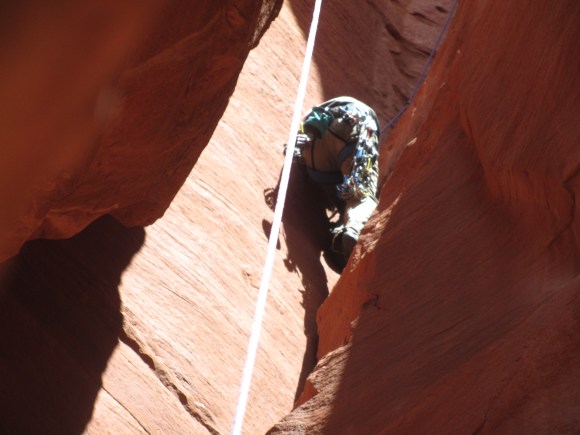
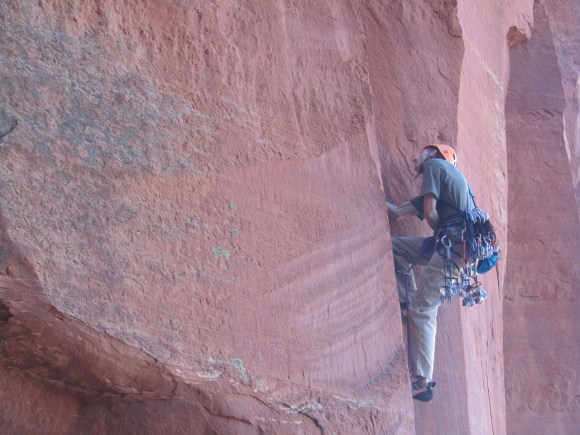
The hell if I’m going to spoil the clean lead. I place a pair of cams and clip in without weighting them. I tie a clove in the rope through a carabiner  clipped to my belay loop, and then I carefully climb back down, past one piece, to the little roof. There, I find the source of the problem.

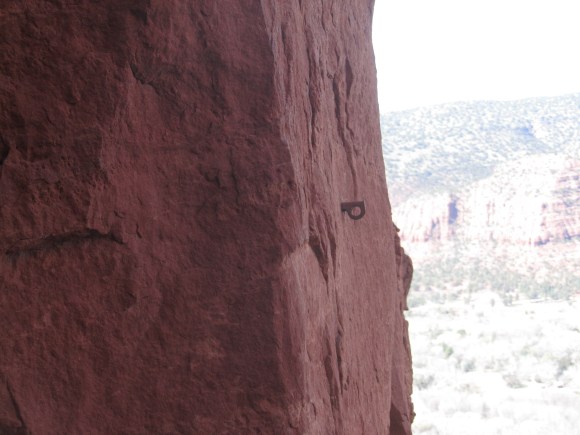
It’s a splitter problem, and one I’ve never encountered before. As I moved above the roof, the rope slipped into the crack and behind the cam I’d placed at the lip. With some tension coming from the GriGri, the rope had pushed the cam farther into the narrowing crack and gotten itself stuck behind the gradually closing, upper lobe of the cam.

At this point I must note, that the tension from the GriGri is not the older boy’s fault. The last thing I say to him before I leave the ground is, “No Euro-loops.”

IMG_1059

God help him; he listens to me. I am subsequently tugging on the rope all the time. Until this moment, it has seemed harmless, or even helpful, as resistance training.

Now, to free up the rope, I really should lower myself below the roof, not stand at the lip, where I am. But, that would mean hanging on the anchors.

Instead, I reach down below my feet and commence to jiggling. I’ll admit, I am still learning how to place  clean cams in sandstone. I have a tendency to over-cam them a little, and a little is all it takes to makes the device’s hold on the soft, grippy rock, tenacious.

The hold for my left hand is good, but I’m stretched out completely and off-balance, so my feet offer little more than moral support. The clock begins to tick. I can feel my fingers start to slide off their sandy perch. But I can also feel the cam shifting slightly, so I keep fighting the losing battle: re-adjust, slip a little faster, re-adjust, etc.

Just before I melt off the hold completely, the cam gives. I can turn it upside down and retract the lobes. I step up and settle into the jams above the roof for a rest.

Once I catch my breath, I trudge back up to the anchor and tie in to the end of the rope once more.

“Back on,” I yell, and as an afterthought, “This still counts!”

IMG_1060

There is no response from the belay. It’s OK; that’s why the GriGri and the parent/child relationship were invented. Both allow us to learn sympathy for ridiculous people.

IMG_1099

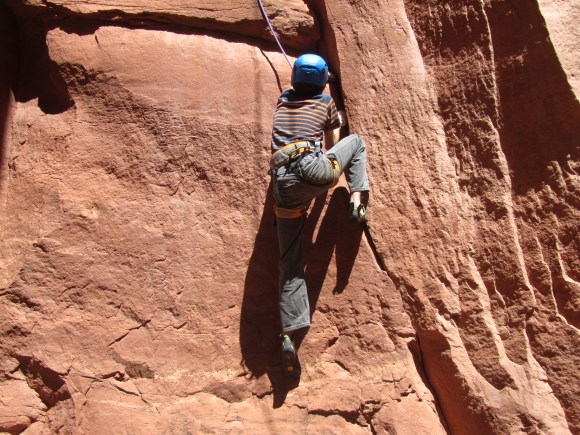
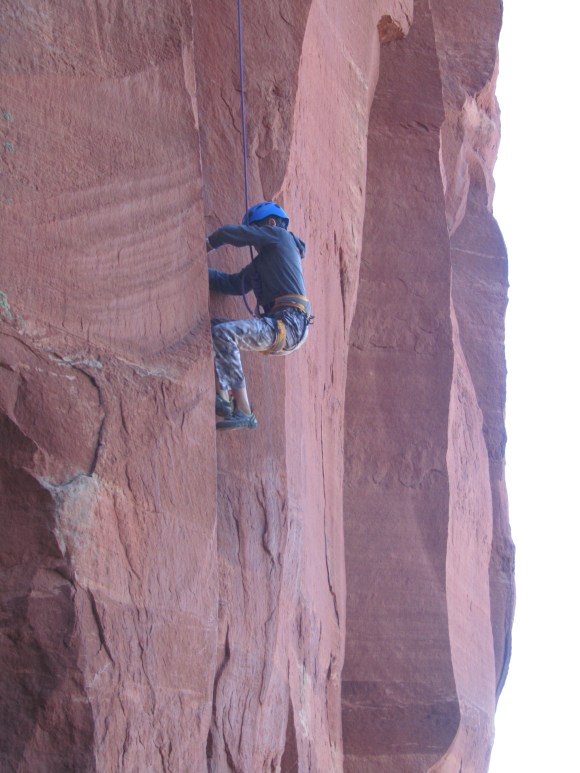
A second crux awaits just before the anchors. I don’t pass it quite as gracefully, now that I’m tired, but it goes. I can’t convince the kids to follow the route. They offer the excuse that they are too tired from climbing Andy Kauffman Crack.

IMG_1090

I don’t believe them for a second, but at least they indulge me (and vice versa). If that’s all they get from the experience, it’s enough.


IMG_1054

They did come back to climb Rusty Cage. The pair of climbs – Rusty Cage and Andy Kauffman Crack – are on the back side of North Mesa. Just walk up the Cathedral
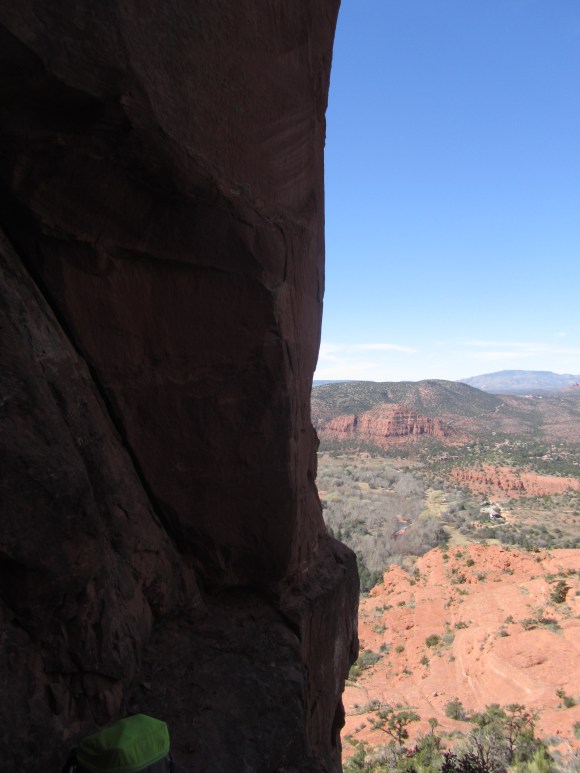
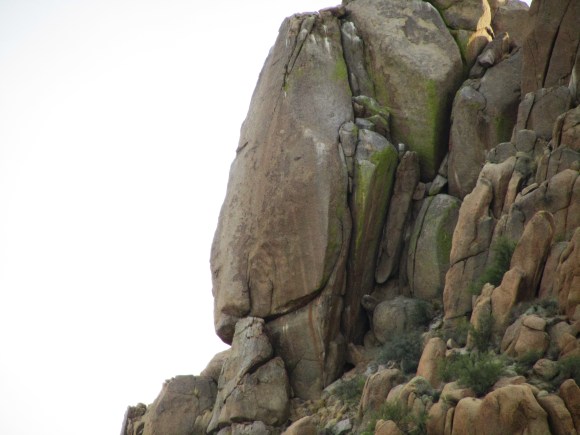
Rocks trail off Back O’ Beyond road. Where the trail passes a little cliff band on the right, keep going on a right branch instead of continuing up and left with the hikers who are headed for a saddle between the two major sets of formations which constitute the Cathedral Rocks. Keep walking all the way around the corner at the far end of the North Mesa. When it looks like you are about to come to the end of the road, look uphill to the left. You will see a shady grotto formed by a pair of towers nestled close against the main formation. You will recognize Rusty Cage as the clean splitter on the right. Andy Kauffman Crack is hidden on the left.

Rusty Cage is .10 c and takes a red tricam, a # 2 Camalot, and then  as many or as few # 3 Camalots as you feel comfortable placing. Six of them keep you looking at no more than a 20-footer at any time.

Andy Kauffman is a corner and then a roof. It is well protected, but takes a # 5 Camalot or a bit of alpine run-out skill in the section just before the roof. Multiples of 1’s, 2’s and 3’s help if you are getting used to sandstone .10 a.

IMG_1127

Tagged , ,

The Most Ridiculous Thing

What’s in a meaning? Something instrumental, and therefore fit to the circumstance of its usage, that’s what. Does that make meanings powerless, because they can be acquired and need interpretation? Not at all.

Take brand logos …

BMW_logo

In a magazine ad., the symbol above is meant to represent sporty sedans from Bavaria.

On the streets of Scottsdale, it says, “I might be a dick.”

mercedes benz 151 logo

In the showroom this symbol indicates a luxury German car.

On the streets of Scottsdale, it means, “I am a dick”.

Land-Rover-Symbol.tiff

Again, parked in the dealer’s lot, this logo stands for British all-terrain vehicles.

On the road in Scottsdale: “I have devoted my life to proving that there are worse things than being a dick.”

All of the above meanings carry plenty of weight. They are all circumstantial, too. People have no worries about that state of affairs, until they begin to talk about the meaning of our existence.

But, does talk about existence itself having meaning, make any sense? Is existence in itself, for something? For example, would it make sense to say that God’s existence, or a hydrogen atom’s, carries an independent meaning?

It is an absurdity. It simply does not apply.

Tagged , ,

Weaponized

There is an interesting post here about jargon. It explores one of the useful aspects of jargon, and as a consumer – indeed a purveyor – of jargon in the medical field, I completely agree. Technical terms give us simple clarity, and simple clarity is one of the most useful things around.

The post focuses on the utility of jargon within its natural environs – dialog between professionals, where it is quite useful as shorthand. As an example from my world, when I say ‘appendicitis’ to someone in the medical field, a fairly specific array of physiologic and anatomic processes comes to mind, along with their likely manifestations, consequences, implications for diagnostic testing and treatment, associated research studies, etc.

The conversation can move right along. Plus by way of its scope, the use of technical terms can serve as a check point in the dialog. If there is a malapropism, it is apparent.

When a colleague says, “The negative ultrasound ruled out appendicitis..”, the conversation must stop. We must clarify why he thinks that the ultrasound ruled out appendicitis, because it is commonly accepted that ultrasound does not, in and of itself, rule out appendicitis. The term ‘appendicitis’ as jargon, contains the understanding of its diagnostic criteria for those in the know.

The situation is different when a patient says, “I think I have appendicitis.”

Typically, the lay person who makes that statement knows little to nothing about appendicitis. The word refers to little if any of the content it carries when I mention it to a surgeon. However, the same process flows from its use, or rather misuse.

The lay person’s usage brings up the question, “Why do you think that you have appendicitis?”

In other words, technical terms provide some solid surfaces in an otherwise squishy conversational world. If we can’t alight upon them, then at least we may bounce off of them in some direction, rather than landing splat in misunderstanding or mere conflict.

The common complaint that jargon is obfuscation doesn’t hold up when we consider the honest usage of technical terms, even outside of their professional environment. There is, however, a dishonest way of deploying jargon.

The current poster-child for such corrupted terminology is ‘mindfulness’. In its original sense, the word referred to a non-reflective state. The idea was: your mind stays fully engaged with what is happening in its scope of awareness, without reaction or abstraction. It was the kind of thing which dart players, test-takers and athletes sought.

Now, though it still gets used to mean engagement with the present, it may also stand for a state of detached self-awareness, in which one is monitoring and regulating one’s responses to one’s present situation. Clearly, the latter meaning is at odds with the former, if only because the latter refers to an essentially reflective activity.  Dishonest users of the term shift back and forth between the meanings depending on the goals of the user’s discourse. If the occasion is a corporate retreat aimed at promoting harmony in the workplace, the second meaning is used. If the speaker wishes to convince the listener that chronic back pain does not require morphine if one simply ceases to reflect upon said pain, then the first meaning of mindfulness is implied.

Clearly, the sort of shenanigans at work when people bat around ‘mindfulness’ are what give jargon a bad name. Mindfulness started out its career innocently enough, as something which Zen practitioners and coaches discussed. But along the way, it picked something up. As something useful, it came to possess an air of desirability. As something desirable, it acquired the reputation of being something good, and then, of being good in itself.

Once imbued with moral character, the technical meaning of mindfulness, along with all associated contents relating to its use, became subsidiary. Being mindful became less important than being a mindful person, and when a moral role presents itself, it is open for definition. The corporate lecturer can tell us what a mindful person does at work. The pain specialist can tell us how a mindful patient takes medicine. The roles make the meaning henceforth.

The situation seems at least a minor victory for the moral expressivists – those who claim that our moral claims are not claims at all but expressions of sentiments like approval and disapproval. It would be a victory too, if the abusers of technical terms were actually making moral statements. But they are not.

When people utilize a bit of jargon with moral character, they are using it as a means to an end. They are weaponizing it. The listener doesn’t receive a sentimental expression from the speaker; the listener is invited to fill in the sentiment. The audience at the corporate retreat must make the connection: a weekly post on the suggestion board means I am mindful, which means I am good. That line of thinking isn’t really moral reasoning; it is a facilitated rationalization.

Jargon as a technical tool is not the problem. Yet, we are right to be wary of jargon. Its use should put us on the lookout for manipulation. But we should not be afraid to use it either.  We must just take care to use it mindfully, by which I mean being critically aware of one’s attitude toward the current subject, which was once known as being an adult. Oops…

Tagged , , , ,

Here’s the Deal…

…a guy, a-friend-of-a-friend, calls you out of the blue with an offer. He has a formula, deciphered from an ancient Daoist text, which yields an elixir granting immortality. It does so by transforming the imbiber from a creature bound by vulnerable flesh, to one which is pure, unencumbered mind.

The trouble is, he needs someone to try it out. Not because he thinks it might fail or be harmful, he says, but because when it goes to market, he needs to tell his consumers what to expect of the process. His liability carrier demands it.

“Hah,” you think, “What a dope. He hasn’t considered that he will quickly become the only remaining mortal, if this catches on. He’ll be standing there with his buckets of cash and nothing worth buying. Well, the hell if I’m going to be standing there beside him, or risk being trampled in the preceding stampede. I’m getting in on the ground floor!”

So, you take the elixir.

You quickly begin to feel lighter. Your body becomes transparent and then invisible, as you fade to immaterial. You drift with the wind initially, but as your body loses mass, you become immobile. You lose all proprioception – the sense of where you are in space, up and down, heavy and light, tired and energetic.

But, so what? Those phenomena are of no use anymore. If you like, you can remember them. The elixir has granted that as a side effect, if it were not inherently possible. Likewise, your sight – or something like it – has been preserved.

Yet, it is just not the same. It is hard to learn. You thought the novelty had worn off life long ago, but your current position takes ennui to a new level. Phenomena promenade across your consciousness. Your experiences still have a quality to them, but it is a quality marked mostly by where the experiences occur in time.

You realize that you can no longer change the aspectual shape* of an experience. Well, you can a little bit, in your mind. You have always done that, by projecting your expectations onto the world.

However, if a table whizzes by you with the earth’s rotation, you can’t go see the name scratched on its leaf, or associate the scratched name with the oblongness of the particular table.

Soon enough, you stop paying attention to the tables whizzing by. That’s OK; they have become difficult to distinguish from the contents of your memory anyhow.

The potion has begun to fulfill its promise now. Without the tick of a beating heart or the suprachiasmatic metronome, phemomenal time ceases. One experience brings to mind the next in kaleidoscopic procession, like a visual illusion shifting from one interpretation to the other based on reference to the proper associations.

Who knows how long you have lingered on one experience? Who cares? You still have your identity. You remain he who saw a table with something scratched upon it, having consumed a sketchy, friend-of-a-friend’s elixir, and having lost the property of inertia (?). You have kept the good, basic, relevant (to a mind) parts of having a body.

It isn’t over, though.  Presently, you begin to lose track of the phenomenal contents of your experience.

Just as experience formed an amalgam with memory, so does the phenomenon meld with and yield to the qualitative experience which it elicits. This transformation, however, is asymmetrical.

The experience of grass brings to mind grass-green, which raises the feeling of greenness in turn. Here is where all is lost. There is no aspectual shape to greenness. It borrows that from the particular phenomenon which referred it to you. The dirty secret is, so do love and justice and all those other  ethereal concepts which you considered privileged property of the mind.

You may feel like you feel Love in the abstract, but it refers to something. ‘Something’ necessarily stands in relation to you (if only to where you are floating at the moment). Cut the abstraction away from the anchoring intention, and it disperses.

Without the prism of their referents to lend them color, the qualities of your experiences are a diffuse, white light – psychically undifferentiated and ineffectual.

The feeling of greenness calls to mind nothing as it stands alone – and neither do you. You have come to the end of consciousness, the end of embodiment, and the end of yourself.

Back in the world, a sketchy friend-of-a-friend packs up and heads home, disappointed.

“Maybe,” he mutters to himself, “next time.”


* Aspectual shape means the certain way something looks to you. For instance, how a pole looks long when you stand it on end, and round when you lay it on the ground. In terms of experience, it means that, even if you could turn into a bat for a moment, you still couldn’t know what it’s like to be a bat. Your experience would  necessarily be of what it is like for you to be a bat, not of what it is like for a bat to be a bat

Tagged , , , , , ,

The Time Has Come

IMG_1083

The oldest child will begin to lead. I’ll admit, I’m a little nervous. Leading is for real, or at least a little more for real than following on a toprope. Still, the transition to leading is as much a shift in psychological reality as it is in physical reality.

You lose control of the short fall, but gain some control over the big one. Tying in to a rope through someone else’s anchor never feels quite the same after you start leading. It is better and worse at once, since you know how many ways their set-up could be defective, and you commit to trust it nonetheless.

I don’t want him to fall. I sure don’t want him to get hurt. I suppose I could turn around and tell him to hoard his life. He wouldn’t abide the dysfunction that goes along with hoarding, though. Ambition turned toward more and more security for its own sake. Money to buy security. Prayers to beg security. Saturdays at work and Sundays listening to some chump explaining how nice it would be to live forever, and how penis-mechanics somehow preoccupy the Almighty. He knows better than all that; he’s watched the swifts.

IMG_1084

Trying to be attractive? Pretty sure they know shit about attractive.

White-bellied swifts fly around our crags. I have seen them fly through a crack narrower than their wingspan and reverse course almost within their own body-length. They happen to feed on bugs loitering around the cliffs. What they do, however, is fly. The bugs are incidental.

Once you see that arrangement of motivations and necessities, you can’t see it back the other way. So, I don’t think I could stop him from leading, even if I really wanted to.

IMG_1085

It’s OK. I can live with the nervousness. It is an incidental. It will get its due and no more.


Tagged , ,

Let’s Do a Thought Crime

One more time, plus a  little more…

On a cold morning, a little girl named Suzy is waiting for the School Bus at the bottom of a steep hill. It was raining the night before, and water has been flowing next to the curb. The water froze in the early hours of the morning, forming a sheet of black ice. The ice sheet extends all the way down to Suzy, and unfortunately for her, passes under the tires of a Cadillac Coupe DeVille parked in the middle of the hill. As the sun hits the hill, the ice loses its grip on the tires and the car slides silently and rapidly down the hill, striking Suzy and killing her instantly.

Now suppose the same chain of events ensues, except this time, the car breaks loose just as the cars owner, Andy, sits down in the driver’s seat and closes the door. The inside door handle is broken, so he can’t just jump back out again. The power windows are up and the horn doesn’t work, so he has no way to warn Suzy of her impending doom. He desperately turns the wheel, but it’s too slick for the tires to grab. Suzy dies just as in scenario #1.
Again, suppose the circumstances are the same, but this time, the owner of the car is different. Let’s call him Brian. When Brian realizes that he is sliding out of control, he thinks, “You know, I’ve always hated that little bitch anyway,” and he turns the wheel to direct the car toward little Suzy. Again, the tires have no purchase on the ice and the chain of events is unaltered.

Is there a moral distinction in the incident between the unoccupied car and the occupied car?

Between the incident with Andy and the incident with Brian?

If so, where is the independent and objective moral fact in each case?

Imagine that none of this actually happened, but that Andy and Brian each dreamed the same dream, in which they behaved as they behaved. Each wakes with a sense of satisfaction about his own behavior in the dream, and goes on to live an impeccable life thereafter, never harming a fly. Is there still a moral distinction to be drawn between the two men?

When we speak of morality, are we describing a fact with inherent causal efficacy – like a runaway Coupe DeVille – or are we describing an attitude (or the formation of an attitude)?

Tagged ,

Dreams in the Witch House

Though it is not one of H.P. Lovecraft’s best stories, Dreams in the Witch House is one of his creepiest. The creep factor mostly emanates from the witch’s  familiar, Brown Jenkin. Jenkin is an intermediary from the netherworld, enticing the unwary to enter. A rat/human hybrid, Jenkin eventually dispatches the protagonist by emerging from the wall (which is actually a partition between alternate planes of existence as well as one between indoors and outdoors) and chewing through the man’s body while he sleeps.
Tunneling through a person in his sleep is chilling enough, but what makes Jenkin really creepy is what it represents: shadowy possibilities which gnaw away at us to our demise.

H. P. was a big believer in the old aphorism, “curiosity killed the cat”, (I’m sure he pictured the inquisitive animal sniffing too close to a questing tentacle). He was leery of natural philosophy run amok, based on what happened to the fabled cat. Science, he felt, risked exposing our dearly held beliefs as a mere façade, laid over an alien, chaotic, deeper reality. H. P. was a little odd, but he has never been alone in his fear of hidden truth – or in his attraction to it.

The fear of a hidden truth appears to drive quite a bit of discussion surrounding the philosophy of mind. The fear manifests in varieties dependent upon the school of thought involved. For some positions, the fear of hidden truth appears to be their primary impetus.

Modern-day substance dualists, for instance, fear scientific implications of an explanatory mechanism for activities which tradition ascribes to the soul. The idea that intentionality or qualitative experience may be dependent upon coarse, material goings-on horrifies them. Their revulsion is compelling enough to make arguments from incredulity seem plausible.

“How,” they ask, “can a thing be ‘about’ something?”

Yet, when one fires an arrow at a target, the arrow flies at the target. Something compels it to do so, rather than allowing it to appear suddenly on the moon. Likewise, it remains an arrow, which is a big part of why it flies at the target. The archer attending to the arrow’s flight maintains her identity and has determined her course as well. Even when she visualizes her shot before releasing the bowstring, her intention derives from the same set of considerations determining the shot, albeit in a roundabout way. Maybe she is just importing her perspective on the shot all long and it’s all happening in her (and everyone else’s) head, but that doesn’t matter. The outcome is the same, whether it is the mental substance or the physical substance which is reduced. Reduction is what the substance dualist really fears.

Monists are not so different. They have faced up to the implications of natural philosophy, yet they still fear the loss of mental causation in their schema. The feared outcome of reducing our mental activities to their base, physical mechanisms has been described most eloquently as a “Ghost in the Machine” scenario. In that case, our  consciousness is the ghost,  a mere byproduct with the mistaken impression that it is in charge of things while it is really  looking on impotently as all the little neurons in our brains respond to various stimuli.

The troublesome issue at work is ‘downward causation’. When the archer releases her arrow, do we think that her will causes the arrow to fly toward the target, or do we think that it is the action of her muscles, muscle fibers, the chemical bonds in the arms of the bow, and on down the line? Natural philosophy tells us that the little things add up to the big ones, in terms of how the arrow does what it does. The limbs of the bow springing back into shape do not cause the chemical bonds to behave as they do; it’s the other way around.

We readily accept that state of affairs when it comes to bows and arrows. But if brains and minds bear a similar relationship to their base constituents, then willing the arrow to fly fares no better than the bow’s springing back – it is caused by what’s going on in the neuronal circuitry rather than causing anything itself. The alternative to accepting this arrangement for brains and minds is to make a special exception for mental activities.

Yet it seems impossible to do so without undermining natural philosophy. We may wish to do so, to save mental activities as causes, but it is hard to see how we could avoid hypocrisy. We would still use our knowledge of chemical bonds to build better bows and devise more effective anti-depressants. We would still act as if the bottom-up story were true.

On the other hand, if we accept the bottom-up story for ourselves, what is the point in asking all these questions in the first place? The repercussion of our conclusion is that we are onlookers, like spectators at a sporting event whose critique of the game is utterly ineffectual. It’s hard to see how such knowledge means anything. Just as we risk hypocrisy if we veer away from natural philosophy when it comes to mind, we equally risk hypocrisy by accepting bottom-up explanations when it comes to mental phenomena – we will continue to behave as if our experiences, intentions and motivations make things happen. What to do?

Richard Feynman gave us a clue to the answer.

“If you think you understand quantum mechanics,” he said, “you don’t understand quantum mechanics.”

Quantum fields are not phenomena with which we are familiar, nor can they be. They may not even be ‘really real’. They may simply be the hooks upon which we hang our descriptions of broad regularities in the world of the very small. Furthermore, it doesn’t matter whether the entities to which quantum mechanics refers are real or not. The theory predicts the regularities of the Lilliputian realm – it works.

The thing is, do any of our theories, right down to everyday descriptions, bear a different sort of relationship to their subject matter? When Ernest Rutherford said, “All science is either physics or stamp collecting,” he meant that physics told the basic, really real story of what was going on in the world. Chemistry simplified physics and summarized the really real story of the microscopic world on a convenient level, and so on for biology, geology, meteorology, etc. But his analysis flips the relationship between the disciplines. If we say that Osmium is a metal which conducts electricity and heat at a certain efficiency, has a certain density, reacts with other elements with a certain propensity, then we need ‘bridge laws’ – extra rules – to relate those chemical properties to their associated quantum mechanical phenomena.

The upshot is, only once we have found the Osmium can we find the particular arrangement of quarks, electrons, up-spins and down-spins without which there is no Osmium.

It is easy to turn around and say, “Oh, that’s just what Osmium is.”

But without Osmium and it’s chemical properties, where is our basic-physics explanation? The phenomena explained by the higher level theory permit an explanation in the lower level theory.

And isn’t that how we know about Osmium itself? It is something which responds to our poking and prodding with fire, pushes, and shocks with an elemental predictability. Once we have an atomic explanation for Osmium, we can use a mass spectrometer to find it more reliably, but our target is still the Osmium, not its counter-factual-supporting constituents.

This world of theoretical explanation is terribly confusing. It is confusing because theoretical explanations are not what we normally consider explanations at all. Theories are useful, but they are not true as we wish them to be true – precisely and thoroughly.

We expect our explanations to be more genealogical. Confronted with a piece of Osmium, we can’t be satisfied with atomic weight and number. Those qualities do not explain this piece of Osmium. Rather, we must know how (and so why) the Osmium is in this lump, now, in this place. Break it down to the sub-parts, the quarks, if you will, but the structure of the story does not change.

Where does that leave the Ghost? Where does that leave the mental substance? The Ghost haunts neurobiology, not a reductive explanation. We think our neurons and their activities are our own. We feel comfortable with the idea that we are not exactly the same person if one of the little guys stops working or grows a new dendrite in the course of learning about the atomic number of Osmium. We are comfortable with the change because it occurs within a historical framework, and that framework lends us a persistent identity.

The mental substance seems doomed to participate in some kind of reductive explanation as well. It’s hard to see how it pertains to us, personally, if it does not. If it does participate, then we can call it a substance, but not a separate one. If there are spirits and ectoplasm, then they are located in the same historical framework as the lump of Osmium, its electrons, its quarks, etc. and make their mark, at least upon our consciousness, within that framework.

There are no hidden truths, then. There isn’t some subtext where it all breaks down, as H.P feared. Or if there is, we can never find it.



Tagged , , , , , , ,

What Do You Really Fear?

If God has an explanation, how does It remain God? If God has no explanation, then why all the fuss?

Tagged , ,

Worried About That Gag and Dog Collar in Your Closet? Let Me Show You Something…


IMG_1030

As I was shopping for knee-pads, I realized: I might have a problem. It was clear that I had developed an unhealthy appetite and here I was, about to feed it. The pads would allow me to wear lighter clothing and so carry on climbing wide cracks into the heat of Summer.

IMG_1031

I fondled one of the expensive pads. It was real leather and neoprene. Clearly, the expensive pad was superior, but it would get destroyed just as fast as the cheap ones. My poor technique limited the pad’s lifetime, sure. However, the nature of my needs did too.


Because, there is a beautiful variety of wide-crack climbing. I refer to the art practiced by people like Luebben, Scarpelli, Randall, Jackson, etc., involving maneuvers like Levittaion, the Kick-Through, and the Hand/Fist Stack. The technique involves only limited insertion of the practitioner’s anatomy into the gap in the rock during any one maneuver. The movement is improbable, powerful and gymnastic.

IMG_1033

Someday…

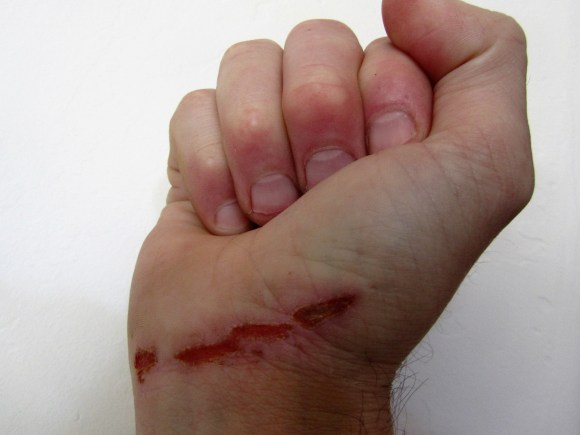
I am incapable of such feats, and furthermore, they are not what I want. I’ll admit, I am after something to fill the hole left by separation from (relatively) easy access to ice. I want a fight. Just like some people cannot feel loved until they have had their bottom spanked, I am only truly happy with climbing when I have done something unlovely, daunting, and bloody.

It isn’t that I don’t enjoy a technical or purely physical challenge, it’s just that I want the stuff just beyond. I want to have to hold it together and be stopped, if I am stopped, by the total exhaustion of everything at my disposal.

IMG_1032

The kind of wide crack that delivers for me, does not abide expensive knee pads. It is too abusive. You have to climb into it, and the whole trip resembles nothing more than an edentulous dog trying to chew up a bone. It is not pretty. Perhaps it is even obscene. I just can’t help it, though.


Tagged , ,