Bite Me

People have traditionally followed two divergent paths to righteousness, a hard and heavy path and a soft and squishy path. I mean old testament versus new testament, duty versus faith, Catholicism versus snake-handling. Most religions contain both these elements and maintain them by cognitive dissonance. Blessed are they who try to reconcile the paths. The task is impossible and it only ever turns out one way. Many, many examples of the inevitable outcome exist, from the Sufis, to the Chan, to the Kabbalists.

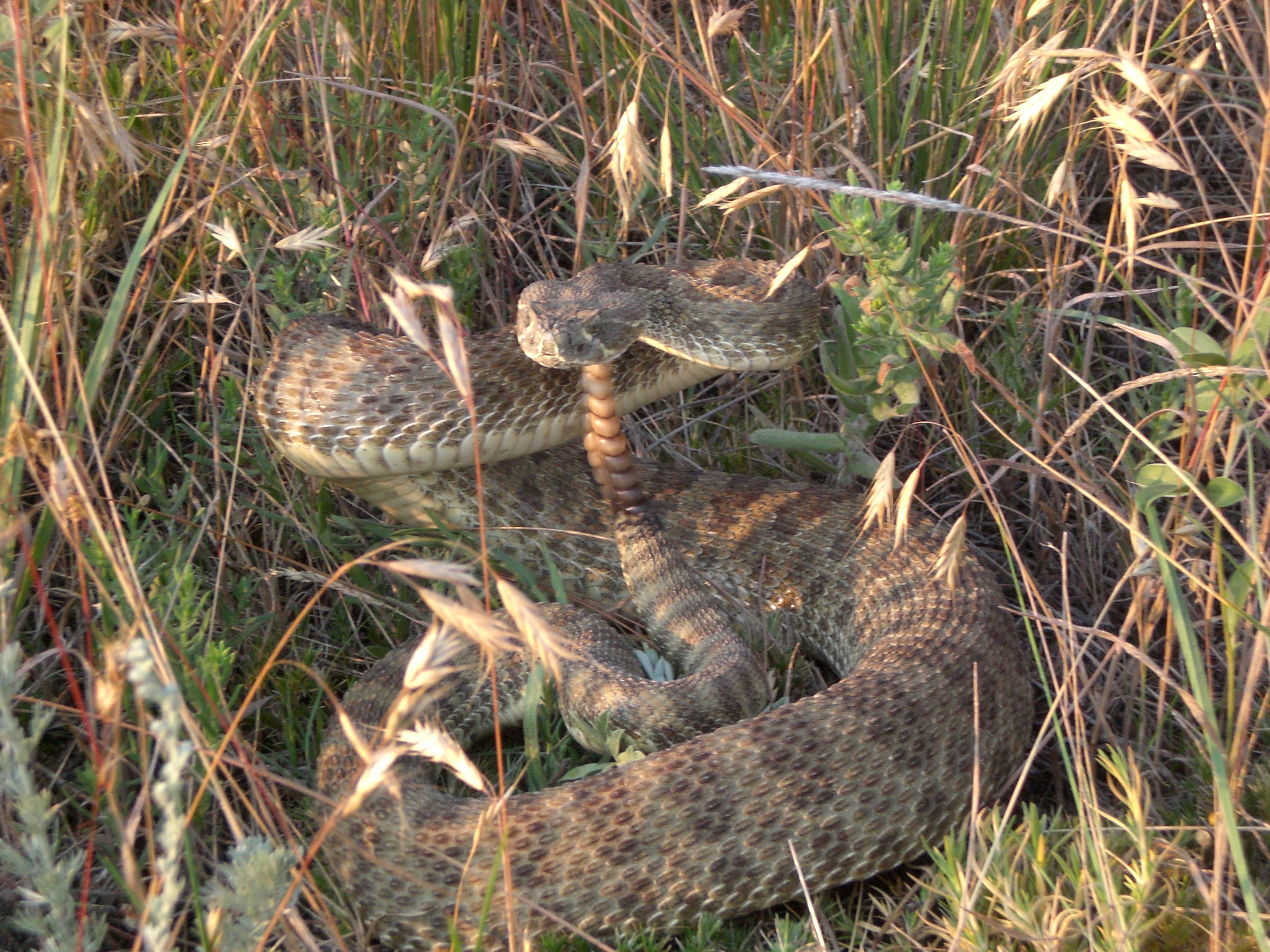
The relevant lot from the Christian tradition are the snake-handlers and they are the best lot of them all. Math, meditation and music do have the power to transform, but a handful of rattlesnakes is clarity itself. Like all sects that get involved in changing how members are as well as what they do, the snake-handling churches subscribe to conventional scriptural authority. Most are even literalists, and quite austere literalists at that. In typical fundamentalists, literalism makes for a dull theology, fearful and full of contradictions. For the snake-handlers however, the rules and regulations, just like the snakes, are guides to align a person’s trajectory. The target is a right way of being, not just a right way of doing. The Holy Spirit subsumes scriptural dictates. The soft and squishy way absorbs the hard and heavy one. This arrangement of the spiritual food chain is necessary, because the hard and heavy way is not real and it must go under. The ought isn’t.

Ask for a definition of Good. A clever theologian will say it is like a primary color – something we can know, but not describe. A less clever theologian will tell you it is what one is told to do. The guy on the bar stool next to you will say it is what he wants. Good is a stick. It can point. It can start a fire. It can crack a skull. Good is all of those things that the theologians and the drinker wish it to be, because moral good is an error of language. Good begins as what we want, then we want things of others, then we need to tell others how to give us what we want. We start using “good” in the first case and carry on through, watching the word transform itself from a mundane descriptor to an ethereal being.

The truth is, “good” remains a descriptor all along and as we boost it to higher and higher levels of discourse, it is the concomitant release of dopamine that makes it radiant. Used in a sentence and pursued through right actions, good’s charge is grounded, contradictions multiply, and the glow dissipates. What’s left for us is a handful of rattlesnakes, which is preferable.

Though an ‘ought’ reconciles the act with scripture, no ‘ought’ drives a believer to pick up a snake or drink poison. He is determined to do those things by his faith. His faith is made of his history, recorded in his genes by forgotten generations of ancestors and accumulated over the moments of his life. In devotion to his faith by acts, he becomes concordant with the truth of that history: he is not a discrete entity. Sounds awful squishy, but that’s what we are, squishy globs of history on a very squishy path. No wonder we like to think solid entities like good and evil might exist to make a channel for us. We must live with our inherent imprecision, though. As messy as it may be, it is still less messy than pursuing an error.

Tagged , ,

Needles Break

The thunder’s rolling now, but the weather was glorious at the Needle’s Eye this afternoon. It’s been beautiful in the Needles all Spring.

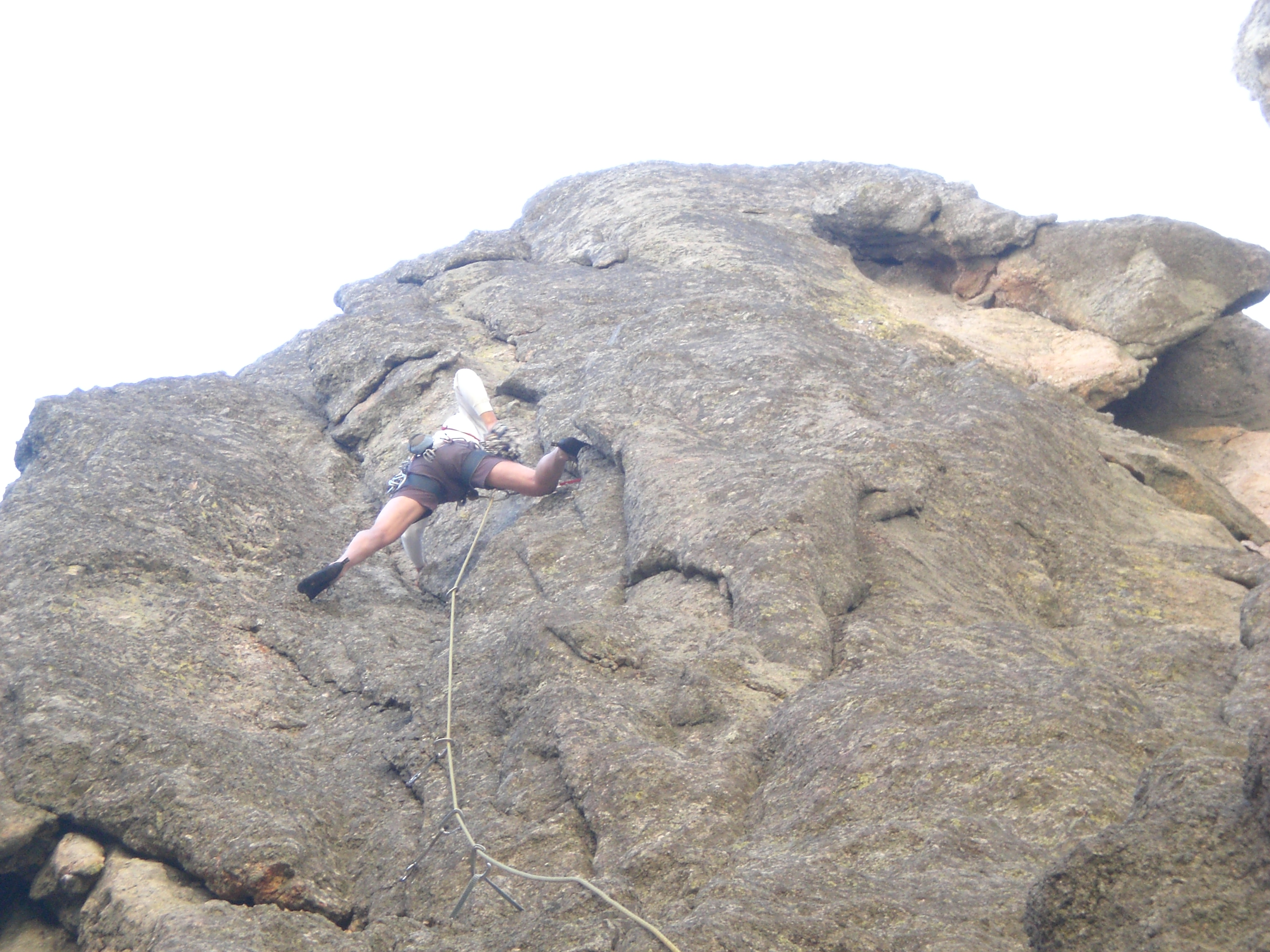
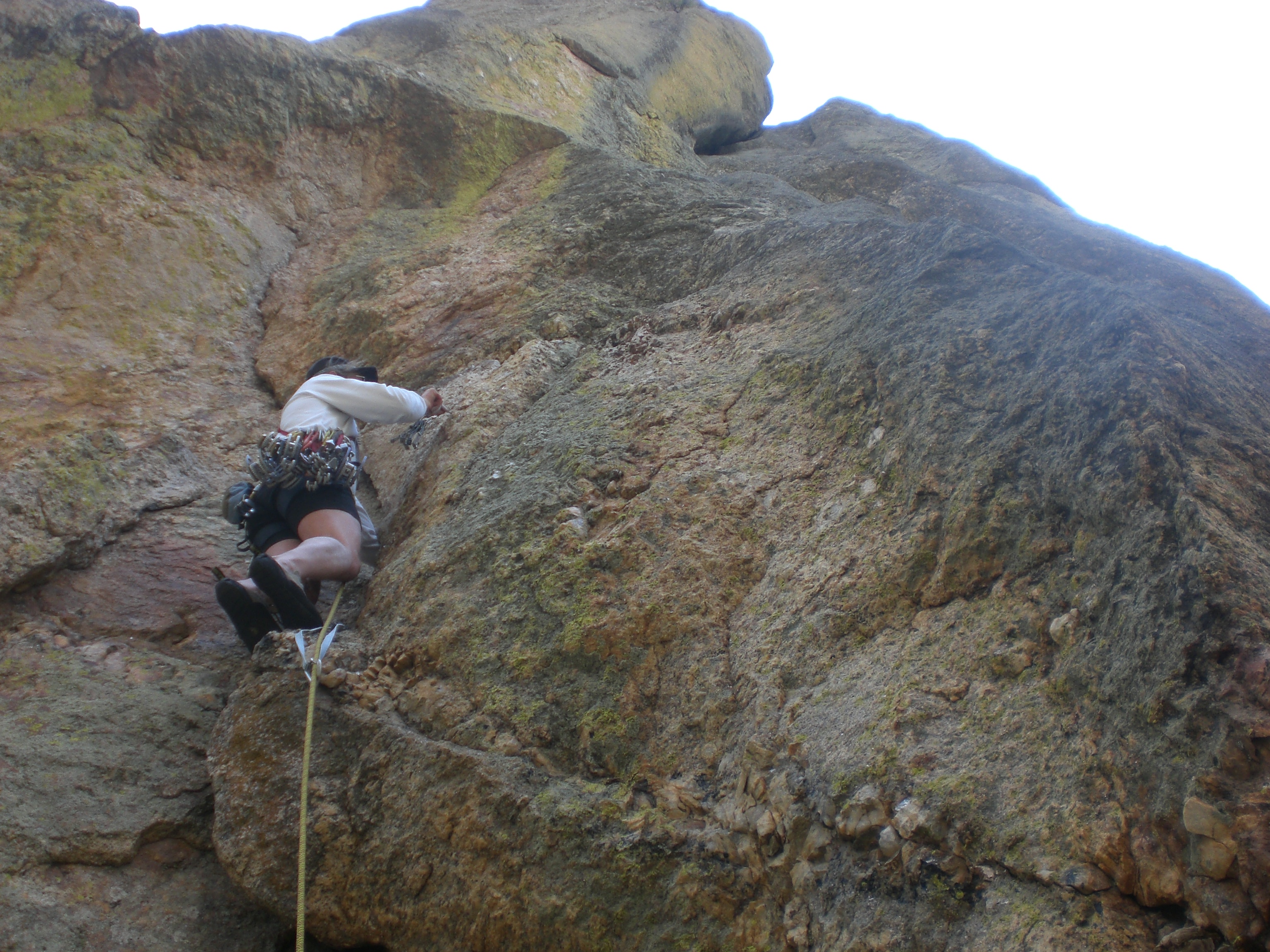
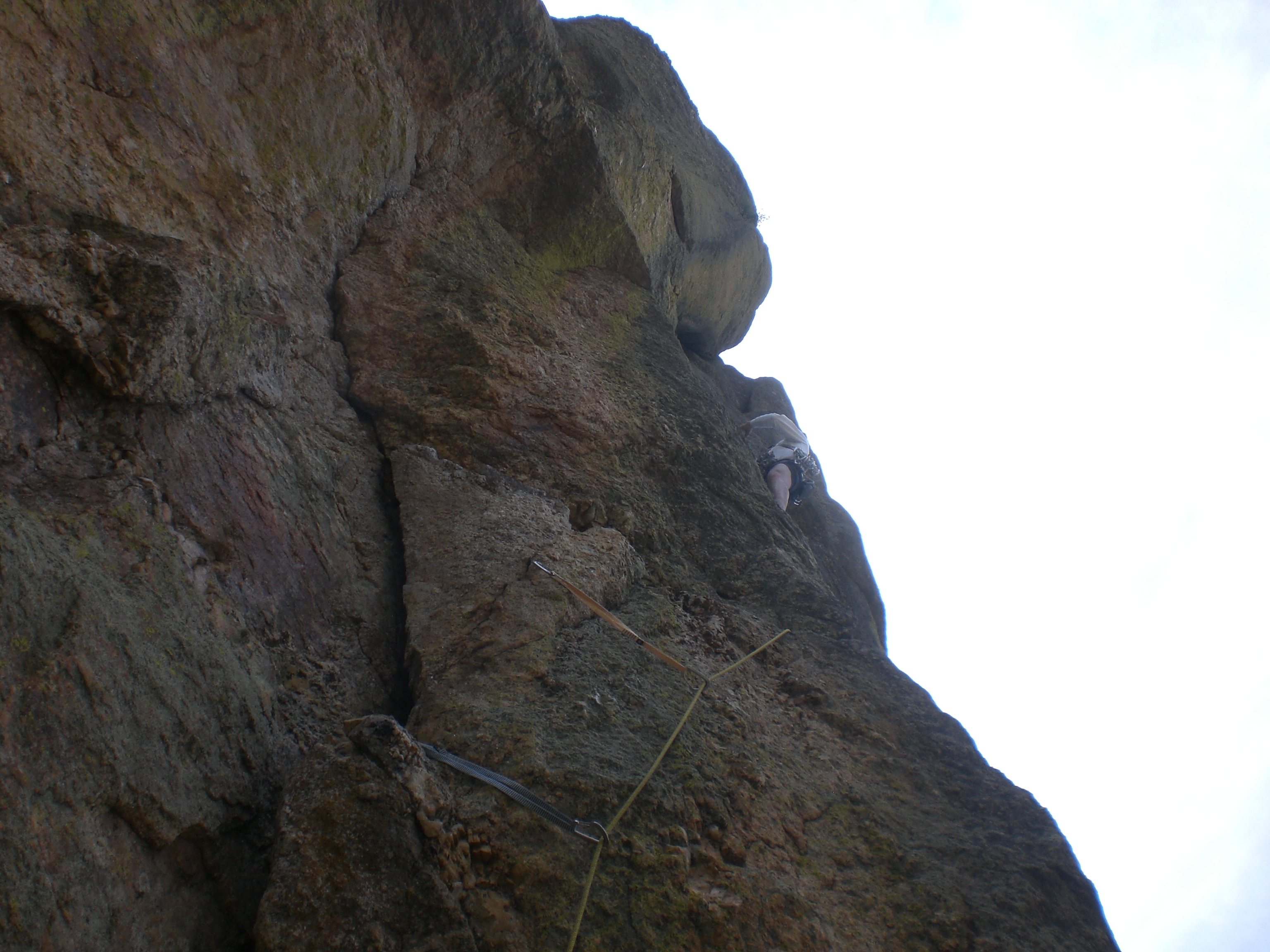
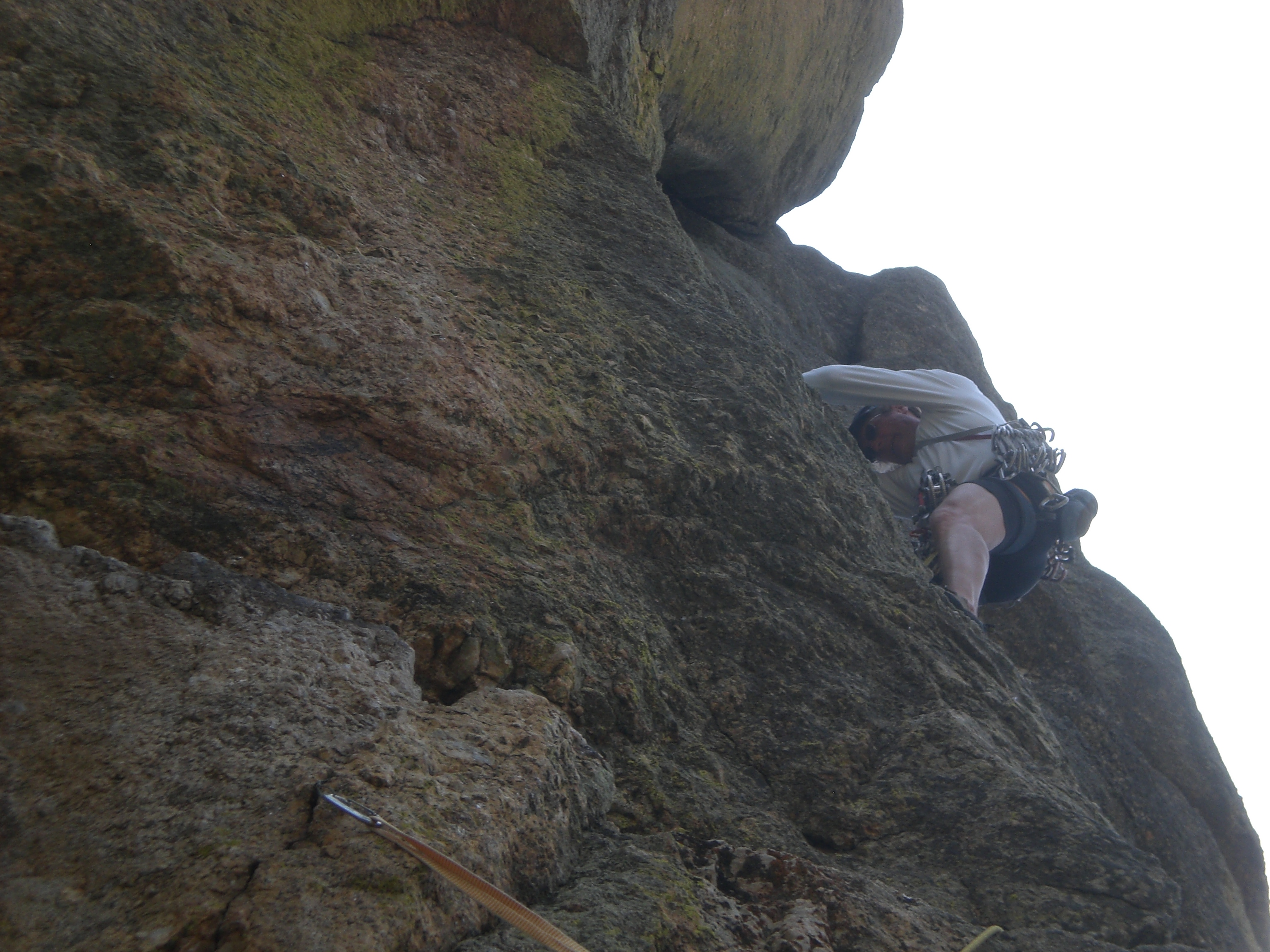
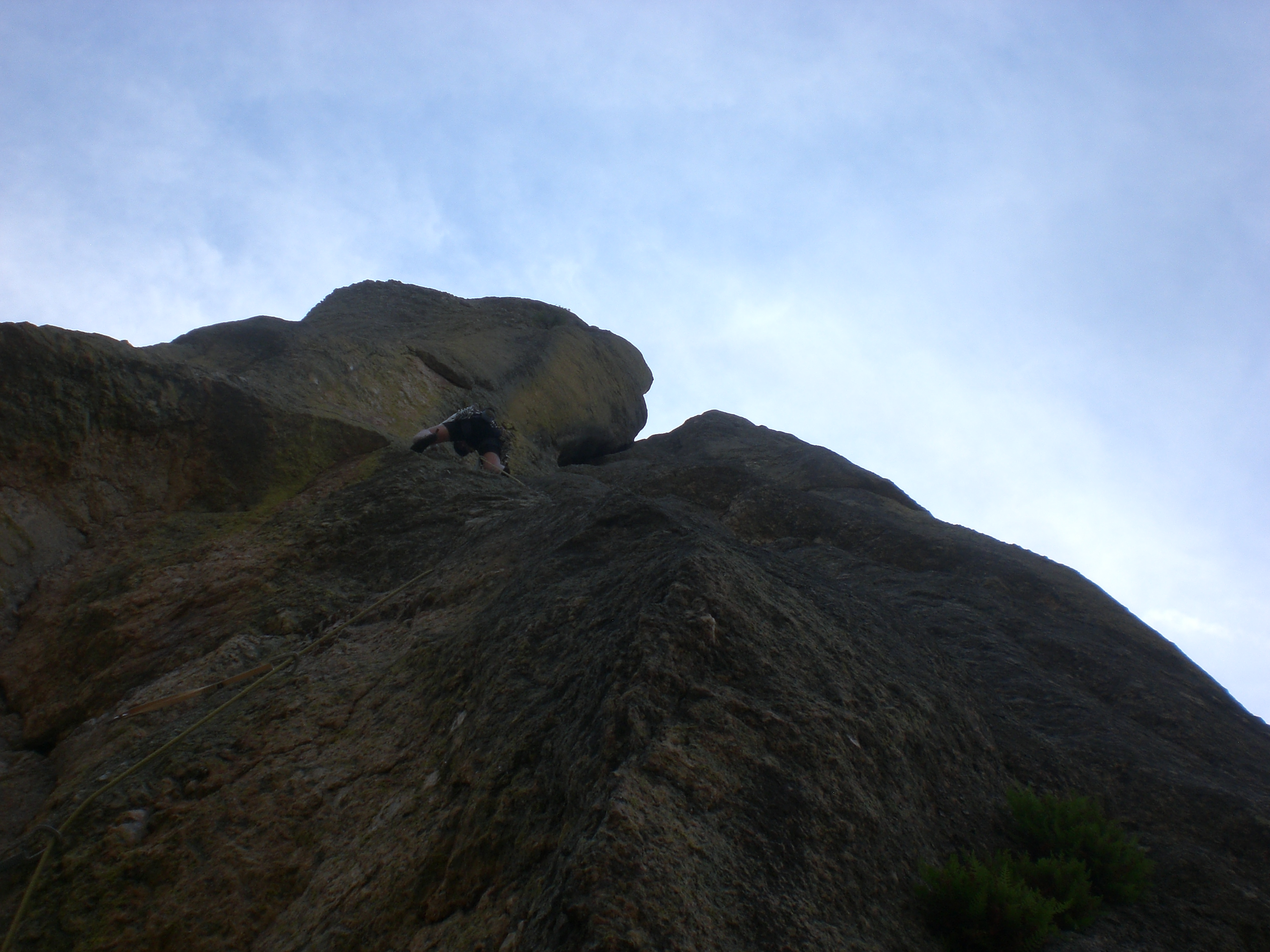
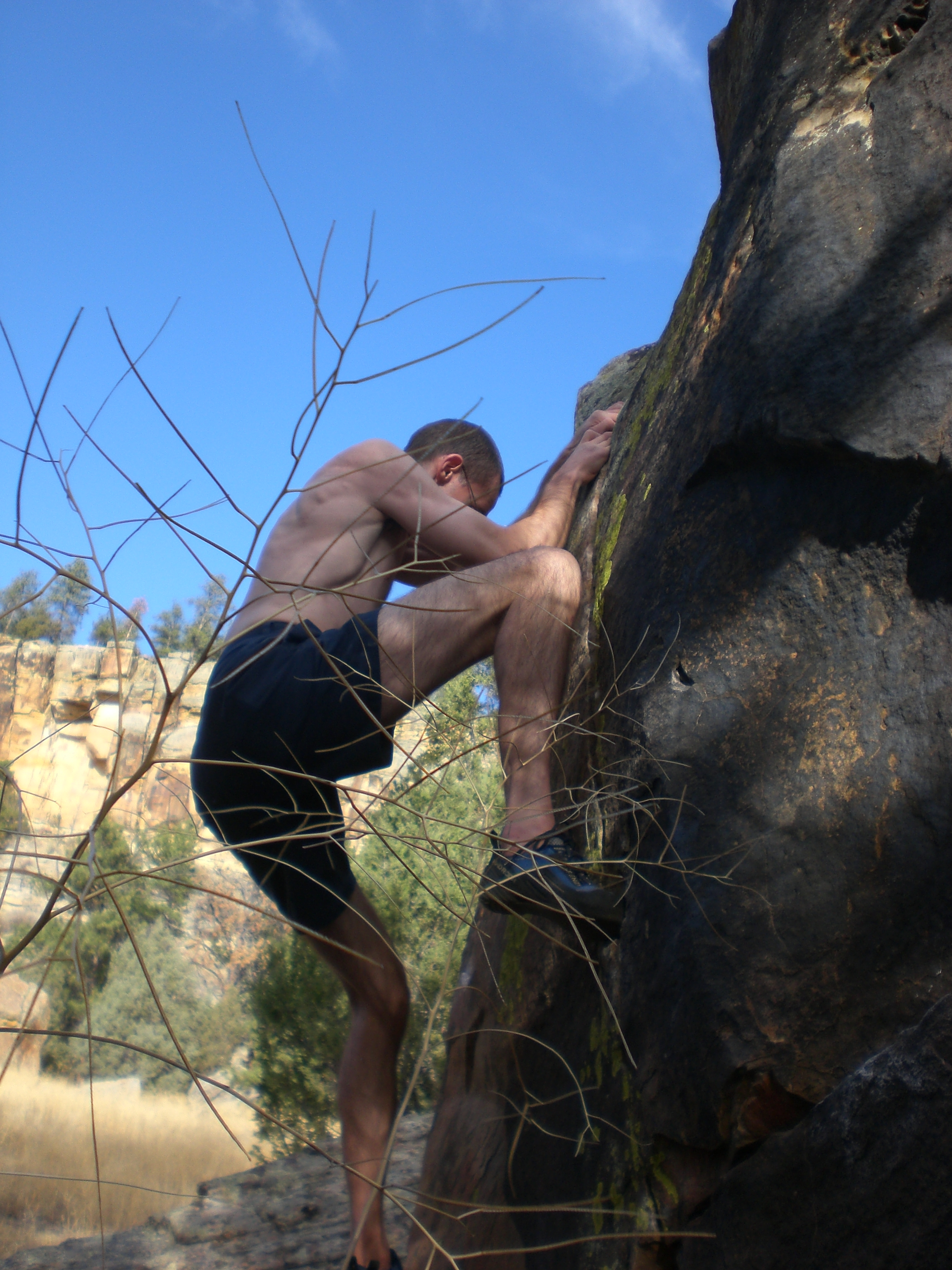
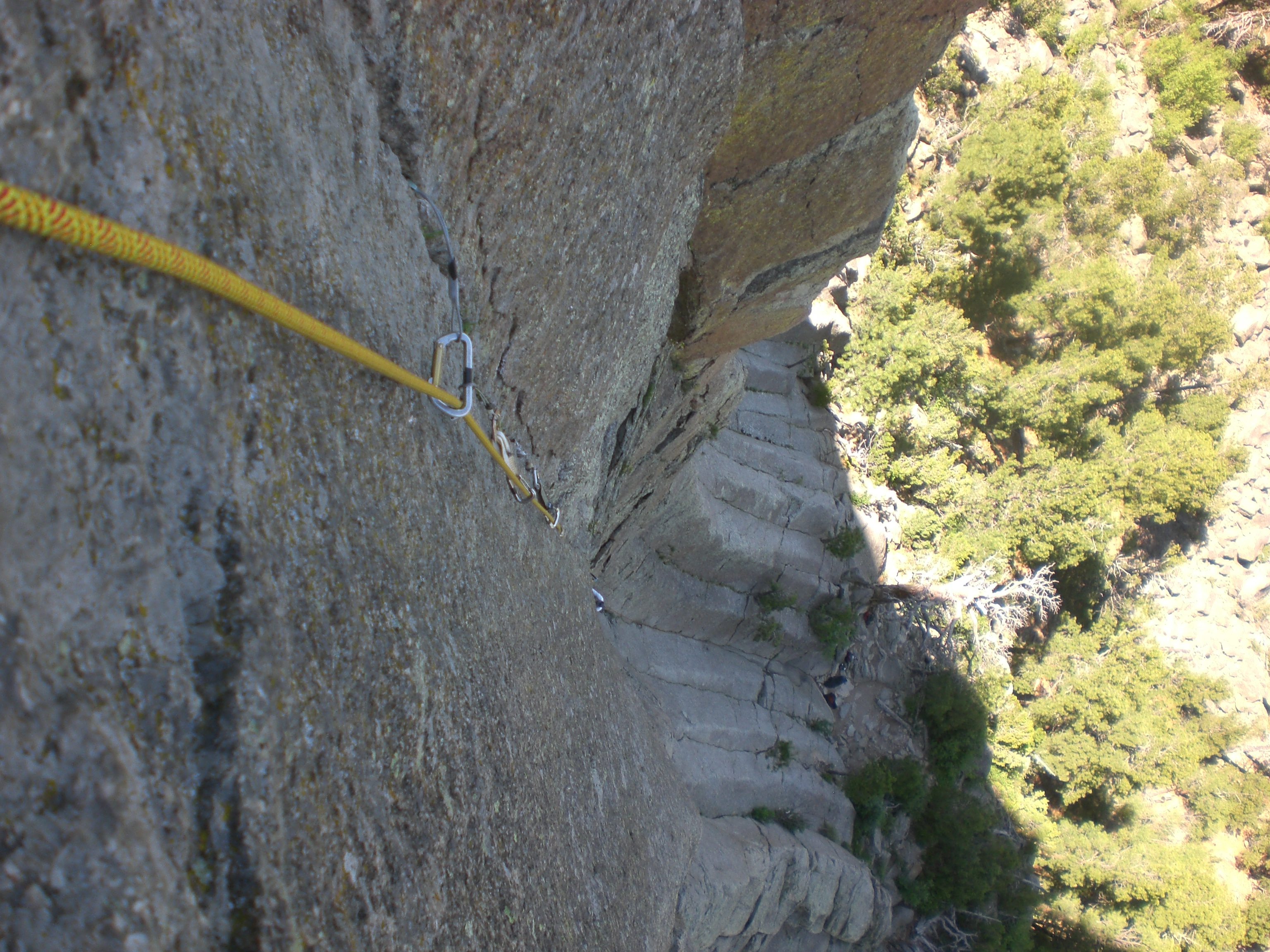
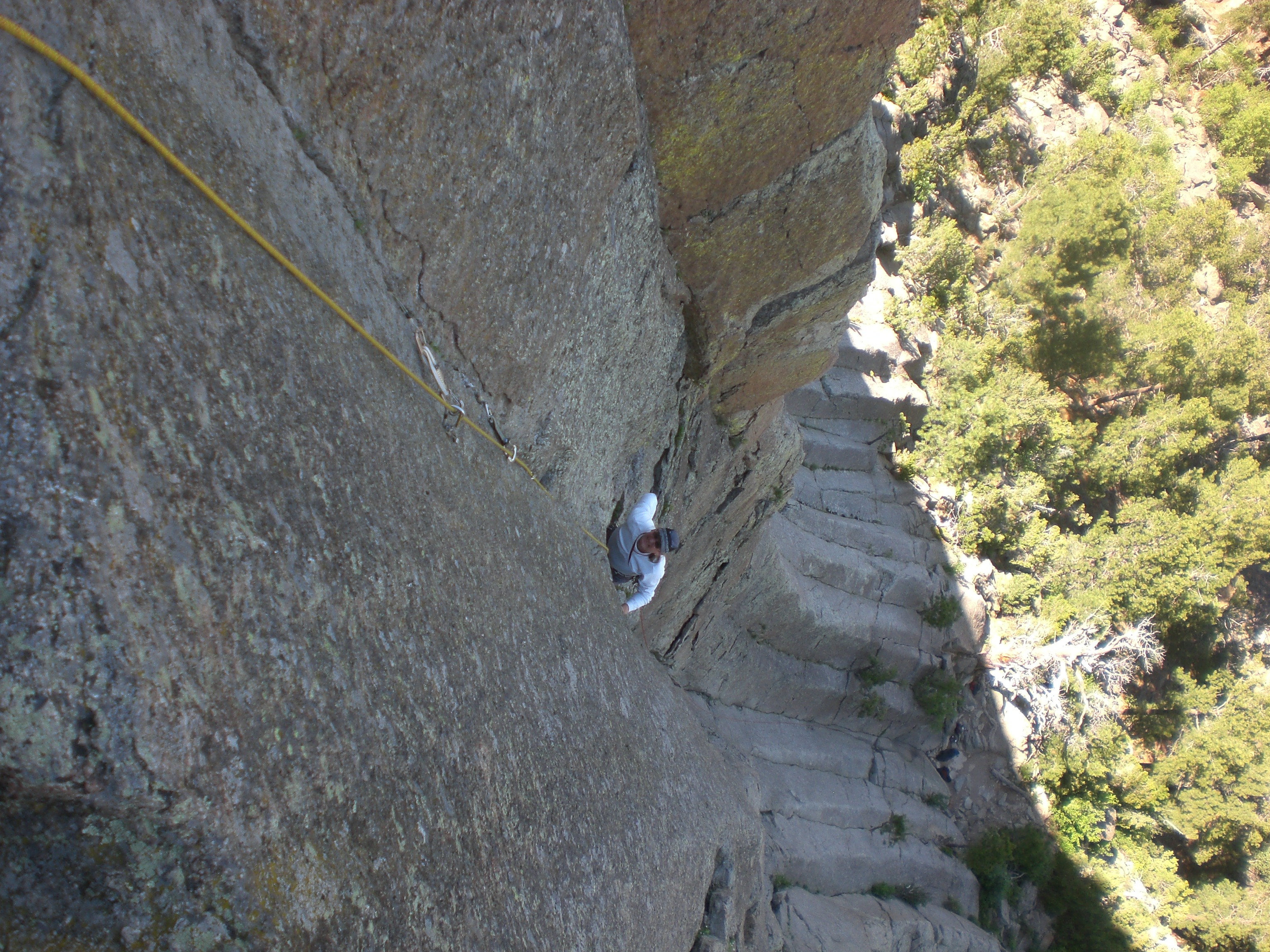
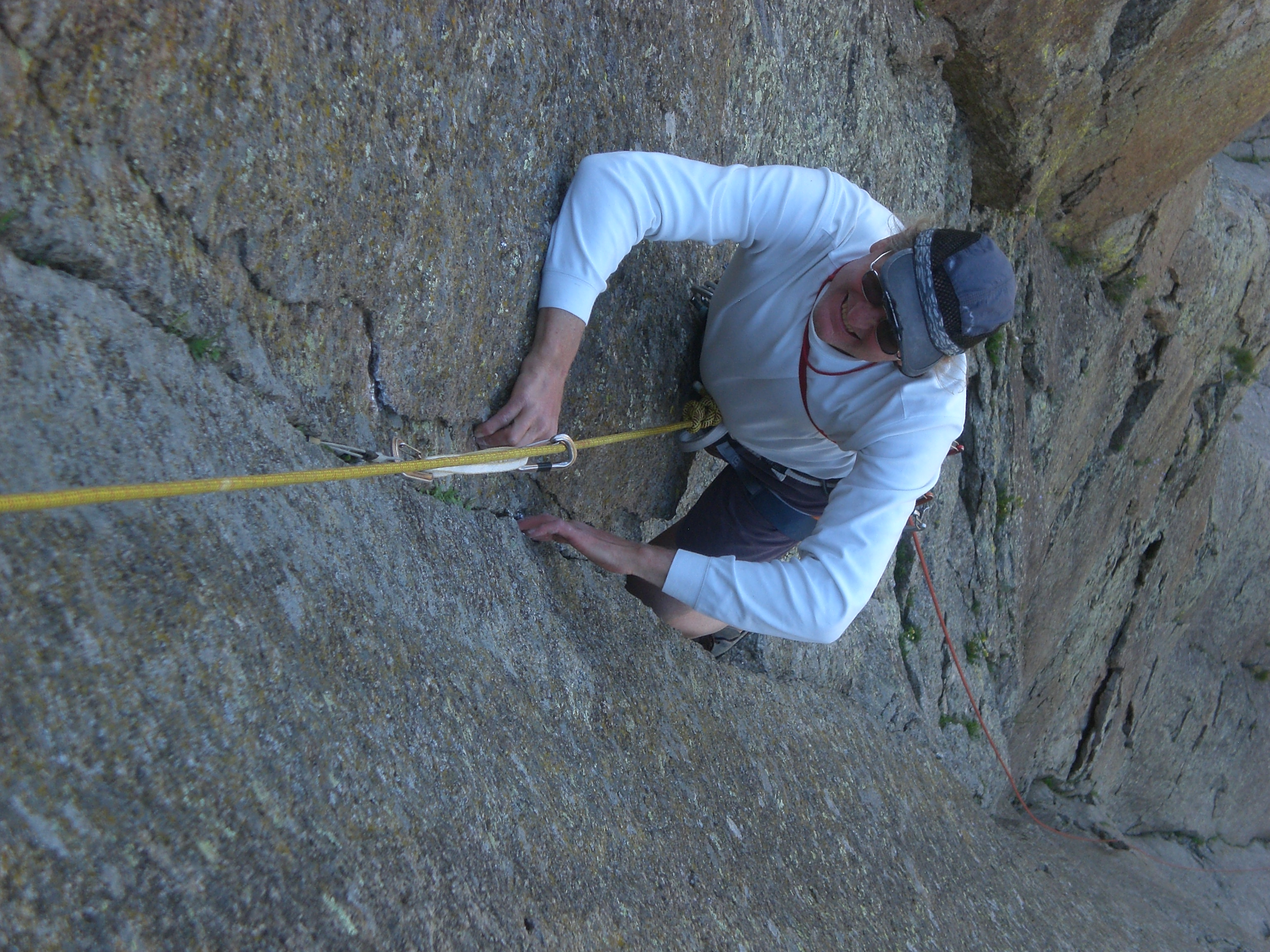
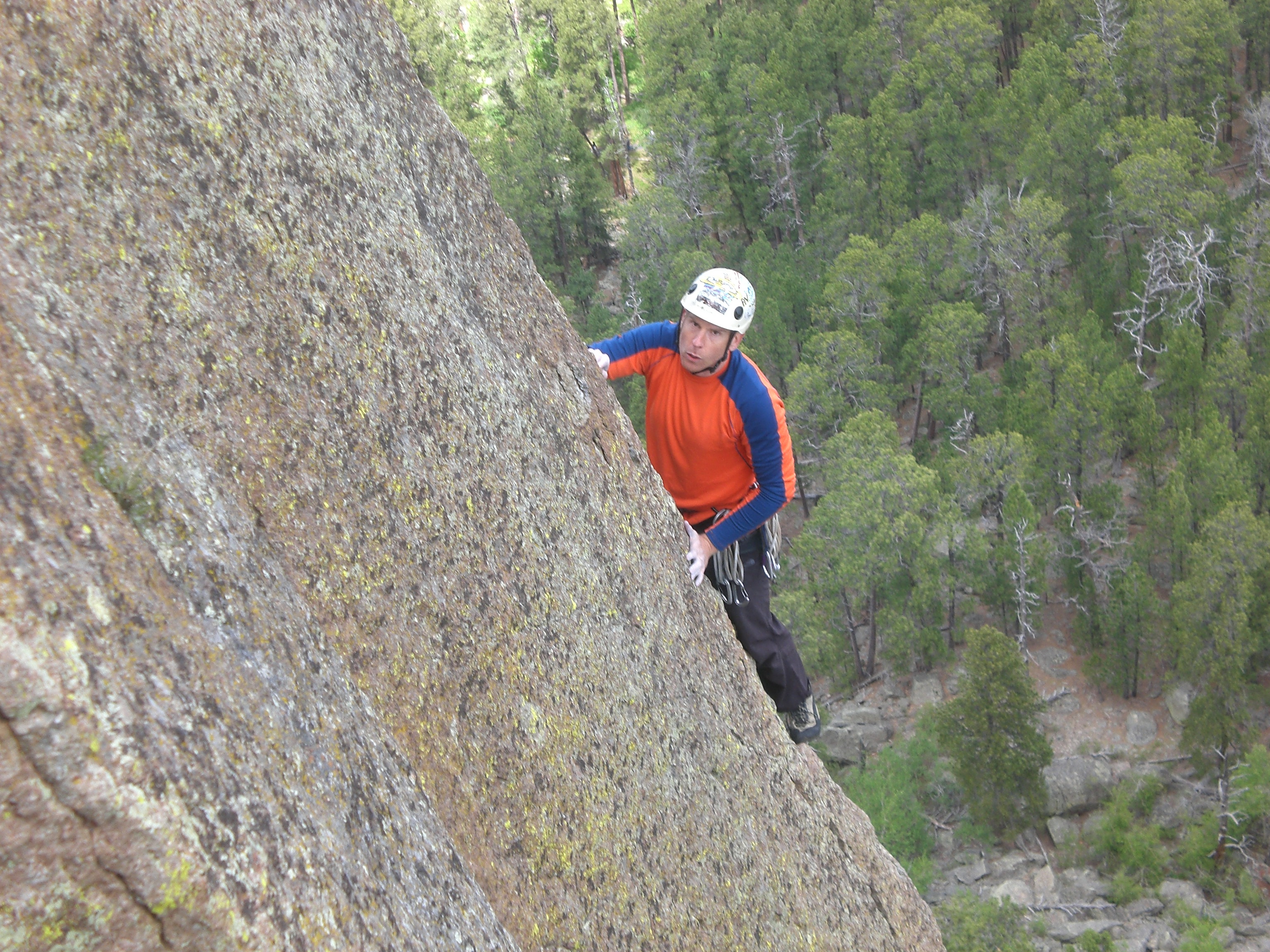
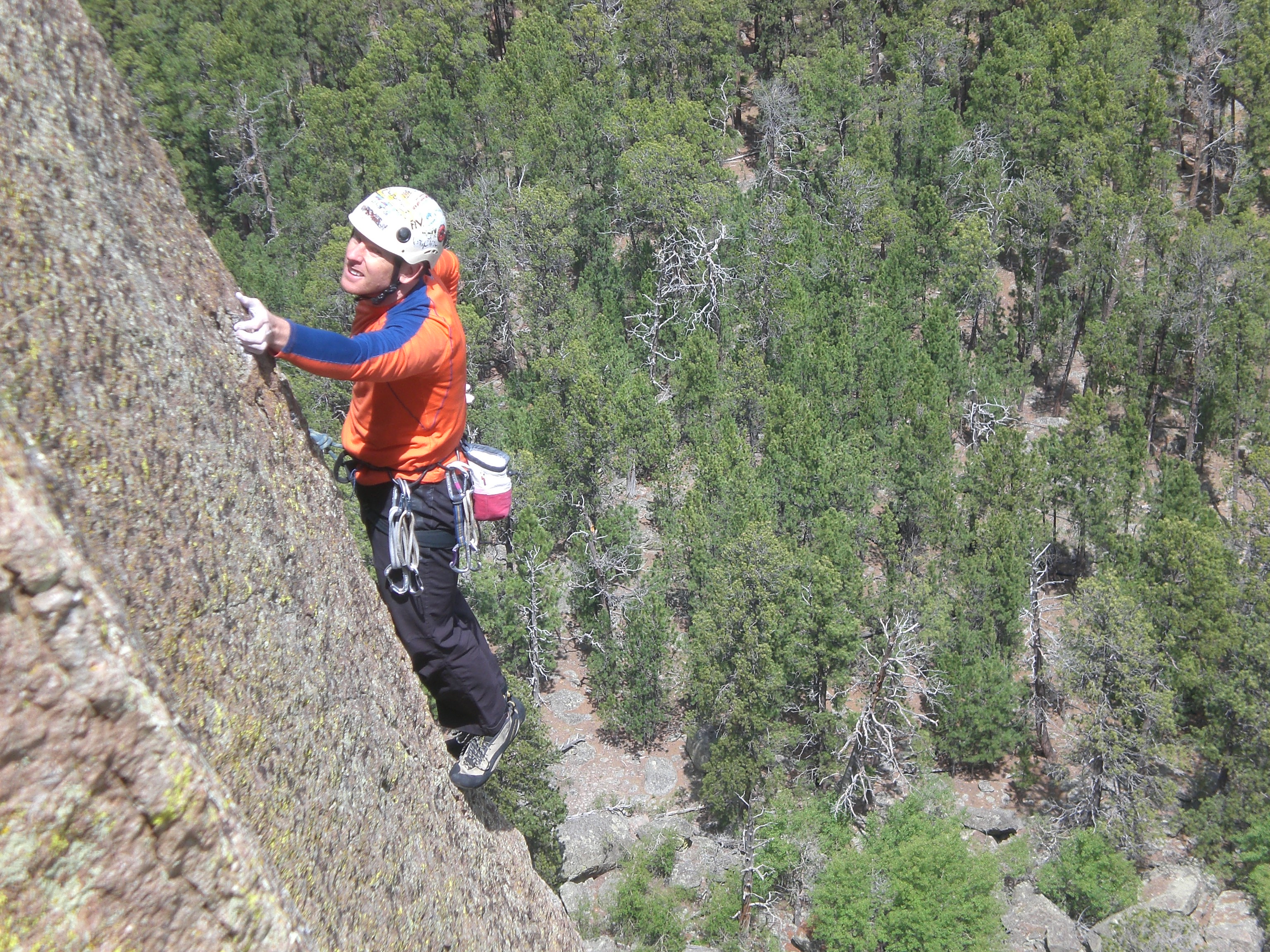
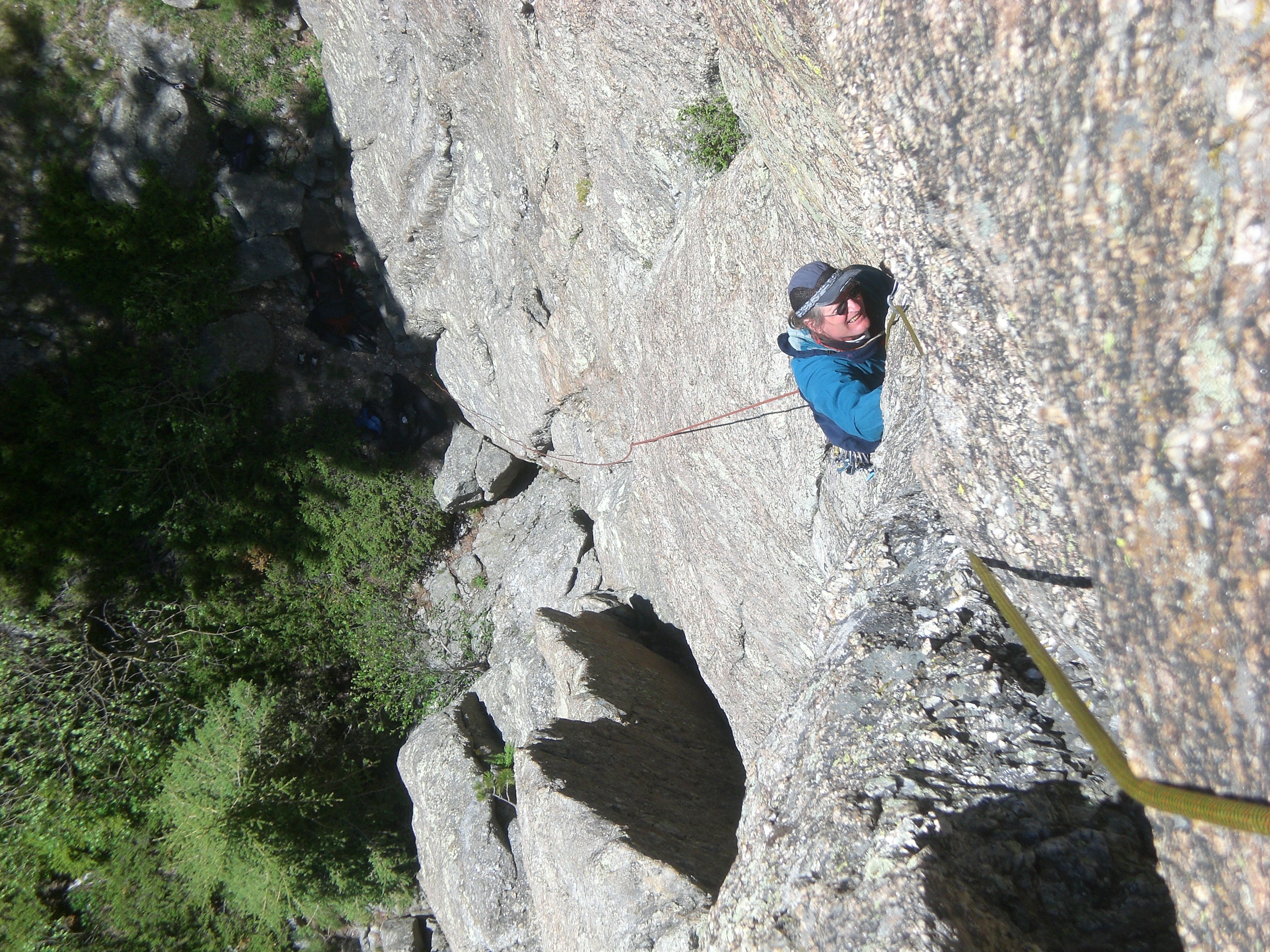
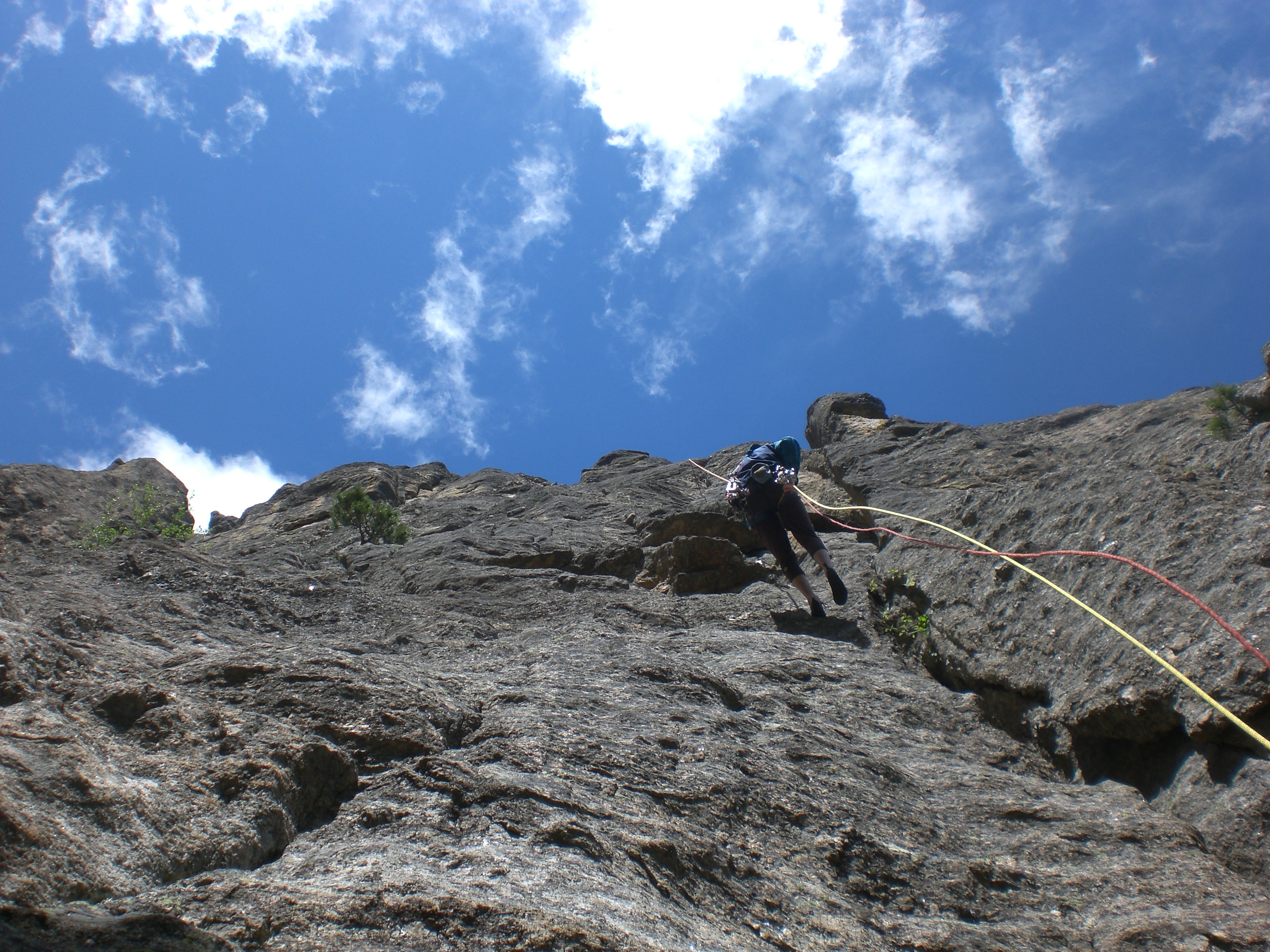
The picture above shows Rich on the first 1/3 of the Larry route on Blockhead. “Five nine” says Larry. I’m not convinced.

It’s hard to switch back and forth between the Tower and the climbs in Custer State Park. The gear at the Tower is generally straightforward and the falls are clean. Needles placements are devious and you really shouldn’t fall. You always feel off-balance.

Climbing doesn’t need Title Nine, it’s got Cheryl.

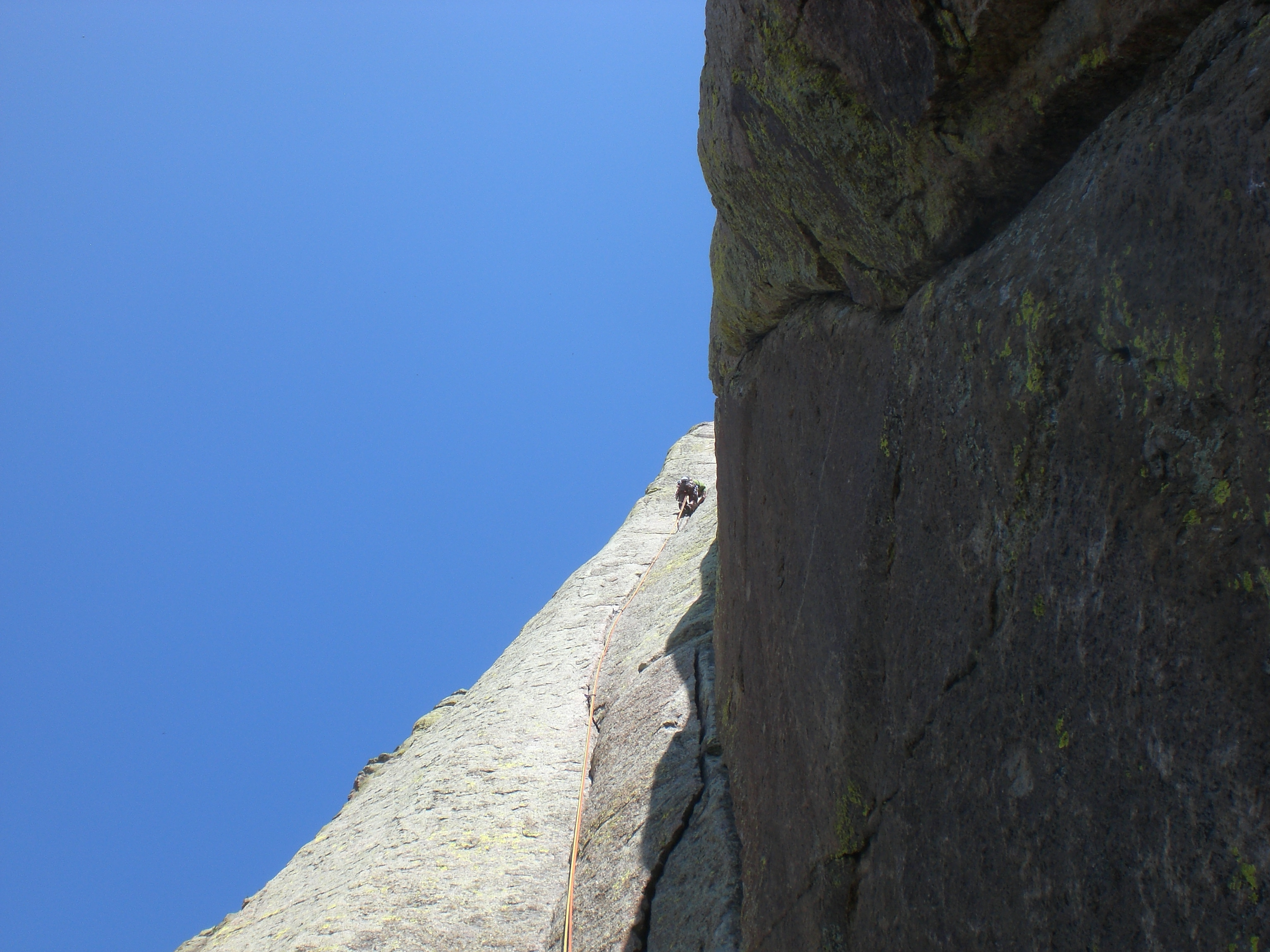
Rich got to lead Sore Thumb first this year. This spire is the climbable Escher.

The Three Most Commonly Heard Lies…

…in Wyoming: “Yes neighbor, my pick-up truck is paid-for.”, “Yes darlin’, I won my belt-buckle in the rodeo.”, “Yes sir officer, I was just trying to help that ewe back over the fence.”.

Like any terra incognita, Wyoming has accumulated quite a bit of mythology. Mythology should be debunked, but it is notoriously resistant to fact. So even though Wyoming is not just rednecks and national parks, I know that I can’t prove that with data. Gestalt is the remedy. Here is the feel of the place – the good and the bad.

The Good

  • The Weather: Much of the state is arid or semi-arid and above four thousand feet. The sun shines a lot. In the Summer, even if the day is hot, the night will be cool. Because the humidity is very low, sweating works. By the same token, low Winter temperatures often prove much more tolerable than the thermometer alone might imply, due to the sun’s warmth and the dry air.
  • sandstone


  • Geology: Uplift, sedimentation, erosion, volcanism – Wyoming has it all. Many states have mountains, but none have the sheer profusion of geological features and types of rock found in Wyoming.


  • Self-sufficiency: A state economy based on mineral extraction and agriculture, sparse population and dearth of urban amenities have bred a powerful streak of self-sufficiency into the inhabitants of Wyoming. This quality leads to a breadth of experience in the populace, with an attendant measure of curiosity. Self-sufficiency also makes for humility and an appreciation for the knowledge of others. Nothing shows a person their limits and cultivates a taste for learned advice more than mandatory DIY. Being far from help makes one value help and be willing to lend it too. It’s rare to see a single car with its hazards on by the roadside in Wyoming.


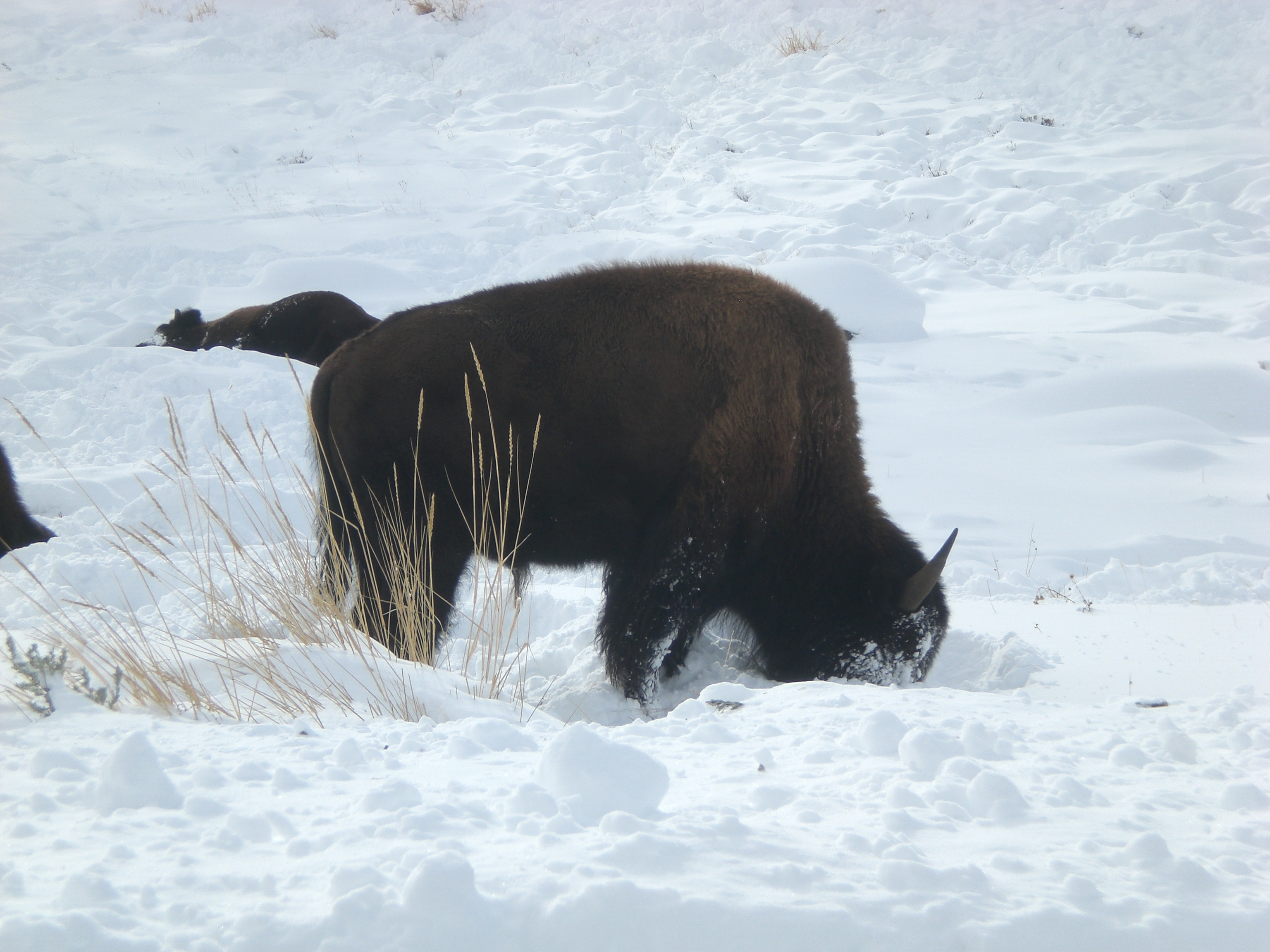
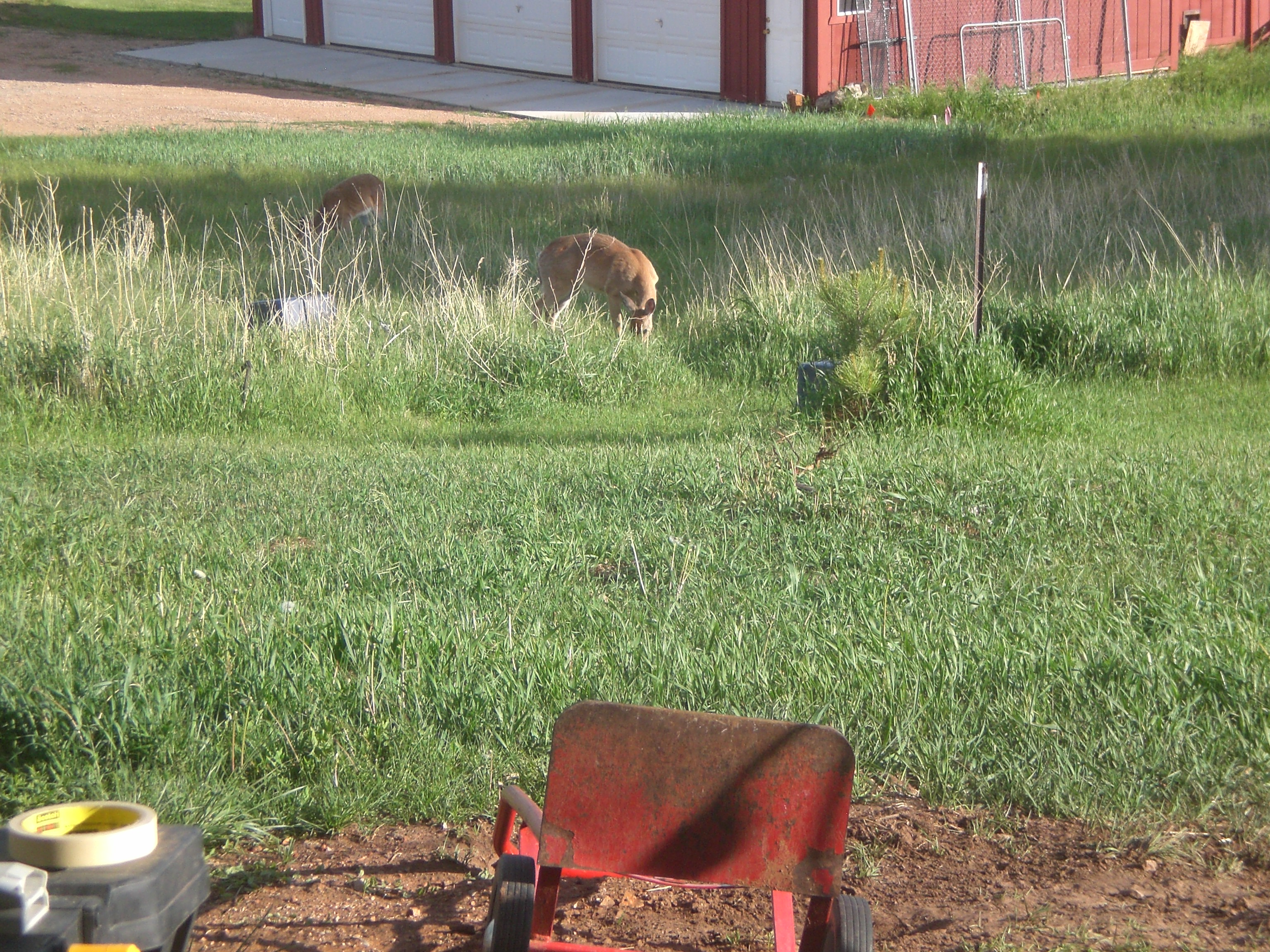
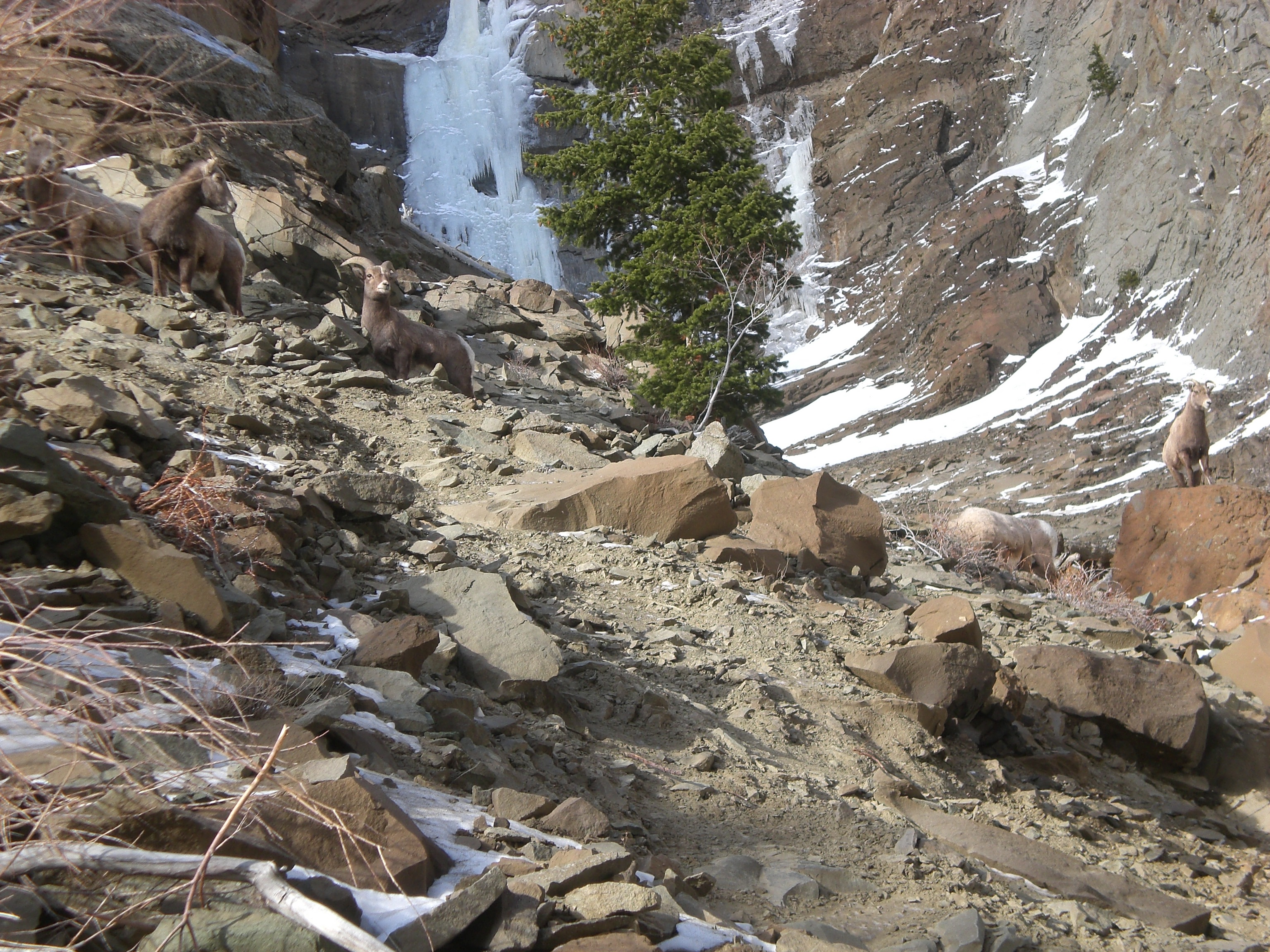
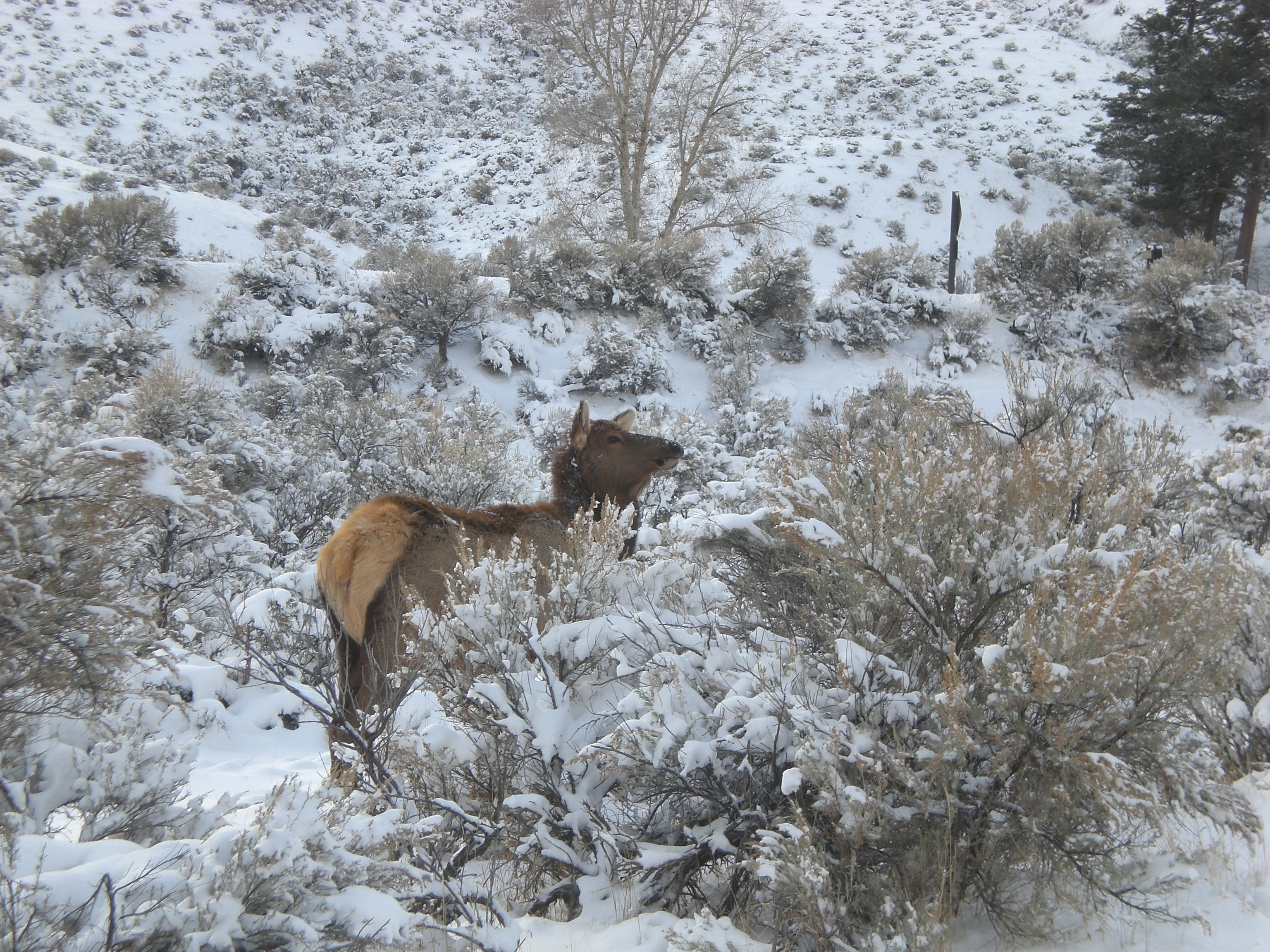
  • Critters: Deer, Bighorn Sheep, Moose, Elk, Wolves, Mountain Lions, Bison, Antelope – you get to see them all, up close and personal.


The Bad


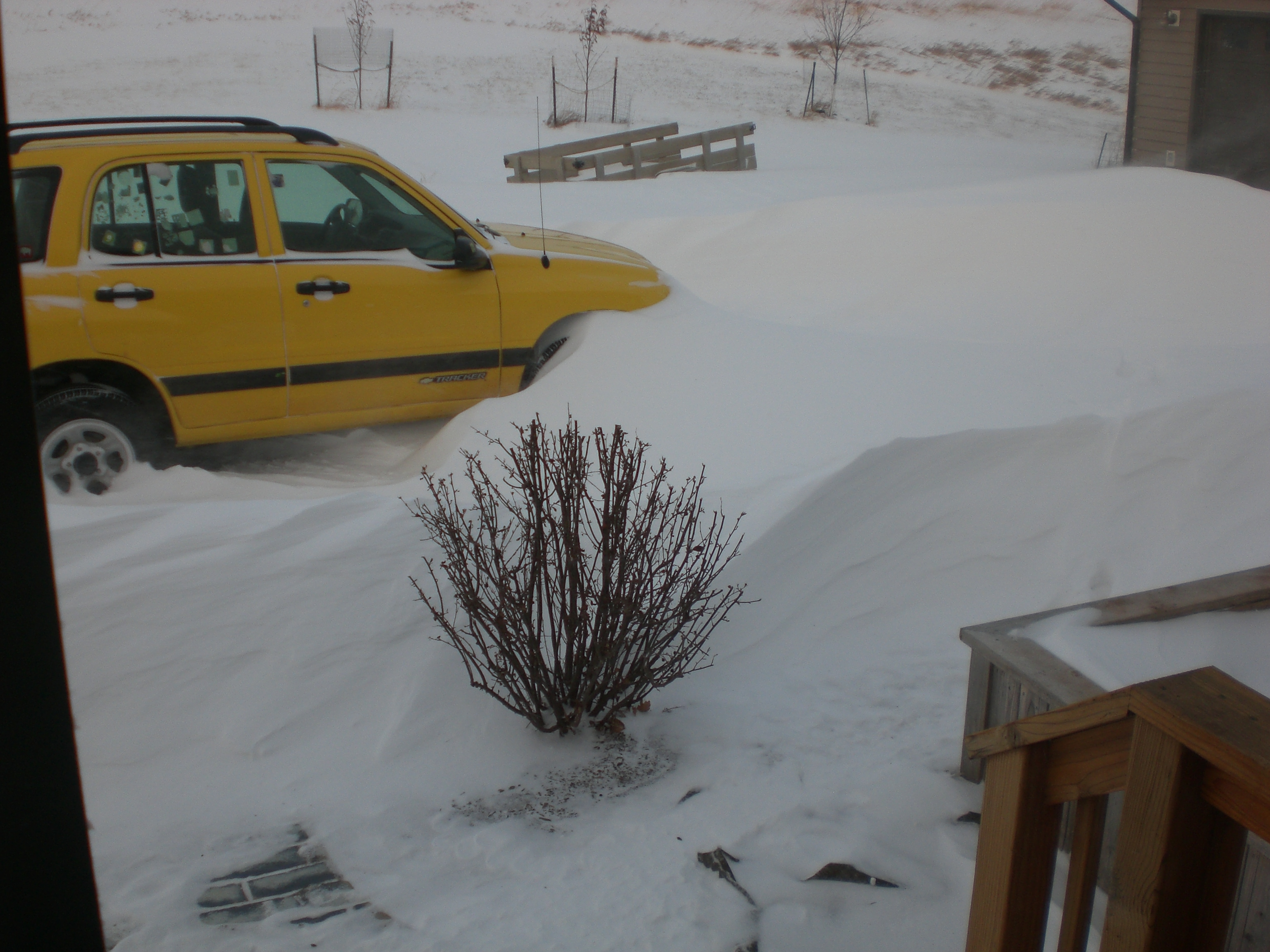
  • The Weather: Sometimes the place catches fire. Wind is considered a natural resource. Remember the line from the song Oh Suzanna, “…the sun’s so hot I froze to death…” ? Wyoming is  the place that makes sense of that line. The snow forms ten foot drifts as hard as concrete and the snowpack is often a thin crust over bottomless depth hoar. There are frequent ‘ground blizzards’, with blue sky above but impenetrable white in every other direction.


  • Geology: Unfortunately, geology translates to geography. Monumental forces make for monumental obstacles – expansive basins and high, jagged mountain ranges. A short drive is anything less than 400 miles. A short walk is anything less than 6 miles.


  • Self-sufficiency: The habits of self-sufficiency lead to a surfeit of caution and a preference for ‘good enough’. Enterprises are frequently one-of affairs. The atmosphere is friendly for extractive industries and Republican politicians, as it is in third world countries everywhere. Witness the number of ghost towns in the state.
  • Critters: Deer, Bighorn Sheep, Moose, Elk, Wolves, Mountain Lions, Bison, Antelope – you get to see them all, up close and personal. Don’t feed the dog outside. Keep the collision insurance on your car. Buy an orange hat and a can of bear spray.

There it is.

Tagged

Profanity

It’s June at the Tower. This month is a designated time for reflection and choice, brought to us by the NPS, the Constitution, and the former exclusive residents of the Black Hills. A decade or so ago, the Park Service did what Solomon could not, it divided the baby. Climbers wanted to climb the Tower without restrictions. Tourists wanted to see the Tower unadorned with climbing anchors. Native people wanted the Tower back, and if they couldn’t have that, they wanted climbers off the Mato Tipila altogether as climbing was felt to profane this sacred place.

In a brilliant compromise – by definition, a deal everybody hated but nobody felt that they could reject – climbing continued with some restrictions. No new bolts were allowed. Anchors were standardized to a low profile set-up. This kept the tourists happy. Signs directed the tourists and climbers to stay on the trails around the base and climbers were asked to stay off the Tower in June, the time of the solstice, when the Sun Dance occurs. This didn’t make the Lakota happy, but it tamped down their indignation enough that they signed on to the agreement.

Some of the climbers sued. This response was predictable and predicted. Political philosophy is circular, with the poles af any creed resembling each other in practice. So it is with anarchism and libertarianism, two vigorous traditions in the climbing community.  Followers of those traditions were obligated to oppose restrictions on principle. Fortunately, traditions based on opposition to law don’t often fare well in court. For one thing, they have a problem with consistency, since that, too is a sort of limitation on personal freedom. In this case, the plaintiffs even made the dangerous assertion that restrictions on climbing violated the constitution’s ban on restriction of religious practice, as climbing was a spiritual pursuit. The assertion was dangerous because the suit was based on the accusation that the June ban on climbing amounted to a government agency promoting a religious practice. The court chose not to engage on that front, and in the end, the voluntary closure and the climbing management plan survived.

The status quo is not entirely healthy though. Native rites get respect thereby, but it’s the kind of respect given a dead relative disliked by the family in life. Despite the sad eyes and solemn words, if the deceased stood up and spoke again, no one would cheer. Native people deserve space, not just allowances.

The voluntary ban confirms climbing as profanity. Nobody can stop you from swearing, it implies, so we ask that you lower your voices and keep it away from the children. Climbing may not be religion, but it isn’t profanity. It is closer to art and I’ll be bold enough to say, art on the Death of a Salesman rather than the musical theatre end of the spectrum. Art deserves space too.

The missing piece is, of course, the Tourons. Climbers calling “On belay,” 200 feet off the deck are intolerably disruptive. Revving Harleys in the visitors center parking lot apparently are not. Of course those RV, motorcycle, and charter bus pilgrims don’t mean to intrude, they just don’t know any better. They constitute the majority of the voting public, and like the song says, this land is their land and the NPS doesn’t dare make any demands of them.

The NPS anticipated all this. It plans to educate its way out of the Yugoslavia it has created. I wish it luck, but a resolution will take more than the passive approach pursued so far. The NPS has focused on the tourists, who aren’t mad at anybody. The indians and the climbers have been left in their respective corners. Maybe Sarajevo felt a bit like this in the Tito era. Maybe it won’t blow up again during my climbing lifetime. I’m not sure whether to hope for that or not.

Tower Blowout

I should have known better. The term “blowout” is never associated with a good aftermath. At best it entails something nasty issuing from an orifice of some sort. I prefer the Tour de Tower, which is a trip around the monolith, hitting as many routes as possible along the way. Some of those routes may be Killer b’s (the 10.b grade at the Tower is a universal sandbag), but not a bunch of 11’s. For me, those are still part of a three route regimen: one warm up, one desperate struggle, and one warm down to wash away the cotton-mouth.

When Mr. Swift suggested the blowout before the voluntary June climbing closure, I figured it would be OK. He’d lead all the hard pitches. Nobody can string together those steep, crimpy slabs and fingertip cracks all the way around the Tower without getting tired. I’d lead the approach pitches and then, when he folded, I’d take over and ease things back into the classic tour.

He didn’t fold, he escalated. Before it was over, I found myself on routes I wasn’t sure I could even follow. I managed, but only just. When it came time for the warm-down, it was I who was forced to quote the great Roberto Duran. No mas.

At least all that time on the dull end allowed me to get some amusing photos.

Anonymous climber on Everlasting, aptly named since you’re sorry you got on it by the second clip and then it just won’t end.

Making his “O-shit” face.

It is important to chalk up here to take your mind off the crappy footholds. 

Busy day on the NE shoulder.

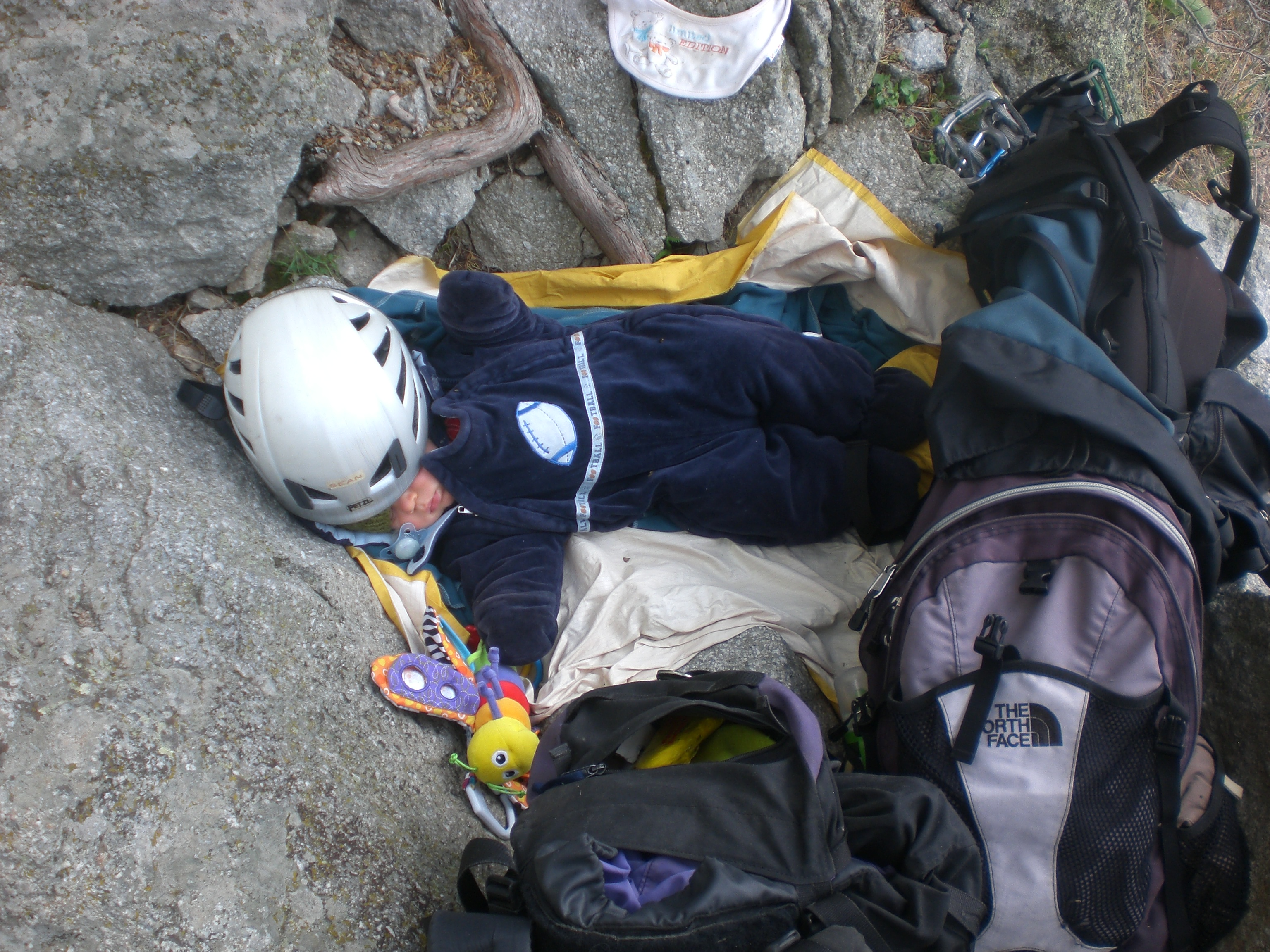
Baby bird doing what good babies do best.


Tagged , ,

Blip!

I swore I wouldn’t get into this anymore. The intelligent design crowd keeps pushing this crap, though, and I have kids who are at risk. Beyond that, I suppose intelligent design’s sort of dishonesty just galls me. Don’t say I didn’t warn you.

I am about to give an argument by analogy. I do so with trepidation, because analogies are always in danger of going off in the wrong direction and have no deductive validity in the first place. However, I think this form is the only fair tool for the subject since I’m going to use this argument by analogy to critique another argument by analogy: intelligent design (ID). Rather, I’m going to critique the positive arm of the intelligent design argument. This is the withered limb compared to the evolution-bashing arm, but it is necessary to the whole and the negative argument is a morass. Since scientific knowledge is never complete, critics have available to them an endless list of objections. The positive side of the ID case is more a philosophical than a scientific argument, so it can be settled on that level.

The positive ID argument is as follows: when humans start with a purpose (a problem to solve) and devise a tool to serve that purpose, the end product looks a certain way. Biological structures have a similar appearance, so biological systems must result from the same sort of process. An immediate problem arises at this point. Since proponents wish the analogy between man-made objects and biological structures to be precise the argument commits the fallacy of the undistributed middle (Designed structures look like X, Biological structures look like X, therefore Biological structures are Designed structures).

The proponents of ID subsequently introduce a number of modifiers to try to alleviate this situation. Complex specified information is not only used to portray designed and biological structures as essentially similar, it is also used to try to pare down the middle by saying it is statistically negligible. Appeals to abductive reasoning serve the same purpose, suggesting that design is so far and away the “best guess” that there’s no need to worry about the logic. There are deeper problems than the modifiers and the middle but those are the simplest things to consider, so let’s go there first. Let me tell you how I built my son a mountain bike.

The bike came in a big box in a bunch of pieces with a couple dozen pages of instructions. The instructions were complex and very specific. In fact, if you read the instructions through, you would know that a mountain bike and nothing but a mountain bike would result from following those instructions, even without actually building a bike to find out. But, I didn’t read the instructions. I know how bike parts work, so I just eyeballed the problem and figured it out. So, even though the Complex Specified Information (CSI) in the instructions has all the qualities that the advocates of biological CSI wish it to have, it doesn’t have the necessary relationship to the endpoint that those advocates want from it. There are multiple paths through the middle to the mountain bike. There is still a way out for ID, though. I must have picked up on the CSI contained in the parts themselves. It’s true. When I looked at the parts, they fit together in certain configurations and orders of assembly best, as I expected. My expectations were key, too. Over the years, bike designers had shaped those expectations, in effect teaching me to read the information they put in the parts so I could use my abductive reasoning to make a really good guess about how the parts should go together.

I use this “best guess” faculty all the time, because it is a great shortcut and pretty reliable in familiar circumstance. Notice I said ‘pretty reliable’. Also note that I said I didn’t use the instructions, but I didn’t say I threw them away. Sometimes the bike makers come up with an innovation and then my abductive reasoning is worthless and I have to rely on the instructions again to tell me what to do about the new part. I get in trouble if I try to rely on that ‘best guess’ shortcut in clinical medicine, too. The causal history of a manufactured bike is well-defined because people decided to make it that way. If the causal history of a patient’s symptoms is well-defined for me, it’s because I have decided so. Used outside of a situation with known prior constraints on the variables, the ‘good guess’ becomes confirmation bias. So, the problem is with the complex specified information. In biological structures, to achieve ‘specification’ and thus make the ‘best guess’ inference to design, the causal history has to be constrained after the fact. Anything less leaves open those pesky intermediate paths through the middle. ID imposes that constraint by assigning purpose to all biological structures it considers. Assigning purpose is easy for us humans and we like to do it because it lets us use shortcuts like guessing. Attributions of purpose (intent) are so appealing that we have trouble keeping them in the realm of human behavior where they belong (and not even there without some confirmatory process to check the attributions). Who hasn’t said their car “worked hard” to get up a steep hill? It’s just as easy to say that E. coli intends to swim to new food sources with its flagellum. In fact, it takes just that sort of presumption of intent to wrangle an object’s causal history into CSI, resulting in a bit of a Cartesian circle (if the flagellum is made for swimming, then it has a complex history treading a narrow path to that endpoint, which shows that the flagellum was made for swimming). Still, we should be able to safely use this attribution of intent after the fact in limited circumstances, as long as we’re careful, right? For instance, it is surely accurate to say that the guys who designed my son’s bike did so from an original purpose. However, even that presumption of intent from the endpoint is not accurate, and the problem with the retrospective attribution of purpose/intent in such a case leads us back to the problem with intelligent design that predates any attempt to distribute or minimize the middle.

What do we know about design? We really just know what we do and what we do requires an agent (us), a purpose, and means. The problem is that the relationship between those three factors is not linear, nor is it even hierarchical. When considering bike design, for instance, we could go back to the origin of the means via the agent and examine the influence the means then had on the agent’s intent and subsequent development of further means. We could track back to the origin of the wheel in geometry, which is in turn based on observed properties of materials, which are in turn based on some basic laws of physics, all of which humans bothered to investigate and remember in the first place because, if you are a tool-maker, it’s easier to investigate and remember than to, um, ‘reinvent the wheel’. We could trace bicycle history back to the wheel and beyond, but let’s keep it brief and just consider the design of mountain bikes.

Mountain biking started when some California bike racers moved to the country. Their new environment confronted them with the problem of riding, and of course racing, on gravel roads. Their road bikes’ narrow tires were too unstable for that purpose, so they found some preexisting cruiser bikes with wide tires that would at least be ridable on the fire roads near their homes. The cruiser bikes were not perfect. They were heavy and hard to pedal, so the riders raced them downhill. Even that compromise lead to problems though. The brakes and bearings on the cruisers couldn’t survive that kind of abuse. The riders replaced the brakes and bearings with motorcycle and road bike components. The riders soon found that the revised cruisers, now possessing cassettes of gears with the road bike bearings, were capable of riding on rough trails as well as fire roads. Trail riding prompted further modifications to the bikes. These guys in rural California invented the mountain bike, but not all at once and not out of the blue. They worked through a progressive series of problems, each leading to the next, until they arrived at a relatively stable final design that did something very different from the structure they started with. The mountain bike evolved. Of course, this is microevolution; the mountain bike is just a tweaked cruiser bike. Neither the mountain bike nor the cruiser looks anything like an old penny-farthing with the giant wheel in front. The lineage is clear though, and bike development has proceeded by the same basic process from the wheel to the velocipede to the mountain bike. Moreover, the agents in this process acted as selective forces and were acted upon by selective forces – and not just physically. As designers altered the bikes, the bikes’ new capabilities altered their conception of where and why they might ride a bike and thus their purpose in the next set of modifications.

To fingerprint design as the ID scheme misrepresents it, we really must close that Cartesian Circle by presuming intent for any and all endpoints we wish to examine. Then the history of that point is seen separated from any branches or external contingencies. If the mountain bike comes from a mountain bike factory, surely the mountain bike factory holds the entire explanation for its structure. When defined after the fact like this, the history of a structure looks irreducibly complex; if you take away one part it is rendered meaningless because it is its own context. ID’s analogy between designed structures and biological structures not only fails to distribute the middle, it doesn’t even accurately depict design processes as we undertake them. People, the source of everything we know about design, don’t start cold from an undetermined purpose and design toward that purpose in an implacable, irreducibly complex chain of events. Replication may work a bit like that, but not design.

What this method really does is provide for a hierarchical relationship between presumed intent and biological structures, where the intent causes the structure. Such a relationship seems to allow for a supernatural cause. This is why ID’s advocates have gone through such contortions to make it work (or at least look like it might). Yet the intelligent design model fails even as a portal for the supernatural. It offers no solution to the interaction problem in dualism. This is a real problem because, as far as I can tell, one tenant of ID is that the design process in nature is ongoing. To drag a spiritual being into the material world and have it start doing things, one has to explain how it does so without being in some way beholden to the same laws, and thus part of the same causal history, as the rest of matter. If there is no good explanation, then the spiritual being from another realm is just a bizarre, unexpected new part of nature. Though this may seem an obscure technicality at first glance, here is an example of just how sticky the problem really is.

Descartes tried to defend the independence of the mind from brain processes. He offered the analogy of a virtuoso violinist asked to play on a broken instrument. The listener would have no clue as to his true skill. Likewise the damaged, diseased, or intoxicated brain may just be a broken instrument unable to give voice to the intact mind which plays upon it. Unfortunately, this analogy raises the question: May the virtuoso be a virtuoso without a violin? Study of music theory or any other purely mental operation is insufficient. He must play a physical violin. Yet the skill he gains is a mental faculty which is subject to his creativity, religious concepts, and emotion. The brain and its adjuncts affect the mind. There is no escape from this problem in a world of two supposedly separate substances in active contact. Deism or a strict idealism offer the only outs (and Deism may just push the problem back in time). Either of these scenarios keeps the supernatural supernatural, but thereby makes it irrelevant to any practical understanding of nature/matter. This is why it is best for religion that science adhere to methodological naturalism. This is why intelligent design is insidious as well as invalid, for all concerned. It robs religion of any hope of philosophical integrity, just as it misrepresents biology. Reason enough for everyone to drop this bullshit for good.

Tagged , , , ,

Salvage

After seriously Scottish weather for most of the week, the hills shrugged it off for a few hours and let us get up to the Cathedral spires for a couple of routes before the afternoon storms pushed in again.

Superstition on Station 13. I had to stop a couple of times on lead to let the wind die down.

Cat’s Meow, the oldest school 5.9.

It doesn’t look that overhanging standing at the base!

Reincarnation

I don’t subscribe to the idea of reincarnation because I don’t like the way it’s said to work. If you are good, you become lighter and float up the preset hierarchy of beings. If you are bad, your evil deeds will burden you and you will sink down the preset hierarchy. This is bogus. It should be more like skeeball. You should get tickets for being good and then get to pick your next incarnation from the highest shelf you can afford. I could go for a scheme like that.
I would choose to come back as a White-Bellied Swift. These birds swarm around Devils Tower in the Spring and Summer. They are specialists in flight with boomerang-shaped wings and sharp, compact tails. They keep the Tower climbing experience real. Finish a hard route feeling all fluffed up and euphoric and one of these little guys will zip past your head, the wind screaming over his feathers, then dive vertically down the wall less than a foot from the rock. No matter how good you feel right then, you will never be as good at what you do as he is at what he does.

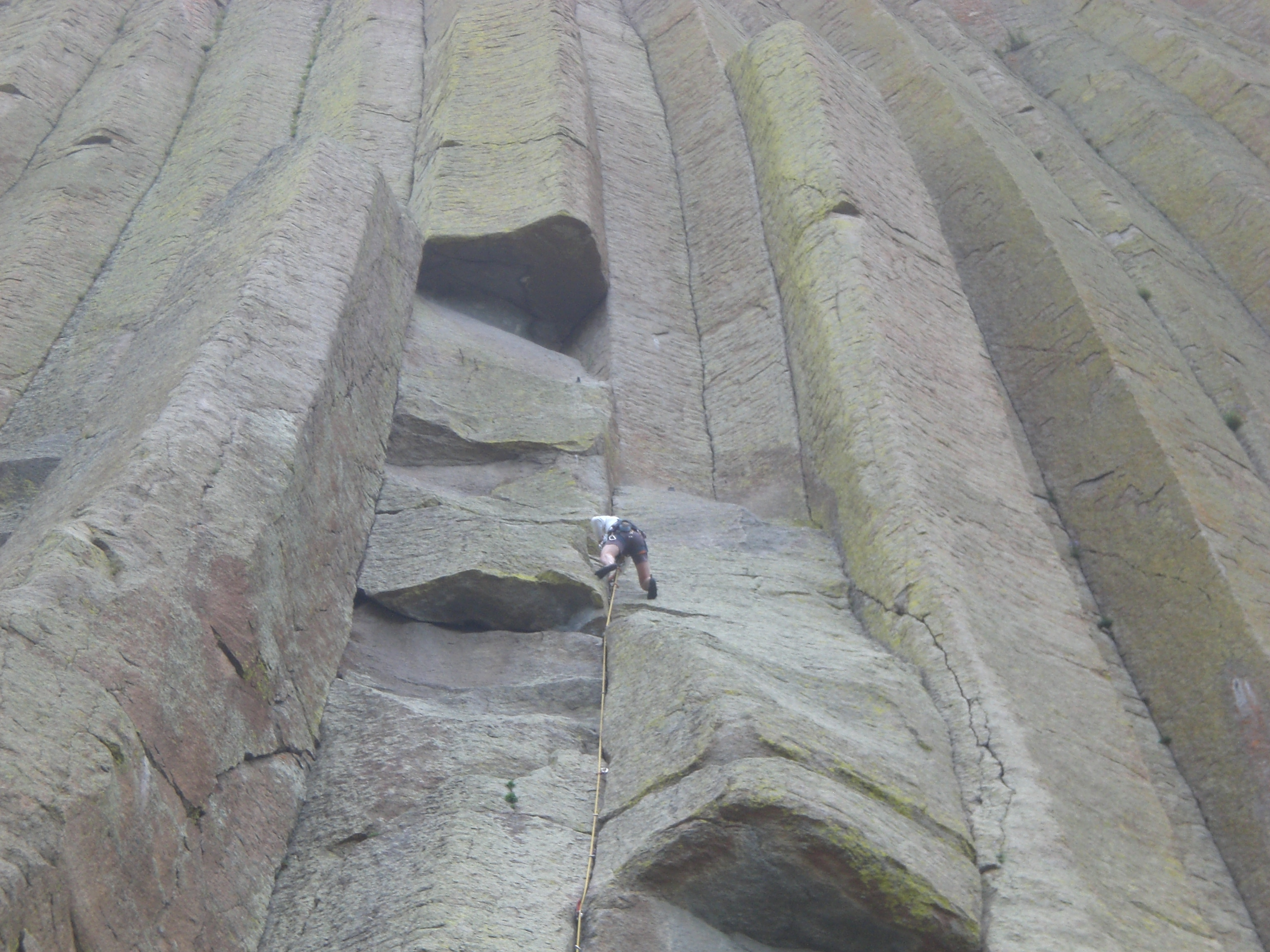
This guy is about as close as we humans come to that kind of mastery. He is a rock climbing specialist. As a result, he’s achieved a degree of control and skill that looks a lot like what the Swifts have. Sadly, that’s not for me. I can’t devote myself to rock and since I lack any singular genetic gifts, I’m doomed to mediocrity. I don’t mean to imply that I’m lukewarm on rock climbing. On the contrary, as soon as the snow melts, I’m itching to smell warm granite and feel the crushing embrace of rock shoes on my toes. It’s just that, by the end of summer, I start longing for bleak landscapes, violence and weird new forms of water.

So if I came back as a Swift, I’d probably start watching the vultures soon enough, wishing I could be soaring up high instead of whipping around the Tower like a madman. Maybe I wouldn’t cash in my tickets on swiftdom after all. Perhaps something small and terrestrial, with a bad attitude and a wicked set of teeth…

Tagged , ,

Solo

Climbing is generally misunderstood. The sport’s diversity alone makes it opaque. The motivations of mountaineers, sport climbers, boulderers, alpinists and aid climbers are inherently heterogeneous solely based on the nature of the climbing discipline each group pursues. Add to that inherent diversity the large number of  dilettantes and duffers which climbing attracts; participants who themselves do not appreciate all the possible benefits and dangers the sport offers. Little wonder the public sees climbing as a sort of gray soup with a troubling  aroma, which would be a puzzling thing to sample voluntarily.

Among the various disciplines in climbing, soloing is the hardest to understand. Abandoning all safety equipment save one’s own body and adjunctive tools may appear foolish, bold, transcendent, or egotistical depending on the observer. It is a challenging taste for climbers and non-climbers alike.

To be clear, soloing means intentionally trying something hard without a rope, not accidentally venturing into a climb or die situation. Everyone has one or two of those in their closet. Nor does it mean dispensing with protection on ground one dominates. Purposefully entering a situation in doubt with the understanding that there will be no salvation takes something different and gives something different than those incidental circumstances.  Much, perhaps most, of the climbing community disavows it. But the truth is, most who participate in the sport have pursued it at some point. That’s logical, since soloing is the only reproducible means of achieving one of the unique benefits of climbing: self-destruction.

We all harbor the urge. Who hasn’t felt the fleeting impulse to steer into a bridge abutment or fought the pull of the abyss while looking over the edge of a precipice? This impulse to rebel against the rules of self-control is quite reasonable. After all, our identity is just a convention. It is a yoke imposed by the thin layer of cells covering our brains on all the structures beneath. To have any hope of success, the self must be founded on a tyrannical belief in its own preciousness, only then does it have the strength to make the rest submit to the restrictions inherent in its own preservation.

This product of the cortex is illusory. Ever since we became aware, we have tried to wipe away the limits which the illusion imposes. Our religious history is a chronicle of such efforts and their failures. We have a messiah who cried out for himself from the cross. We have scores of Bodhisattvas, but no more Buddhas. Rather than unshackling us from our identity, religion has settled for turning the self against its own weaknesses, but the project of making us “good” has  always been play-acting. Our consistent hypocrisy shows what a poor compromise it’s been. We were fools to think we could shake our identities in the presence of others. The only place to remove the self is in isolation, where it has no hope of salvation from outside.

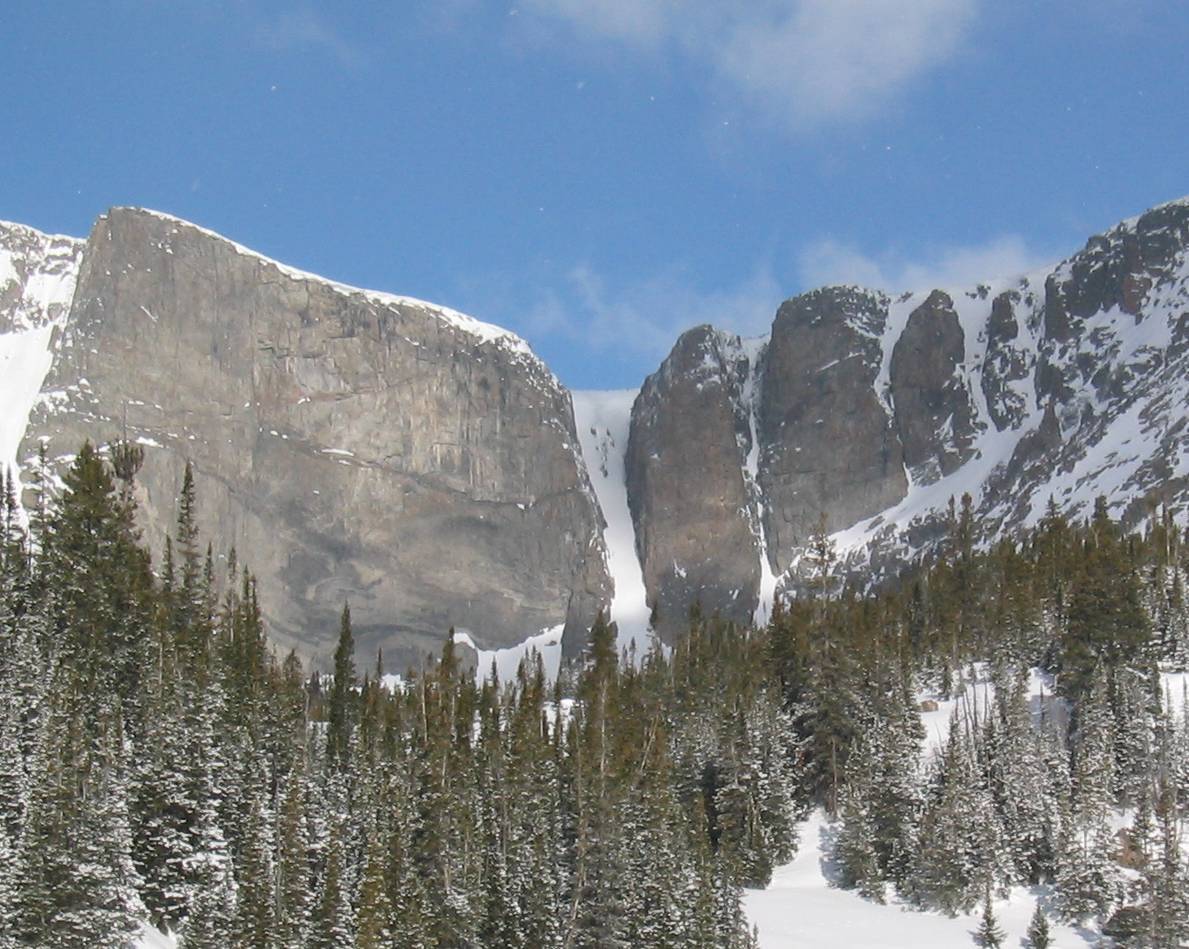
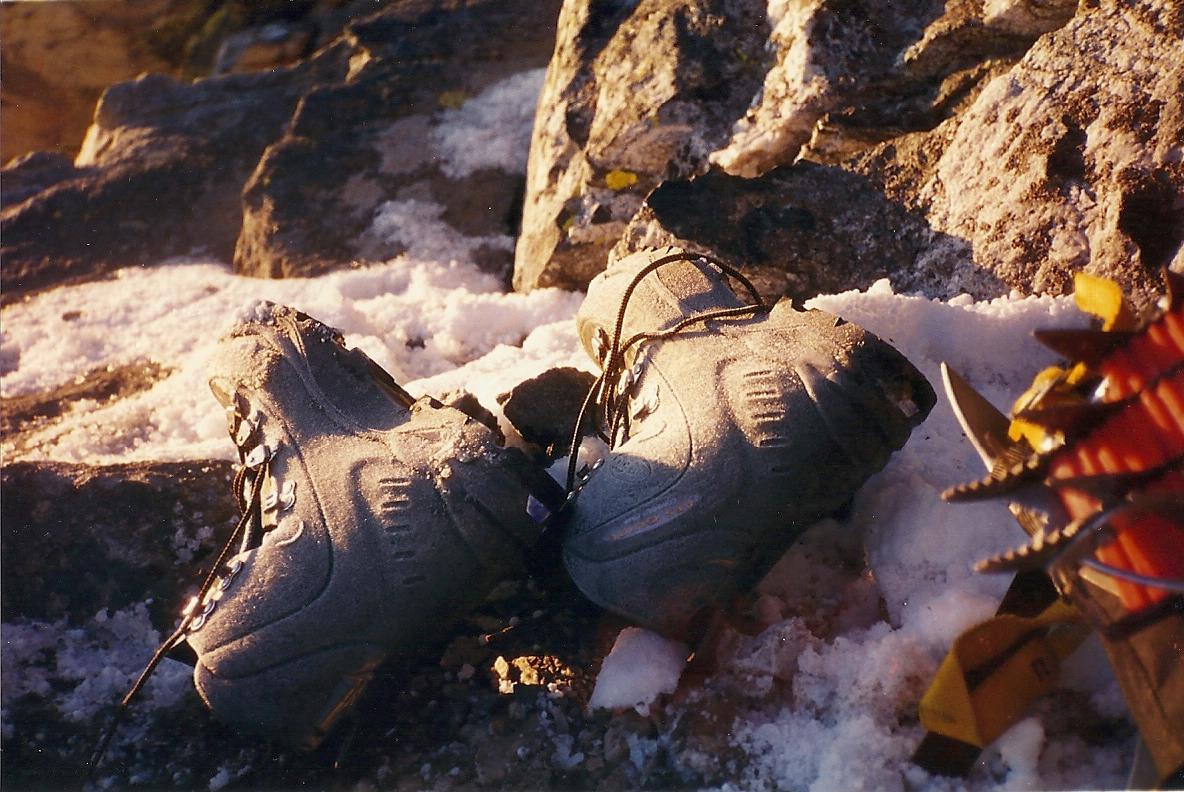
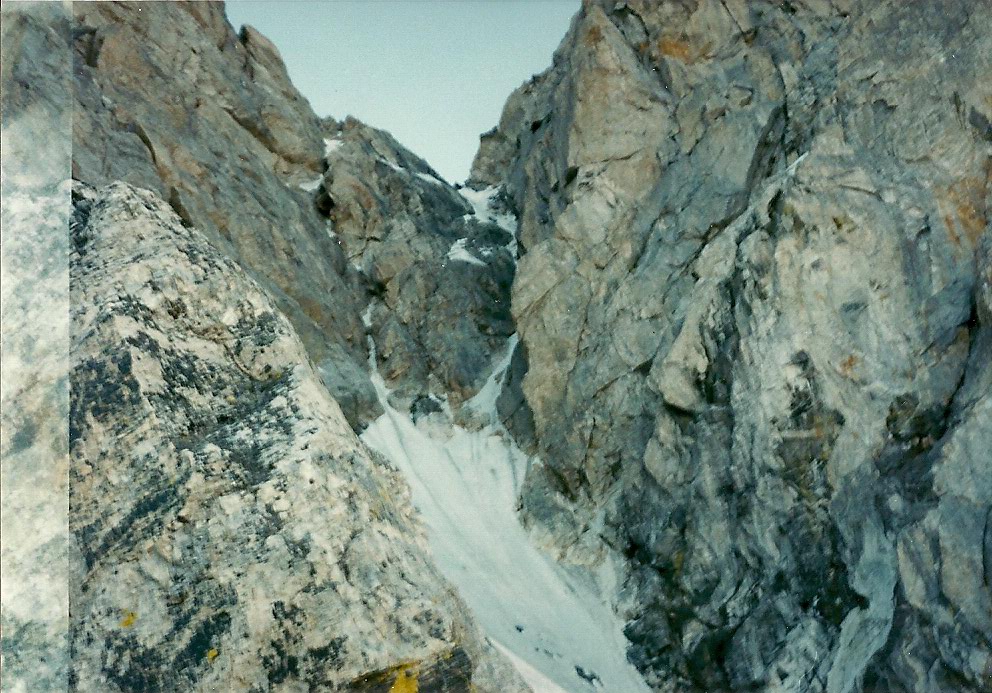
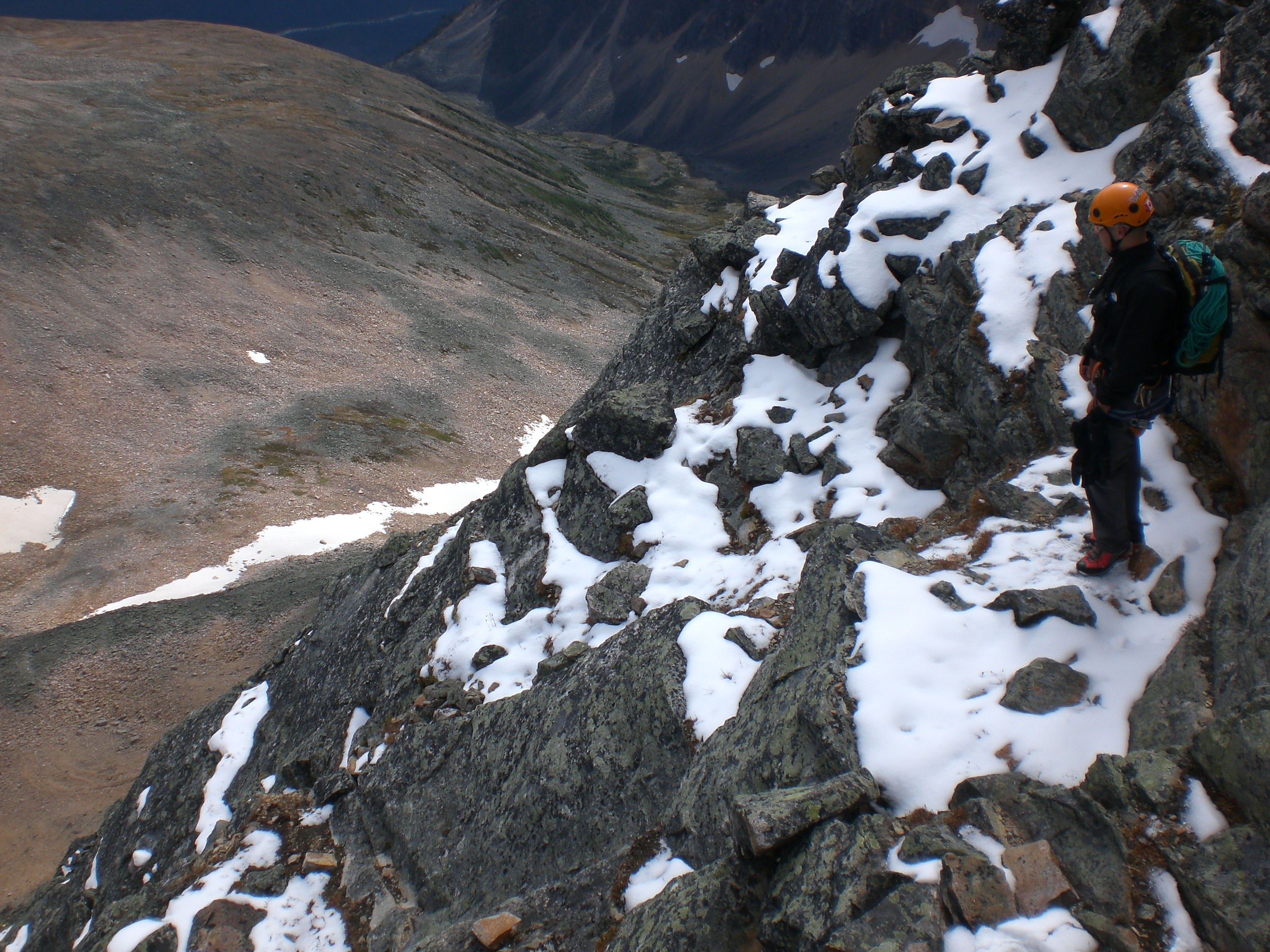
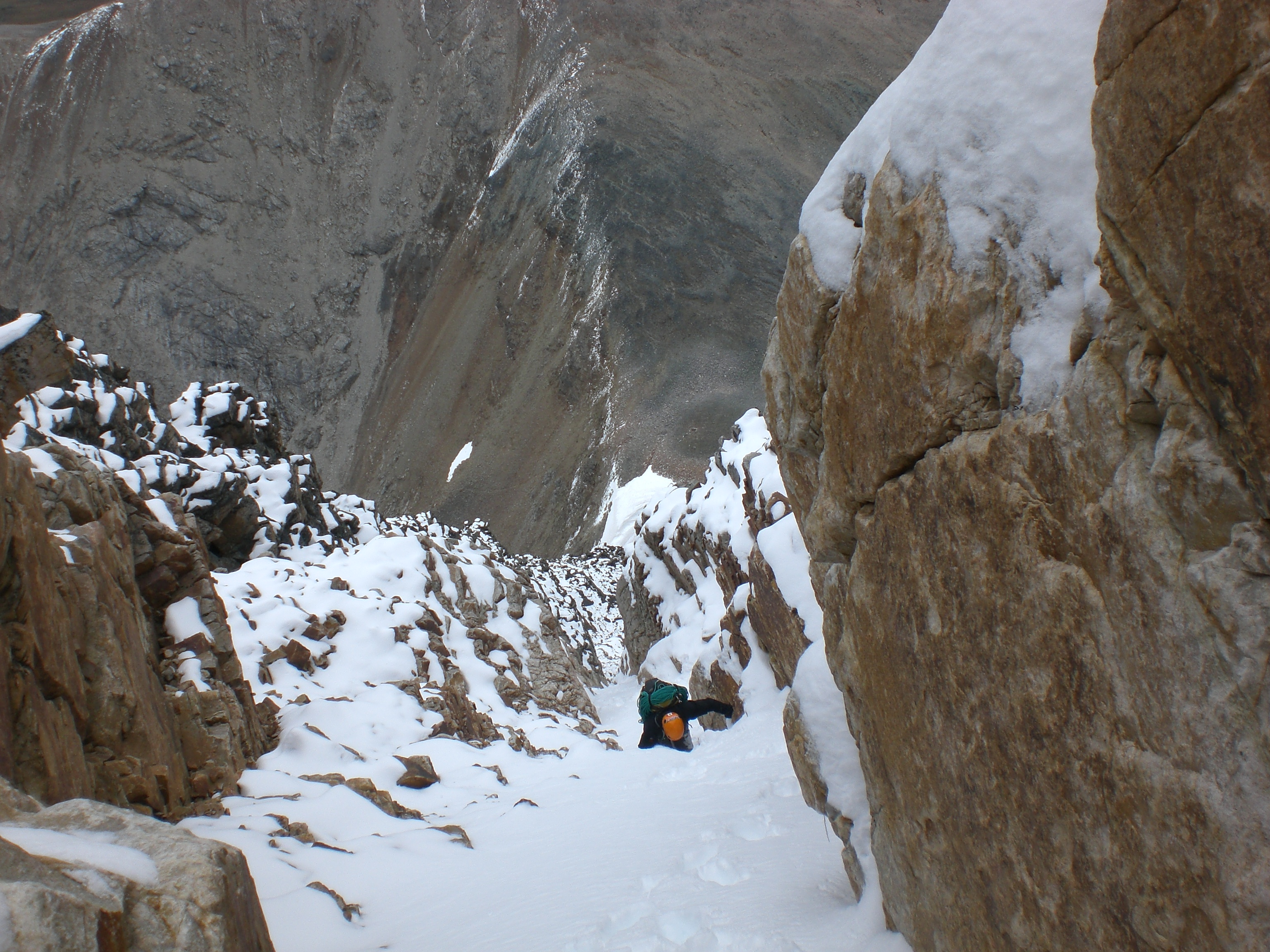
I have done a few solo climbs, but most were on the soft side. They were climbs I had done before with a rope or technically in little doubt. A couple have been for real, though, and the Black Ice Couloir was the realest of those. The route is not particularly hard from a technical standpoint. However, it is an alpine climb with attendant difficulties, including loose rock and variable ice conditions. At the time I climbed it, it was only a couple of grades below what I had ever climbed in the mountains and I was equipped with straight shaft tools, plastic boots and Foot Fang crampons. I wasn’t set to dominate the terrain.

I hiked up Valhalla Canyon the afternoon before the climb and tucked myself under a rock for the night. Several times on the walk up, I changed my mind. Immobility, nightfall and the confines of the bivy sack did nothing to ease the turmoil. Through the night I picked away at my fears with my ambition until both were in tatters. At about 2 AM, there was nothing left but the decision to climb. I sat quiet for two more hours, waiting for the alarm.

I moved up the first icefield by headlamp, and climbed a short, steep chimney on the right side of the headwall. A section of easy climbing passed quickly and I arrived at the second icefield with the light of day. Up to that point, I had felt calm, almost empty, but as I moved onto the ramp above the icefield, an intense focus and motivation took hold. Every move was perfect. A bolt of lightning couldn’t strike me from the rock. The traverse across the third icefield and the climb up the final gully seemed to pass in no time. The short mixed section where the ice ended felt so secure I wished it could go on forever.

Back in the sun, I made my way down to the lower saddle, lay down on the tundra and went to sleep. When I woke, I set off down Garnet Canyon and on to a path of destruction in the world beyond. I tried to bring that sense of perfection and unitary movement with me, to recreate it in the populated world. Of course, it stayed in the mountains, but the expectation was a portable hazard. A hard object, it battered everything softer than itself.

People and their things cannot reproduce the rewards of soloing, despite humans’ capacity to have those experiences for themselves. The preparatory tear-down itself precludes it. Doing that to yourself is illuminating; doing it to somebody else is just plain nasty. Besides, perfect things are transitory by nature. Held closed in memory or kept as principle, they turn rancid, however gently they are tended.

I haven’t done any more solos. Perhaps someday I will again, when I’m no longer wrapped up with other people or when I’ve honed my schizophrenia to an edge sharp enough to cleanly divide climbing from everything else. Until then, I’ll use a rope to protect me from falls and dangerous expectations.

Tagged , , , ,

Uh-Oh

Republican politicians be talkin’ bout risk:

Dependency is death to initiative, to risk-taking and opportunity. It’s time to stop the spread of government dependency and fight it like the poison it is.”                                – Mitt Romney

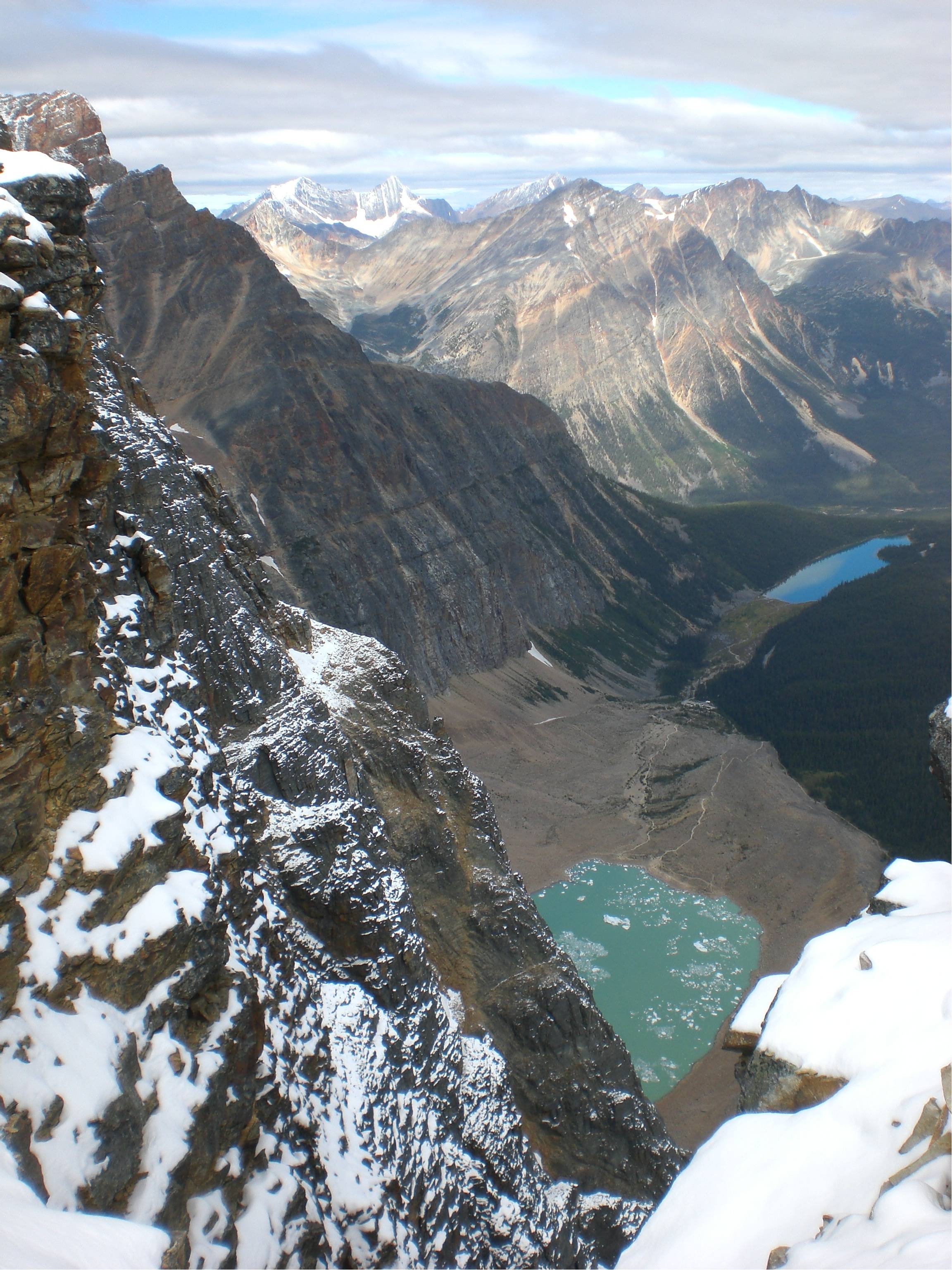
I’d like to extend an open invitation to Mitt, to go climb the East Ridge of Edith Cavell with me.

Now, I am rich in climbing skills compared to Mitt. Still, I expect him to be true to his convictions and simul-solo it with me. No matter how he begs, I promise not to poison him with dependency on the rope. Naahhh…

I’m not in it to demonstrate my superiority; there’s always somebody better. I’m not in it to tag summits or tick off numbers, those are empty pursuits and they denigrate the game. I’m in it to climb the hell out of everything I possibly can, and sometimes, that takes a rope, especially if you are going to take risks. It also takes a partner that’s got your back, even if you screw up.

So, I’ll throw the rope down when it gets to be too much. I’ll even bail if you can’t take the exposure, Mitt. I won’t sneer or otherwise be nasty about it either. I’ll do all those things because I value the society that the rope entails and because I am not a Republican politician. You don’t have to be either; I believe it’s not too late.

Oh, and if you feel like you aren’t up to it physically, Paul Ryan has made that same sort of statement, why don’t you send him in your stead. That little bitch is supposed to be in shape, isn’t he? I believe it may be too late for him, though – too much Ayn Rand.  That shit is poison.

Tagged , , , ,