Tag Archives: God

Cutting Up an Ox

IMG_1312

Ben Sasse fears for our youth.

He is a U.S. Senator, and therefore he is a very busy man with little time to spare for side projects. Yet, so great is his concern for our kids’ predicament that he has taken the time to write a book about it. It is not a bad book, even if you disagree with what it says. You will have to trust me (or not) on the exact contents, because, “You may not make this e-book public in any way”, is all I will quote directly from it.

His thesis is laid out in the book’s title, The Vanishing American Adult, and he has summarized the gist of his prescription in the subtitle, Our Coming-of-Age Crisis – and How to Rebuild a Culture of Self-Reliance.

In the text, he depicts a generation afflicted by aimlessness. They have been stunted by coming up in the shade of social media and cultural relativism. Deprived of the harsh choices and bright lessons that come with social responsibilities and traditional rites of passage, kids have grown passive. They lack the ‘grit’ to sustain our society.

I won’t quibble with his depiction. Social media is a blight. The current generation operates on the assumption that ‘someone will take care of it’. Giving up is always an option for them.

I do disagree with his diagnosis and prescription, however. He seems to think that helplessness and hollowness result from a deficiency of citizenship. The correction would then involve a big shot of citizenship. He is completely mistaken. In fact, emptiness is the natural outcome of citizenship, and helplessness is just a reactive symptom.

On the most basic level, citizenship is a position in which one gets told that one’s life is fungible. One’s time, attention, motivation, and psyche can be chopped up and traded for goods to satisfy certain needs. Of course, Sasse recognizes this situation. He mentions “development of the individual” on a couple of occasions as a worthy pursuit, but only if it is pursued to certain ends (becoming responsible, self-sacrificing, ‘gritty’ – in other words, all those things that make a solid citizen). As far as I can tell, only the ends distinguish healthy developmental activities from selfishness, in Sasse’s estimation. And in a shocking coincidence, healthy ends are those for which the goods of citizenship come in handy.

“Why won’t my blood sugar go down?”

Maybe my analysis is unfair. Sasse contends that we are all a little defective, and our institutions may be a little defective, too. We should not expect a perfect synergy between man and social machine, even though the basic program is sound and actually the best that we can do.

But I hear differently all the time.

“I’m doing all those things that the diabetic educator told me to. I have changed my diet. I am walking every day. I am taking my medications like clockwork. So why is my blood sugar still high?”

This person is in my office every day, wearing a different, outfit, a different ethnicity, or a different gender. Yet they are the same person. They have a sit-down job, or two, in which they spend 40-60 hours per week dealing with an incestuous dataset – something so about itself, whether it is driving a cab or processing claims, that it demands attention to automatisms rather than any  particular skill. To ensure that their attention does not waver, an overseer tracks their activities and rates their efficiency. Their extraneous physiological and psychological functions are regulated by the employer as distractions.

The citizen in my office sleeps 6 hours per night, or less. They drink energy drinks to keep going, and eat foods which the package or the vendor says are healthy, because they haven’t the time or energy to prepare their own food. They are too exhausted to exercise properly.

As a result, they are obese, diabetic and hypertensive. As a result, they now require one of the goods for which they can sub-divide themselves: medical care.

Which brings us to where the defense of citizenship as a natural-born fertilizer for human development, breaks down. The trouble with the whole thing is not the palate of goods on offer, their costs, or the means of valuation. The trouble is the chopping, because the roots of experience (attention, motivation, responsiveness, etc.) can’t be cut up for a purpose, especially for delayed gratification of a specific need. The very notion mistakes the nature of needs and the relationship between our needs and our activities. Here, Sasse may have been better served by spending a little more time reading Nietzsche, and a little less time reading Rousseau and the Bible.

For an organism’s needs can’t really be parsed. The motivations underlying our activities are merely aspects of a single motive which Nietzsche labeled ‘will to power’. Even when we try to perform an isolated act of attention, we feel something about it, our neuro-hormonal system responds to it, and it tires us globally.

But Sasse seems to think there’s a neat way around the problem of dividing the indivisible.

Life on the Farm or 8 Pitches Up?

In the latter half of the book, Sasse talks about how he sent his daughter to work on a ranch. The idea was to teach her how to enjoy work – not any particular task, but work itself. Basically, he sought to teach her how to thrive as an instrument. It’s pretty clever, really.

He explains the strategy in a vignette:

Martin Luther met a man who had just become a Christian and wanted to know how best to serve the Lord. He asked Luther, “How can I be a good servant? What should I do?” He expected Luther to tell him that he should quit his job and become a minister, monk, or missionary.

Luther replied with a question, “What do you do now?

“I’m  cobbler. I make shoes”, the man answered.

“Then make great shoes”, Luther replied, “and sell them at a fair price – to the glory of God.”

In other words, find integrity in being a good instrument. I think the flaw in this reasoning is obvious: Why not make great shoes to the glory of Satan? It’s the devotion part that really matters, right? This notion of the human lost at heart and essentially in search of a set of rails (any rails) undergirds fascism through the ages, and it works superficially, so long as the social venue is stable.

But I took another path with my kids, because I learned more from sitting on a ledge, than I ever did from a job.

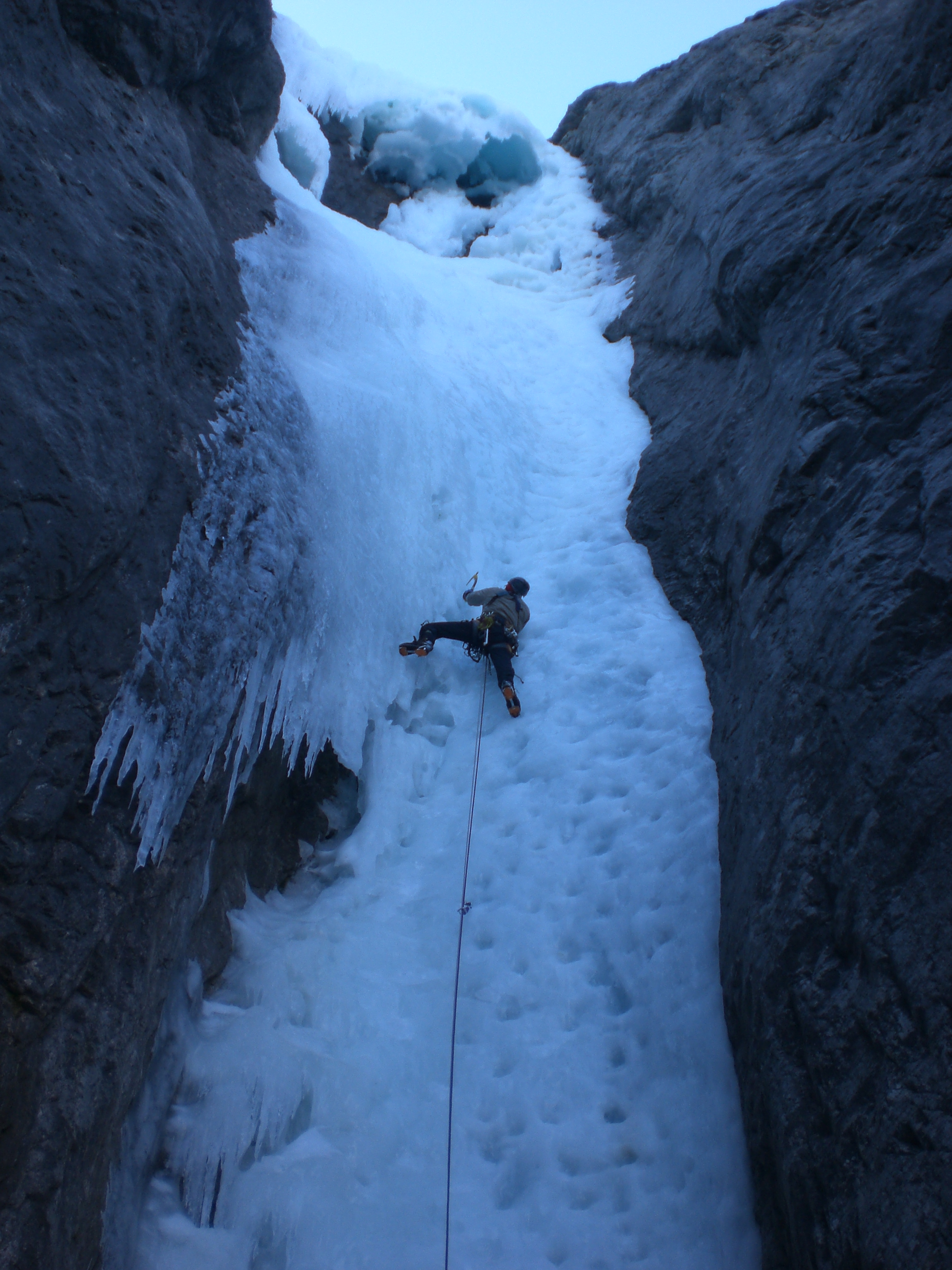
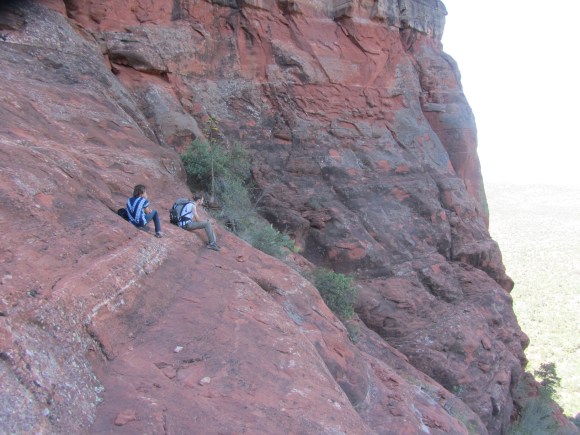
We have climbed several long routes together. We have looked up, down, and out from ledges in the middle of those routes and soaked in the lessons: however precarious the position, what falls to us is to pass the water around, check the system, and find our way through the next rope-length of terrain; trust your partners as you trust yourself; no matter how cold, hot, tired or thirsty you are, the beauty of the sky and landscape remain; achievement, i.e. ‘ticking the route’, doesn’t really matter – it is only a means to get you to the ledge.

In taking them on those climbs, my hope was to offer them a way of life which put making a living in perspective, rather than telling them that making a living would put everything in perspective for them.

A different vignette illustrates my point:

     Cook Ding was cutting up an ox for Lord Wenhui. At every touch of his hand, every heave of his shoulder, every move of his feet, every thrust of his knee — zip, zoop! He slithered the knife along with a zing, and all was in perfect rhythm, as though he were performing the Dance of the Mulberry Grove or keeping time to the Jingshou Music.
“Ah, this is marvelous!” said Lord Wenhui. “Imagine skill reaching such heights!”
Cook Ding laid down his knife and replied, “What I care about is the Way [“Dao”], which goes beyond skill. When I first began cutting up oxen, all I could see was the ox itself. After three years I no longer saw the whole ox. And now, now I go at it by spirit and don’t look with my eyes. Perception and understanding have come to a stop and spirit moves where it wants. I go along with the natural makeup, strike in the big hollows, guide the knife through the big openings, and follow things as they are. So I never touch the smallest ligament or tendon, much less a main joint.”
“A good cook changes his knife once a year — because he cuts. A mediocre cook changes his knife once a month — because he hacks. I’ve had this knife of mine for nineteen years and I’ve cut up thousands of oxen with it, and yet the blade is as good as though it had just come from the grindstone. There are spaces between the joints, and the blade of the knife has really no thickness. If you insert what has no thickness into such spaces, then there’s plenty of room — more than enough for the blade to play about it. That’s why after nineteen years the blade of my knife is still as good as when it first came from the grindstone.”
“However, whenever I come to a complicated place, I size up the difficulties, tell myself to watch out and be careful, keep my eyes on what I’m doing, work very slowly, and move the knife with the greatest subtlety, until — flop! the whole thing comes apart like a clod of earth crumbling to the ground. I stand there holding the knife and look all around me, completely satisfied and reluctant to move on, and then I wipe off the knife and put it away.”
“Excellent!” said Lord Wenhui. “I have heard the words of Cook Ding and learned how to nurture life!”
— Zhuangzi, chapter 3 (Watson translation)

I do not see the current generation as sissified hedonists, any more than previous generations. The hypersensitivity, the passivity, the absorption (self and otherwise) all look like symptoms of a bunker mentality. They see what’s in store for them and they don’t like it, but they don’t seem to know how to resist.

A Sasse-type message has gotten through. The citizenry coming of age does think that it must learn to embrace a social role (little worker, little voter, little contributor) wholeheartedly in order to fully mature, and it just can’t bring itself to do so. The instinct is right. Kids growing up in this era are being asked to pursue a sort of faux-maturity which involves merely “giving up childish things”, and the achievement of that state will leave them empty and utterly dependent on a structure which deals with them on the basis of a flawed methodology.

They need a little less Ben Sasse, and a little more Cook Ding, when it comes to advice about how to grow up. Because maturity means dealing with your situation – not just endorsing it – and dealing with it artfully. It means getting over being The Cobbler, The Christian, The Cobbler-Christian, or even The Cook.

In Sasse’s terms, I have laid out the Romantic counter-argument to his Realist argument regarding the nature of the individual’s relationship to civilization. But I reject that characterization to some extent. There isn’t an inherent conflict between the individual and the civilization. We are stuck with our civilization. It lies before us like the carcass of a great ox, and it is just as indifferent.

We get chopped up in our interaction with it, but our own hand is on the knife. And I agree with Ben Sasse here,  maturity is the solution. Not the faux maturity which the senator espouses, which is just a form of selling out, but actual maturity which sets limits and carves its own way, not towards some magical future, but like the cook’s knife, in the present where we all reside.

IMG_3666

Tagged , , , , , , , , , , , , , , ,

The Dilemma of Divine Purpose

It is often said that God is the source of human (and indeed, animal) purpose, and that without God, there is no purpose.

But what is God’s purpose, and who can say?

Let’s dispense with the common confabulation offered in response: God’s purpose is to do  just what he does and to be just like he is. Of course, this response defines the difference between an explanation and an assertion, and when it is stated as an explanation, it makes a very tight circle.

When God acts, he manifests divine will.

God created the world, so the world is meant to be a manifestation of divine will. In other words, it is meant to be just what it is.

Any questions?

But there is no real answer within the common confabulation. Maybe the question can be reframed to elicit a precise response.

Can God say why he created the world?

This is not to say that he need explain himself to us. Is he able to explain it for himself ?

If creation was instrumental to some purpose for God – perhaps a cure for loneliness – then creation is actually dependent upon some set of determinants of divine will, i.e. circumstances to which the divine will responds.

If so, whence those cicumstances? Even if God can say, we all (us via God) are beholden to those circumstances. For all of us, the circumstances simply exist, and therefore, all of us simply exist.

But what if creation was not instrumental? Let’s say God simply willed it. In that case, there is no divine insight in principle – not even a Muse to blame – and again, all of us simply exist.

So,  we all simply exist, God too.


Tagged , , , , , , , , ,

What Does It Mean to Be a Disembodied Mind?

Really, we should go to the source for a self-report.

We immediately confront a problem, then. Where do we look?

That is to say, if we are to establish communication with the disembodied mind, then we must somehow individuate it. It must be a candidate for intentional inexistence if we even hope to take heed of it.

Yet individuation is precisely the psychological consequence of embodiment.

Look at it from the other side. What if the disembodied mind wants to talk to us poor saps wallowing in bodies?

Mustn’t it make it make the subject-object distinction first? And if it does, hasn’t it wiped out any hope of qualitative distinction from the rest of the body-wallowers?

It is merely a prettier critter, after all.


Tagged , , , , , , , , ,

A Quick Defense of Fideism

First, consider the alternative: natural theology. It is a failure on two levels. On a technical basis, all the arguments which constitute natural theology rest upon a claim that God can be known in the same way that we know any subject of our experience. No matter how clever the argument, the basic  premise saddles a natural deity with some very limiting baggage – like an appointment book of times and places where the deity must be, with the associated activities and relationships. And, if the deity is the sort of fellow who can have an appointment book, then It is not the sort of fellow who can have all the limitless characteristics(?) which make a deity interesting.

Which leads to the level two problem: the arguments of natural theology lead to a deity who is completely uninteresting. Let’s say that someone came up with a cosmological argument which made sense, for instance. God is left with some familiar questions. It can’t tell anything about the source of Its motive by examining It’s creative act. It can’t say why It woke on our day #1 with the thought of creation in Its mind, any more than I can say why I looked at the ceiling fan when I opened my eyes this morning*. We are left with a God who is a guy. It’s a very powerful guy, but one who is in the same metaphysical boat as we are.

Two arguments are typically advanced to remedy the above situation. Let’s call them the Springboard argument and the Aspect argument. In the Springboard, we creep to the edge of an explanatory plank (think Aquinas’ contingency argument) and then launch to a conclusion by inference. For instance, the conclusion that, because we can’t abide an infinite regress of contingent causes, there must be a non-contingent cause at the source of causation.

In the Aspect argument, we are told that we may discover aspects of the deity by analysis of our experience, but that we should not expect to see Its whole structure due to our own limitations, though that structure is implied in the aspects.

The trouble is, neither of these arguments offer any explanation of what is in their remainders – the unexplained parts. In the Springboard, the remainders are things like an explanation of non-contingent causality. In the Aspect, the remainders are relations between things like intentionality and aseity or omnipresence. In other words, there is no account, in either the Springboard or the Aspect arguments, of the things lost in the guy-God conclusions of natural theology.

Implications are fine, but in the end, we need to be able to say what is implied, or we have gotten nowhere. Both the Springboard and the Aspect fail to give such an account, and we can see in their shared mode of failure, that they are actually the same argument. To understand an aspect of something which is unlimited and fully extant, is to understand nothing about “it”. To leap into an inexplicable conclusion, is to leap into the void.

But we are faced with voids no matter which way we turn. There are situations where we can’t climb out of our own skins (to borrow a phrase from Dr. Blackburn) to look into our own motives or the intelligibility of our experience. In those cases, no beliefs are possible, but assertions are as good as a shrug and a shake of the head.

So, if you feel that there must be something rather than nothing, nothing is stopping you. There.


*I can give a reductive explanation for what motivated me to look at the ceiling fan, but then I must explain my motive for reducing and explaining, and so on and so on…the motives seem to come first.

Tagged , , , , , , ,

‘Cause You’re Doin’ it Wrong

Regarding thoughts and discussion of deity, the question must eventually arise, ” Why?”. Once one has decided not to take such notions too seriously, why engage on the matter with those who do?

Morbid curiosity is part of the answer. Or to paraphrase a famous psychologist’s response to the same question about his interest in UFO’s: I am more interested in the motives for holding the belief, than I am in the belief itself.

But beyond morbid curiosity, there is an ethical impetus. For within the mish-mash of desperate apology and cognitive dissonance, lies a kernel of consistency. It begins with the question, “Why is there something rather than nothing?”

It is a ridiculous question, but the reason why it is ridiculous is interesting. We are in the world and can never step outside to see whether the world must be as it is, what other way it might be, or whether it must be at all. In light of our blindness on the matter, an assertion of existential necessity appears to need no further justification. And that’s good, because nothing explains (existential necessity) God, though (existential necessity) God explains everything  – if you believe it. And that’s as far as it goes, for those few who are ethically sound.

For the rest, they go on to endow existential necessity with intentionality, motive and any number of other, inconsistent properties, all as a way of swinging their dicks around  (to allay their own anxieties, most often). That is doing it wrong, and I just hate to see folks doing it wrong.


Tagged , , , , , , , , ,

Why Have Children?

img_1200

Everyone who has had children has asked themselves the question. The answers leave one feeling a bit squeamish, because the answers are all tautologies. The simplest is some version of: Because people have children. The more complicated responses – to make little caretakers for ourselves, for example – beg the question off to another, underlying tautology (We want to live because we live, in this case). There is no immediately obvious rationale.

The question in question is just the sort of question which religion purports to answer. But answers from divine purpose fare no better than circumstantial answers. The simplest answer from religion is: Because God commands it, which does not differ functionally from the first statement above, ‘Because people have children’. More nuanced responses again beg off to deeper tautologies, like the famed divine mission statement from the Christians: Man’s chief end is to glorify God and enjoy Him forever. The statement is lovely, but it is devoid of functional content. After thorough contemplation, we are still left standing around, awaiting the Lord’s instructions before we can get on with the glorifying and enjoying.

These tautologies lurk at the bottom of all teleology. No attempts to divine purpose from conditions avoid the fate of Leibniz’s theodicy. When applied, teleological excursions all discover the type of gem unearthed by Dr. Pangloss.  Study of a language’s syntax alone, will never reveal the language’s semantics. What is cannot tell us why it is, any more than it can tell us what ought to be. Attempts to divine purpose from structure, while operating strictly within the structure, are futile.

So, why have children? Why not? Or more precisely, why ask why? It is not a fit question.

Tagged , , , , , , ,

Guess What?

If you believe that your thoughts, feelings, and motives have – or are – explanatory causes, then you are a determinist.

You are also a physicalist.

If you think that God is a person with thoughts, feelings and motives similar to your own, nothing changes. You remain a determinist and a physicalist. God just joins the club.

Welcome.

Tagged , , , , , , , ,

Things and Things

No thing can come from nothing. And so, the argument goes, things must have come from something, hence the Lord our God, who neatly avoids the initial difficulty by not being a thing.

But then the argument trips over that initial statement. Because the initial statement is one about the nature of things and how we know things.

Being a thing means existing in the context of other things. Even those poor, deluded Platonists cannot avoid that fate for their Ideals. The metaphysical ‘light (or is it shadow?) cone’ of the ideal circle is distinguishable from the realm of the square, and that is part of being a circle from our viewpoint.

So, when we begin to speak of things coming from God, we have already begun to speak of God as a thing. We can back up at this point, and say that we don’t really mean to say things ‘come from’ God in the way that things ‘come from’ – in other words, are known by their association with – other things.

It is only a loose analogy. The way in which things come from God is not, in itself, explicable. There is no possible mechanism of divine emanation.

But that position is just a special kind of Nihilism. It is a claim of revelation, which stands opposed to explanation, and marks the end of argumentation. If one ‘just knows’, then one ‘just knows’ and that’s the end of it.


Tagged , , , , , ,

Buddy the Blastocyst’s Ensoulment Adventure

It’s the wildest yarn of them all. Be warned: you may not like the ending, but the thrill is worth it.

Let’s set the scene.

In the lead role, we have Buddy. He consists of a few hundred cells arranged in a hollow sphere. There is nothing too special about Buddy. He is not that far removed from the fused gametes which preceded him in that he is full of promise, yet without much substance or even a distinguishing feature. To be honest, he is a pretty passive character in his own tale.

As such, he is a perfect foil for the soul. The soul is no simpleton, and unlike Buddy, the soul is very difficult  to describe. Here we can turn to words from the wise philosophers and theologians who have previously contemplated the mystery of the soul. The wise have described the soul as the “I”-ness of experience or the proper subject of mental properties. The key point to take from such descriptions is: Don’t ask the wise for directions to the nearest coffee shop. Those directions are likely to lack substance.

Substance is exactly what we need in the case of the soul, to characterize it. Lucky for us, we need no more than substance, or at least the agreement that the soul is a substance distinct from the sphere of cells which is Buddy. Not everybody will agree. Some may contend that Buddy is simply the dawning realization of something which has always been, kind of like a Chrysler LeBaron. Let me try to clarify.

In a certain sense, one could contend that the specific turbulence pattern in the early universe, doomed us to the Chrysler LeBaron, because one could ostensibly track a chain of distinct events back from the structure of the LeBaron to the details of the turbulence pattern of the early universe. And by the same token, one could track the turbulence pattern back to a purported state of affairs before the early universe started doing anything. A claim of pre-existing potential opens up, of which the early turbulence pattern and the Lebaron are mere manifestations.

There are loads of problems with this account of history, but only a couple concern Buddy and his soul. First, we cannot do anything with this account. An auto designer in 1896 could not foresee the Lebaron in all it’s hideous detail. We can see the inevitable  manifestation of LeBaron essence in retrospect only. Think vitalism (and its discontents).

Second, the pre-existing potentials do not do anything for themselves. They are manifested, without occupying space or expending energy or participating in the manifestation process, other than as an additional explanation. Like solipsism, the tale of essences suffers from terminal irrelevance.

Therefore, Buddy shall receive soul-stuff rather than a post-hoc rationalization.

Now, what is the nature of Buddy’s relationship to his soul, and how does the soul adhere to that little, hollow sphere of cells? Maybe the second question is too ambitious. Yet at least there has to be a singular moment in which some sort of threshold for ensoulment is surpassed and the membranes which a moment ago contained only chemical elements now serve as vesicles for spirit.

Some spirit-permeable membrane channel opens or an angel-beacon gene gets transcribed, and the soul binds to Buddy irrevocably. This must be the case. We want an active soul for Buddy, so he cannot merely slip into it. In that case – where Buddy is the realization of some soul formula written into the cosmos – we are right back to the maximally inefficient essences.

Once he has his soul, Buddy begins to exist in two worlds at once. He takes in nutrients, builds membranes, and generally engages with events in the world. At the same time, he is moved by the spirit to do Good or Evil, and his soul bears the weight of his activities in the world.

At the end of it all for Buddy, he can stand in the court of the Lord and the Lord can say to his angel, “Bring me Buddy and I shall judge him, for he lusted after a Unicorn Frappe and was moved by the wickedness in his soul to purchase a Unicorn Frappe, and his soul was soiled by the act. ”

“Wait, who is this you bring before me? No, no, that’s Benny, who turned aside from his evil impulses and purchased a tall coffee. Now let Benny go and bring me Buddy, who smells of shame and sugar, not wholesome ground roast.”

How else does the Lord know who is Benny and who is Buddy?

And so we have arrived at the shocking dénouement: the story of Buddy’s spiritual existence and his physical existence are one and the same. His soul, however convoluted the mechanism, moves electrons, as much as a magnet moves electrons. His soul, as much as any magnet, is moved by electrons. In being so engaged, Buddy’s soul becomes part of the reductive explanations which constitute physicality.

Is this the end for Buddy’s soul?

For his soul as a supernatural substance, maybe it is. But the point of the story is: those supernatural substances can’t get going in the first place.

They just don’t hold together at all.

For Buddy’s soul as a strange appendage, who knows?

The world is a weird place.


Tagged , , , , , , , , , , ,

Can Demon Possession Make You a Better Ice Climber?

I’ve been wanting to sell my soul for a while now, but I just can’t find the right buyer. I’ll admit I didn’t think it through before I started looking, but who does? This sort of transaction has such a history, it’s hard not to slip into the ruts, and I did. The first buyer I considered was the Devil.

It turns out that he has already had a pretty extensive background check, and is not considered a good risk. Even though a seller knows that the Devil is the embodiment of dishonesty, it is almost impossible to devise an effective means to circumvent that fact. A whole lot of very smart people have evaluated deals with the Devil, and the consensus is that even if you get what you want, you won’t get it in the way you want, which, unfortunately, is crucial.

Having rejected what the Devil had to offer, I next considered God. Dealing with an all-powerful, benevolent entity takes care of the reliability problems which confound deals with the Devil, but I had to reject a deal with God as well. As an all-powerful being, he can be very picky about what he offers, and as a benevolent being, he’s only going to offer what’s best for you. Trouble is, what’s best for you isn’t necessarily what’s good for you. He offers one package built around guarantees of immortality and eternal pats from the hand that holds it all, including ultimate reassurance. Your satisfaction is guaranteed, and there is the problem. If you make the sale on those terms you will be satisfied with what you get, and stop wanting whatever it was that prompted you sell in the first place. In that case, the crusaders had it right. Once you settle, it’s best to find some helpful fellow to kill you quick so you can get to the goods and avoid running afoul of  contractual conditions.

With the conventional choices eliminated, I decided to go with eccentric, so instead of scrolling through the Saints or Old Testament demons, I investigated Laplace’s Demon as a possible buyer. Laplace’s Demon is part of a thought experiment about determinism. The Demon is a perfect calculator who, knowing the initial conditions of the universe, can figure all future conditions. A critical few cast aspersions on my inquiry, saying that the Demon was a purely imaginary creature. However, during my background check of God I had encountered the Ontological Argument, which said that if I could imagine a perfect being, the only way it could really be perfect was if it was real as well as imaginary, so a perfect imaginary being must also be a real being. I had received a reassuring number of reassurances from the keepers of the Lord’s earthly franchise that this metaphysical maneuver actually detected a real  quality of the universe via an indirect examination of the nature of our minds and didn’t just ignore the dependency of imaginary objects. It seemed I was on the right track. Sadly, the complete examination of Laplace’s Demon ended in disappointment as well.

I have to back up for a moment here to clarify my motivation for marketing my soul in the first place. It is a modest ambition, really: I thought I might be able to trade my soul for something that would make me a better ice climber. You see, I am very dissatisfied with the method and means of improvement available to me currently. The method is learning through practice and progressive challenge. The means is critical appraisal of what it is ‘like’ to properly swing and weight an ice tool. The means part is the real problem; I could live with the method if I didn’t have to deal with the vagaries of the means.

Swinging an ice tool isn’t like juggling or jumping rope. Once you know the technique, you don’t just get better by repetition, up to your physical limits. You have to know what a good swing feels like so you can know whether the pick has set well in the ice, and if it hasn’t, just how badly it has set. Everything else – the energy you expend for each foot of upward progress, the security of the protection you place, the speed of your ascent – follows from what each swing is like. By the same token, the quality of a swing depends on a huge bundle of factors beyond the alignment of the elbow and timing of the wrist-flip. The quality of my swing follows from the appearance and feel of the ice, my level of mental focus, my level of physical responsiveness, the accuracy of my estimation of my physical responsiveness, etc..

It’s an impossible set of variables to track, but all together, they feel a certain way when they fall together right. To get better,  I can match every swing against the memory of that right swing until they begin to cluster closer and closer to that theme. There’s a hidden bonus in this means of progression, too. I can use the information I get from what a swing is like in combination with the same kinds of themes regarding body position, balance, and ice structure to sort out an entire climb, both before I start and as the climb unfolds. Though it’s a slippery and imprecise means, my mind, anybody’s mind,  can use it to manipulate otherwise intractable sets of details, albeit by proxy, which brings me back to why the Demon can’t help me.

To have the reductive knowledge that he does, the demon must rely on one simple trick: he ignores time. Since events are multiply contingent upon other events in an ultimate reduction (or even in an incomplete one) the resulting structure, with all events completed and with all the chaotic processes gamed out, is a web of converging and diverging causal chains. From the Demon’s viewpoint, it makes no sense in sequence, any more than it makes sense to say an unmarked map has a beginning or end rather than boundaries. Given his quirk, the Demon can help me in one of three ways. First, he can jump in and yell, “Stop!” when I approach a point where a bad swing exists. That may only make things worse. Second, he can take over and guide my arm, but to realize each step to a good swing in sequence is likely to take ages in lining up, or proceed in fits and starts as he makes adjustments to jump from path to path, neither of which I can afford. Third, he can show me where I am in the interlocking mass of causal connections relative to a good swing, but then the information is only approximate until I actually swing (or close enough) and that’s just the kind of situation I’m trying to escape.  Laplace’s Demon is no more helpful than the Devil himself. I can’t use either of them to cheat the world out of another degree of freedom. I’m stuck feeling my way through with qualities and beliefs about qualities.

The worst part is, I suspect I am taking advantage of the means I have about as well as I can, as is the rest of the species. Our brains are quality having, belief generating, story telling organs. The stories our brains make are good enough that we can’t say for sure where the stories end, and where their causes begin. I don’t think beliefs or qualities cause anything, but maybe they do capture something about the way the world works that reduction misses. They seem like way points on the Demon’s map of causal relations, marking time. Even so, I can’t say for sure that qualities and beliefs aren’t real things, determining the actions of their constituents. That would require an external perspective, like the kind a perfectly knowledgeable Demon could give me. Hmmm – What does the Ontological Argument say about contacting a perfect being, and whether or not I can get an hourly rate?

Tagged , , , , , , , , ,