Tag Archives: meaning

Weaponized

There is an interesting post here about jargon. It explores one of the useful aspects of jargon, and as a consumer – indeed a purveyor – of jargon in the medical field, I completely agree. Technical terms give us simple clarity, and simple clarity is one of the most useful things around.

The post focuses on the utility of jargon within its natural environs – dialog between professionals, where it is quite useful as shorthand. As an example from my world, when I say ‘appendicitis’ to someone in the medical field, a fairly specific array of physiologic and anatomic processes comes to mind, along with their likely manifestations, consequences, implications for diagnostic testing and treatment, associated research studies, etc.

The conversation can move right along. Plus by way of its scope, the use of technical terms can serve as a check point in the dialog. If there is a malapropism, it is apparent.

When a colleague says, “The negative ultrasound ruled out appendicitis..”, the conversation must stop. We must clarify why he thinks that the ultrasound ruled out appendicitis, because it is commonly accepted that ultrasound does not, in and of itself, rule out appendicitis. The term ‘appendicitis’ as jargon, contains the understanding of its diagnostic criteria for those in the know.

The situation is different when a patient says, “I think I have appendicitis.”

Typically, the lay person who makes that statement knows little to nothing about appendicitis. The word refers to little if any of the content it carries when I mention it to a surgeon. However, the same process flows from its use, or rather misuse.

The lay person’s usage brings up the question, “Why do you think that you have appendicitis?”

In other words, technical terms provide some solid surfaces in an otherwise squishy conversational world. If we can’t alight upon them, then at least we may bounce off of them in some direction, rather than landing splat in misunderstanding or mere conflict.

The common complaint that jargon is obfuscation doesn’t hold up when we consider the honest usage of technical terms, even outside of their professional environment. There is, however, a dishonest way of deploying jargon.

The current poster-child for such corrupted terminology is ‘mindfulness’. In its original sense, the word referred to a non-reflective state. The idea was: your mind stays fully engaged with what is happening in its scope of awareness, without reaction or abstraction. It was the kind of thing which dart players, test-takers and athletes sought.

Now, though it still gets used to mean engagement with the present, it may also stand for a state of detached self-awareness, in which one is monitoring and regulating one’s responses to one’s present situation. Clearly, the latter meaning is at odds with the former, if only because the latter refers to an essentially reflective activity.  Dishonest users of the term shift back and forth between the meanings depending on the goals of the user’s discourse. If the occasion is a corporate retreat aimed at promoting harmony in the workplace, the second meaning is used. If the speaker wishes to convince the listener that chronic back pain does not require morphine if one simply ceases to reflect upon said pain, then the first meaning of mindfulness is implied.

Clearly, the sort of shenanigans at work when people bat around ‘mindfulness’ are what give jargon a bad name. Mindfulness started out its career innocently enough, as something which Zen practitioners and coaches discussed. But along the way, it picked something up. As something useful, it came to possess an air of desirability. As something desirable, it acquired the reputation of being something good, and then, of being good in itself.

Once imbued with moral character, the technical meaning of mindfulness, along with all associated contents relating to its use, became subsidiary. Being mindful became less important than being a mindful person, and when a moral role presents itself, it is open for definition. The corporate lecturer can tell us what a mindful person does at work. The pain specialist can tell us how a mindful patient takes medicine. The roles make the meaning henceforth.

The situation seems at least a minor victory for the moral expressivists – those who claim that our moral claims are not claims at all but expressions of sentiments like approval and disapproval. It would be a victory too, if the abusers of technical terms were actually making moral statements. But they are not.

When people utilize a bit of jargon with moral character, they are using it as a means to an end. They are weaponizing it. The listener doesn’t receive a sentimental expression from the speaker; the listener is invited to fill in the sentiment. The audience at the corporate retreat must make the connection: a weekly post on the suggestion board means I am mindful, which means I am good. That line of thinking isn’t really moral reasoning; it is a facilitated rationalization.

Jargon as a technical tool is not the problem. Yet, we are right to be wary of jargon. Its use should put us on the lookout for manipulation. But we should not be afraid to use it either.  We must just take care to use it mindfully, by which I mean being critically aware of one’s attitude toward the current subject, which was once known as being an adult. Oops…

Tagged , , , ,

The Time Has Come

IMG_1083

The oldest child will begin to lead. I’ll admit, I’m a little nervous. Leading is for real, or at least a little more for real than following on a toprope. Still, the transition to leading is as much a shift in psychological reality as it is in physical reality.

You lose control of the short fall, but gain some control over the big one. Tying in to a rope through someone else’s anchor never feels quite the same after you start leading. It is better and worse at once, since you know how many ways their set-up could be defective, and you commit to trust it nonetheless.

I don’t want him to fall. I sure don’t want him to get hurt. I suppose I could turn around and tell him to hoard his life. He wouldn’t abide the dysfunction that goes along with hoarding, though. Ambition turned toward more and more security for its own sake. Money to buy security. Prayers to beg security. Saturdays at work and Sundays listening to some chump explaining how nice it would be to live forever, and how penis-mechanics somehow preoccupy the Almighty. He knows better than all that; he’s watched the swifts.

IMG_1084

Trying to be attractive? Pretty sure they know shit about attractive.

White-bellied swifts fly around our crags. I have seen them fly through a crack narrower than their wingspan and reverse course almost within their own body-length. They happen to feed on bugs loitering around the cliffs. What they do, however, is fly. The bugs are incidental.

Once you see that arrangement of motivations and necessities, you can’t see it back the other way. So, I don’t think I could stop him from leading, even if I really wanted to.

IMG_1085

It’s OK. I can live with the nervousness. It is an incidental. It will get its due and no more.


Tagged , ,

Dreams in the Witch House

Though it is not one of H.P. Lovecraft’s best stories, Dreams in the Witch House is one of his creepiest. The creep factor mostly emanates from the witch’s  familiar, Brown Jenkin. Jenkin is an intermediary from the netherworld, enticing the unwary to enter. A rat/human hybrid, Jenkin eventually dispatches the protagonist by emerging from the wall (which is actually a partition between alternate planes of existence as well as one between indoors and outdoors) and chewing through the man’s body while he sleeps.
Tunneling through a person in his sleep is chilling enough, but what makes Jenkin really creepy is what it represents: shadowy possibilities which gnaw away at us to our demise.

H. P. was a big believer in the old aphorism, “curiosity killed the cat”, (I’m sure he pictured the inquisitive animal sniffing too close to a questing tentacle). He was leery of natural philosophy run amok, based on what happened to the fabled cat. Science, he felt, risked exposing our dearly held beliefs as a mere façade, laid over an alien, chaotic, deeper reality. H. P. was a little odd, but he has never been alone in his fear of hidden truth – or in his attraction to it.

The fear of a hidden truth appears to drive quite a bit of discussion surrounding the philosophy of mind. The fear manifests in varieties dependent upon the school of thought involved. For some positions, the fear of hidden truth appears to be their primary impetus.

Modern-day substance dualists, for instance, fear scientific implications of an explanatory mechanism for activities which tradition ascribes to the soul. The idea that intentionality or qualitative experience may be dependent upon coarse, material goings-on horrifies them. Their revulsion is compelling enough to make arguments from incredulity seem plausible.

“How,” they ask, “can a thing be ‘about’ something?”

Yet, when one fires an arrow at a target, the arrow flies at the target. Something compels it to do so, rather than allowing it to appear suddenly on the moon. Likewise, it remains an arrow, which is a big part of why it flies at the target. The archer attending to the arrow’s flight maintains her identity and has determined her course as well. Even when she visualizes her shot before releasing the bowstring, her intention derives from the same set of considerations determining the shot, albeit in a roundabout way. Maybe she is just importing her perspective on the shot all long and it’s all happening in her (and everyone else’s) head, but that doesn’t matter. The outcome is the same, whether it is the mental substance or the physical substance which is reduced. Reduction is what the substance dualist really fears.

Monists are not so different. They have faced up to the implications of natural philosophy, yet they still fear the loss of mental causation in their schema. The feared outcome of reducing our mental activities to their base, physical mechanisms has been described most eloquently as a “Ghost in the Machine” scenario. In that case, our  consciousness is the ghost,  a mere byproduct with the mistaken impression that it is in charge of things while it is really  looking on impotently as all the little neurons in our brains respond to various stimuli.

The troublesome issue at work is ‘downward causation’. When the archer releases her arrow, do we think that her will causes the arrow to fly toward the target, or do we think that it is the action of her muscles, muscle fibers, the chemical bonds in the arms of the bow, and on down the line? Natural philosophy tells us that the little things add up to the big ones, in terms of how the arrow does what it does. The limbs of the bow springing back into shape do not cause the chemical bonds to behave as they do; it’s the other way around.

We readily accept that state of affairs when it comes to bows and arrows. But if brains and minds bear a similar relationship to their base constituents, then willing the arrow to fly fares no better than the bow’s springing back – it is caused by what’s going on in the neuronal circuitry rather than causing anything itself. The alternative to accepting this arrangement for brains and minds is to make a special exception for mental activities.

Yet it seems impossible to do so without undermining natural philosophy. We may wish to do so, to save mental activities as causes, but it is hard to see how we could avoid hypocrisy. We would still use our knowledge of chemical bonds to build better bows and devise more effective anti-depressants. We would still act as if the bottom-up story were true.

On the other hand, if we accept the bottom-up story for ourselves, what is the point in asking all these questions in the first place? The repercussion of our conclusion is that we are onlookers, like spectators at a sporting event whose critique of the game is utterly ineffectual. It’s hard to see how such knowledge means anything. Just as we risk hypocrisy if we veer away from natural philosophy when it comes to mind, we equally risk hypocrisy by accepting bottom-up explanations when it comes to mental phenomena – we will continue to behave as if our experiences, intentions and motivations make things happen. What to do?

Richard Feynman gave us a clue to the answer.

“If you think you understand quantum mechanics,” he said, “you don’t understand quantum mechanics.”

Quantum fields are not phenomena with which we are familiar, nor can they be. They may not even be ‘really real’. They may simply be the hooks upon which we hang our descriptions of broad regularities in the world of the very small. Furthermore, it doesn’t matter whether the entities to which quantum mechanics refers are real or not. The theory predicts the regularities of the Lilliputian realm – it works.

The thing is, do any of our theories, right down to everyday descriptions, bear a different sort of relationship to their subject matter? When Ernest Rutherford said, “All science is either physics or stamp collecting,” he meant that physics told the basic, really real story of what was going on in the world. Chemistry simplified physics and summarized the really real story of the microscopic world on a convenient level, and so on for biology, geology, meteorology, etc. But his analysis flips the relationship between the disciplines. If we say that Osmium is a metal which conducts electricity and heat at a certain efficiency, has a certain density, reacts with other elements with a certain propensity, then we need ‘bridge laws’ – extra rules – to relate those chemical properties to their associated quantum mechanical phenomena.

The upshot is, only once we have found the Osmium can we find the particular arrangement of quarks, electrons, up-spins and down-spins without which there is no Osmium.

It is easy to turn around and say, “Oh, that’s just what Osmium is.”

But without Osmium and it’s chemical properties, where is our basic-physics explanation? The phenomena explained by the higher level theory permit an explanation in the lower level theory.

And isn’t that how we know about Osmium itself? It is something which responds to our poking and prodding with fire, pushes, and shocks with an elemental predictability. Once we have an atomic explanation for Osmium, we can use a mass spectrometer to find it more reliably, but our target is still the Osmium, not its counter-factual-supporting constituents.

This world of theoretical explanation is terribly confusing. It is confusing because theoretical explanations are not what we normally consider explanations at all. Theories are useful, but they are not true as we wish them to be true – precisely and thoroughly.

We expect our explanations to be more genealogical. Confronted with a piece of Osmium, we can’t be satisfied with atomic weight and number. Those qualities do not explain this piece of Osmium. Rather, we must know how (and so why) the Osmium is in this lump, now, in this place. Break it down to the sub-parts, the quarks, if you will, but the structure of the story does not change.

Where does that leave the Ghost? Where does that leave the mental substance? The Ghost haunts neurobiology, not a reductive explanation. We think our neurons and their activities are our own. We feel comfortable with the idea that we are not exactly the same person if one of the little guys stops working or grows a new dendrite in the course of learning about the atomic number of Osmium. We are comfortable with the change because it occurs within a historical framework, and that framework lends us a persistent identity.

The mental substance seems doomed to participate in some kind of reductive explanation as well. It’s hard to see how it pertains to us, personally, if it does not. If it does participate, then we can call it a substance, but not a separate one. If there are spirits and ectoplasm, then they are located in the same historical framework as the lump of Osmium, its electrons, its quarks, etc. and make their mark, at least upon our consciousness, within that framework.

There are no hidden truths, then. There isn’t some subtext where it all breaks down, as H.P feared. Or if there is, we can never find it.


Tagged , , , , , , ,

What Do You Really Fear?

If God has an explanation, how does It remain God? If God has no explanation, then why all the fuss?

Tagged , ,

Worried About That Gag and Dog Collar in Your Closet? Let Me Show You Something…


IMG_1030

As I was shopping for knee-pads, I realized: I might have a problem. It was clear that I had developed an unhealthy appetite and here I was, about to feed it. The pads would allow me to wear lighter clothing and so carry on climbing wide cracks into the heat of Summer.

IMG_1031

I fondled one of the expensive pads. It was real leather and neoprene. Clearly, the expensive pad was superior, but it would get destroyed just as fast as the cheap ones. My poor technique limited the pad’s lifetime, sure. However, the nature of my needs did too.


Because, there is a beautiful variety of wide-crack climbing. I refer to the art practiced by people like Luebben, Scarpelli, Randall, Jackson, etc., involving maneuvers like Levittaion, the Kick-Through, and the Hand/Fist Stack. The technique involves only limited insertion of the practitioner’s anatomy into the gap in the rock during any one maneuver. The movement is improbable, powerful and gymnastic.

IMG_1033

Someday…

I am incapable of such feats, and furthermore, they are not what I want. I’ll admit, I am after something to fill the hole left by separation from (relatively) easy access to ice. I want a fight. Just like some people cannot feel loved until they have had their bottom spanked, I am only truly happy with climbing when I have done something unlovely, daunting, and bloody.

It isn’t that I don’t enjoy a technical or purely physical challenge, it’s just that I want the stuff just beyond. I want to have to hold it together and be stopped, if I am stopped, by the total exhaustion of everything at my disposal.

IMG_1032

The kind of wide crack that delivers for me, does not abide expensive knee pads. It is too abusive. You have to climb into it, and the whole trip resembles nothing more than an edentulous dog trying to chew up a bone. It is not pretty. Perhaps it is even obscene. I just can’t help it, though.


Tagged , ,

What Is It Exactly?

Theology and its discontents are the source of endless confusion. To be clear, there are certain, specific parts of it which are problematic.

“God’s intent”, “God’s thoughts”, “God’s feelings” are used as poor metaphors for our understanding  of some unfathomable necessity which precedes existence.

Apologies and Natural Theology cannot apply, as the “entity” in question defies explanation. You either feel, for one personal reason or another, that you can’t live without this “thing” at the bottom of it all, or not. I won’t argue against that; no one can.

But the “quotations” get dropped so quickly, and then the subject of the conversation becomes a truly disembodied mind. It is something without location or temporal orientation, yet it is something which has plans, thinks, and has experiences.

That set of notions is simply incoherent with the first notion. In fact, that second set of notions doesn’t fit together with anything. It is a word salad. You can’t convince me of it, and you don’t even believe it yourself, because there is nothing there to believe or not.


Tagged , , ,

Realism in the Time of the Troonians

IMG_1005
My son pointed at the massive dwelling crouched on the mountainside below us.
“Just one mortar round…,” he said, “Wouldn’t you like to see it?”
He was having some trouble adjusting to our move from rural Wyoming to the swanky part of the Southwest desert. He took little comfort in my assurances that all the car washes and golf courses would soon (in geologic terms) suck the metropolis dry and leave its snotty, effete denizens to perish on the parched dust like beached fish gasping for water. Even the fact that we were hastening the demise of this false oasis by our presence, did not satisfy him.
I, on the other hand, felt a certain degree of fulfillment from participating in the great blooming and dying-back.
But, I had to admit, I would like to see the house explode.
It was offensive to me, for a number of reasons.
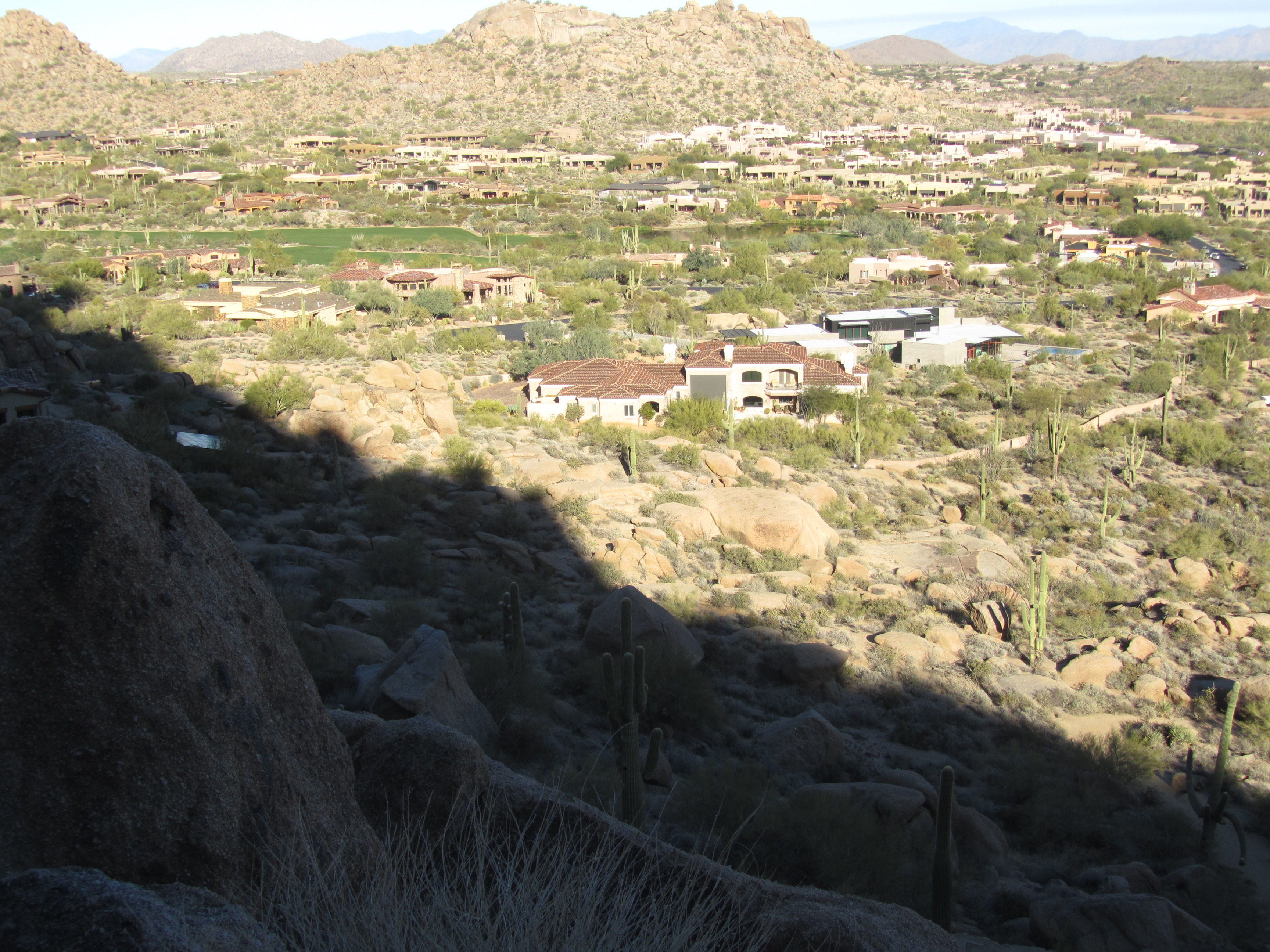
The house was part of a cluster of housing developments and country clubs which had sprouted below a small range of granite crags north of Scottsdale. All were emblems of wretched excess, with the concomitant nomenclature: “The Estates at Xanadu”, “Regent Manors”, and the like. I had taken to lumping the lot under the oddest of their labels – “Troon”.
It wasn’t just a funny name; it designated a private golf course and a gated community, so it represented the entire syndrome nicely. The homes all cost millions, and they sprawled. The square footage stood for the worst aesthetic arrangement which our society had to offer, which was the joy of possession over the joy of experience.
Worse, though, was the history of the Troons relative to the surrounding crags. They had posed a serious risk to climbing access.
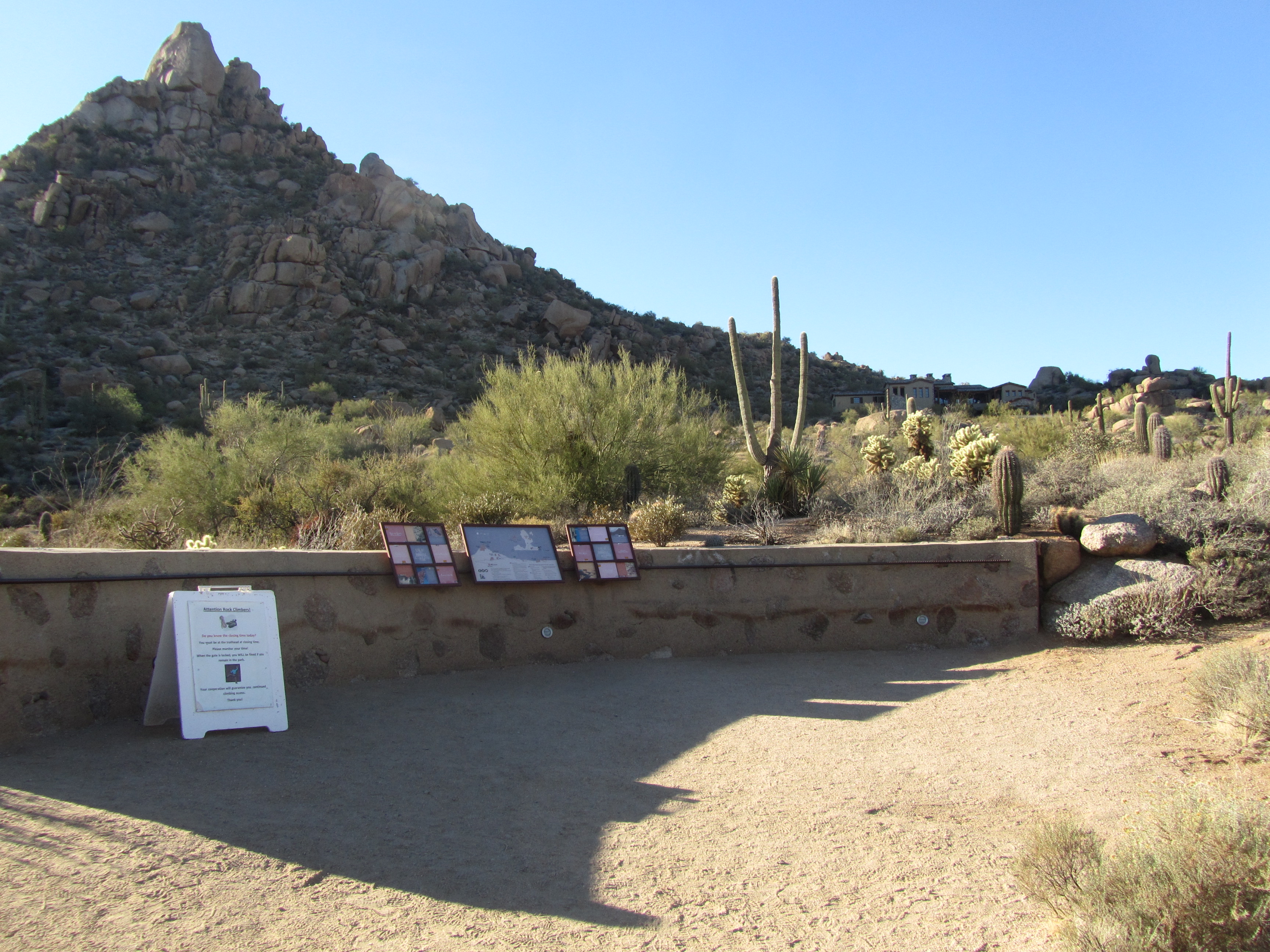
Most of the problems had been resolved with the creation of Pinnacle Peak Park. However, it was the idea behind the threat to climbing access that was offensive. The threat implied an equivalence, at least, between the Troonians’ appreciation for the crags, and my own.
IMG_1004
Clearly, that was not the case. For them, the rock constituted part of a lifestyle badge. It was kind of nice to look at, and living beneath it gave the Troonian status. He could feel a little removed, and above it all, like the proud peak in his backyard. He didn’t want climbers ruining the image of the rock, much less disturbing his sense of splendid isolation otherwise by yelling ‘off belay’ during his afternoon tea.
I understood the beauty of distant peaks, too. But I also knew the beauty of the rock close up, under finger and foot. It was something more, and forever unavailable to the Troonian. He had no right to impinge on my more complete and superior aesthetic.
But how could one convince a Philistine that he was a Philistine? The problem was intractable. He would always have some rejoinder about a set of related values which justified his being a rotten little twerp. In this case, it would be property, the rights of exchange which came with hard- earned (hah!) wealth, and liberty. Forget the fact that he could not own the rock in any meaningful way. He had to either bring it down or squat below it. Forget the fact that his array of goods for purchase was already limited by the aesthetics of his society, which found it distasteful, for instance, for him to buy humans for any purpose. Forget the fact that he had already sacrificed the greater portion of his liberty in the process of becoming a Troonian (the chances of one of those poor, business-softened bastards even scrambling up the Pinnacle Peak approach trail, were practically nil).
The Troonian’s frame of reference could not encompass my own. He would never be able to appreciate the inferiority of his aesthetic relative to mine, and so he would continue to hold his own values precious by mistake. If ethics boiled down to the reconciliation of intentionality and motivation with truth, there could be no ethical resolution between myself and the Troonian. There was no commonly held truth between us.
Traditionally, that class of differences has been settled with mortar shells. The Trooninan’s annihilation would be a consensual truth. But it would be a superimposed truth, and an impolite way of changing the subject. It missed the intention, since it was no longer about me and the Troonian and our aesthetic differences, but about the prejudicial elimination of those differences. And it was discordant with my motive, which was to appreciate the climbing experience.
The relevant truth was that the Trooinian and I valued something about the peaks, and generally valued our valuations in a similar way. That last bit was the truth that our difference was about, and it was not the truth to which my impulse to see his house explode and to hack him to death with a machete as he stumbled, flaming, from the wreckage, appealed. It did not feel as good, acting on this second-order stuff – the valuation of values – as would a good hacking which made its own truth. I could see how one would come to think that feeling anything about a moral decision was a red herring. And from there, I could see how one would come to think that moral decisions had a real and objective life of their own.
I looked back at my son.
“Hmmm,” I answered, “I’d rather climb the Y-crack.”
And I would. I would rather climb, keep my voice down, leave the crag before dark and choose to see the little McMansion at our feet as a quaint feature of the landscape. Hell, who knew? Maybe the squishy critter in the cage below us was really an old dirt bag who’d hit it big in the lottery and looked up at us with a sense of appreciation and nostalgia.
Maybe, but I doubted it.

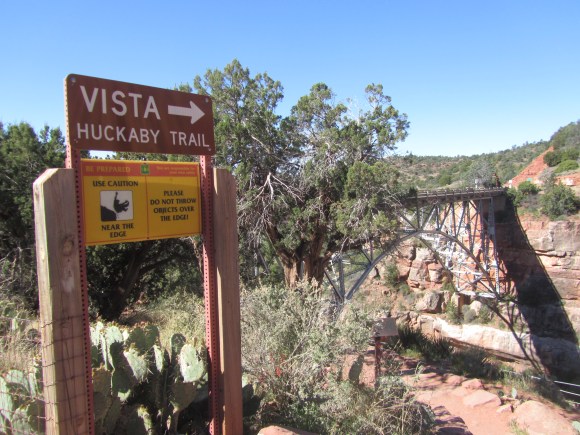
Besides, there is always something better in Sedona

Besides, there is always something better in Sedona

Tagged , , , , , , , ,

One and Done

IMG_0973
The one and only Devils Tower Climbers Festival has passed into the annals of our nation’s first national monument. It transpired over three days in September, and it aimed to be a little different than other climber rendezvous – but not too different. Festival events are hard to plan, but there are some successful examples to draw upon. For the Devils Tower event, the organizer studied a long-running festival nearby, and used it as a springboard. The idea was to take the International Climbing Festival in Lander, Wyoming and kick it up a notch.
The Lander Festival is a big to-do. It’s a party, really. There are cookouts, and vendors, and if there’s any extra time, a little bit of climbing. The afterthoughts occur at Wild Iris, a famous sport crag outside town. All in all, the International Climbers’ Festival at Lander, Wyoming is what passes for a glamorous event in the world of real, amateur climbing.
What the organizer of the Devils Tower gathering sought was not to out-glam the Lander event. That would be expensive and difficult. The idea was to be more authentic than Lander, and pull the climbing into the festival. Now, there was a complicating factor from the start. The climbers’ festival coincided in time, and mostly in space, with the annual Beer Fest in Sundance. The arrangement was intentional, and not entirely unreasonable. As a rule, climbers have taste for beer, not to mention wine, and the occasional sip of scotch. The organizer calculated that the Beer Fest might attract a few visiting climbers on its own merits. And, the Beer Fest had some notoriety to lend. It had grown large enough, over the few years since its inception to draw the ire of local moralists, as expressed on the opinion page of the town paper. If an event provoked fear in the righteous for the souls of the general public, that event likely had coattails.
What went unconsidered in the decision to link the two events, were the effect of alcohol on the climber psyche, and the true role of alcohol in the climbing culture. The ‘in-town’ events for the Climbers’ Festival were scheduled for the evening, while the Beer Fest was up and running soon after the sun rose. This was a mistake.
There is a thing in the climbing world called, “bailing” – as in bailing out of a stricken aircraft. It crosses all sub-disciplines. Everyone understands it. It refers to the abrupt decision to stop going up and start going down, in particular, and, by metaphor, any abrupt decisions to change course drastically in the face of adverse conditions. It carries the suggestion that one is definitively casting one’s fate to the wind. Attending the Beer Fest provided a strong temptation to ‘bail’ on evening lectures and slideshows in favor of, say, passing out.
On the first night, the ranger in charge of Devils Tower resource management gave a talk on the preservation of the Tower as a climbing destination, and the climbing management plan. It was a very good talk, I’m told. Three people attended. On night two, the crowd swelled to seven. However, there were more pictures and music ( the speaker is an accomplished pianist).
Nor was the drinking crowd prone to participate in the actual climbing part of the festival. But that should have come as no surprise. The climber’s reputation as a booze hound is largely mythological. It used to be the case, back when the avocation was associated with the counter-culture, and the gear was so bad that it helped one’s performance to be hung-over or even still a little drunk while climbing. But the modern climber is an athlete. He or she is much more likely to have a temperature controlled cooler full of (ostensibly) performance enhancing supplements in the back of the van, than a box of wine. Modern climbers have a bedtime.
Festivals still attract the alcohol traditionalists, but the drinkers don’t show up for any active activities. Such exertions are better left to the professionals. The drinking crowd wants a show – and a little validation. The best festivals leverage the dichotomy between the athletes and the partiers. The Southfork Icefest, for example, has the synergy dialed.
At the Icefest, the daily agenda begins with a fashionably late breakfast – ‘free’. You’d be crazy to pass it up. Then there are clinics and tool demos. These are held on some of the easier climbs in the valley, and are not too far from the road. After a couple of hours of edification, and having gotten properly chilled, everyone heads back to town to get ready for the evening meal and slideshow. As the food is served, a new group of festivants appears, burned by wind and sun, glassy-eyed, and still outfitted in their climbing gear. These stragglers have come for the “best lead” contest. Basically, it is a chance to spray, an irresistible opportunity for the hard core. Everyone gets to tell a story of the day’s climb, and why their partner should be rewarded for having lead the most mind-blowing route in the valley. Then there is a pull-up contest. Everybody leaves happy. The hard core have unburdened themselves and gotten some recognition. The rest have heard some stories and gotten a little validation by association. During the Devils Tower Climbing Festival, any visiting athletes remained at the Devils Tower campground, rather than venturing into town.
IMG_0947
Only one group of locals attempted to enter the real climbing event. That event was not ill-conceived. It capitalized on the history of the Tower as a bastion of traditional climbing by challenging participants to climb a route with passive gear only, and film the ascent. The best movie would win a new rope for the artistes. The only takers made a valiant effort. My partner and I spoke with them as they were headed up to climb Walt Bailey Memorial. We climbed a nearby route, Double Indemnity, so we could hear them all the while. It seemed to be going well, so we were surprised to see them all looking glum at the base of the rappels. Upon inquiry, the cameraman simply held up his iPhone, which he’d been using to record the leader’s success. It had fallen out of his pocket 250 feet above, at the start of the rappels. Even Gorilla Glass has its limits. The phone still came on, so they hoped to download the movie. But it was not to be. Chalk one up for the Luddites; the new rope went unclaimed.
They still showed up for the final day contests. This was the best-attended portion of the whole meet. It was held in the little park behind the county courthouse, just across the street from the beer fest. There were three events: slack chain walking (like a tightrope, but slack, and chain), a combination pull-up and ‘toes-to-bar’ lactate tolerance test, and crate stacking. The last contest stood out as the most entertaining. It was also the activity at which the attendees excelled. The test of strength was disappointing. Fifteen of each maneuver was the best that anyone could muster in the allotted two minutes. At the Southfork Icefest, I have watched Aaron Mulkey crank out 35 pull ups hanging from a pair of ice tools – and that’s after a hard day of climbing. Nobody got across the slack chain in three tries. But, climbing at the Tower doesn’t take pure footwork or arm power; it takes dynamic weight distribution. Stacking one milk crate upon the last, as one stands on the growing structure, tests one’s dynamic weight distribution. The winning total was 19.
Besides being suspenseful and impressive, the crate stacking event had an old-west flair, as it was conducted with the belay line strung from a giant cottonwood on the courthouse lawn, calling to mind the era of frontier justice. A crowd, drawn from the adjacent beer fest, gathered (the other two contests having been completely ignored), and a couple of wobbly young men among the onlookers even asked if they could have a go.
IMG_0976
When the climactic event concluded, the results were read and prizes distributed with little ceremony. Participants said their brief goodbyes and dispersed. No one felt particularly disappointed; it was just how things focused on the Tower, worked. The Bear’s Lodge is an awesome and intimidating object to regard. It reflects one’s attention back. As a whole, those who have stood at it’s base have recognized the mirror-effect. Aboriginal people have approached it privately, quietly, to leave their prayer bundles in the trees surrounding its rearing columns. Climbers feel it as well, and then some. Climbing at the Tower is hard. It can’t be overpowered or out-foxed. However, it will let you be as safe as you want to be. It treats its climbers like a good grandparent, at once strict and kind. It does not feel right to pound beers and get loud with grandfather looking over your shoulder. And maybe that is the main reason for the failure of the First Annual Devils Tower Climbers’ Festival, as such. However it was promoted, organized, and realized, it was still a party in honor of a place just doesn’t generate a party atmosphere. And that’s OK.

Tagged , , , ,

Experiencing Embodiment – with Extreme Prejudice

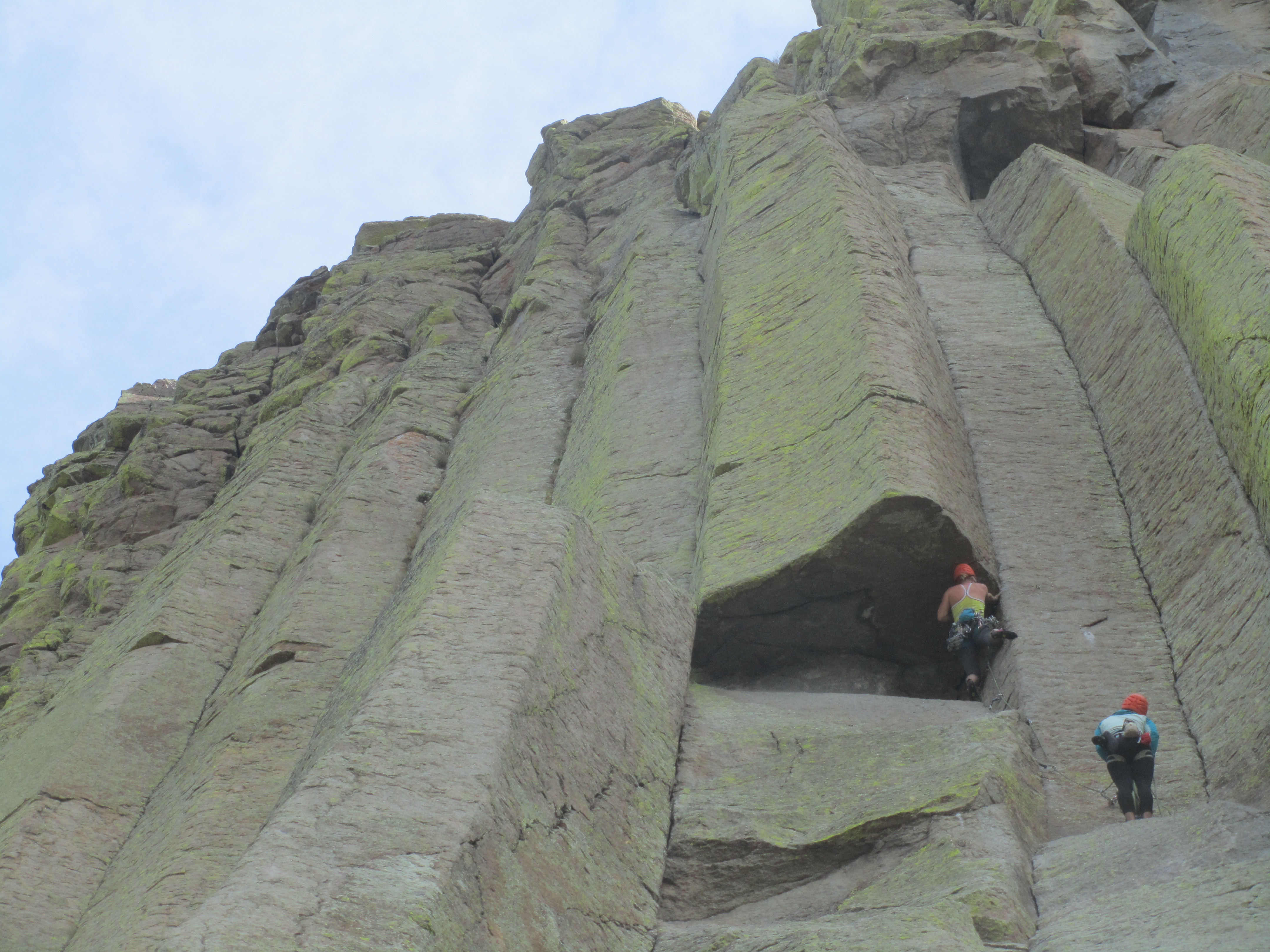
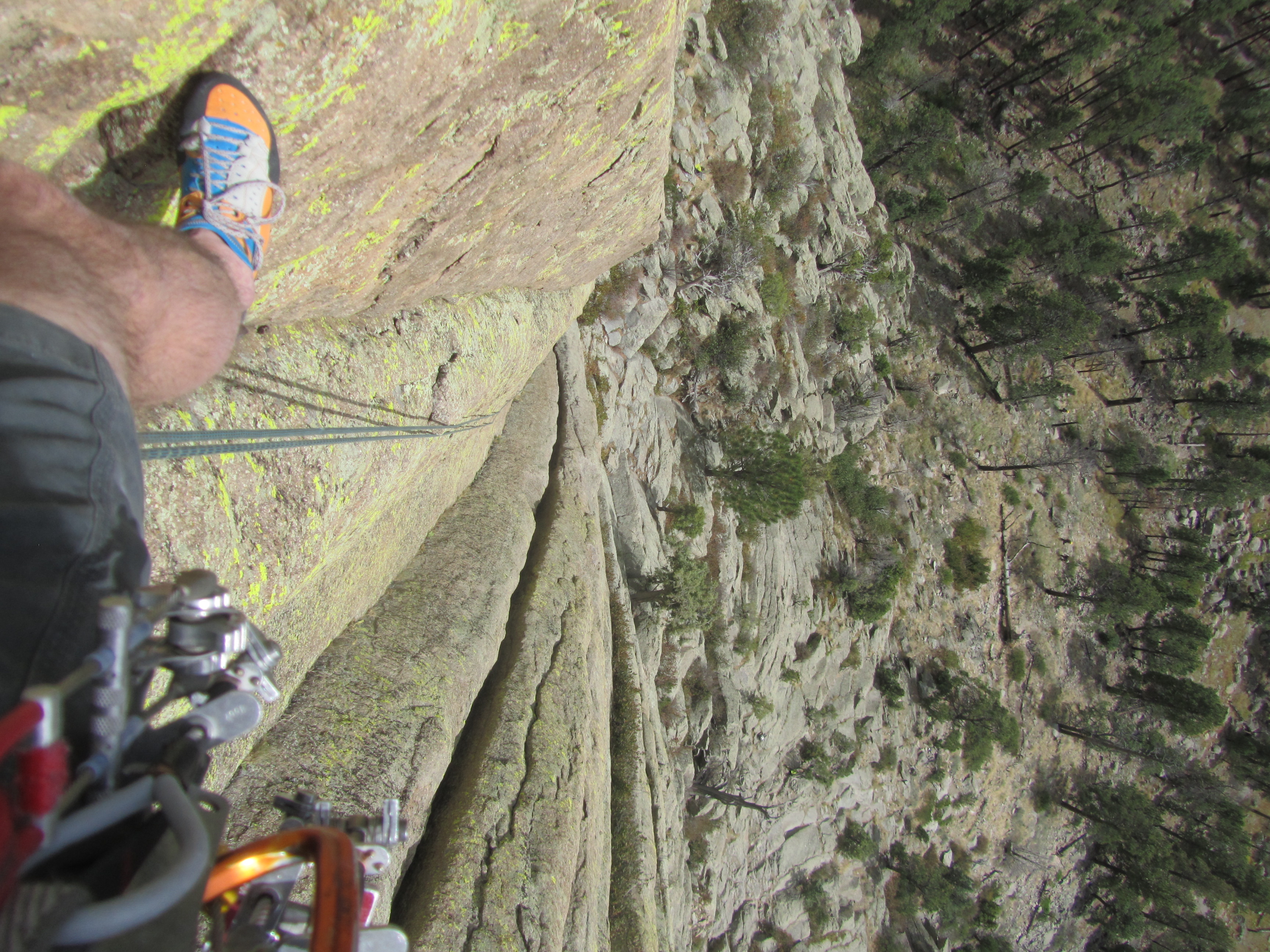
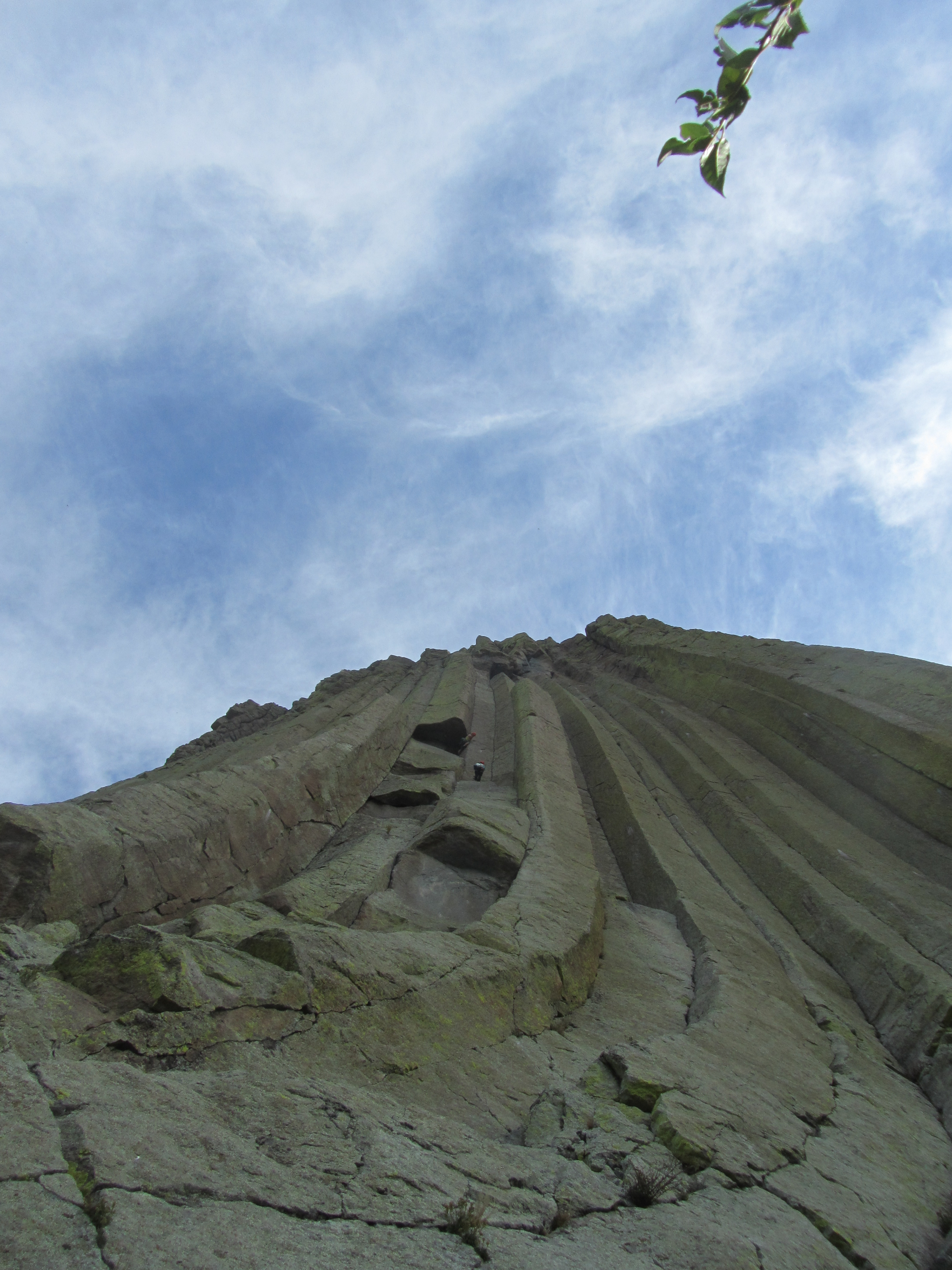
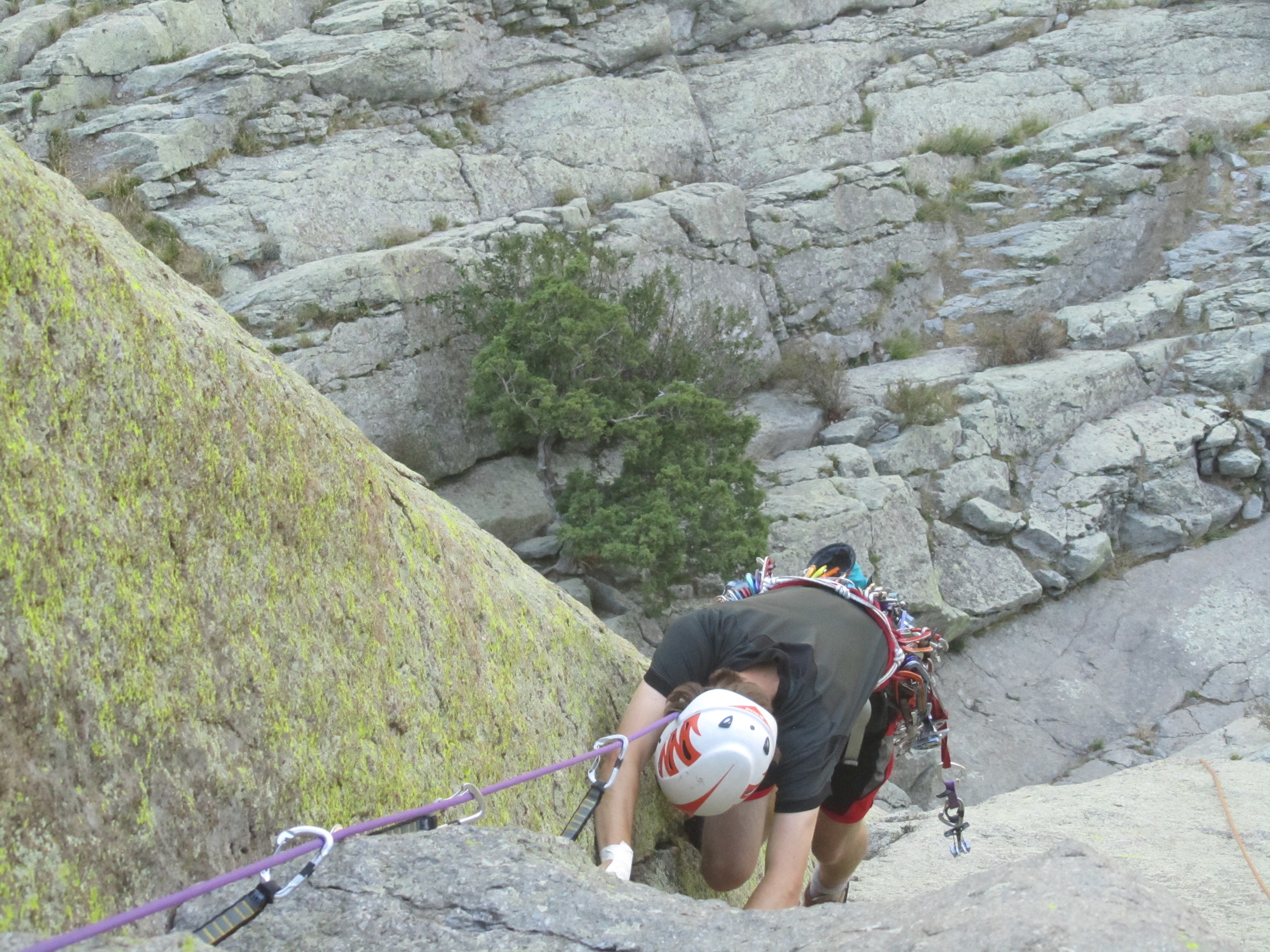
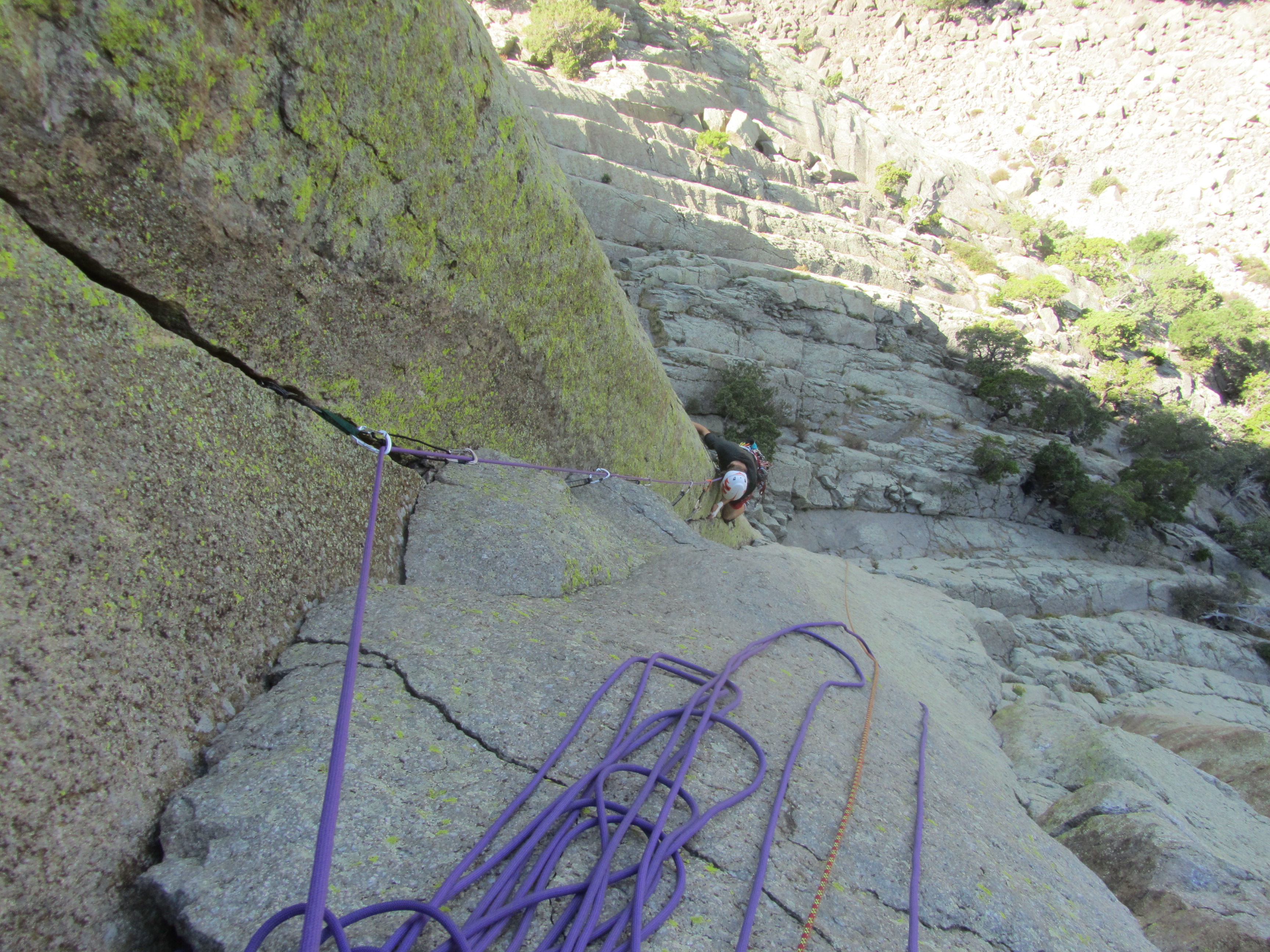
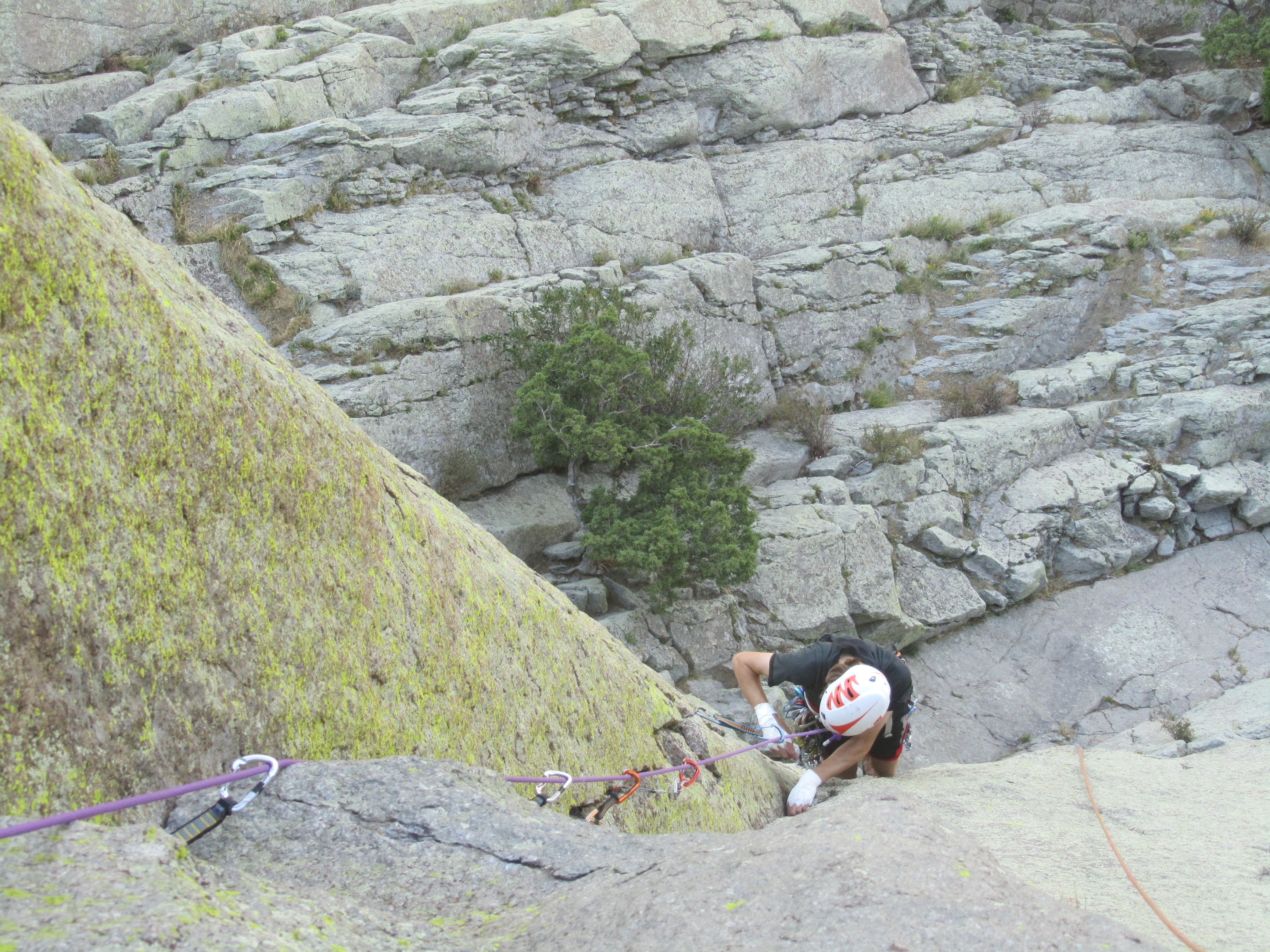
Rowan on McCarthy West Face, Hong Variation

Rowan on McCarthy West Face, Hong Variation

The edge was huge – at least half a finger-pad wide. But how to get there? The fingers of my right hand were crimped on the vertical edge of a slight irregularity at shoulder height. My thumb lay across the top of the same feature. My feet teetered on the corner of the column which bordered the little roof. My left hand gripped the corner of the neighboring column, thumb down, elbow up, in a maneuver called a ‘Gaston’.
My right hand needed to get to that good edge. That edge meant security, success, salvation from the tension of my current situation. I stretched for the hold, pushing down with the Gaston and straightening my knees. It was too much for the foot holds on the corner. They needed pressure to work.
I was off.
I prepared to drop into the corner below the roof. I had two small chocks above the feature. They looked set when I placed them, but the crack flared slightly, and small stuff had a tendency to shift. In the time dilation of the fall, I got another glimpse of blood and hair on the rock below, left by a fellow traveler the week before.
IMG_0936
He had been climbing the standard variation on this route. His belayer had been standing on a comfortable patch of dirt about 50 feet below. He fell from about the same level as I had. With rope-stretch and slack in the system, he hit the ledge below the roof. He injured his leg in the initial impact, then flipped upside down and hit his head. He suffered a nasty scalp laceration, but fortunately no damage to the contents of his skull. We wore our helmets, and took the trouble to set the belay on the ledge below the roof. Never disregard a free lesson.
The little chocks held. I jerked to a stop just a few feet below the roof.
I looked down at my son. He looked bored. I couldn’t tell if the expression of ennui was a 15 year old boy’s affectation or actual lack of concern. I hoped it was the former.
“Lower me a little,” I asked him.
He complied, and I got back into the corner, a sporting distance below the difficulties. I moved back up to the overhang and inspected the chocks. They looked no worse for the wear. I grabbed the right hand crimp and set my feet on the corner. My left hand caught the Gaston.
This time, I ignored the edge. Keeping pressure on my feet, I reached up and pinched the corner with my right hand. I leaned back. Like so many things in climbing and outside it, the move felt precarious and it was committing – I would not be able to reverse it – but it was also the answer. My feet locked onto the small holds and I was able to step up. The right hand pinch turned into a good side-pull and my left hand swung up to a nice shelf. It was over. I plugged in a good cam and moved up to stand on the little ledge.
But, it wasn’t over. The corner above wasn’t as steep, but it was still thin and tricky. I got a short break. There was a section of crack climbing, with pretty good footholds. Then the crack closed up again. A bulge confronted me, with no obvious way past. I got a couple of small chocks in the corner formed by the intersecting columns, and took the most feasible path that I could see.
IMG_0934
Once upon a time, my mother-in-law had an out-of-body experience. She was in labor with her second daughter, and things were not going well. As they prepared her for an emergency C-section, she floated above her body and looked down on the scene in the surgical suite. My dearest love relates this story in terms of wonder, as an example of the mysteries of the world beyond our limited comprehension. Her appreciation for such mysteries is one of the things I love most about her. But for me, astral transformation is not so mysterious, though it remains wonderful. It is a familiar experience, and I pursue it doggedly.
It happens on the hardest moves of a climb sometimes. I can break down the moves before and after, but during the movement, the analytic distance disappears and another distance replaces it. The real me is absorbed in action and no longer has time for silly self-awareness. But, the reflective consciousness is selfish. If it can’t do, it will watch. The phenomenon is weird – like a movie observed, but not experienced. Yet it is also wonderful, because for a moment, thought is banished and everything is aligned in its proper place.
That’s what happened at the little bulge. With the moves mapped out in my head, I took a deep breath and began. The fugue hit me. Afterwards I could recall images of small adjustments. I saw my right foot move up to a tenuous hold that I could not have seen at the time. I saw my left foot stick to a sloping hold in the face of counter-pressure from my right hand, which rested flat against the wall of the dihedral.
At the time, I snapped back to a brighter day above the bulge, not entirely sure of how I got there, but feeling wonderful, with the whole thing still catching up to me. Or maybe, it was vice versa.
No matter, I soon stood at the anchor belaying my son as he followed the route (with only one fall and one hanging rest). My motivation had never been higher. I was itching for another lap on the climb – or maybe, something harder.

Tagged , , , , , , ,

The Whole of the Law

“…and life itself told me this secret: ‘Look,’ she said, ‘I am that which must always overcome itself.’
– Nietzsche
“Love, and what you will, do.”
– Augustine
“Become what thou art.”
– Nietzsche

The hole in his head was large and within it, something pulsed. At long intervals, he took great, gasping breaths, as if the deeper parts his brain were expressing their shock. The thinking parts had abandoned the rest, and all the little cells remaining, dependent upon the whole, would soon follow. It was the most shocking thing possible.
We would delay the full consequence of the cortex’s betrayal. His intent was to donate his tissues and organs. It was an admirable act, but one which made the pulsing wound more jarring. I covered it with gauze and did not look at it again as we prepared him for delivery to the surgeons.
According to the social worker, there would be no family to inform. That was good. Families wanted an explanation from the medical professionals, but the condition of the patient spoke for itself. I could add nothing.
Besides, the central message was, “You can’t understand.”
The gasping stopped as we paralyzed him with medications and took control of his breath. The sense of shock persisted. The leader of the transport team looked at the floor and shook his head as he guided the gurney out.
I went home. I tried to start forgetting such cases immediately. Of course, it was impossible. The only effective defense against the impact was to abandon all defenses. I drifted.
“You can’t understand”: perhaps it was a horrible mistake; perhaps it was a horrible truth.
If it were true, did we owe it anything for being true?
One of the dogs met me at the door. He sniffed me all over. I had washed my hands thoroughly and there was no visible blood on my clothing, but he could tell.
He looked up at me and wagged his tail. The behavior meant to get something from me. His bowl was empty.
I turned up a bag of food to fill it.
The dog took a few perfunctory bites from the pile of brown nuggets, then came back to look up at me again. When I didn’t respond, he put his head back down and leaned against my leg. I scratched between his ears. His tail thumped a calming rhythm on the adjacent wall.
“You can’t understand.” It implied that you ought to understand.
I paused and looked down at the dog. He noticed that I had stopped scratching his head, and he looked up at me.
“I can owe you though, can’t I?,” I asked him.
He folded his ears back and wagged a bit harder. He did not know what I was saying, nor did I know what he was thinking or what really motivated him to wag harder. But, I barely had better insight into my own motivations.
We could anticipate each other, at least. That was enough, apparently, to build a relationship between our species which had lasted tens of thousands of years. We could owe that relationship, and know by it what we ought to do about each other.
So, there were two ‘oughts’. Like all value judgments, each sought reconciliation with truth.
I stared into the dog’s eyes.
“Are you lying to me? Is it all a big lie?”
He made a grumbling noise deep in his throat and wagged even harder. I couldn’t make out the details of his response.
It was possible that he was an automaton, as Descartes proposed. It was possible that he was a cold manipulator, in it for the food-for-love quid pro quo.
But possibilities were good for nothing, except to keep me speculating consistently. To discover any truth in possibilities, meant transcending my place and time – an impossibility. If I wanted to stick to the truth, I was stuck where I was.
On the other hand, perhaps I could transcend my point of view. It seemed like I ought to be able to transcend my point of view. I was not a dog; I was a man and I could see into the future. I could discern the possibilities and necessities of this world or any other.
No, such aspirations were doomed. The logical means by which I hoped to rise were not themselves, real. Allegories of truth, they relied upon circumstantial roles assigned to players in their tragedies.
Following the tales too far afield, obligating oneself to their lyrical potentials and certainties, led to fatal contradictions. I could only purchase a simulacrum of truth with understanding, and understanding was not substantial enough to invoke obligations to itself.
His head-scratch having ended several minutes ago, the dog lay down on my feet, no longer concerned with the smell of blood on me.
I doubted that he had forgotten the smell; he was simply reconciled to it. Truthfully, it was what he ought to do.
My only real option was to follow his example.

Tagged , ,