Tag Archives: realism

Here’s the Deal…

…a guy, a-friend-of-a-friend, calls you out of the blue with an offer. He has a formula, deciphered from an ancient Daoist text, which yields an elixir granting immortality. It does so by transforming the imbiber from a creature bound by vulnerable flesh, to one which is pure, unencumbered mind.

The trouble is, he needs someone to try it out. Not because he thinks it might fail or be harmful, he says, but because when it goes to market, he needs to tell his consumers what to expect of the process. His liability carrier demands it.

“Hah,” you think, “What a dope. He hasn’t considered that he will quickly become the only remaining mortal, if this catches on. He’ll be standing there with his buckets of cash and nothing worth buying. Well, the hell if I’m going to be standing there beside him, or risk being trampled in the preceding stampede. I’m getting in on the ground floor!”

So, you take the elixir.

You quickly begin to feel lighter. Your body becomes transparent and then invisible, as you fade to immaterial. You drift with the wind initially, but as your body loses mass, you become immobile. You lose all proprioception – the sense of where you are in space, up and down, heavy and light, tired and energetic.

But, so what? Those phenomena are of no use anymore. If you like, you can remember them. The elixir has granted that as a side effect, if it were not inherently possible. Likewise, your sight – or something like it – has been preserved.

Yet, it is just not the same. It is hard to learn. You thought the novelty had worn off life long ago, but your current position takes ennui to a new level. Phenomena promenade across your consciousness. Your experiences still have a quality to them, but it is a quality marked mostly by where the experiences occur in time.

You realize that you can no longer change the aspectual shape* of an experience. Well, you can a little bit, in your mind. You have always done that, by projecting your expectations onto the world.

However, if a table whizzes by you with the earth’s rotation, you can’t go see the name scratched on its leaf, or associate the scratched name with the oblongness of the particular table.

Soon enough, you stop paying attention to the tables whizzing by. That’s OK; they have become difficult to distinguish from the contents of your memory anyhow.

The potion has begun to fulfill its promise now. Without the tick of a beating heart or the suprachiasmatic metronome, phemomenal time ceases. One experience brings to mind the next in kaleidoscopic procession, like a visual illusion shifting from one interpretation to the other based on reference to the proper associations.

Who knows how long you have lingered on one experience? Who cares? You still have your identity. You remain he who saw a table with something scratched upon it, having consumed a sketchy, friend-of-a-friend’s elixir, and having lost the property of inertia (?). You have kept the good, basic, relevant (to a mind) parts of having a body.

It isn’t over, though.  Presently, you begin to lose track of the phenomenal contents of your experience.

Just as experience formed an amalgam with memory, so does the phenomenon meld with and yield to the qualitative experience which it elicits. This transformation, however, is asymmetrical.

The experience of grass brings to mind grass-green, which raises the feeling of greenness in turn. Here is where all is lost. There is no aspectual shape to greenness. It borrows that from the particular phenomenon which referred it to you. The dirty secret is, so do love and justice and all those other  ethereal concepts which you considered privileged property of the mind.

You may feel like you feel Love in the abstract, but it refers to something. ‘Something’ necessarily stands in relation to you (if only to where you are floating at the moment). Cut the abstraction away from the anchoring intention, and it disperses.

Without the prism of their referents to lend them color, the qualities of your experiences are a diffuse, white light – psychically undifferentiated and ineffectual.

The feeling of greenness calls to mind nothing as it stands alone – and neither do you. You have come to the end of consciousness, the end of embodiment, and the end of yourself.

Back in the world, a sketchy friend-of-a-friend packs up and heads home, disappointed.

“Maybe,” he mutters to himself, “next time.”


* Aspectual shape means the certain way something looks to you. For instance, how a pole looks long when you stand it on end, and round when you lay it on the ground. In terms of experience, it means that, even if you could turn into a bat for a moment, you still couldn’t know what it’s like to be a bat. Your experience would  necessarily be of what it is like for you to be a bat, not of what it is like for a bat to be a bat

Tagged , , , , , ,

Let’s Do a Thought Crime

One more time, plus a  little more…

On a cold morning, a little girl named Suzy is waiting for the School Bus at the bottom of a steep hill. It was raining the night before, and water has been flowing next to the curb. The water froze in the early hours of the morning, forming a sheet of black ice. The ice sheet extends all the way down to Suzy, and unfortunately for her, passes under the tires of a Cadillac Coupe DeVille parked in the middle of the hill. As the sun hits the hill, the ice loses its grip on the tires and the car slides silently and rapidly down the hill, striking Suzy and killing her instantly.

Now suppose the same chain of events ensues, except this time, the car breaks loose just as the cars owner, Andy, sits down in the driver’s seat and closes the door. The inside door handle is broken, so he can’t just jump back out again. The power windows are up and the horn doesn’t work, so he has no way to warn Suzy of her impending doom. He desperately turns the wheel, but it’s too slick for the tires to grab. Suzy dies just as in scenario #1.
Again, suppose the circumstances are the same, but this time, the owner of the car is different. Let’s call him Brian. When Brian realizes that he is sliding out of control, he thinks, “You know, I’ve always hated that little bitch anyway,” and he turns the wheel to direct the car toward little Suzy. Again, the tires have no purchase on the ice and the chain of events is unaltered.

Is there a moral distinction in the incident between the unoccupied car and the occupied car?

Between the incident with Andy and the incident with Brian?

If so, where is the independent and objective moral fact in each case?

Imagine that none of this actually happened, but that Andy and Brian each dreamed the same dream, in which they behaved as they behaved. Each wakes with a sense of satisfaction about his own behavior in the dream, and goes on to live an impeccable life thereafter, never harming a fly. Is there still a moral distinction to be drawn between the two men?

When we speak of morality, are we describing a fact with inherent causal efficacy – like a runaway Coupe DeVille – or are we describing an attitude (or the formation of an attitude)?

Tagged ,

Dreams in the Witch House

Though it is not one of H.P. Lovecraft’s best stories, Dreams in the Witch House is one of his creepiest. The creep factor mostly emanates from the witch’s  familiar, Brown Jenkin. Jenkin is an intermediary from the netherworld, enticing the unwary to enter. A rat/human hybrid, Jenkin eventually dispatches the protagonist by emerging from the wall (which is actually a partition between alternate planes of existence as well as one between indoors and outdoors) and chewing through the man’s body while he sleeps.
Tunneling through a person in his sleep is chilling enough, but what makes Jenkin really creepy is what it represents: shadowy possibilities which gnaw away at us to our demise.

H. P. was a big believer in the old aphorism, “curiosity killed the cat”, (I’m sure he pictured the inquisitive animal sniffing too close to a questing tentacle). He was leery of natural philosophy run amok, based on what happened to the fabled cat. Science, he felt, risked exposing our dearly held beliefs as a mere façade, laid over an alien, chaotic, deeper reality. H. P. was a little odd, but he has never been alone in his fear of hidden truth – or in his attraction to it.

The fear of a hidden truth appears to drive quite a bit of discussion surrounding the philosophy of mind. The fear manifests in varieties dependent upon the school of thought involved. For some positions, the fear of hidden truth appears to be their primary impetus.

Modern-day substance dualists, for instance, fear scientific implications of an explanatory mechanism for activities which tradition ascribes to the soul. The idea that intentionality or qualitative experience may be dependent upon coarse, material goings-on horrifies them. Their revulsion is compelling enough to make arguments from incredulity seem plausible.

“How,” they ask, “can a thing be ‘about’ something?”

Yet, when one fires an arrow at a target, the arrow flies at the target. Something compels it to do so, rather than allowing it to appear suddenly on the moon. Likewise, it remains an arrow, which is a big part of why it flies at the target. The archer attending to the arrow’s flight maintains her identity and has determined her course as well. Even when she visualizes her shot before releasing the bowstring, her intention derives from the same set of considerations determining the shot, albeit in a roundabout way. Maybe she is just importing her perspective on the shot all long and it’s all happening in her (and everyone else’s) head, but that doesn’t matter. The outcome is the same, whether it is the mental substance or the physical substance which is reduced. Reduction is what the substance dualist really fears.

Monists are not so different. They have faced up to the implications of natural philosophy, yet they still fear the loss of mental causation in their schema. The feared outcome of reducing our mental activities to their base, physical mechanisms has been described most eloquently as a “Ghost in the Machine” scenario. In that case, our  consciousness is the ghost,  a mere byproduct with the mistaken impression that it is in charge of things while it is really  looking on impotently as all the little neurons in our brains respond to various stimuli.

The troublesome issue at work is ‘downward causation’. When the archer releases her arrow, do we think that her will causes the arrow to fly toward the target, or do we think that it is the action of her muscles, muscle fibers, the chemical bonds in the arms of the bow, and on down the line? Natural philosophy tells us that the little things add up to the big ones, in terms of how the arrow does what it does. The limbs of the bow springing back into shape do not cause the chemical bonds to behave as they do; it’s the other way around.

We readily accept that state of affairs when it comes to bows and arrows. But if brains and minds bear a similar relationship to their base constituents, then willing the arrow to fly fares no better than the bow’s springing back – it is caused by what’s going on in the neuronal circuitry rather than causing anything itself. The alternative to accepting this arrangement for brains and minds is to make a special exception for mental activities.

Yet it seems impossible to do so without undermining natural philosophy. We may wish to do so, to save mental activities as causes, but it is hard to see how we could avoid hypocrisy. We would still use our knowledge of chemical bonds to build better bows and devise more effective anti-depressants. We would still act as if the bottom-up story were true.

On the other hand, if we accept the bottom-up story for ourselves, what is the point in asking all these questions in the first place? The repercussion of our conclusion is that we are onlookers, like spectators at a sporting event whose critique of the game is utterly ineffectual. It’s hard to see how such knowledge means anything. Just as we risk hypocrisy if we veer away from natural philosophy when it comes to mind, we equally risk hypocrisy by accepting bottom-up explanations when it comes to mental phenomena – we will continue to behave as if our experiences, intentions and motivations make things happen. What to do?

Richard Feynman gave us a clue to the answer.

“If you think you understand quantum mechanics,” he said, “you don’t understand quantum mechanics.”

Quantum fields are not phenomena with which we are familiar, nor can they be. They may not even be ‘really real’. They may simply be the hooks upon which we hang our descriptions of broad regularities in the world of the very small. Furthermore, it doesn’t matter whether the entities to which quantum mechanics refers are real or not. The theory predicts the regularities of the Lilliputian realm – it works.

The thing is, do any of our theories, right down to everyday descriptions, bear a different sort of relationship to their subject matter? When Ernest Rutherford said, “All science is either physics or stamp collecting,” he meant that physics told the basic, really real story of what was going on in the world. Chemistry simplified physics and summarized the really real story of the microscopic world on a convenient level, and so on for biology, geology, meteorology, etc. But his analysis flips the relationship between the disciplines. If we say that Osmium is a metal which conducts electricity and heat at a certain efficiency, has a certain density, reacts with other elements with a certain propensity, then we need ‘bridge laws’ – extra rules – to relate those chemical properties to their associated quantum mechanical phenomena.

The upshot is, only once we have found the Osmium can we find the particular arrangement of quarks, electrons, up-spins and down-spins without which there is no Osmium.

It is easy to turn around and say, “Oh, that’s just what Osmium is.”

But without Osmium and it’s chemical properties, where is our basic-physics explanation? The phenomena explained by the higher level theory permit an explanation in the lower level theory.

And isn’t that how we know about Osmium itself? It is something which responds to our poking and prodding with fire, pushes, and shocks with an elemental predictability. Once we have an atomic explanation for Osmium, we can use a mass spectrometer to find it more reliably, but our target is still the Osmium, not its counter-factual-supporting constituents.

This world of theoretical explanation is terribly confusing. It is confusing because theoretical explanations are not what we normally consider explanations at all. Theories are useful, but they are not true as we wish them to be true – precisely and thoroughly.

We expect our explanations to be more genealogical. Confronted with a piece of Osmium, we can’t be satisfied with atomic weight and number. Those qualities do not explain this piece of Osmium. Rather, we must know how (and so why) the Osmium is in this lump, now, in this place. Break it down to the sub-parts, the quarks, if you will, but the structure of the story does not change.

Where does that leave the Ghost? Where does that leave the mental substance? The Ghost haunts neurobiology, not a reductive explanation. We think our neurons and their activities are our own. We feel comfortable with the idea that we are not exactly the same person if one of the little guys stops working or grows a new dendrite in the course of learning about the atomic number of Osmium. We are comfortable with the change because it occurs within a historical framework, and that framework lends us a persistent identity.

The mental substance seems doomed to participate in some kind of reductive explanation as well. It’s hard to see how it pertains to us, personally, if it does not. If it does participate, then we can call it a substance, but not a separate one. If there are spirits and ectoplasm, then they are located in the same historical framework as the lump of Osmium, its electrons, its quarks, etc. and make their mark, at least upon our consciousness, within that framework.

There are no hidden truths, then. There isn’t some subtext where it all breaks down, as H.P feared. Or if there is, we can never find it.


Tagged , , , , , , ,

Realism in the Time of the Troonians

IMG_1005
My son pointed at the massive dwelling crouched on the mountainside below us.
“Just one mortar round…,” he said, “Wouldn’t you like to see it?”
He was having some trouble adjusting to our move from rural Wyoming to the swanky part of the Southwest desert. He took little comfort in my assurances that all the car washes and golf courses would soon (in geologic terms) suck the metropolis dry and leave its snotty, effete denizens to perish on the parched dust like beached fish gasping for water. Even the fact that we were hastening the demise of this false oasis by our presence, did not satisfy him.
I, on the other hand, felt a certain degree of fulfillment from participating in the great blooming and dying-back.
But, I had to admit, I would like to see the house explode.
It was offensive to me, for a number of reasons.
The house was part of a cluster of housing developments and country clubs which had sprouted below a small range of granite crags north of Scottsdale. All were emblems of wretched excess, with the concomitant nomenclature: “The Estates at Xanadu”, “Regent Manors”, and the like. I had taken to lumping the lot under the oddest of their labels – “Troon”.
It wasn’t just a funny name; it designated a private golf course and a gated community, so it represented the entire syndrome nicely. The homes all cost millions, and they sprawled. The square footage stood for the worst aesthetic arrangement which our society had to offer, which was the joy of possession over the joy of experience.
Worse, though, was the history of the Troons relative to the surrounding crags. They had posed a serious risk to climbing access.
Most of the problems had been resolved with the creation of Pinnacle Peak Park. However, it was the idea behind the threat to climbing access that was offensive. The threat implied an equivalence, at least, between the Troonians’ appreciation for the crags, and my own.
IMG_1004
Clearly, that was not the case. For them, the rock constituted part of a lifestyle badge. It was kind of nice to look at, and living beneath it gave the Troonian status. He could feel a little removed, and above it all, like the proud peak in his backyard. He didn’t want climbers ruining the image of the rock, much less disturbing his sense of splendid isolation otherwise by yelling ‘off belay’ during his afternoon tea.
I understood the beauty of distant peaks, too. But I also knew the beauty of the rock close up, under finger and foot. It was something more, and forever unavailable to the Troonian. He had no right to impinge on my more complete and superior aesthetic.
But how could one convince a Philistine that he was a Philistine? The problem was intractable. He would always have some rejoinder about a set of related values which justified his being a rotten little twerp. In this case, it would be property, the rights of exchange which came with hard- earned (hah!) wealth, and liberty. Forget the fact that he could not own the rock in any meaningful way. He had to either bring it down or squat below it. Forget the fact that his array of goods for purchase was already limited by the aesthetics of his society, which found it distasteful, for instance, for him to buy humans for any purpose. Forget the fact that he had already sacrificed the greater portion of his liberty in the process of becoming a Troonian (the chances of one of those poor, business-softened bastards even scrambling up the Pinnacle Peak approach trail, were practically nil).
The Troonian’s frame of reference could not encompass my own. He would never be able to appreciate the inferiority of his aesthetic relative to mine, and so he would continue to hold his own values precious by mistake. If ethics boiled down to the reconciliation of intentionality and motivation with truth, there could be no ethical resolution between myself and the Troonian. There was no commonly held truth between us.
Traditionally, that class of differences has been settled with mortar shells. The Trooninan’s annihilation would be a consensual truth. But it would be a superimposed truth, and an impolite way of changing the subject. It missed the intention, since it was no longer about me and the Troonian and our aesthetic differences, but about the prejudicial elimination of those differences. And it was discordant with my motive, which was to appreciate the climbing experience.
The relevant truth was that the Trooinian and I valued something about the peaks, and generally valued our valuations in a similar way. That last bit was the truth that our difference was about, and it was not the truth to which my impulse to see his house explode and to hack him to death with a machete as he stumbled, flaming, from the wreckage, appealed. It did not feel as good, acting on this second-order stuff – the valuation of values – as would a good hacking which made its own truth. I could see how one would come to think that feeling anything about a moral decision was a red herring. And from there, I could see how one would come to think that moral decisions had a real and objective life of their own.
I looked back at my son.
“Hmmm,” I answered, “I’d rather climb the Y-crack.”
And I would. I would rather climb, keep my voice down, leave the crag before dark and choose to see the little McMansion at our feet as a quaint feature of the landscape. Hell, who knew? Maybe the squishy critter in the cage below us was really an old dirt bag who’d hit it big in the lottery and looked up at us with a sense of appreciation and nostalgia.
Maybe, but I doubted it.

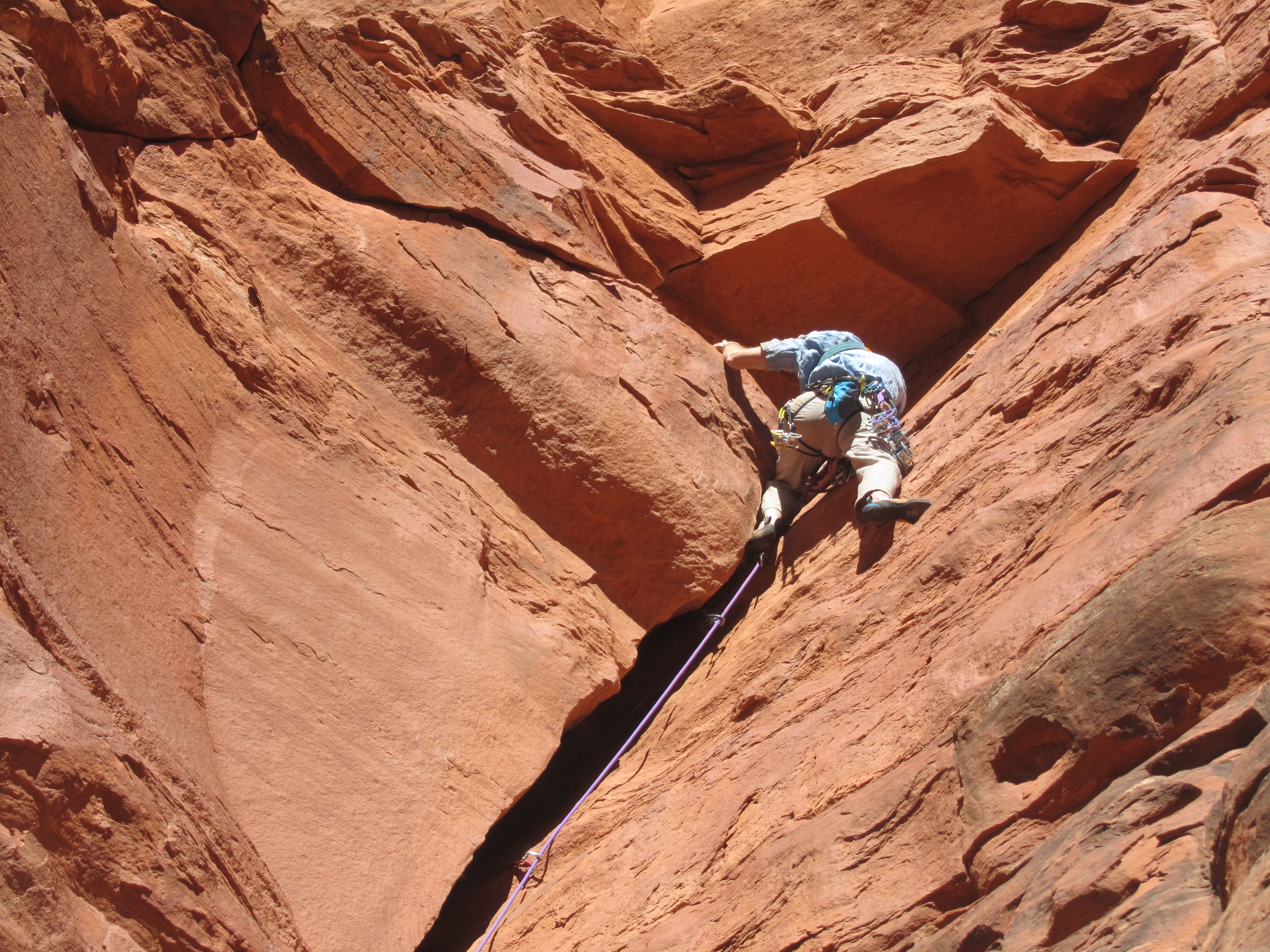
Besides, there is always something better in Sedona

Besides, there is always something better in Sedona

Tagged , , , , , , , ,

The Whole of the Law

“…and life itself told me this secret: ‘Look,’ she said, ‘I am that which must always overcome itself.’
– Nietzsche
“Love, and what you will, do.”
– Augustine
“Become what thou art.”
– Nietzsche

The hole in his head was large and within it, something pulsed. At long intervals, he took great, gasping breaths, as if the deeper parts his brain were expressing their shock. The thinking parts had abandoned the rest, and all the little cells remaining, dependent upon the whole, would soon follow. It was the most shocking thing possible.
We would delay the full consequence of the cortex’s betrayal. His intent was to donate his tissues and organs. It was an admirable act, but one which made the pulsing wound more jarring. I covered it with gauze and did not look at it again as we prepared him for delivery to the surgeons.
According to the social worker, there would be no family to inform. That was good. Families wanted an explanation from the medical professionals, but the condition of the patient spoke for itself. I could add nothing.
Besides, the central message was, “You can’t understand.”
The gasping stopped as we paralyzed him with medications and took control of his breath. The sense of shock persisted. The leader of the transport team looked at the floor and shook his head as he guided the gurney out.
I went home. I tried to start forgetting such cases immediately. Of course, it was impossible. The only effective defense against the impact was to abandon all defenses. I drifted.
“You can’t understand”: perhaps it was a horrible mistake; perhaps it was a horrible truth.
If it were true, did we owe it anything for being true?
One of the dogs met me at the door. He sniffed me all over. I had washed my hands thoroughly and there was no visible blood on my clothing, but he could tell.
He looked up at me and wagged his tail. The behavior meant to get something from me. His bowl was empty.
I turned up a bag of food to fill it.
The dog took a few perfunctory bites from the pile of brown nuggets, then came back to look up at me again. When I didn’t respond, he put his head back down and leaned against my leg. I scratched between his ears. His tail thumped a calming rhythm on the adjacent wall.
“You can’t understand.” It implied that you ought to understand.
I paused and looked down at the dog. He noticed that I had stopped scratching his head, and he looked up at me.
“I can owe you though, can’t I?,” I asked him.
He folded his ears back and wagged a bit harder. He did not know what I was saying, nor did I know what he was thinking or what really motivated him to wag harder. But, I barely had better insight into my own motivations.
We could anticipate each other, at least. That was enough, apparently, to build a relationship between our species which had lasted tens of thousands of years. We could owe that relationship, and know by it what we ought to do about each other.
So, there were two ‘oughts’. Like all value judgments, each sought reconciliation with truth.
I stared into the dog’s eyes.
“Are you lying to me? Is it all a big lie?”
He made a grumbling noise deep in his throat and wagged even harder. I couldn’t make out the details of his response.
It was possible that he was an automaton, as Descartes proposed. It was possible that he was a cold manipulator, in it for the food-for-love quid pro quo.
But possibilities were good for nothing, except to keep me speculating consistently. To discover any truth in possibilities, meant transcending my place and time – an impossibility. If I wanted to stick to the truth, I was stuck where I was.
On the other hand, perhaps I could transcend my point of view. It seemed like I ought to be able to transcend my point of view. I was not a dog; I was a man and I could see into the future. I could discern the possibilities and necessities of this world or any other.
No, such aspirations were doomed. The logical means by which I hoped to rise were not themselves, real. Allegories of truth, they relied upon circumstantial roles assigned to players in their tragedies.
Following the tales too far afield, obligating oneself to their lyrical potentials and certainties, led to fatal contradictions. I could only purchase a simulacrum of truth with understanding, and understanding was not substantial enough to invoke obligations to itself.
His head-scratch having ended several minutes ago, the dog lay down on my feet, no longer concerned with the smell of blood on me.
I doubted that he had forgotten the smell; he was simply reconciled to it. Truthfully, it was what he ought to do.
My only real option was to follow his example.

Tagged , ,

Simplicity Itself

Arguments about nature, gods, and human beliefs are often convoluted and massive. The central issue can be boiled down to a manageable residue.
The phrases “mental substance” and “independent identity” are incoherent. They are combinations of words which indicate nothing but the byproducts of speech. At best, their proposed subjects are things which we could not claim to know. That is why all arguments in their favor must finally deduce from analogy, if they hope to avoid fideism. All else follows.

Tagged , , , , , , ,

Speaking Essentially and the Root of the Problem

Let me tell you about unicorns. Unicorns are white-coated creatures, with bodies resembling those of horses. The unicorn’s hooves are cloven, and it has a single, spiral horn protruding from its forehead. The horn has a property which allows it to purify water and cure disease on contact. The animal itself has the ability to detect human female virginity and is highly attracted to the same, so much so that it exhibits a stereotypical set of behaviors in the presence of said females.

I can now make some meaningful statements about unicorns. I can say, for instance, “A unicorn is a unicorn if and only if it has one horn.”

I now say, “You should be able to recognize a unicorn if you see one.” Is that true? If it is true, what about it is true? That is to say: Does my statement reference a unicorn, the inherent possibility of a unicorn, or all that stuff I just said about unicorns? If it is the latter, does that necessitate anything beyond a bare, opaque unity?

Tagged , , , , ,

Finding True North

[Note: this post builds on 3 previous posts, Jesus Christ: Error Theorist, Men, Mores and Mimbos: The Strange Case of Moral Fact, and Chaos Theory]

People talk a lot about meaning and purpose. Most consider those two things quite important. But for concepts held so dear, most people have an ill-formed notion of meaning and purpose. That most hold the two ideas to be roughly equivalent is testament to the squishiness of the concepts. Meaning and purpose are quite different things overall, but they do have one thing in common, and their one commonality may account for much of the confusion between the two and otherwise.
The feature which they share is that each idea can be held as a tautology. Actually, that’s about it for purpose, because purpose is the action of an intent. Talk of purpose assumes intent. So, reasonable talk of purpose is local. It can’t fly far from the source of intention without losing its power. For example, if I give you a morphine tablet for your pain from a broken leg, the purpose of the morphine tablet leaves my hand with the pill. As the pill drops into your palm, your intention is imported and so is your purpose. It is entirely possible that you will save the tablet to get high when you’re feeling better. This importation of purpose is the source of much of our sense of agency. It is also a thready link to meaning.
Meaning can be taken as what can be represented – a tautology. That’s a little cheap. Meaning is locality. There, that’s better; it no longer begs the question. ‘The red book’ means paper, ink spots shaped by interlocking sets of purpose (the writer’s, the publisher’s, the printer’s), the space it occupies among colored books, books I know about, other red things, etc. on and on.
Here’s the meaning-purpose link. Meaning shapes our intention. Our location gives us the things to be about. Our location is what we are all about and is all about us.
So, the meanings are relative, but not free-floating. They are not unmoored from space, time or history. We can map them – represent them – like the North pole. In fact, true North is a perfect example of the relations in question.
True North is kind of a convention. We don’t need it, we have satellites and radio receivers. There’s no logical necessity to true North. True North has a meaning behind it though. It is located, and not just on the earth. Because it has location, it also has a vicinity – surroundings which create its boundary conditions. Considered in terms of the point where the axis of the earth’s rotation meets the planet’s surface, declination means something, as does Polaris – and vice versa. The specificity of meaning constrains the intention it shapes and the scope of action available to that intention. It’s subsequently tempting to see the representation of that meaning as independent and efficacious Form. But true North is finally a relative location, not a mark on a map. It is made of stuff as far down as we can dig, and in every direction. So are all our representations, down to our self-representation.
There is a final question which people like to ask of this state of affairs: Is the lattice-work self-supporting, or is there some truer North? Is all this in some way necessary? That’s something buried too deep for the tools with which we are equipped. The only answers we can give are a priori assumptions (not presuppositions) whose relevance is questionable to us dwellers in the world of representations. But believers in a truer North don’t want or need an answer, I think. The assumption serves well enough, and I have to agree with Dostoyevsky about what would happen should someone show up one day with an answer to put an end to all projection. The question for the believer is: do you think this is an indictment of your faith, or a good reason to hold it?

Tagged , , , , ,

What Dies on the Sharp End

As children, many of us were cautioned not to judge another person until we had walked a mile in their shoes. This simple aphorism is meant, and taken, in two ways. For those with a literal bent, it means that we should withhold judgment until we have the all the relevant information. For those with a more philosophical inclination, it means we should understand that our judgments about others are always bound to be a little off. The latter interpretation is more accurate, because we cannot walk in another’s shoes. Beside them or in their tracks we can experience their walk, but not in their shoes or their skin. To do so would demand abandoning our own identity. In light of the latter interpretation, the implication of Mom’s trite admonition becomes apparent. We aren’t limited by our subjectivity – the statement is nonsense – our subjectivity makes us. Like so many things which children must learn to get straight, it marks a snag in our understanding which trips the most carefully considered philosophies.
Let’s see how philosophical problems regarding mind fare under the heat of our kindergarten lesson. With no subjective experience of subjectivity, philosophical zombies – hypothetical creatures which exhibit behavior without experience – take a shot to the brain, not because we cannot conceive of behavior which does not entail qualitative experience, but because we cannot conceive of qualitative experience divorced from activity (after all shouldn’t something which is a property of experience rather than a product of it show some sign of life for itself?). Rigid designators – necessary identities – hold for representative entities in logic, but not for the objects from which the logical entities derive (would that it were otherwise; think of the savings on auto repairs and trade-ins alone, not to mention the safety benefits of “the red car turning left in front of me” being true in fact as well as in theory). Determinism becomes an analytical curiosity. There is no quantity of happiness, suffering, or human thriving calculable. There is nothing that it’s like to be a bat – or a human.
Philosophies stumble because most of them have not been field-tested. This state of affairs is understandable; field testing is a grim business. The best contrivances fail in unexpected ways, leaving us deflated and puzzled. Trying to break a precious invention in the course of it’s intended use admits to some basic pessimism, but it is vital. Yet how do we test an idea of how the mind works in the world? What we need is something other than the sort of post-game analysis which always concludes that the contest turned out as it did because one team managed to “execute” and one didn’t, that one managed to fit the criteria of our post-hoc definitions and one did not. We need to know what happens, what falls away, what persists and the shape of the relationship between the whole lot.
Fortunately, we don’t have to go to the trouble of designing a test for philosophies of mind. The sort of test in question happens naturally on the sharp end of a rope. Every rope in use has a sharp end, attached to the lead climber, and a loose end, secured by the belayer. As soon as the leader finishes his knot, things begin to fall away. The belayer is a person who pays attention or not, who arrests a fall or not. He may be a Saint, or he may have walked out of prison that morning; it doesn’t matter. Likewise, the leader is a person who falls or not, who puts the belayer at risk or not. The relationship is quite specific and pertains to the subjects and the salient features, the valuable points, of the situation, as do all the relations and values which fall away. But the test extends beyond the mind-to-mind relationship. In the leader’s experience our ideas about the nature of mind itself get tested, because the leader is the one who grasps the holds. Looking at a hold creates a shaped perception of it. The hold has size, conformation, anticipatory feel, relevance to body position, distance and even strategic utility. But that hold is not the hold which the finger touches, and the leader knows the hold in hand by a different means.
Here is where another important set of ideas breaks down. Contact with the hold demolishes the mental theater. The hand and mind know the hold by assimilation. They know the edge as a hold by becoming the hand and mind which grasp it. The meaning of the feature’s heat, slipperiness, sharpness and adequacy are immediately apparent, because all those remake the first person in the moment of contact. The hand and mind know the feature as a hold because that is how they are capable of knowing it and the situation could not be otherwise in the revised individual. The subject doesn’t transcend the moment by discovering some permanent and essential nature realized in the experience, but by diving in, taking in and being taken into the meaning of the hold.
So what dies on the sharp end is transcendence, permanence, and commitment in the abstract. But these are no losses at all, because we can see that, all along, those defunct ideas were merely mistaken shaped perceptions of engagement, persistence, and understanding of change. With the death of its bearers, on more thing must fall and break in our field-test: meaning as a graven image – of God’s will, nature, humanity or whatever other imagined necessity. Meaning is revealed as, like us, the property of the present moment. The edge on the face of the stone is many things, we think, possibly, but with fingers on it, it is a hold – and that fact accounts for all valuation, all confusion over minds and bats, and the limits of footwear exchanges. This is not mysticism; it is much, much smaller. It is just what we know.

Tagged , , , , , , ,

Wu Wei and the No. 2 Pencil

My son zones out. Eighth grade is prime time for daydreaming, but he spends little of his own time escaping into fantasy. He goes blank during tests. He won’t say just what is happening during those spells, except to insist that he is still thinking about the test. Those of us charged with his education think he is thinking about his thinking. Metacognition is the term. But metacognition encompasses too much to accurately characterize what he seems to be doing in those silent intervals. What my son does is negative in context of the testing process. Metacognition need not be negative. A little strategic consideration of the thought process is often very helpful.
For example, suppose you are taking a test which contains the question “Nitrazine paper turns blue in the presence of a base,” as a true or false proposition. You have no idea what makes Nitrazine paper change color. You set the question aside without further thought, but keep it in mind, in the background, as you continue. After a bit, you come upon a multiple choice question: “Tests for rupture of membranes include all of the following except: a) ferning b) Nitrazine test c) ultrasonography d) Ham’s test”. There’s the word ‘Nitrazine’ again, with some associated information. You know from the previous question that Nitrazine paper undergoes some sort of color change when exposed to solutions of differing pH. If you know that ‘rupture of membranes’ refers to amniotic membranes, with leakage of amniotic fluid into the birth canal, then you can ask yourself whether or not a paper which detects pH differences is a good test for amniotic fluid. In other words, does the pH of amniotic fluid differ from the normal pH in the birth canal. Amniotic fluid is, of course, baby pee (where did you think it went?). Baby pee is pretty dilute, so it is pretty close to the pH of plain water. The pH of the birth canal is the preoccupation of a small, vinegar-based industry – the douche makers. So, there probably is a difference in pH between vaginal fluid and amniotic fluid. At this point, the first question has helped you include the Nitrazine test in the group of true tests for amniotic fluid leakage in the second question. Can the information you’ve uncovered help you determine whether it is likely that Nitrazine paper turns blue in contact with a base? If you remember anything about litmus paper, that knowledge might help you out, but let’s say you don’t. Premature rupture of membranes is a bad thing. You wouldn’t want to miss it. A false positive test is more acceptable than a false negative test. Now you just need to know what color wet paper turns, and whether blue is closer to that color than the alternatives. Wet paper tends to get darker, blue is a dark color, so blue is a likely color change for a paper used to test for leakage of amniotic fluid and amniotic fluid is at least a relatively basic solution. The conclusion is no slam-dunk, but it’s better than the coin-toss which you faced moments before.
This process – reference to more general knowledge in the absence of certainty about specific answers, consideration of the available information in total, cross reference of deductions with the specific knowledge available, acceptance of a more probable answer in lieu of a flat-out guess – all might occur during a reflective pause during the test. None of this is what my son is doing. As near as I can gather, his pause involves thoughts like: I don’t know the answer to this question. Why don’t I know the answer to this question? Am I stupid? What do they mean by asking me this question? Are they trying to find out if I’m stupid, or do they want to prove to me that I’m stupid? Why am I taking a test with this sort of question? What happens if I don’t answer the question? If I miss too many questions, will they make me take another test? What is the purpose of all this standardized testing anyway?
Both the former, strategic analysis and the latter, motivational analysis come under the heading of metacognition. They are of disparate utility for the test-taker, however. At first glance, it seems that we might fix the pairing of unlike processes by getting rid of the motivational analysis. Maybe it would be better classified as a kind of neurosis. But on closer examination, we cannot entirely excise it. There is an element of motivational analysis firmly lodged in the strategic analysis. To get started on the latter, we must first conclude that test-taking is worthy of a strategy. We must conclude that test-taking is not a comprehensive, critical assessment of competence or moral character which demands certain answers or none at all. We must also decide that it is worth doing well on tests, that the people administering the test are worthy of our best effort, and that the test-makers have our ultimate educational success in mind. In short, we must conclude that a test is the sort of thing which properly motivates us to adopt a strategy.
Metacognition may have trouble encompassing the relationship in question between motive and method, but there is a term in Chinese philosophy which captures it: Wu Wei. The words have been translated in various spooky ways, such as ‘non-action’ or ‘acting without acting’. Really, the meaning is not spooky. It looks that way because, like many concepts in Chinese philosophy, it contains the basic concept and the second-order concept. In this case, Wu Wei means to characterize both our actions themselves and the relationship between intentions and actions. A better translation might be, “When preparation is done, your problem is the problem before you.” or as a prescription, “Reflect upon your actions but don’t act upon your reflections”. To de-mystify things a little more, Wu Wei means action is primarily about what is acted upon, and only secondarily about our motives. We act upon our motives primarily when we direct ourselves to a certain action. In the case of test taking, we aim to take the test as a result of reflecting on the relevance of tests to our desire to learn, earn a living, or gain the approval of others. Once the test starts, if we subscribe to Wu Wei, we are about retrieving the information to answer question number one.
The concept of Wu Wei serves the test taker better than the concept of Metacognition. But Wu Wei is not true because it is useful, it is useful because it is true. It isn’t a theory of truth, but it contains a deflationary notion and an artist’s depiction of truth; in Blackburn’s words, it maintains that “the issue is the issue”. From a certain perspective, Wu Wei commits us to a pessimistic outlook. It is bowing to the inevitable and resembles the sentiment in aphorisms like, “Call out to the Gods, but row away from the rocks.” It sounds a little jaded, a little compromised. My son certainly sees test-taking Wu Wei in a pessimistic light. He resents being made to take tests and can’t see focused action as anything but capitulation. The test is, however, about the test, the questions about the items in question, and capitulation about him and his attitude. Likewise, rowing is about the position of the boat relative to the rocks and calling out to the Gods is about the supplicant and his desire to survive. Confusing the two is best for neither. Keeping these relationships straight is what makes best in the first place. I’ve yet to convince my son to adopt Wu Wei at test time. I’m not sure that I’m capable of the lesson; considered experience may be the only teacher for Wu Wei. Perhaps if he calls out to the Gods a few more times, he’ll understand why he should pay attention to his stroke as well.

Tagged , , , , , ,