Tag Archives: rock climbing

On Being Struck in the Face by a Large Rock

The single purpose of the present moment.

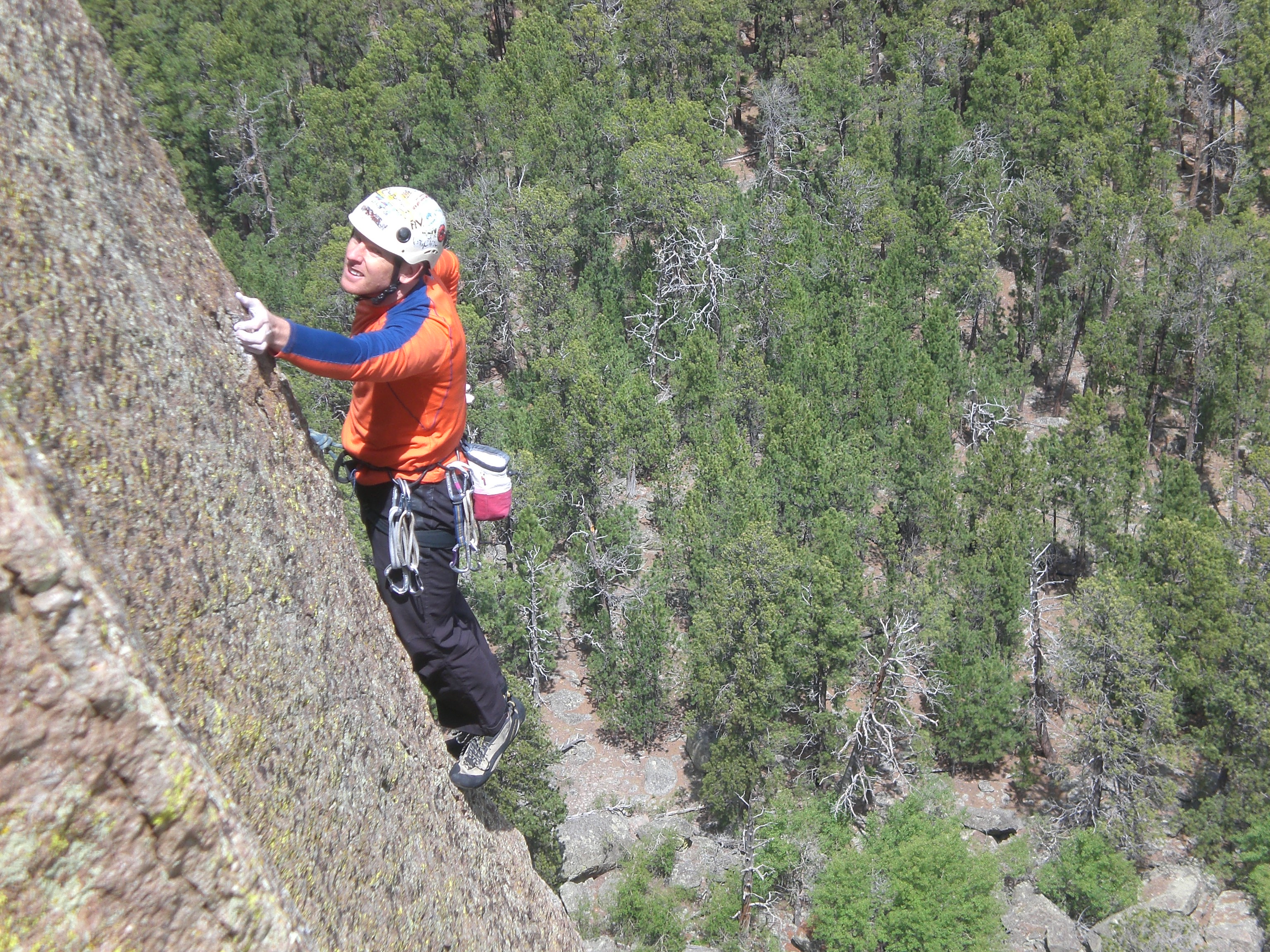
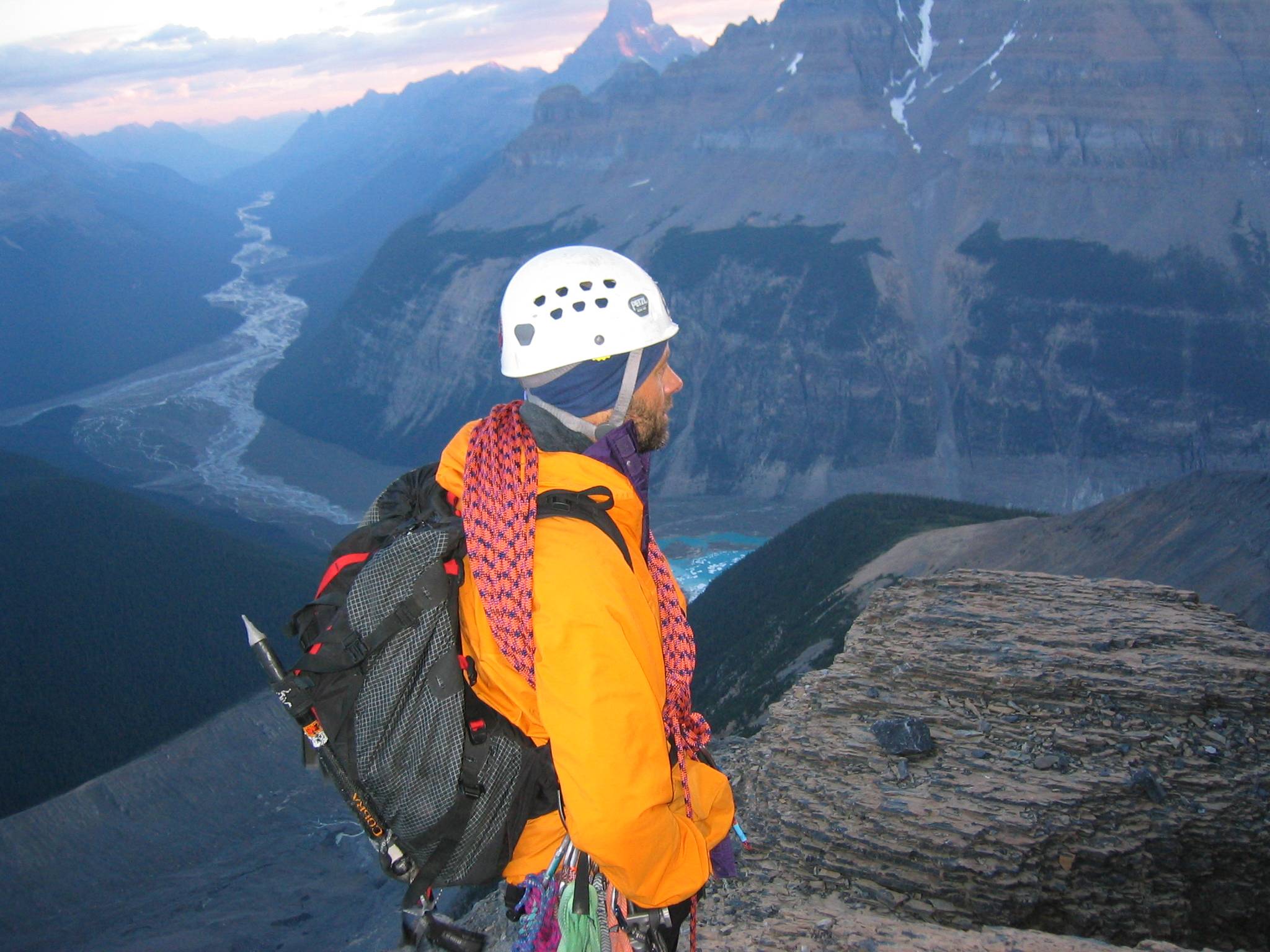
The Diamond is the upper half of the East Face of Long’s Peak in Rocky Mountain National Park. It gets its name from its shape, but the name also fits it from a climbing perspective. The vertical to overhanging plate of granite is striped with cracks from the width of a fingertip to the width of a basketball. It is a jewel, and irresistible even for sport climbers from Chicago like me and Jim were.

In our defense, we were not sport climbers by choice. Living in Chicago severely limits a person’s options. Despite our circumstances at the time, both myself and Jim, had extensive experience in the mountains, including long routes in the Tetons. Our experience meant that we were not complete fools to think we could climb the Diamond in the first place, but it also meant that we should have picked up on a few clues that things might be off track before the incident.

The line of evidence goes all the way back to the contemplation phase. When I was thinking about a big trip in those days, I always tried to run the idea by my friend Tim. He was a veteran of Ama Dablam and the Cassin Ridge on Denali as well as a living, intact paraglider pilot, so I figured he must know something about risk assessment. He was also a model pagan skeptic of Swedish heritage, born and bred in a factory town in upstate New York.   He soft-pedaled nothing.

“What?” he said, “the Casualty Route?”

He shook his head. When I corrected his assumption that we intended to climb the Casual Route (the easiest and so most popular route on the Diamond) he  dialed back the distaste a single click.

“Yeah, well,” he said, “the whole place is a god damned zoo. Good luck.”

I ruminated on his comments just exactly up to the moment I looked at the picture of the Diamond in the guidebook again. Then I forgot about them until the trip back from Colorado.

The scene at the registration office should have refreshed my memory sooner. It was climber Babel. There were kids and old people, dirtbags in flannel shirts with frayed ropes slung over tattered backpacks and teams of smartly dressed outdoorsmen lugging huge, spotless haul-bags. We got one of the last remaining permits to sleep in the boulderfield below Mills glacier at the base of the East face. When we arrived at the bivouac site, the sun was setting and the slopes, speckled with headlamps, looked like a reflection of the Denver suburbs far below.

The North Chimney was not the best approach to the Diamond, but it was expeditious and that was important in a race. As the first light of morning touched Long’s summit, the dash for positions on the ledge atop the lower East face was already well underway. Several of the wiser teams crept up the snow slope at the far edge of the glacier. Others descended ropes from the plateau on the other end of the precipice. One group had chosen to climb the shield of rock in the middle of the lower face, and daylight found them hauling a fully assembled portaledge up their route, the frame of the collapsible sleeping platform bumping along like a kite stuttering across the ground in a high wind. One group was ahead of us on their way to the chimney. Another trailed us by just a few minutes.

The North Chimney was not the best approach to the Diamond because it was not a climb and it was not a walk, it was a scramble – easy hand-and-foot climbing. As such it was easy for a climber to ascend without a rope – a little less so lugging a heavy pack and even less again wearing hiking boots. In other words, it was fast, loose and dangerous.

The party ahead of us was well out of sight and, we justifiably assumed, probably clear of the chimney when we started up. I was in the lead, about twenty feet above the gap between the top of the glacier and the base of the lower East face at the moment that they yelled, “Rock!”

On hearing that warning cry, a climber has two choices: look up in hopes of dodging the missile or hug the rock and rely on the strength of one’s helmet. I was in poor position to dodge, supported as I was by hands and feet on a steep bit of the scramble, but the ominous sound of what was coming convinced me that the helmet might not suffice. I did manage to head-shuck the first , cantalope-sized chunk, and ducked the next, slightly larger stone as it bounced over me. The third one wasn’t bouncing; it was too big. It grated along in light contact with the face, striking sparks. I leaned back to get out from under it.

As the block cleaned me off my stance I slipped into a certain clichéd state which I’ve only rarely experienced. Time slowed down. I felt myself tipping back, the heavy pack dragging my shoulders down faster than my hips. I felt my partner’s hand on the bottom of the pack and though it was physically impossible ( my helmet had been pushed down over my eyes and the broken edge forced through the end of my nose by the impact) I saw him trying to keep me from flipping over. I couldn’t right myself. I didn’t have enough leverage against his outstretched arm. However, the force was just enough to let me twist and face out from the wall, reversing the pull of the pack. My new position felt better, but looked worse. From beneath the broken rim of my helmet, I saw the long sweep of glacier below, lying at the angle of a ski run and now strewn with debris. At the top of the slide was a black moat between the rock face and the ice. A narrow ledge projected into the shadow a few feet below the lip of the ice. I aimed my heels at the ledge and put my forearms out in front or me.

The impact must have hurt, but I have no recollection of it. I might as well have settled like a feather balanced on the edge of the ice. Immediately, I was fumbling around in real-time again, trying to pull the pack over my neck as the tail end of the rockfall pummelled my back and legs.

I’ve often wondered what was going on in those first moments. How could I have a memory of seeing my friend spotting me when I couldn’t possibly have seen him? How could I make decisions in the span of time I had to react? I think the Hagakure  may hold the answer.

“Even if  one’s head were to be cut off, he should be able to do one more action with certainty.”

Quite an odd notion on the face of it. The idea is sound, though. Newborns show a visual preference for faces at nine minutes of age, and this too is an odd notion. We have inborn comparators against which our identity is a reference point and we refine and build on those comparators as we grow. That constant process comparing current state versus prior state versus anticipated state is the root of consciousness itself. Pre-reflective consciousness, our direct, subjective experience, is not pure perception. It is beautifully impure. The mind maps the present onto the past and future by the moment. It is only in moments of utmost need that we lay down enough memory to see the process at work. So the mind, if it has the right set of references at the fore, might seem to carry out one more anticipatory action, in death or in life, such as putting out a hand as if to spot a partner’s fall.

What good is this understanding? Yamamoto Tsunetomo’s most beautiful thought answers:

“There is surely nothing other than the single purpose of the present moment. A man’s whole life is a succession of moment after moment. There will be nothing else to do and nothing else to pursue. Live being true to the single purpose of the moment.”

Sadly, we cannot escape reflection and live the dream the author sketches in this passage. We have to face the horror of war that comes with the joy of battle. However, we can hope to keep the two straight, the reflective and the pre-reflective,  and that is what understanding is good for – holding onto memories without bending them into trinkets or icons.

That’s what I walked away with from the base of Long’s Peak, having been smashed in the face by a large rock. That, and the knowledge that the Diamond is indeed a god damned zoo at the end of August. And the realization that I should pay more attention to Tim’s opinions. And four tiny, blue, Kevlar threads lodged in the end of my nose.
Tagged , , ,

Nostalgia

East Gruesome

Summer is shrinking away to the equator. The rock doesn’t warm over the day and the Needles’ shadows at noon grow longer and longer. We have a couple of weeks of denial left at best. On the good days we took for granted less than a month ago, we can climb on the  faces last season’s heat denied us.

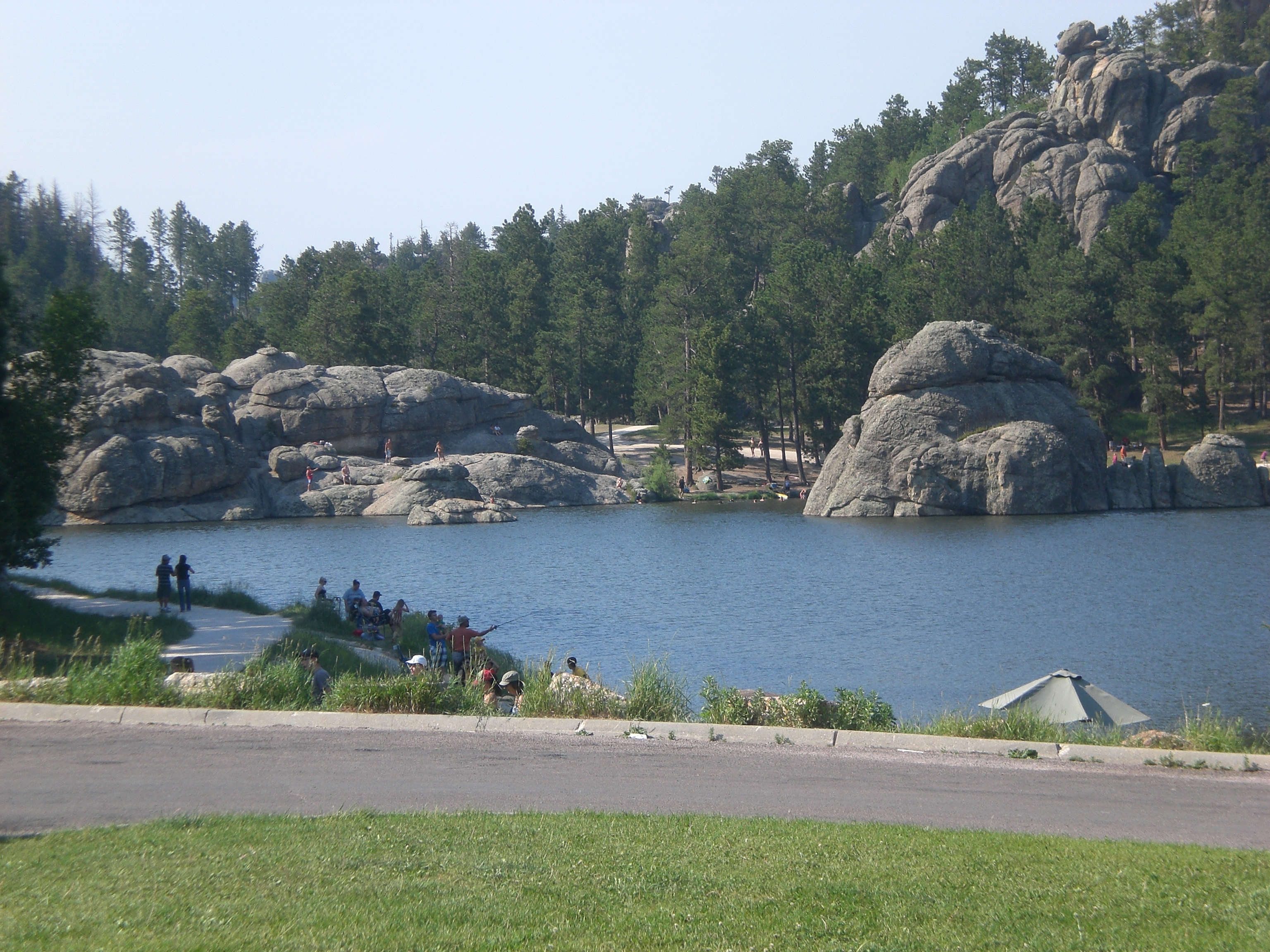
Driving past the entrance to Custer State Park this week, the fee station was closed and its windows boarded up. Soon the custodians will gate the road and abandon the park until Spring. We stopped at Sylvan Lake and wandered around looking for routes in the sun and out of the wind. Only two routes held no shade. The first was an easy face climb. The second was an arching crack protected in the upper half by three pitons, each thinner, more rusty, and more unfavorably oriented than the last. The route proved that the smallest summits can be more daunting than the tallest.

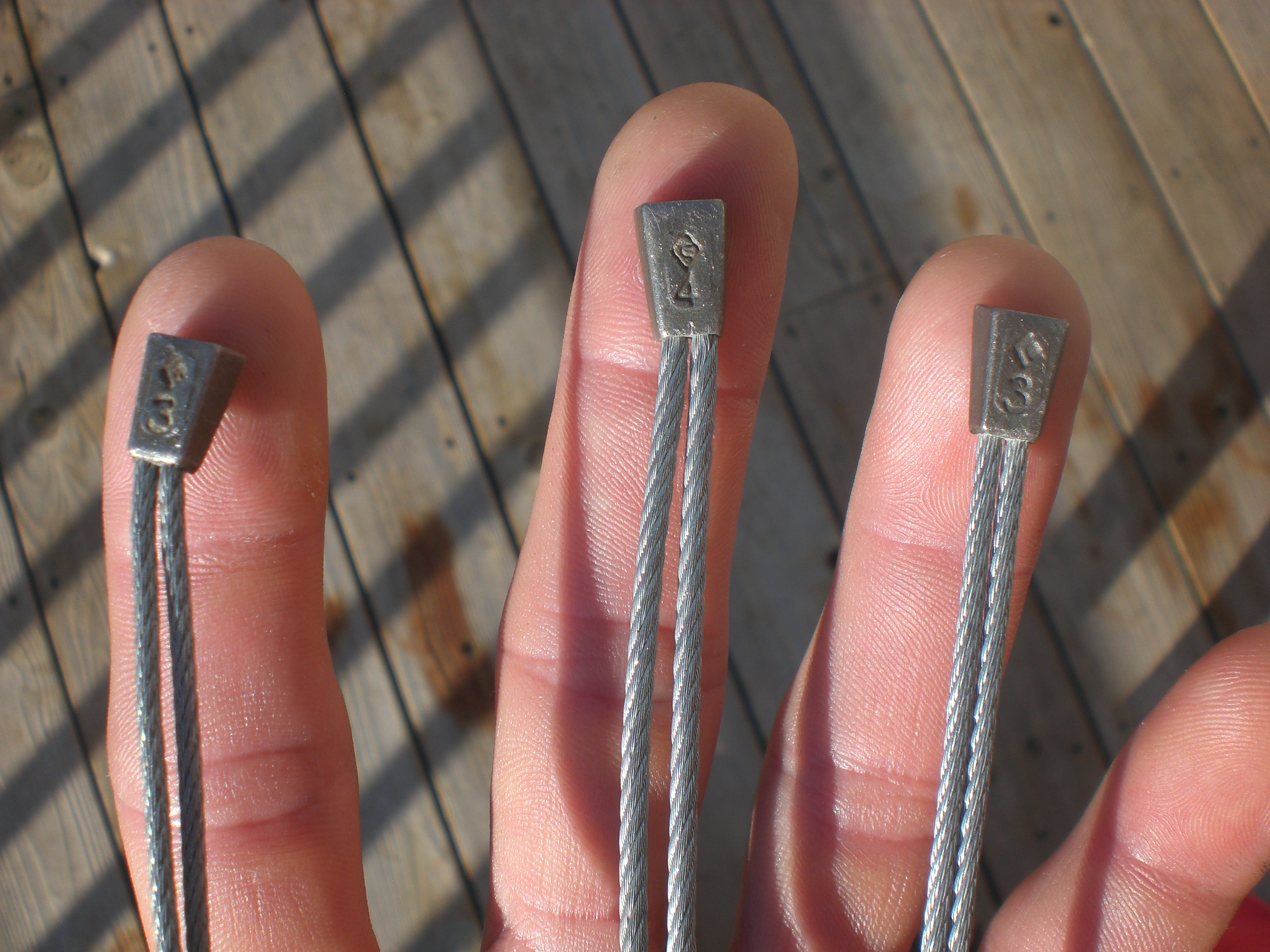
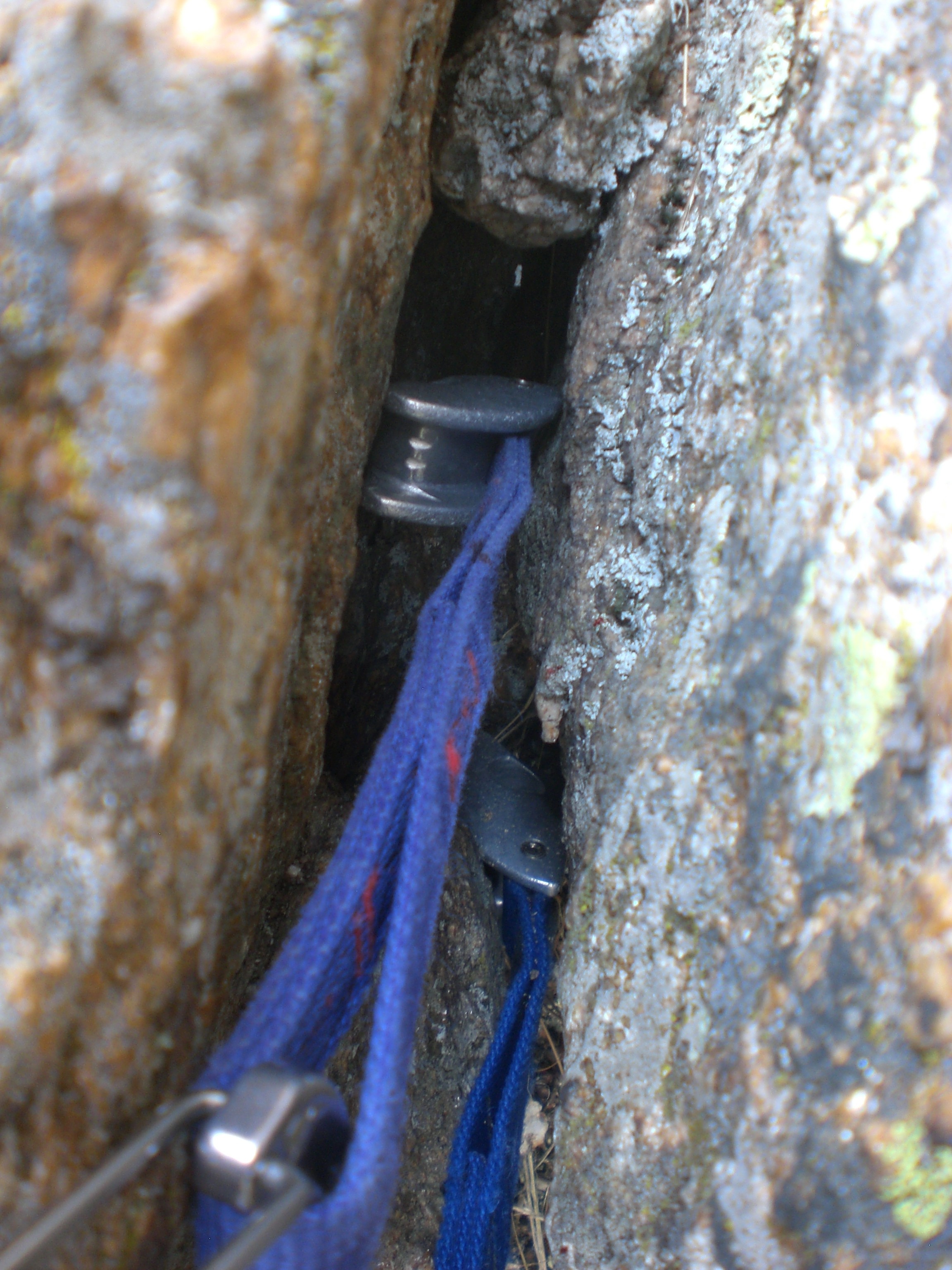
Don’t leave home without them. Tricams in a pegmatite crack

As a climber passes a point of protection, if he falls, he will fall twice the distance he climbs above that point. The closer to the ground, the quicker that distance becomes equal to the distance to the ground and the sooner one is utterly dependent on a single, rusty metal blade in case of a slip. ‘The leader must not fall’ is how a now defunct generation of climbers summed it up. On the arching crack, we backed the pitons up with modern, removable equipment, and nobody fell.

We walked by a further reminder of previous generations on the way out – a memorial plaque for Renn Fenton, one of the Black Hills’ climbing pioneers. Whenever we pass the small memorial, with its birth and death dates, Rich comments on the unlikely gap between the numbers. In those days, climbing was part of a counter-culture more concerned with hard-drinking and pursuing inspiration than building a retirement account. Somehow, the early climbers survived, and with some amazing accomplishments to their names.

Base of East Gruesome rappel

Jan and Herb Conn represented that era as well as anyone. The couple, who made so many of the Needles’ first ascents in tight, dime-store tennis shoes, with a braided rope around their waists and a handful of pitons clipped to their belt-loops, may not have drunk as hard as some, but they made up for it with the finest inspirations. A week prior to standing before Renn Fenton’s memorial, we had visited the Conns’ masterpiece, East Gruesome.

Nobody knows for sure where the original route goes. We climbed a somewhat difficult crack on the East side of the formation, which the Conns almost certainly did not follow. Above the crack, though, all paths converge on a thin seam through a steep slab. Driven into the seam are three pitons. The section is awkward. The handholds are tiny crystals and the foot work requires precise balance. We did it with no mishaps, but it did not feel any easier than the first two times I climbed it. Eric Sutton’s comment in the summit register says it all: “Damn, Herb!”

Energy Crisis

A week later, we left Sylvan Lake after climbing the crack across from the memorial; it was just too cold and windy. We drove over to the Ten Pins and climbed Energy Crisis, another thin, arching crack. I fell at the crux. My foot came off a crystal as I tried to pull up on a triangular hold I had pinched between my thumb, index and middle fingers. A small metal chock caught me after just a couple of feet, and after a rest, I was able to climb it top to bottom with no falls.

Rich on Energy Crisis

Herb Conn died this past year. Jan is still alive, but no longer does her annual singalongs at the Devils Tower picnic shelter. Climbs like Energy Crisis were inconceivable in the Conns’ day. Even if they’d had our stretchy ropes, sticky shoes and sculpted metal gear, they may not have been capable of such routes, as modern equipment allows us to run up against limits of tendon and muscle which the techniques of the Conns era did not test. We will never know how the Conns may have performed in the modern era. However,  I don’t think I would have, or even could have tiptoed up the upper portion of East Gruesome with a cord of twisted plant fiber tied around my waist and cheap tennis shoes on my feet. Looking back, I just have to shake my head and agree with Eric, “Damn!”

Tagged , , , , , ,

Commitment

In the climbing culture , there is an ongoing dispute about who is a “real climber”, who is a poser, and how the two may be differentiated. The distinction between real climbers and posers is stark in some cases. Most of the folks on reality TV shows about Everest expeditions are posers. Most of the suburbanites dangling from top-ropes at the climbing gym are posers. Yet, even these most benighted dabblers are at constant risk of becoming real climbers.  The only thing separating them from real climbers is commitment, and even in the gym or on the snow slope, given time, a moment of commitment will come. Then, provided they don’t simply turn away, the basest poser may get real.

The addiction to commitment is what distinguishes all real climbers. Addiction is normal for humans. By the broadest definition, we are addicted to all sorts of pleasant things, from food to companionship. We are not normally addicted to unpleasant things, like commitment. We tend to see people’s repeated forays into piercing or swimming in frozen lakes as borderline pathological. Nevertheless, some folks are addicted to these things too, and the climber’s addiction to commitment belongs in the same category.

Now, religious types and other defenders of the social order may object to the characterization of commitment as unpleasantness. They are wrong, of course. Commitment presumes change and uncertainty. The psychology literature is clear on the effect of change and uncertainty on a person’s stress level, and the effect is not salutary. What makes commitment in climbing addictive is the same thing that makes other unpleasant things addictive: commitment moves us toward reconciliation of our core contradiction.

The sense that we are conscious undergirds everything we think and do. Many definitions of this essential quality exist, with some of those definitions occupying volumes of text. A simple, adequate definition is possible though. Consciousness is the perception of identity. We say we are conscious when we perceive ourselves as distinct from other perceptual objects. But we can never directly experience our identity, we can only perceive it as we perceive other things inside and outside of us. As we gain experience, we see our identity change, not spontaneously, but by means of interaction with other perceptual objects. We begin to suspect that our identity is contingent on history and relations with other objects, while our consciousness still tells us that our identity is necessarily independent. We have a central contradiction growing in us from the moment we first see ourselves.

Seeking out unpleasant experiences is rebellion against our core contradiction. When we hurt ourselves a little bit, we deny the preciousness of identity, and so relieve a little bit of the tension between what we actually experience and what our consciousness is telling us we experience. The more so when we make a commitment, especially in climbing. To commit to a difficult move or a difficult climb, we have to write off our future and make a dispassionate assessment of our past and the capabilities which our history reflects. We are committing to the climb, and also committing to the notion that our identity is not independent, precious or permanent. The resolution of our essential tension has nothing to do with wholesome exercise or achievement, but it lurks just behind those inviting, pleasant aspects of climbing, waiting to snare the unwary poser and make them a real climber.

Tagged , , , , , ,

A Few Photos

Days are getting short. The Weird Season is about to begin. It’s time to cram as much Tower climbing as possible into early Autumn’s ideal weather window.

The sloping horror, Tulgey Wood.

Deli Express, much tastier than the hermetically sealed, gas station sandwiches.

September light on the NW shoulder.


Tagged , ,

Bartizan

The mighty Bartizan, from the Spires

The Bartizan is an oft overlooked gem. It flanks the Cathedral Spires on the West, and because it sits slightly lower and isn’t pointy, people walk on by it without a second glance. It does, however, sport several features of interest to climbers. I could tell you about a quaint little 5.7 on the North end, or the truly horrible chimney and off-width right next to it. However, I am a snob trained by snobs, so I will only talk about the two best routes on the rock.

After the 5.0 approach up the gully, The Crack…

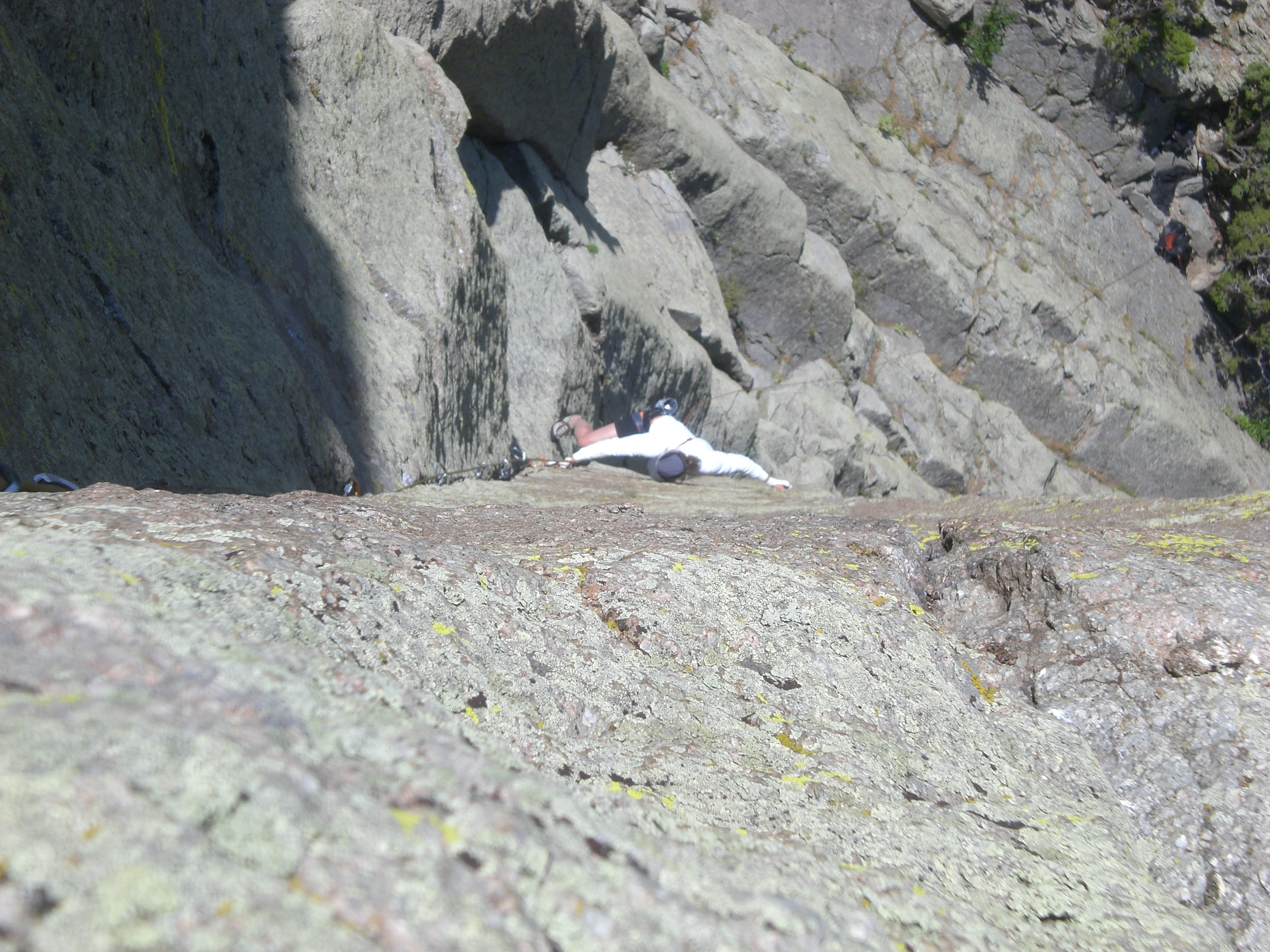
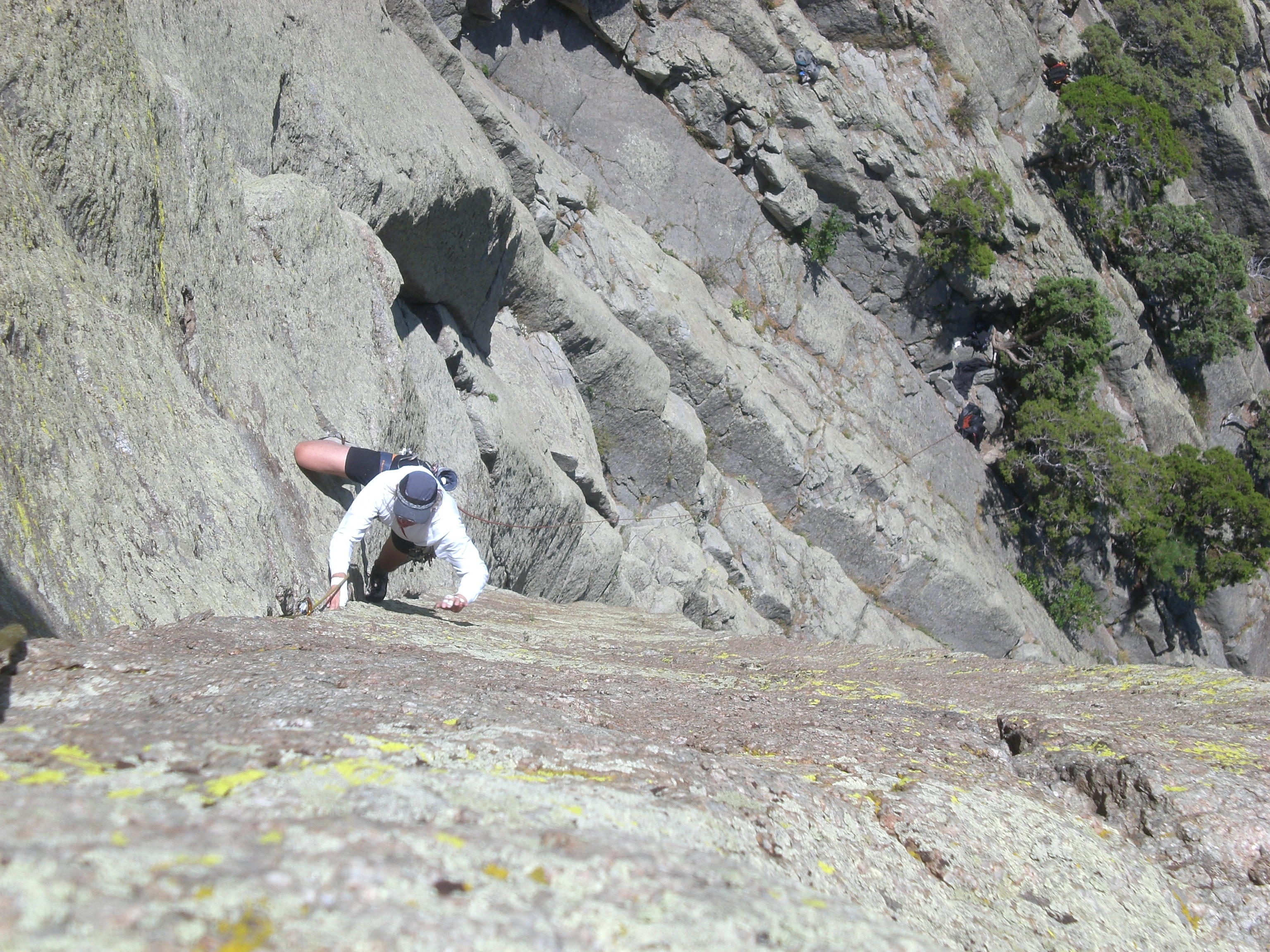
The Crack of Earthly Delights is a crack, but it is so much more. It is a lie-back, a face climb, an alpine rock climb and a stemming problem. It is also potentially dangerous. The crux comes low on the route, just after stepping off a little pedestal. If you piece it together properly, after the fact you’ll be able to say, “I can see how you could call that 5.9.” But if you put the right hand where the left should be or disregard the improbable-looking holds out to the left, you’ll be faced with a frightening lie-back which takes you far enough above your last gear to risk dynamic re-acquaintance with the top of the little pedestal should you fall.

So this is how steep the crux really is.

The remainder of the climbing in the corner is safe and fun. A hard left turn before the crack ends takes you to an exciting run -out to the anchors on a pinnacle to the left of a small gully.

Looking up toward the roof

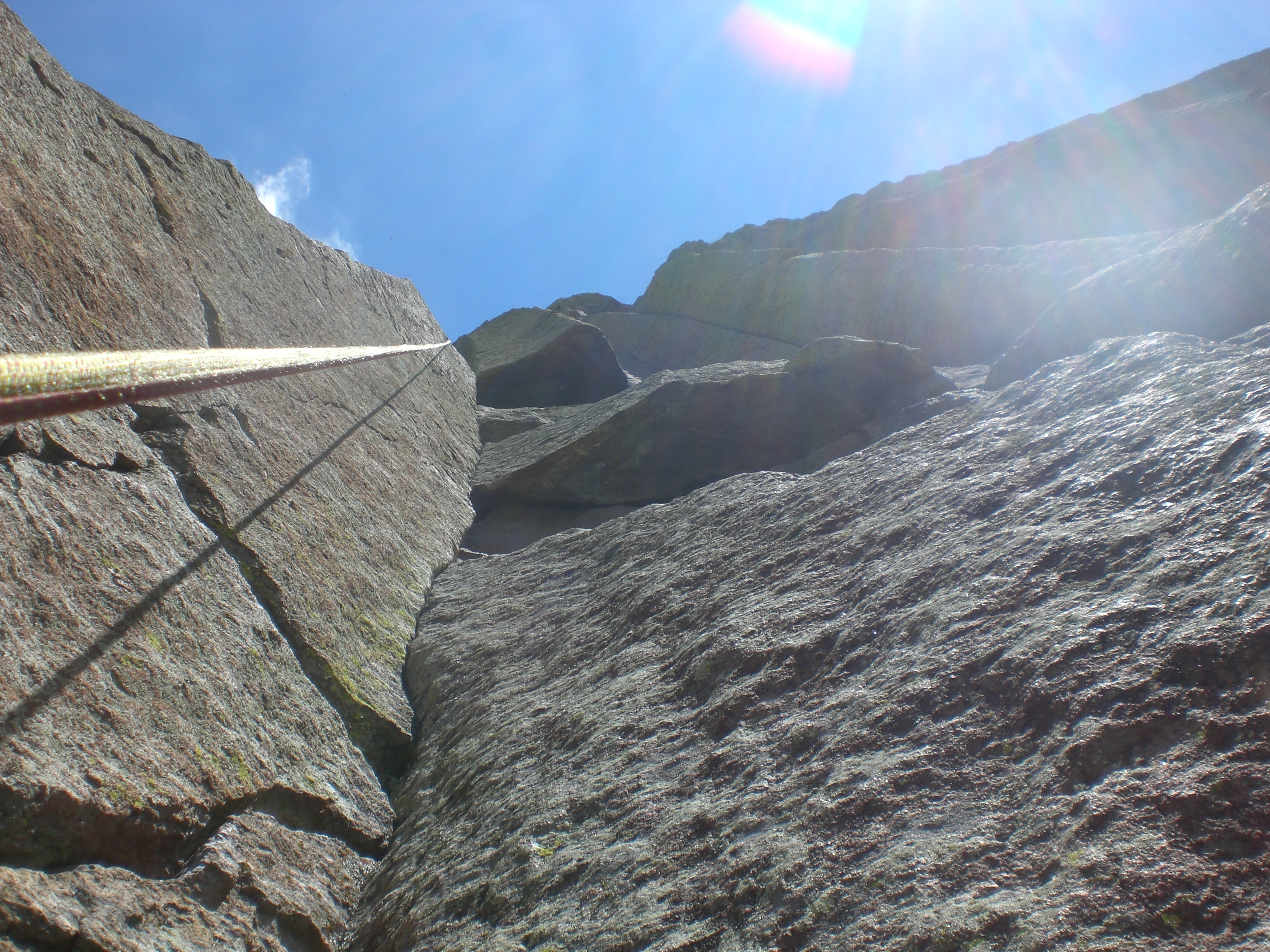
Kevizan goes from the base right up the middle of the formation. The first pitch is an off-width with an overhanging section.

Looking SE from the belay ledge

The second pitch continues the off-width for a few, desperate feet, then eases up before turning a roof.

From the top

A key, hidden flake on the right takes you past the overhang to some of the best finger locks and hand jams in the Needles – if you have the sauce left to stick to them.


Tagged ,

Dirtbag Libertarianism

Wool, fiberfill and Scotch-guard – vintage dirtbag

In recent years, there’s been a loud discussion in the black community on the merits of the N-word. Specifically, people have disputed the value of  ‘claiming’ the word. Many have offered eloquent arguments on either side of the issue, but few have looked for lessons in history. Those lessons exist; here is a familiar and recent one.

The word ‘dirtbag’ is an honorific in the climbing world. It refers to devotees whose total commitment to the sport has led to a de facto vow of poverty. Nowadays, the word calls to mind the romanticized, early days of climbing in Yosemite, where the pioneering resident climbers, in the course of surviving in the Park, earned the label as an epithet.

The Park Service and the concessionaires saw the climbers as parasites – dirtbags who camped illegally and stole food scraps while contributing nothing to the park or society in general. The authorities were correct, too. Most of the climbers were parasites, due to lack of means and a single-minded desire to climb. They didn’t pursue parasitism, they fell into it by default, abetted by the availability of a corpulent, plethoric, degenerate host. Besides, their parasitism produced results.

Climbing  thousands of feet of seemingly impassable rock may not be worth anything to society at large, but it might buy you a word. To the original users, ‘dirtbag’  meant someone who was nothing but a worthless nuisance. A ‘dirtbag’ who could climb El Cap. might still be considered a worthless nuisance, but it was hard to say that was all they were. Plus, not all those who lived to climb were rootless kids looking for an outlet for their dissatisfactions. Always, some dirtbags chose an austere life to pursue their visions.

The latter group planned to work only enough to buy gear, subsist on cat food, and climb as much as possible. Their’s was a long-term plan, and it became a template. Over time, they emerged from the rest of the ‘dirtbags’ but never disavowed the name. Through them, ‘dirtbag’ came to mean ‘the opposite of dilettante’. So much so that modern climbers see ‘dirtbagging’ as a rite of passage and a special opportunity.

By this definition, all sorts of people, from artists to Buddhist monks, are dirtbags, and many of them have taken to using that shorthand description for their lifestyles of devotion. Of course, the original sense of the word will persist. No derogatory term can escape its origins, and the American conservative libertarian will continue to call everybody who chooses to live low and climb high, a dirtbag in the original sense of the word.

He didn’t build that wood stove, and the Yeoman farmer didn’t mine the iron for his plow. There is no free-range human.

That’s one of the good things about dirtbagging, though. There may be some true libertarian dirtbags – people who believe in the myth of the Yeoman farmer. There are precious few American conservative libertarian dirtbags – people whose credo is: “Everyone must be free; free to be just like me”. Just as being a dirtbag can teach one the difference between voluntary frugality and true poverty, wearing the word can be a reminder of the source of its negative content, and serve as a warning against perpetuating that negativity.

Nevertheless, claiming the word is a perilous trick. The term is a poisonous thing at heart, and it’s hard to play with it without getting any on you. However, some people are going to call climbers camped at a crag with nothing but a rope and a rusty Subaru to their names, ‘dirtbag’ anyway. Tucking tail and slinking away or trying to teach stupid people a lesson don’t seem like better strategies, and overall, owning the dirtbag label has worked out pretty well for the climbing community. For what it’s worth.

Tagged , , , ,

I Don’t Get a Scooby Snack (But Then Again, Who Does?)

Being an all-around climber is like being a pig: it’s a dirty life spent wallowing in mediocrity, which garners no respect and may end early by trauma. While the rock purists are hiding from the snow in the desert, we swine are mutilating frozen waterfalls and scraping our way up icy rock with tools and crampons. When the last pillar of ice collapses in the spring and the wet snow avalanches start to slide, we must set down our tools, pick up our sticky slippers, and relearn the more delicate art of rock climbing.

Climber on El Matador

It’s a frustrating experience, but a person gets used to it. Progress is starting at a higher level and getting back to ‘go’ quicker each year. For me, that means starting on the 11’s at the Tower earlier and earlier. This year, I arrived back at my previous high point in July, and my first 11 lead of the season was Way Laid, the thin corner just left of McCarthy West Face.

Looking up Way Laid

We belayed high on a ledge where the two climbs diverge. You get to ease into the difficulties on this climb, as the corner it follows turns gradually toward vertical. Building confidence on the lower section, I made my way up the thin crack to a horizontal break where the corner gets steeper. Even as the terrain got harder, the moves felt good enough that I could enjoy the route’s puzzles rather than simply having to worry about sticking to the rock. Soon I stood below the first of two small roofs and the technical crux of the route.

Rich approaching the crux

Wedging my left foot in the corner, I stepped up into a under-cling and then latched onto a solid finger lock with my left hand. Another flared finger lock let me move my left foot up to a sloping foot hold above the roof. With my palm out on the right wall to provide counter-pressure, I moved my right foot up to a tiny edge and stood up. It all held. In fact, it felt good. As I locked my fingers into the next solid hold, I was probably feeling a little too good. The next roof went well, as did the mantel onto a narrow ledge below the final difficulties.

From the ledge, the top of the column where the route ends is very close. If you had the guts to pull up some slack and jump, you just might be able to snag the edge. When considering this plan, two things give one pause. First, to make the distance, you really ought to be able to touch the rim of a basketball goal from a standing start. The second concern is the gear. There is a bomb-proof gear placement just below the little mantel ledge.  Above the ledge though, the crack pinches down and the only protection is a nest of micro-stoppers. Overall, the situation seems to call for a less parsimonious, more controlled solution.
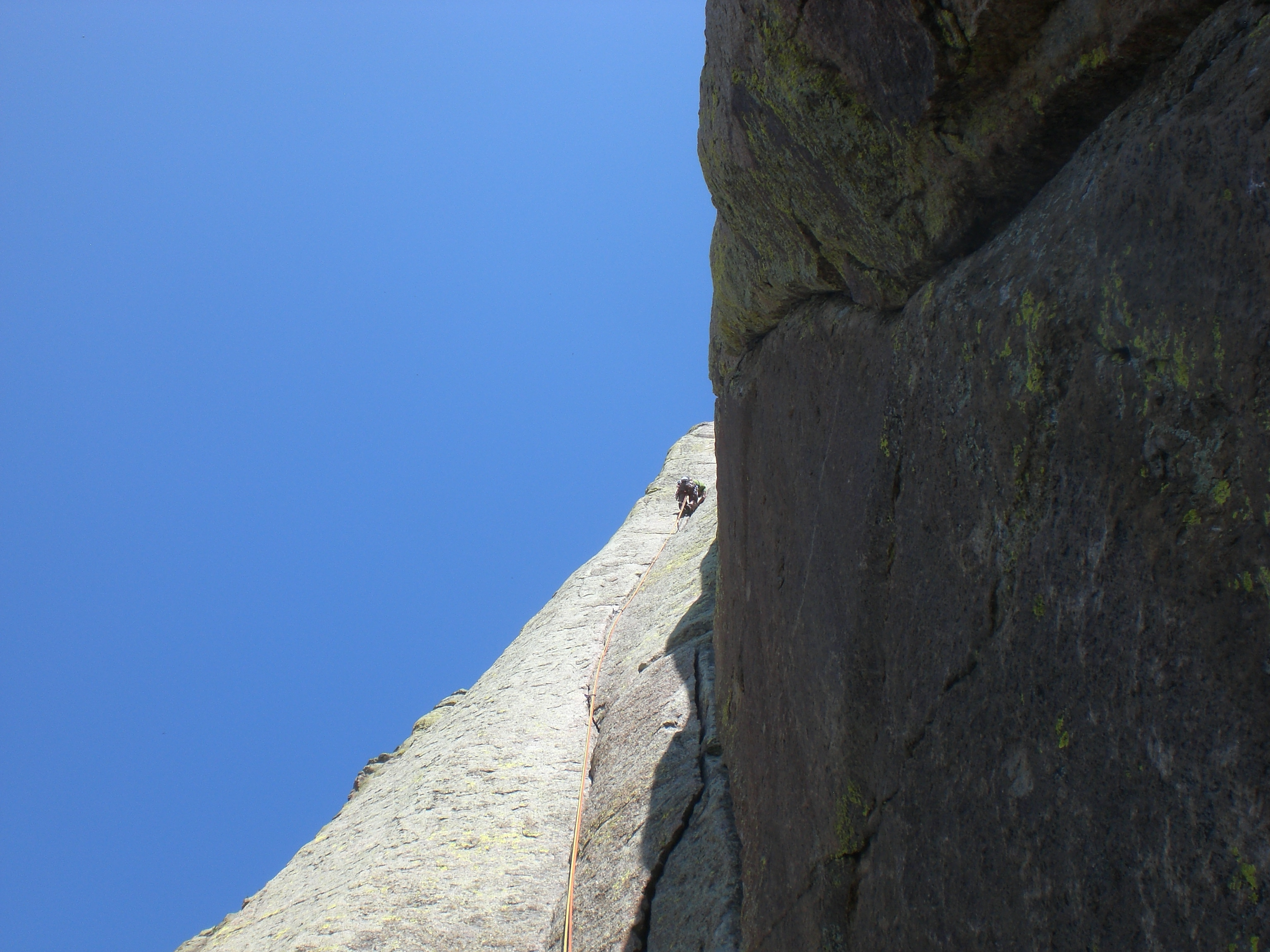
The three stoppers protecting the last moves

To that end, I placed my right foot on a diagonal hold out on the face and grabbed a disappointing side-pull with my right hand. A tenuous crank on the side-pull let me paste my left foot higher on the blank wall above the mantel ledge, then move my left hand up to a better side-pull above my right hand. Here’s where the unreasonable optimism from my performance at the crux came into play, along with a little pigeon shit.

View past the line of roofs on the West face

As I reached for the next hand hold, a ‘thank god’ sort of edge, I noticed a blob of guano right where I wanted my fingers to go. It looked dry, but as I prepared to sweep it away I noticed a very slight squishiness. Instead of smearing the whole hold, I left the turd lie and laid a finger on either side of it. Now my situation had changed and it demanded a reassessment and probably a little stabilization before I continued. And I would have done just that, if I hadn’t been feeling so damned good about things.

Instead, I proceeded with plan A. Moving my left hand up to an edge that would prove a very good hold once I swung my feet around, I cut loose my left foot and tried to swing my right over to a hold on the edge of the column. With no potential to generate lateral force on the crappy hold, I couldn’t make it happen. With the holds now well below and to the wrong side of me, my feet blew off entirely and started to make the sound that a startled Hanna-Barbera character’s do as they scrabbled for friction on the wall.

Finally, I let my legs hang and resorted to the ‘skills’ gained from all those hours of training in the basement. I skipped my left hand up to a slightly better hold, then my right, just like working the campus board. At last, I flopped onto the apex of the column. It wasn’t the graceful finish I wanted, but it was controlled. I guess I ought to just be happy with not having tested out those micro-stoppers.

Climbers atop the first pitch of El Matador

Tagged , ,

Oxidative Stress

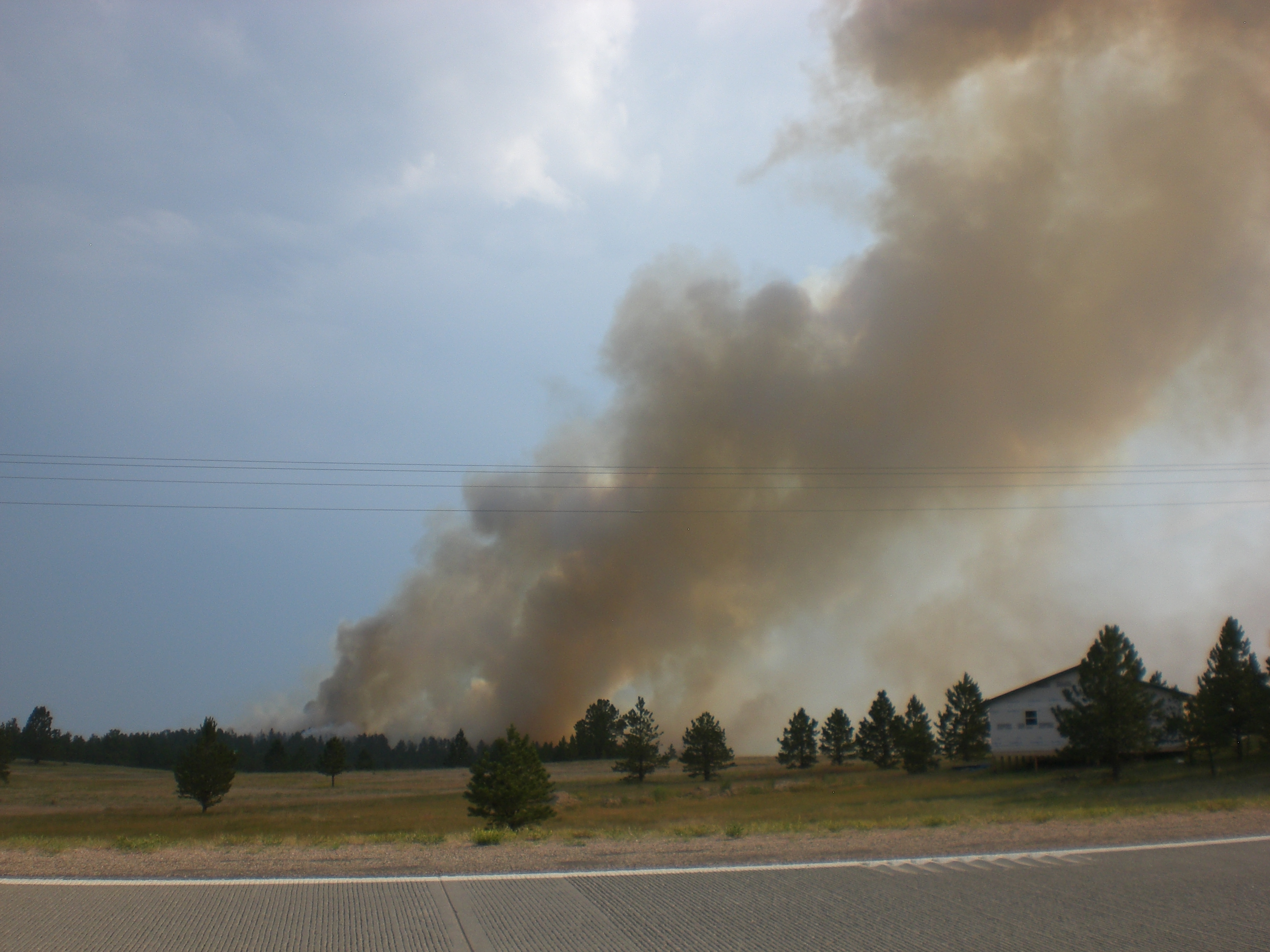
Weston County caught fire Sunday. On the way to the Needles, the air was clear and the land, peaceful. On the drive back, the trees were exploding and the sky was filled with buzzing aircraft and stinging smoke.

As I waited with the other cars for a grader to pass, I got to watch fire-fighters scramble for their trucks as flames popped out of a 40 foot pine less than 10 meters from them. They were experiencing severe oxidative stress. Scaled back and slowed down, that moment captured my whole day.

With temps in the upper nineties, our climbing choices were limited to the Cathedral Spires or Sylvan Lake, the best places to chase the shade. There’s an off-width with my name on it in the Spires, so I begged off that option – too hot, I insisted.

I wanted to climb Shelob before the day was over. This route is a Bob Kamps classic, a steep series of cruxes protected by just enough bolts and gear to make it reasonable. If I’d had my way, we would have gone right over to it. Instead, we warmed up.

The actual warm-up, the first route, made sense. It was a 5.7 crack named what every good 5.7 crack in every climbing area in every part of the world is named: Classic Crack. The second route, ostensibly part of the warm-up, was, in retrospect, what sealed my fate.

I believe the route is called Four Play (apparently lots of lonely climbers roaming the Hills back in the day – watch for a pattern in the route names). Though it is a slab and gets a low difficulty rating, it is a route made to make anybody look bad. It follows a line of greasy feldspar crystals up a nascent groove in the rock. Most people step back and forth several times trying to find the best way through the lower section. The generous gaps between the bolts add to the sense of insecurity and the angle permits indecisiveness.

With fingertips and toes feeling a little tired, we slogged up the other side of the little valley to Shelob. This is one of my favorite routes at the Lake because I can cheat my way through the crux. An alpine climber at heart, cheating makes me feel clever and I am proud of it whenever I manage to weasel my way through a challenging bit of climbing that would otherwise demand skill, strength or boldness.

The first moves are steep, but straightforward up to a couple of bolts. Then a pair of cams in a horizontal crack protect a few moves through a bulge. A fall on those moves would be bad. The cams would hold, but you would brush the ground, at best. Three boulder problems, protected by bolts, follow, then a step up and right to the little roof and corner which constitute the crux. Once I peek over the lip of the roof, I can set my feet on some good holds below the roof, lay my left side and shoulder against one side of the corner and apply counter-pressure. This allows me to rest while I place a pair of micro-stoppers to protect the move over the roof. I can then step high with my right foot to maintain the pressure and just wriggle my way up the wall until I get to the next good hold. It was just as beautifully uncouth this time as the first time I ever did it.

The diagonal crack, Sex Never Did This to My Hands

Perhaps I was feeling too smug coming off that success. I felt like finishing the rotation with a route on Vertigo View called Sex Never Did This to My Hands. It’s only 5.8. Plus, it’s a crack. It’s a diagonal crack though, steep, crusty and irregular. Much of it is just wider or just narrower than a clenched fist.

I felt a peculiar sense of fatigue as I skirted the small roof at the bottom, but I wasn’t worried; I had climbed this route many times before, and I had just waltzed up Shelob after all. About midway, the tape sweated off my right hand, and when I got to the hard part the back of my fist was slick with more sweat and a light sheen of blood. By then, I was cooked.

Tape vs. No Tape and why the route is named as it is

Fermenting like mad, I tried to pull through, but realized I couldn’t get to the next stance with enough left to place gear. I managed one and a half moves back down before I had to disengage. Eighteen feet later, it felt like my cheap rope delivered every bit of the 8.5 KN of impact force it allows right to the leg loops of my harness.

Deflated and burdened with what I am convinced were actual crystals of lactic acid in my blood vessels, I climbed back up to check the tricam that saved me, then staggered on through to the anchors. From the top, I could see smoke in the distance.

As the line of motorists watched those poor bastards scrambling to save their fire truck, I’m sure some of the observers questioned the fire fighters’ decision to park where they did. I wasn’t among the critics. I was thinking that the firemen probably thought the situation was more manageable than it turned out to be, and I was reluctant to blame them for that. Hell, I know that’s the reason most of them were out there in the first place. Civic duty be damned, some folks just need the oxidative stress. It’s the kind of love-hate relationship that keeps you going.

Tagged ,

Tower Blowout

I should have known better. The term “blowout” is never associated with a good aftermath. At best it entails something nasty issuing from an orifice of some sort. I prefer the Tour de Tower, which is a trip around the monolith, hitting as many routes as possible along the way. Some of those routes may be Killer b’s (the 10.b grade at the Tower is a universal sandbag), but not a bunch of 11’s. For me, those are still part of a three route regimen: one warm up, one desperate struggle, and one warm down to wash away the cotton-mouth.

When Mr. Swift suggested the blowout before the voluntary June climbing closure, I figured it would be OK. He’d lead all the hard pitches. Nobody can string together those steep, crimpy slabs and fingertip cracks all the way around the Tower without getting tired. I’d lead the approach pitches and then, when he folded, I’d take over and ease things back into the classic tour.

He didn’t fold, he escalated. Before it was over, I found myself on routes I wasn’t sure I could even follow. I managed, but only just. When it came time for the warm-down, it was I who was forced to quote the great Roberto Duran. No mas.

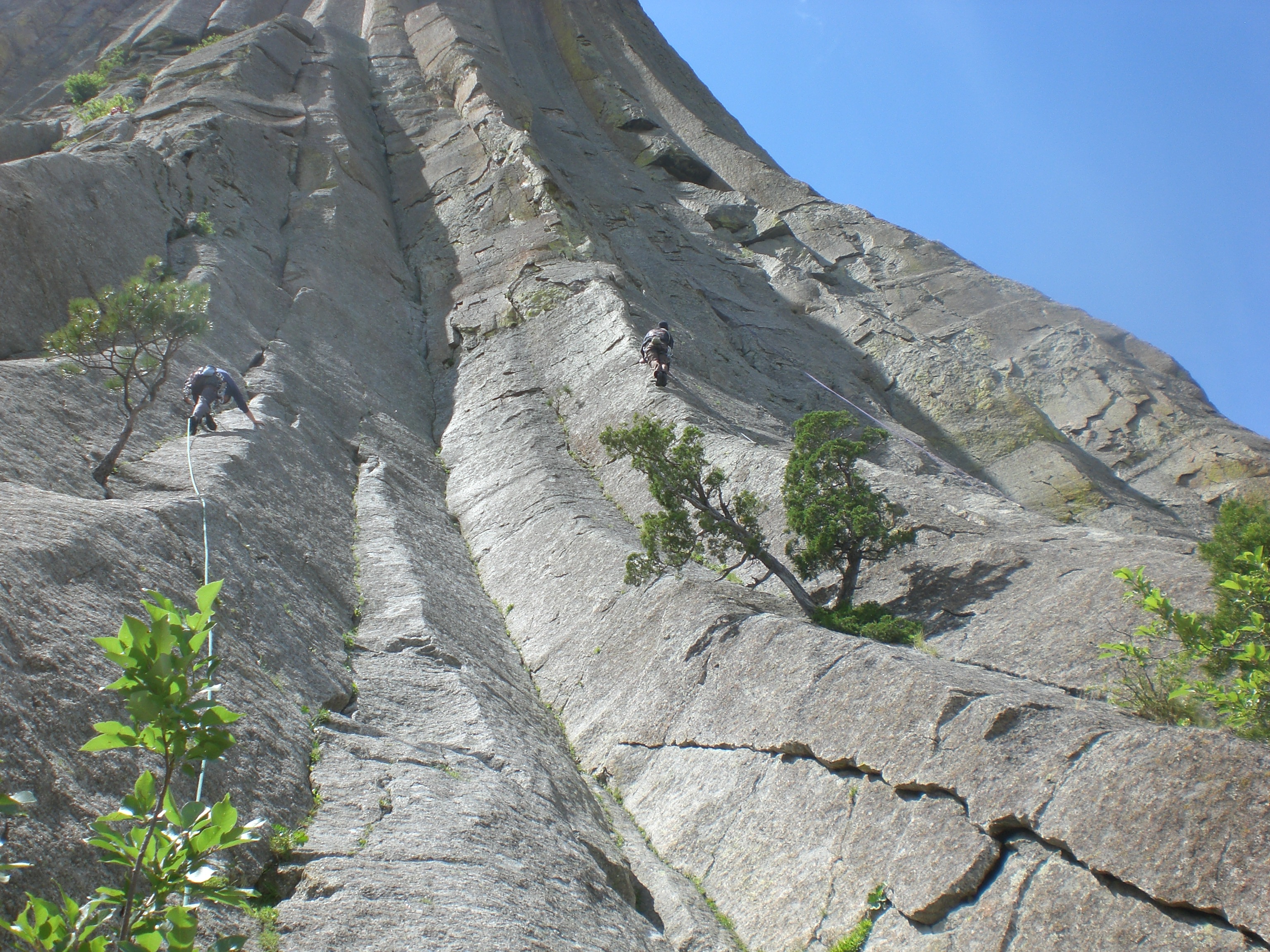
At least all that time on the dull end allowed me to get some amusing photos.

Anonymous climber on Everlasting, aptly named since you’re sorry you got on it by the second clip and then it just won’t end.

Making his “O-shit” face.

It is important to chalk up here to take your mind off the crappy footholds. 

Busy day on the NE shoulder.

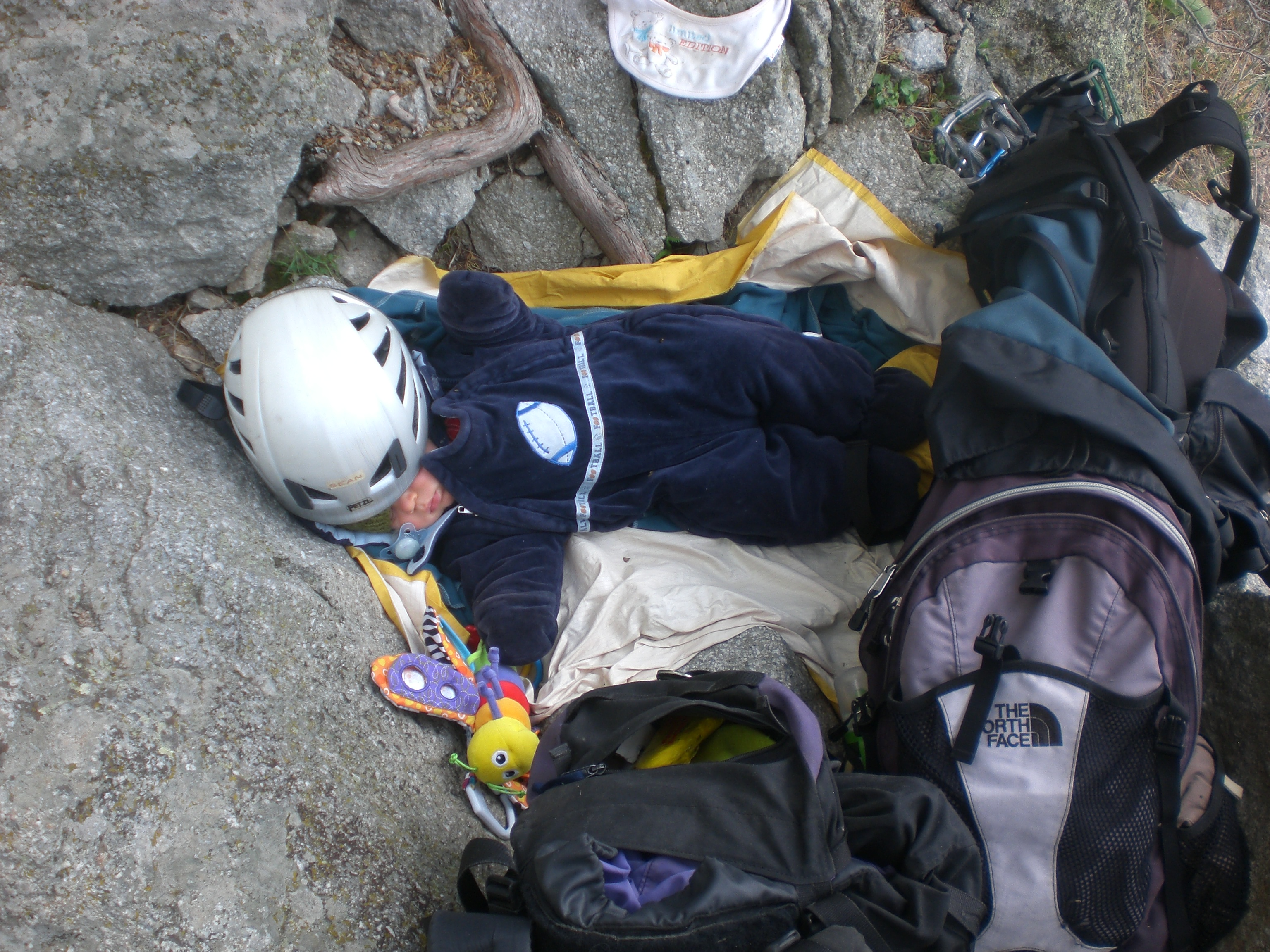
Baby bird doing what good babies do best.


Tagged , ,

Reincarnation

I don’t subscribe to the idea of reincarnation because I don’t like the way it’s said to work. If you are good, you become lighter and float up the preset hierarchy of beings. If you are bad, your evil deeds will burden you and you will sink down the preset hierarchy. This is bogus. It should be more like skeeball. You should get tickets for being good and then get to pick your next incarnation from the highest shelf you can afford. I could go for a scheme like that.

I would choose to come back as a White-Bellied Swift. These birds swarm around Devils Tower in the Spring and Summer. They are specialists in flight with boomerang-shaped wings and sharp, compact tails. They keep the Tower climbing experience real. Finish a hard route feeling all fluffed up and euphoric and one of these little guys will zip past your head, the wind screaming over his feathers, then dive vertically down the wall less than a foot from the rock. No matter how good you feel right then, you will never be as good at what you do as he is at what he does.

This guy is about as close as we humans come to that kind of mastery. He is a rock climbing specialist. As a result, he’s achieved a degree of control and skill that looks a lot like what the Swifts have. Sadly, that’s not for me. I can’t devote myself to rock and since I lack any singular genetic gifts, I’m doomed to mediocrity. I don’t mean to imply that I’m lukewarm on rock climbing. On the contrary, as soon as the snow melts, I’m itching to smell warm granite and feel the crushing embrace of rock shoes on my toes. It’s just that, by the end of summer, I start longing for bleak landscapes, violence and weird new forms of water.

So if I came back as a Swift, I’d probably start watching the vultures soon enough, wishing I could be soaring up high instead of whipping around the Tower like a madman. Maybe I wouldn’t cash in my tickets on swiftdom after all. Perhaps something small and terrestrial, with a bad attitude and a wicked set of teeth…

Tagged , ,