Author Archives: keithnoback

Who Are We to Believe, the Lion, the Scorpion or Circe?

People have been preoccupied with the nature of mind and personality at least since anyone realized that everyone’s first question is the same question – “Huh?”.

A slave named Androcles once escaped from his master and fled to the forest. As he was wandering about there he came upon a lion lying down moaning and groaning. At first he turned to flee, but finding that the lion did not pursue him, he turned back and went up to him. As he came near, the lion put out his paw, which was all swollen and bleeding, and Androcles found that a huge thorn had got into it, and was causing all the pain. He pulled out the thorn and bound up the paw of the lion, who was soon able to rise and lick the hand of Androcles like a dog. Then the lion took Androcles to his cave, and every day used to bring him meat from which to live.
But shortly afterwards both Androcles and the lion were captured, and the slave was sentenced to be thrown to the lion, after the latter had been kept without food for several days.

The emperor and all his court came to see the spectacle, and Androcles was led out into the middle of the arena. Soon the lion was let loose from his den, and rushed bounding and roaring towards his victim. But as soon as he came near to Androcles he recognized his friend, and fawned upon him, and licked his hands like a friendly dog.

The emperor, surprised at this, summoned Androcles to him, who told him the whole story. Whereupon the slave was pardoned and freed, and the lion let loose to his native forest.

•Source: The Fables of Æsop, selected, told anew, and their history traced by Joseph Jacobs (London: Macmillan and Company, 1902), no. 23, pp. 60-61. First published 1894.

In Androcles and the Lion, the lion represents a certain view of mind. When Androcles meets him, the lion is preoccupied with the thorn in his paw. Nothing else matters; the lion is an animal in pain, above all. After Androcles removes the thorn, the lion is an animal relieved of pain, above all. Henceforth, in Androcles’ presence, all that matters for the lion is the presence of Androcles. The mindfulness appears to be contagious too. The emperor is caught up in the fellowship and, cries for blood, bread and circuses be damned, he releases the slave and the lion. In this view of mind, what happens is what’s at work. The lion is still a lion. Androcles is right to fear the cat on sight. But the lion-ness is something of an accident of birth. The creature is mostly damp clay. It may start as a lion-shaped lump, but it is a natural born empiricist. It responds to stimuli as any set of enzymes and neurotransmitters would. Androcles’ mercy is the lion’s mercy is the emperor’s mercy because Androcles’ pain is the lion’s pain is the emperor’s pain. The story is lovely. No one really thinks the lion would have let Androcles approach, though. Nor does anyone reasonably expect a politician, even a despot, to disappoint his constituents for the sake of a slave and a predatory animal. So much for the sovereignty of current events. What else, then?

A scorpion and a frog meet on the bank of a stream and the scorpion asks the frog to carry him across on its back. The frog asks, “How do I know you won’t sting me?” The scorpion says, “Because if I do, I will die too.” The frog is satisfied, and they set out, but in midstream, the scorpion stings the frog. The frog feels the onset of paralysis and starts to sink, knowing they both will drown, but has just enough time to gasp “Why?” Replies the scorpion: “Its my nature…”

The scorpion cannot escape his nature. Neither can the frog, and his is the nature which cannot tell the difference between helping someone across the river and helping a deadly scorpion across the river. In either case, the creature’s transcendent essence trumps the matter at hand. Just as the lion is ruled by the insistent facts of the moment, the frog and the scorpion move to the tug of their respective natures, with the facts of the moment as props and extras on the stage, setting the scene but not truly affecting the action. The frog feels mortified as the truth is uncovered. But the scorpion goes down happily, for he has apparently learned to love his fate.
However, his fate is to sting, not to cross rivers, though he speaks of it all as one piece. By nature, the scorpion has much in common with the frog, except the scorpion’s nature is one which cannot tell the difference between loving its fate and hurtling headlong to its doom. Stinging isn’t the issue for the scorpion, wanting a ride across the river on a stingable boat is. Circumstances are not just window dressing, and the closer we examine essences, the more they look like they’re ruled by circumstances, and might even be made of circumstances themselves.
If there is no absolute power in mechanism and no absolute power in identity, then what do we make of ourselves?

Listen with care to this now, and a god will arm your mind. Square in your ship’s path are Seirenes (Sirens), crying beauty to bewitch men coasting by; woe to the innocent who hears that sound! He will not see his lady nor his children in joy, crowding about him, home from sea; the Seirenes will sing his mind away on their sweet meadow lolling. There are bones of dead men rotting in a pile beside them and flayed skins shrivel around the spot. Steer wide; keep well to seaward; plug your oarsmen’s ears with beeswax kneaded soft; none of the rest should hear that song. But if you wish to listen, let the men tie you in the lugger, hand and foot, back to the mast, lashed to the mast, so you may hear those harpies’ thrilling voices; shout as you will, begging to be untied, your crew must only twist more line around you and keep their stroke up, till the singers fade.
– Translated by Robert Fitzgerald

The Seirenes will sing his mind away with a song based in a natural, essential property of man: to be motivated, and so ruled, by his desires. Circe advocates Amor Fati. Listen to the song; the desire it carries is an essential fact in you. No theory of desire will save you. But it is not a transcendent fact. It is a fact with an explanation. It is a fact made of things in history, the same as the joy of homecoming from the sea. Rooted as it is in history, it is a fact no more powerful than a column of cedar, beeswax and cords. Circe saw clearest when it came to mind and personality. Like, Odysseus, we’d be well advised to listen to her.


Tagged , , , , , , ,

12/22/13, 0200

home%2520005

When I came back from the emergency call, I expected to find her drinking. She had been upset with me, with her job, with something big and shadowy which I had been trying to get her to describe for the last year. Actually, I hoped to find her drinking. Sometimes she got drunk and wandered, or drove, off and I had to go looking for her. I couldn’t afford to do a search that morning; I was on call.

Her car was in the driveway, but she was not asleep in our room. That late, there was one other place in the house to check. In the early hours, she liked to sit downstairs and watch the fire when she was feeling agitated. I walked down to the basement and there she was, sitting on a cushion in front of the wood stove. But her posture was wrong, and then I noticed the rope and saw that she was not sitting on the cushion, but was suspended a few inches above it. I ran to her and slipped a finger through one of her belt loops, but the stitching popped loose as I began to lift. When I did manage to lift her I heard no in-rush of air. In that moment, I knew that we had lost, me and her. I couldn’t accept it right away though; I had to try to get her back. I dithered for a for a few moments. To cut her down, I would have to let her weight come back on the rope. I knew I would not outlive that act. It took every speck of my mental discipline to let her hang again. I severed the rope and went through the motions of resuscitation, with the expected results. I’ve been going through the motions ever since.

Rockies%2520%252709%2520003

I spent seventeen and a half years with her. We met in medical school during an Ob./Gyn. rotation. After a prolonged reconnaissance, she talked a mutual friend into approaching me. The friend, a traditional woman who’d immigrated from Vietnam as a child, had been instructed to ask me if I was: 1) gay 2) married 3) in a relationship. All that came out was the question about marital status, mumbled quickly with eyes averted. Though it lacked the impact of the full set of questions, the inquiry was strange enough. It was strange to have any woman show any interest in my relationship status, period. I’m not exactly what most women would consider a “catch”. I cut my own hair. My nose has been broken on several occasions, and let’s face it, the thing sticks out enough in the first place to be at risk. Attempts at orthodontia undertaken during my childhood were not entirely successful. And although I’ve suffered from loneliness, much of it has been the consequence of a solitary temperament. Besides, I’m a climber, and so quixotic. Maybe my wife recognized a shared vision in that last quality, but if so we were probably ill-matched. She may have been better off had she chosen Sancho.

She was an artist. At the age of five, her parents caught her in the garage coloring in the fender of their new car with a crayon. The car was the wrong color, and she intended to fix it. As an adult, she spent a year trying to paint a scene from a photograph of Mt. Columbia. I tried to talk her out of it. The intriguing things about the photo were its detail and flatness. The brain could see different depths in the scene because the camera didn’t commit to any one perspective. The conventions of painting did not permit the same insouciance. She kept at it until she had a damaged trochlear muscle in her eye from looking back and forth from the photo to her painting. When she finally gave up, it was with a sense of bemused fatalism. Failures and frustrations brought up a black bile in her. My bile was always yellow.

When I had to forego climbing opportunities or persist in a profession which I have always considered ethically bankrupt, I boiled. I never got angry at her. On the contrary, she was my solace. But living in the same space as a whistling kettle begins to wear on a person. She finally set me straight. I got the parts of my life teased apart, once I realized that they must be kept apart or else destroy each other. As a climber who values climbing’s unitary action, the admission was difficult. I had to concede that, despite my wishes, all was not climbing, and acknowledging that all was not climbing did not invalidate anything.

She accomplished the turn-around by convincing me that some sentiments are irreconcilable. Feelings of frustration with everything, and so nothing in particular, real expectations based on our ideal desires of other people – and the same feelings toward ourselves – must be accepted as absurdities about us and byproducts of conflict within each of our identities. We cannot bring those feelings into line and make them reasonable in context of anything that we signify. She convinced me, but I could not do the same for her.

Since her death, I have had two dreams about her; the first, two days after I found her and the second, the day after I came back from the undertaker. I usually don’t remember dreams, but these were bad enough to intrude into waking memory. The first was a straight forward nightmare. She was sitting on the cushion in front of the fire with her eyes closed, crying. The tears were black and she just kept on crying them though they ate into her eyes and face.

IMG_0327

In the second, I had just walked into the house and she was standing in the kitchen. She was older and taller than she had been in life, and she was smiling. She began to explain that she hadn’t really died, she had just staged an elaborate ploy to get away and sort things out for herself, and it had worked. She said she was sorry for the trick; there was just no other way. I started to forgive her and asked what she wanted to do now, what she wanted to do differently. But as I spoke, I noticed that she was standing partly inside the counter and her eyes were sad. My arms felt heavy then, and I looked down to see the box of her ashes in my hands.

Tagged , ,

The Art of Losing

IMG_0339

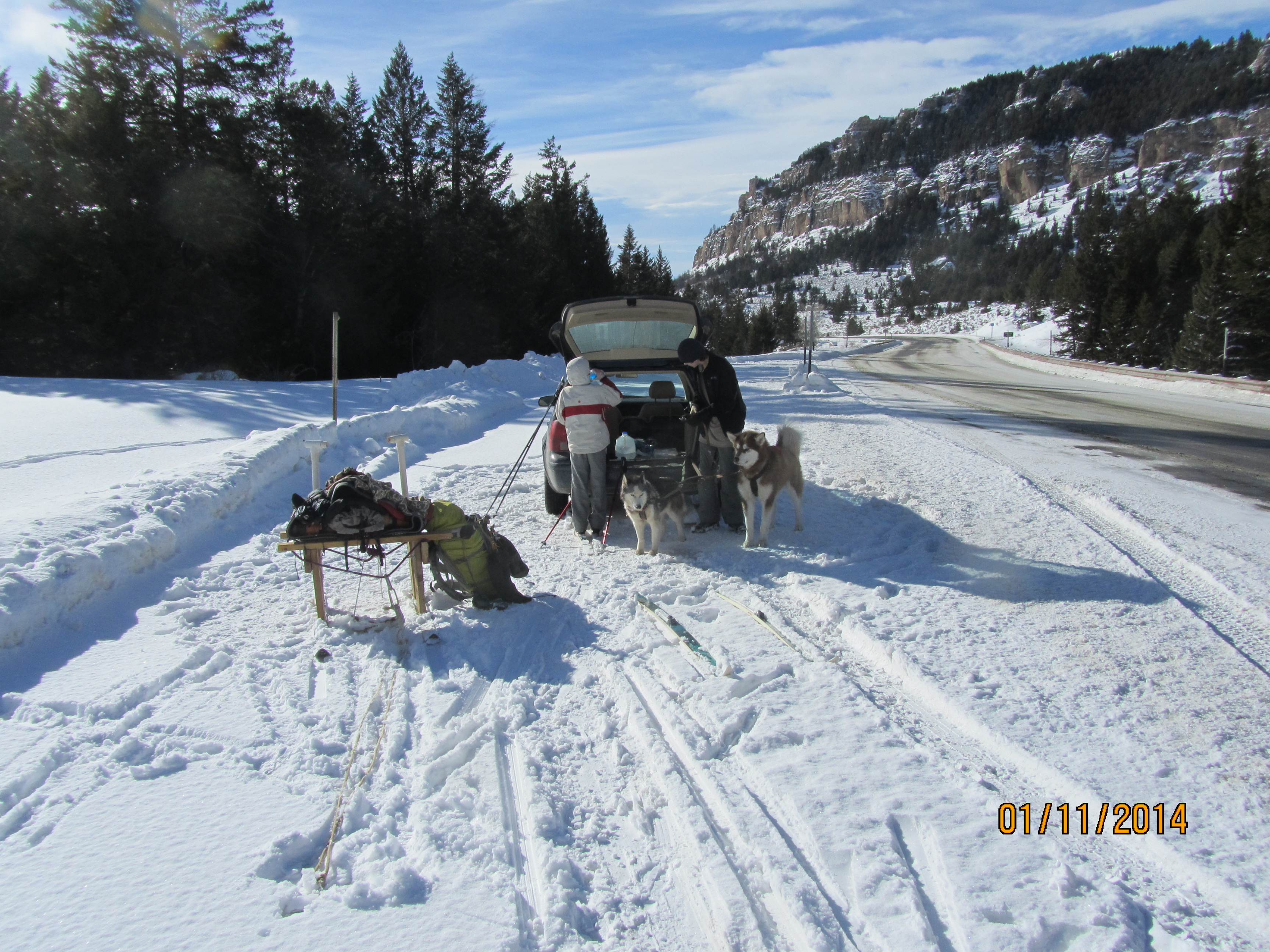
So, I had plenty of excuses from the start, which is good. The logistics alone were ambitious. Just getting everything in the car would be hard. We had to fit two dogs, a sled, climbing packs, boots, skis and three people into a compact station wagon. If we cleared that first barrier, we then had to drive the better part of three hours, with a nervous Husky and a Malamute prone to motion sickness crammed in the rear compartment. The concentrated dog breath alone might justify turning around. We had plenty of reasons to fail, but the boys were motivated to go and, more importantly, didn’t know any better. No savvy adults would have consented to the endeavor.

IMG_0338

The whole plan was to drive to Ten Sleep Canyon, ski and dog sled 3.5 miles down the fire road on the South side of the canyon to the frozen waterfall on Leigh Creek, climb, and come back. I looked at it as a climbing trip, which is how I rationalized even getting started. You see, no climbing trip can be taken as a given. It’s all provisional – if the weather, if the conditions, if the time, if the guidebook author is not a pathological liar, etc. Unlike some punk-ass managers and motivational speakers who say that planning for failure is planning to fail, climbers assume failure from the start of the expedition. Sure, we count out grams of food, lay out the gear, go through the pack again and again, and memorize route topos, but we also carry along our headlamps, space blankets and stoves. If the outcome of a trip was a foregone conclusion, we would probably stay home and watch a romantic comedy. The principle holds on the level of the meta-trip as well. In the words of my friend Andy, “Always bring all your gear,” on a climbing road trip.

The trick to making it all seem worthwhile is to declare victory early and often. Fitting the gear and the dogs in the car, we win. Arriving at the parking lot with a car free of dog puke, we win. Getting the sled assembled without any missing parts, we win. There is an art to winning the climbing game. There is a very similar art to losing it, too. You want to have a good look before you back off, and know just what you are looking for. You want to know just how thin the ice can be before you won’t risk it. You want to know just how late it can be before you need to turn around. You also want to be able to look for reasons to ignore your metrics. You want to be able to see that the weather man was wrong about the high pressure system or listen to last night’s burrito festering in your guts right at the start of the route.

For us, the snow conditions were the reason. As it crested the Southern rim of the canyon, the sun beat fluffy snowfall from the previous three days into mashed potatoes. By the time we’d gone half way, the dogs had stopped twice and their tongues were slapping their paws as they plodded along. The oldest kid was leaning on the sled handle. We were still on schedule, however.

“We’re just about half-way,” I noted, “Do you want to keep going?”

“Yes!” the older boy snapped.

This is the hammerhead mentality: “I pound on things, and that’s it. Now shut up and show me the next nail.”

It takes a few swings to deflect a hammerhead’s intention. After ten more minutes and a small hill, I asked again.

“Do you want to keep going? We have all this to reverse…”

“No,” he admitted, “Goddamit!”

He was mad at me and the dogs and himself. I assured him though, that we would be back in the next couple of weeks, without the dogs, for a meta-swing, and he was happy again. That is the final piece to the art of losing at climbing – the art of losing without losing. The game is over when you say so. You can always change the rules and call for another period.

IMG_0342

Tagged , , , ,

The Limit

My wife recently killed herself. Me and the boys are trying to cope with our new circumstance and the sympathy of the community. Much of the sympathy comes from Good Christian People, which is fine when the people are good and Christian. Some who count themselves in that group, however, are uncomfortable in their expression, as they are first a certain sort of Christian, and then good people. Their condolences are nuanced because they believe my wife still exists in Hell. In principle, their belief does not move me one way or the other. It concerns me as much as my grandmother’s warnings of impending apocalypse, resurrection and divine judgment, which is to say not at all.
The belief itself is mere human silliness – denial, magical thinking – whatever label best fits the realm of imagination in question. But the believer is another matter. The believer imagines an entity who would cast aside a thing of beauty, actively or passively, not in a fit of intoxication and despair, but soberly and in principle. Who would ally himself with such a being? What sum purchases such allegiance, in principle? Maybe the allegiance is also mere human silliness in the face of fear, without any principle behind it and bought with the psychological equivalent of poker chips. If so, I understand and allow; I am no less weak in spells. If not, then partisans of the doctrine in question merit pity, but no trust and no respect. They are traitors to their own kind.
I don’t begrudge people their religious beliefs, nor do I think religion is inherently destructive. Social organisms must struggle with destruction as part of their circumstance, God or no. I think most religious sentiments can be accommodated. There is a limit to everything, however.

Tagged , , ,

So far, Sooo Good

Crazy Mountains from Mission Creek

Crazy Mountains from Mission Creek

It started during a warm spell in Montana.

CIMG4150 - Copy

We almost got skunked.

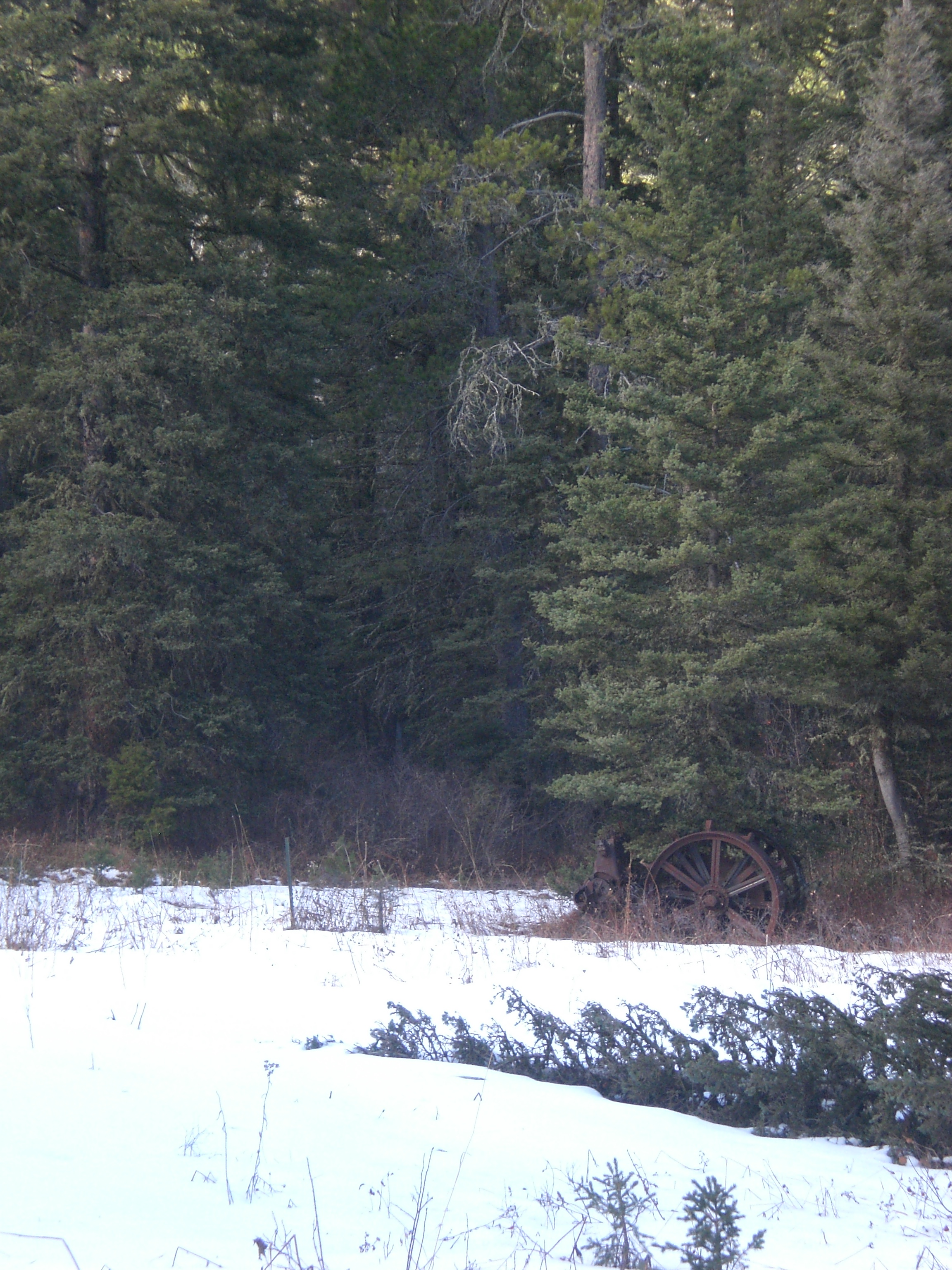
Prospectors' abandoned equipment up Mission Creek - they got skunked.

Prospectors’ abandoned equipment up Mission Creek – they got skunked.

But not quite.

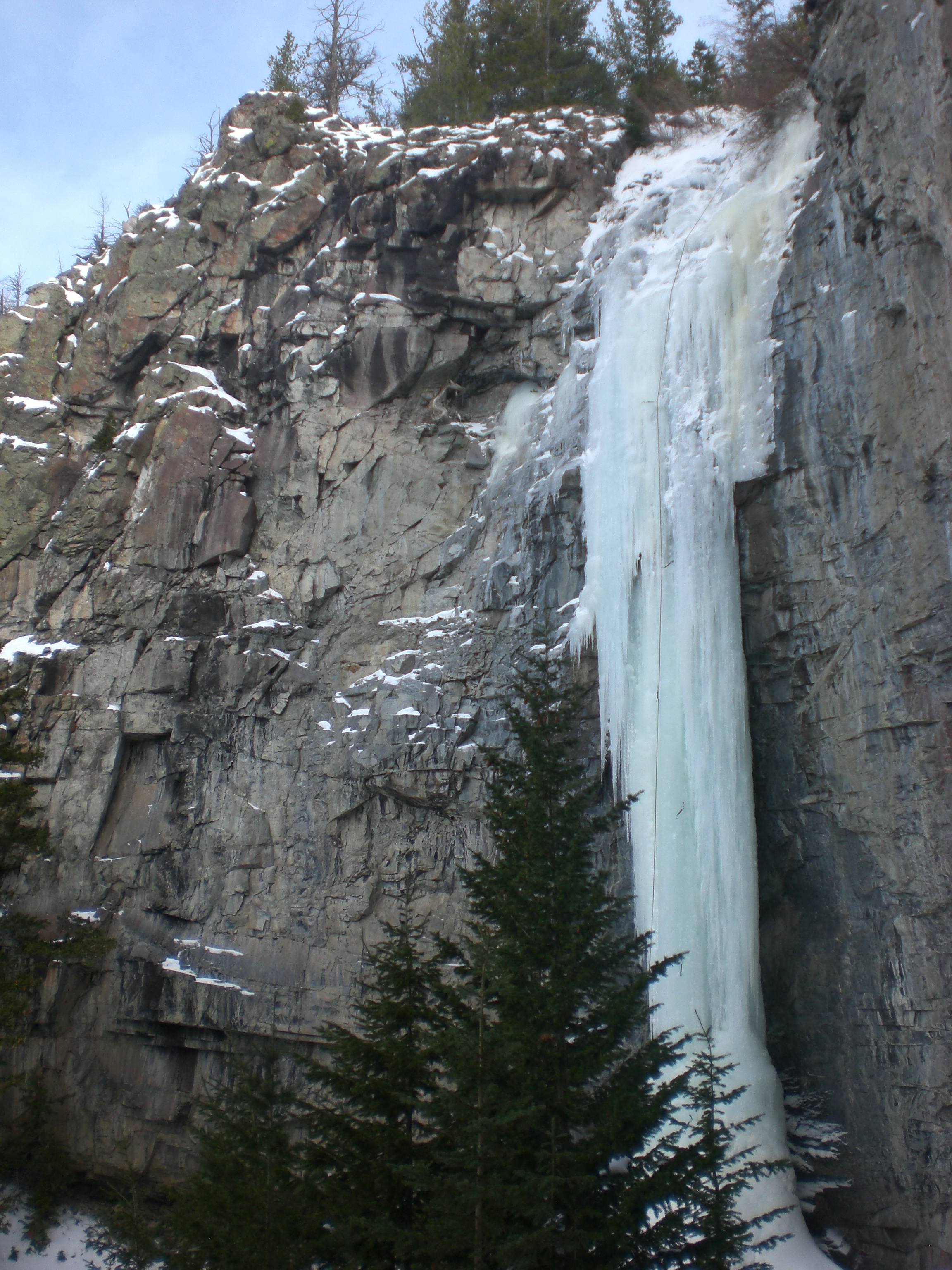
Das Ist Eis, Mission Creek, Montana

Das Ist Eis, Mission Creek, Montana

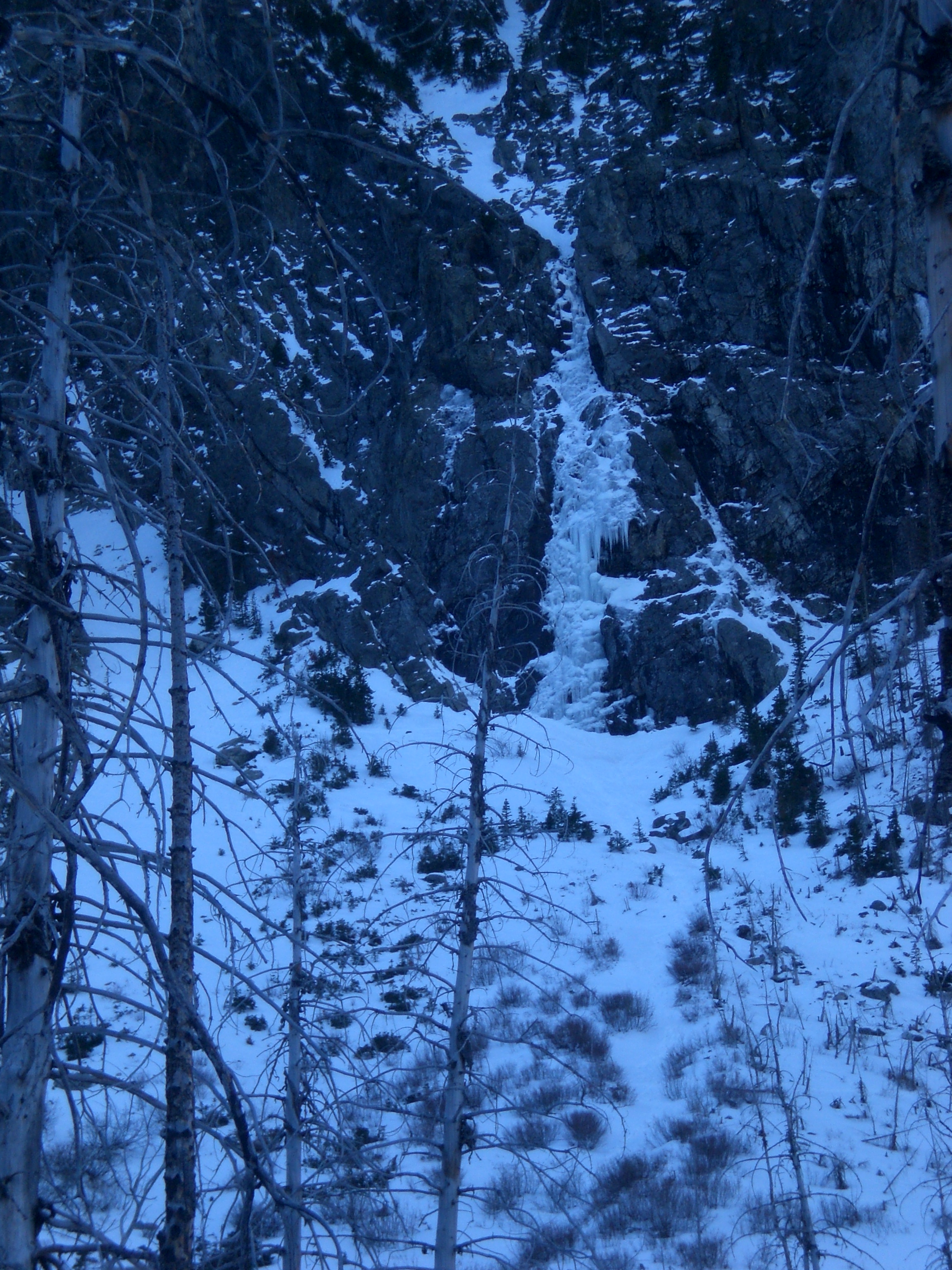
Then it got cold, and the South Fork went nuts.

Moonrise

Moonrise

Pillar of Pain

Pillar of Pain

Enjoying the Pain

Enjoying the Pain

At last! Scratch My Itchy. (Damn, I need to do some squats...)

At last! Scratch My Itchy. (Damn, I need to do some squats…)

Everything I always hoped. Must have walked up there twenty times before to find the pillar broken off.

Everything I always hoped. Must have walked up there twenty times before to find the pillar broken off.

Tagged , , , ,

Men, Mores and Mimbos: The Strange Case of Moral Fact

In the era surrounding the second World War, in England, there lived a brilliant man who happened to be a homosexual. Unfortunately, this man had a weakness for at least one mimbo – a younger man who seemed at best cute and clueless and at worst shallow and self-involved. Unfortunately, because in the course of their relationship, our genius had his apartment burgled by some acquaintances of the younger man (allegedly). Besides being a wet blanket on the love affair, the turn of events presented a peculiar legal problem for the crime’s victim. In providing evidence to the police, he would have to admit the nature of his relationship with the other man. Our protagonist was not particularly ashamed of his sexual orientation, and his friends and family would not shun him if the information became public. But the admission would run him afoul of a “buggery law” – an appropriately nasty name for a class of regulation which forbade homosexual behavior under the same criminal statute as child molestation.
The technical offense in question is moral turpitude. The term refers to acts of depravity and appears to turn on something like Kant’s admonition not to use people solely as means. Gay sex can’t result in progeny so it must be undertaken for gratification alone, which would place homosexuals squarely in the category of users of other people. Anyway, this is the charge which was successfully prosecuted in the case of our man, Alan Turing. The sentence was ablation of Turing’s libido by high dose injection of estrogen. Any hormone which acts on the central nervous system can produce mood disturbances at pharmacologic doses, and the injections likely contributed to Turing’s death by poisoned apple two years after his conviction.
It’s likely others shared a similar fate under the same law, but Turing’s ordeal is remembered because he is justifiably regarded as an exceptional fellow. He was fascinated with mathematics and logic and achieved great things in those fields. His name identifies the Universal Turing Machine and the Turing Test. The latter has enduring currency. Turing would probably be pleased, because he seemed to be particularly invested in how we might know about and model our own mental processes. His test is an elegant statement on the subject.
He called it the Imitation Game. A computer and a person are sequestered in a room, each with a connection to an interrogator on the other side of the wall. The interrogator then fires questions at the man and the machine, trying to sort out, based on their responses, which is which. If the interrogator cannot make the distinction, then we must admit that the computer appears to think. If we deny that conclusion, then what are we to say of the other fellow?
Now, it’s understandable that modern lawmakers began to regret their predecessors’ having destroyed a man of such capability in the name of stamping out buggery. Eventually, some proposed a pardon. However, the justice minister, a certain Lord McNally, objected. Read in whole, Lord McNally’s statement of opposition is quite sympathetic. His objection does not rest on Turing’s having gotten what he deserved or a nihilistic contention that the times were different and the law was right for them. Per McNally, Turing must not be pardoned because The Law must be upheld. In other words, Law and therefore any individual law, means something in and of itself.
The viewpoint espoused in the objection to pardoning Turing sees laws operating on two levels. There is a functional level, as in the laws which enforce contracts. If a contract has no guarantee of enforcement, it is no longer functional as a contract and no one will have a use for it. Then, there is a prescriptive level. On this level the Law pursues a state of affairs which we think ought to prevail in society. We have in mind a model of a preferred set of relationships when we construct laws with prescriptive intent and the laws represent the principles of those relationships. People should not simply use other people, so law should prohibit purely selfish sex acts.
Law has always been tangled up with morality and here is the point of entanglement. Law apes morality on the prescriptive level. Moral assessments are not merely descriptive, they are also prescriptive by definition. There is a difference in saying something is in good working order and saying that something is good. The difference is summarized in a saying which has come to be called Hume’s Law: You can’t derive an “ought” from an “is”, or more precisely you can’t derive an ought exclusively from an is. Facts in the world can’t, by themselves, tell us what we ought to do; we need valuations as well, and those are intrinsic to the evaluator. Yet values refer to facts. When a person says that they value kindness or abhor violence, they mean kindness toward feeling entities or violent relations with the same, not kindness toward clothing or violent relations with baseballs. Values are properties of relationships between the evaluator and the facts. Our moral prescriptions are the theories or models of those properties. Even when we say something so vague as, “Be kind to others.”, we imagine the listener maneuvering their way in the world with the purpose of establishing a certain quality of relationship with others. Note that the source of these properties is irrelevant. The values may attach to our relationships developmentally, as brute fact, or by the stamp of God. Like all properties, we will be concerned with how they are rather than where they come from.
Prescriptions need facts and relational properties among those facts to get going. The statement, “I ought to keep my promises” represents a model of the world which favors a specific set of relationships exhibiting the quality of respect (to be preferred because the Lord loves respect, respect is a preferable quality – period, or respectful relations have a salutary effect such that nature has selected a respect-preference in us; it doesn’t matter). The prescription is not the value itself. The value isn’t a thing at all, it is a property of the promise keeping. Whatever I say I ought to do, I must still keep my specific promise to my wife to be home on Tuesday. Furthermore, to employ the prescription properly in that case, I must live up to the expectation of exemplifying respect in my promise keeping. I’m violating the prescription if I “lawyer up” by rolling through the door at 11:59 PM on Tuesday night, throwing my dirty gear on the floor and flopping into bed.
An understanding of moral statements, and their prescriptive component in particular, as representations makes Turing’s conviction and McNally’s subsequent objection to Turing’s pardon, ironic. Turing’s Imitation Game plays on just what we can make of our representations. At the conclusion, if the computer can’t be distinguished from the human correspondent, we are not forced to admit that the computer thinks; we are forced to admit that it appears to think. In the process, we are forced to admit that, though computing may or may not be an complete model of our mental processes, it may be the best that we can do because we couldn’t know if we’d done better. In a compound irony, the full implications of Turing’s test, in principle and for his treatment under the law, were developed in response to an over-interpretation of his test.
As computing progressed from the rudimentary technology of Turing’s day to a period of exponential growth, researchers in the field began to think that they might be able to construct a computer that thought and know it. They either proposed or implied that a version of Turing’s Imitation Game might give them proof of success when it came. The response came from the philosopher John Searle, who devised a thought experiment which has become one of the most famous of all time: the Chinese Room.
We are asked to imagine a man sequestered in a room, much like the participants in the Imitation Game, with a detailed set of ‘if-then’ instructions. On one side of the room, is a letter-box through which questions written in Chinese characters come into the room. On the other side, is another letter-box for the man to pass out the answer, which he constructs based on the appearance and order of the characters on the papers passed in to him, with reference to the detailed instructions in his book. The task is feasible, even if the man has never seen a Chinese character before in his life.
In the course of the experiment the man does not learn to understand Chinese. The point being, representations serve their meanings, they do not make meaning themselves. This holds for our moral representations as well. Lord McNally made a well-intentioned mistake. The law serves the properties of relations – our values. The Law does not make values it represents them. It is the same mistake made in the original conviction. The law could, by itself, determine nothing about the properties of Turing’s “buggery”. Perhaps those who make such laws view them as a sort of Imitation Game, where the behaviors in question look like behaviors which necessarily exemplify certain properties to be valued or condemned. If so, they make the mistake, in strictly legislating for or against the behaviors, which the Chinese Room illustrates.
The case is no different in moral law than in statutory law. Objective moral systems make the same mistake. By taking values as things rather than properties and prescriptive models as real, values are unmoored from their subjects and become scribbled papers moving through the moral system. We have goodness, not as a category containing all those preferable properties of relations, but a thing which seems to alight hither and yon in sweetness, pleasure, or promise-keeping. It is no wonder when we open our hands, thinking we have goodness, we find only sweetness, pleasure or respect.
The converse landed on Alan Turing. In a reversal of fortune characteristic of moral realism, he was treated for homosexuality and a representation of Kant’s dictum not to treat people solely as means, taken as real, made an instrument of a man. To realize the statutory representation of a moral prescription, Turing was altered to fit the purported fact: homosexual activity is bad and one ought not do it. This is a pathology characteristic of moral realism. In the same way, when a blasphemer is stoned to death, a representation of personal integrity, taken as real, demands the disintegration of a person. The alternative is a morality which is seen to be about its subjects rather than about itself. Not a moral nihilism which claims that good and bad are nonsense, but a moral subjectivism which reminds us that good and bad are adjectives – properties not facts. As it turns out then, a pardon for Turing was in order, but not a pardon by way of apology. Lord McNally was right about that. Instead, Turing deserved a pardon by way of admission of a mistake, for he was the victim of an improper conviction – the conviction that there are moral facts which need reconciled. However, the required pardon may still be beyond a legislature’s power, for the mistake in question is a much bigger, broader flub than an error of prosecution.

Tagged , , , ,

Chaos Theory

The last several centuries have seen the rise of a perverse vision of morality. Going by various aliases this modern moral concept tells us that moral terms refer to something other than good and evil. Instead, the adherents of this viewpoint would ask us to believe that good and evil are mere descriptions, applicable to fashion choices as much as acts of benevolence or depravity. But the modern viewpoint is a lie. Descriptions have no power. They cannot motivate us to do anything. Of course, one suspects that the agenda driving our modern metamorphosis aims at a world where morality is not motivating. With moral focus dimmed, people can be motivated by those things which bring them pleasure and worldly profit. However, the agenda merely trades upon the normalizing effect of objective morality. We could not live as we do by following the path of moral relativism in real life.
Without objective moral terms, chaos would ensue. We do not have chaos, because moral terms refer to real things. Consider the alternative. If good and bad only operate within local frames of reference, we have a cascade of conflicting claims. Sometimes an act is good, sometimes bad. Sometimes an arrangement between individuals is evil, sometimes it is not. We cannot know which is which on the face of it. The authority of moral adjectives saves us from this fate. We need that authority to explain ourselves, and without it, we haven’t the motive power and clarity demanded by the moral challenges we face.
For example, walking among us is a small class of persons without remorse. They have no aversion to murder, and so require a reason outside themselves to condemn killing other people for any reason at all. Without objective moral terms, we have little to tell the psychopath. We can waffle about relationships and ties that bind, hoping to lash the psychopath to us with weak logic referring to dependencies. But what’s to stop him from replying in our own terms, like a serial-killing Popeye, “I am what I am and that’s right for me.”?
With objective moral terms at our disposal, we may respond with authority. “Murder is evil,” we may say, “and evil must be opposed.” A good moral concept is not just explanatory. A good moral concept tells us that we ought to do something, not just why we should think something is preferable. A good moral concept is solid, not riddled with re-words to the point of hollowness.
The moral troubles of the world require something with heft. Consider an even more difficult problem than individuals prone to violence: organized violence. Sadly, war is a fact of life. Our morality must confront it with an obligation powerful enough to justify such a monstrous activity . We can’t reasonably bomb the citizens of Dresden or Hiroshima and say to them or ourselves, “It is inconsistent with your identity as a human being that your group destroy other humans – the very source of that identity. Therefore you must die.”
We must provide a proper justification. We must say, “You have proven yourselves a proper medium for the perpetuation of evil. That is what we are bombing. Your deaths are regrettable, but that’s the best we can do and we are obligated to do our best when it comes to opposing evil.”
We cannot escape the reality of our moral terms, nor should we try. They are bound to catch us, because they do carry the obligations which we see at work in a just war. Nothing demonstrates our situation in that regard better than the way we deal with animals which kill humans.
If a bear kills a child, we execute the bear. We don’t kill the bear for any qualities relative to its bearishness, i.e. being a carnivore, needing to fatten up for hibernation, having an instinct to protect its young. We don’t care about the bear’s reasons; we care about the act. It has destroyed something invaluable. It has shown itself a creature with evil in its nature, and so must die. We are not angry at the bear. This is not revenge. This is justice.
Objective moral entities will finally allow no re-words at all. No relative merits, relations, revenge or reconsideration apply. Nor does scale. Absolutes do not mind scale. Evil is evil, and must be expurgated. What differentiates big evils from little ones is the ease with which they may be expurgated, not the strength of their demand on us.
The analysis at hand extends even to the smallest evils. Every year, 11,000 invaluable human lives are lost to infection with the bacterium Staphylococcus Aureus. We execute these tiny monsters with antibiotics. For the microbes which succumb, that’s the end of it, they have proven themselves minor evils and our obligation has been concomitant. But some do not succumb. Some of the bacteria are resistant to our antibiotics. In the case of the resistant bacteria, our duties are more complicated.
The bacteria in question, the resistant and the susceptible, live in people’s noses. The carriers of these bacteria are therefore complicit in the mediation of the evil which Staph. Aureus perpetrates. We may start by treating the carriers’ complicity as a minor evil and employ appropriate methods. We inform the carriers of their status and offer them the chance to eradicate the evil in their noses. History tells us that some of them will be unsuccessful. In those cases, a greater evil confronts us. The bacteria are persistent because they are resistant and so are better able to kill. As accomplices, we may treat the sub-group of carriers more leniently, though we are obligated to deal with the associated evil. These people have the choice of exile or suicide. These options neatly close the circle of obligation, but that’s not the important thing. What matters is that we have answered to our obligation. We have successfully solved the moral calculus and maximized human thriving. We can answer the carriers as we can answer the citizens of Dresden or Hiroshima. Your excision is regrettable, but that’s the best we can do, and we are obliged to do our best when it comes to opposing evil.

Tagged , , , ,

Vitrification

Autumn is a season for reflection. The humors slow. We are reminded of mortality, as the life around us shuts down. The maudlin huddle under blankets and hide from the change. Happy fatalists jump in the leaves and ignore it. We shouldn’t contrive a situation where certainty is ours and we wait for the change with eyes shut tight. We ought to be thinking about life instead of death, but not in the fatalists’ way. Out in the cold, in crevices and under bark, tiny creatures illustrate a better way as they face the real crux, the exposure.
As the nights cool, substances like the stored reserves of hibernating animals accumulate in the tissues of certain insects. But rather than providing energy through a long sleep, these substances will embalm their creator. If the rate of transition allows, water in the animal’s body will become an amorphous solid, a glassy ice. Glass spares all the containing structures in the body from lacerating crystals which destroy cell membranes and organs when the other form of ice takes hold. We are familiar with this process because, with less reflection than the insects, we bring the dilemma of a frozen state to our own, furry kinsmen. Motivated at once by fatalistic optimism (in the method) and insecurity (in the act itself), people have taken advantage of vitrification to postpone the development of human and animal embryos in anticipation of more favorable conditions.
In every case, resuscitation is not guaranteed. Some of the vitrified wild animals are clearly doomed. They don’t have enough of the embalming substances in their cells, or have too much water on board. Some are victims of circumstance, as the rate and depth of temperature change affects survival, all else being equal. The insects can’t bank on their potential. For all they know, when the frost takes them, they are dead. That’s all we know too. We freeze many embryos because we can’t know what’s going to happen to any one of them, only what tends to happen to a population. Life is like that. It is fuzzy on the edges, where things like viruses, self-replicating proteins, frozen beetles, and frozen embryos lie in wait to rob us of our reassuring, formal picture.
Worse, when the frozen, the ones that do survive, come back to life, it is through a completely generic influence. Heat does it. The atoms in a particular space vibrate a little faster and the bug resumes its life. The embryo begins to grow again, and barring any further mishaps, becomes a lamb or a human infant, depending on what came before it. The potentials of the process, like those of the form, fade into the landscape. Odds don’t mean much for the frozen individuals. The relationship of the odds to the individual demonstrates that the forms and processes of life aren’t special. We can’t have precious life and its illusion of prescience to hide beneath. We want it instinctively though, because it protects us from the vista tugging at our tails. Nor does the landscape recede if we write it off to fate. If we look down from our preoccupations, we see the individuals poised on vertiginous points of space and time. The location is special, but not cozy. It’s a spot of massive focus and alien potential. The view down is disturbing, but it is more accurate, and more immense than our mythology or our philosophy, if we can take it in.

Tagged , , ,

Can I Have a Sunday School Lesson?

So, the weather crapped out and I’m sick besides. It’s a day indoors reading and training, mostly to avoid housework. This page is usually like a journal and sketch pad for me, and I don’t usually invite comment. But today is one for latent curiosities and nostalgia.
Most of my Sunday school lessons were pretty didactic. Only after I left religion did I realize anything else was possible. Even the world with God was weirder than I had ever been lead to believe. I’d like to ask some of the questions of any believers or non-believers out in the cyberether, the weird questions, that my Sunday school teachers never broached.
I’m interested in hearing what people think about these things, and how much. I don’t really expect to respond, so please just lay it out. That said, I’m not interested in appeals to authority. Not to denigrate those who answer any questions about God with “because scripture says so”, that is just a different issue, and one less interesting to me.
Without further preamble: Is it “like” anything to be God? That is to say, does god have any subjective experience, or any experience at all? If so, how does that work?
Does God have intentionality? Does he think about things and if so, how does that work?
Lastly, does God wish to be worshipped, and if so then how and why? Again, please show your work.
Obviously, the questions are related and may not require separate responses. Thanks in advance for any and all replies.

Tagged , , , , ,

Success Is Just Another Word for Something Left to Lose

Sixty degrees was the forecast high temperature for the next day. Standing in the Hyalite parking area, we felt some bitterness at having squandered our forty degree day. A bit of information would be our only solace. We had just come down from having a look at the route, Zack Attack. There are some things in climbing for which I would risk serious injury or death. I could now declare: Zack Attack was not one of them. That’s all our best weather day would yield, and it was a brand of success, I suppose.
In our defense, it was very hard to judge the nature or condition of the first pitch from the road. So, first thing in the morning, we labored up the valley wall, bypassing the unformed steps of easy ice which would have made the approach entertaining in itself. When we arrived at the base of the climb, we saw that the reports of “all ice” were outdated. Several warm days had cleared the first short corner of its climbable adornment. The naked corner wasn’t much to look at – a collection of blocks and frozen turf. Except it wasn’t frozen. As I climbed up to have a look, my ice tools cut into the clumps of grass with light pressure from my wrists. Some of the blocks shifted ever so slightly under the crampon points.
As I looked up the route, the only obvious gear placements appeared to involve similar sets of blocks and flakes. The climbing didn’t look desperate, but the protection was illusory at best. In short, it was uninspiring. Besides, others were waiting by that time.
A team had come up to stand in line while I was scoping out the first pitch. Their persistence despite our priority and the look in the eye of the younger one made my decision even easier. I climbed down. Back on the snow platform, I let the guy with the look know what I’d seen. I knew he wouldn’t heed my assessment; this route obviously meant something to him. We watched the other for a bit before heading down.
He moved up to the first cam placement behind a flake, plugged in the gear and moved on, fifteen, then twenty feet to the next, similar opportunity. Eventually he found something which looked like it might hold a fall, just ten feet below the crux. He paused to think about his situation for several minutes and we took our leave. I knew what was coming and I didn’t want to stay and watch.
Like Lot’s wife though, we were compelled to look back as we picked our way down the slope, and he moved ten, then twenty feet above his last good protection. He was driven right by the difficulties of the route onto ground which the guidebook describes as “sporty”, shorthand for unprotectable. Now at least thirty feet out, he stood for an hour in one spot, searching for gear or another way forward. Finally accepting the fact that the nature of his situation was plain climb or die, he made the moves left and up, achieving easier ground atop the crumbly slabs.
For my part, I’m glad he made it and I didn’t. He has a story to tell now, and a good one. It will be the kind of story I was recalling as I frowned up at the blocks and dirty slabs from the start of the route, and I’ve enough of them, thank you.

Tagged , , ,