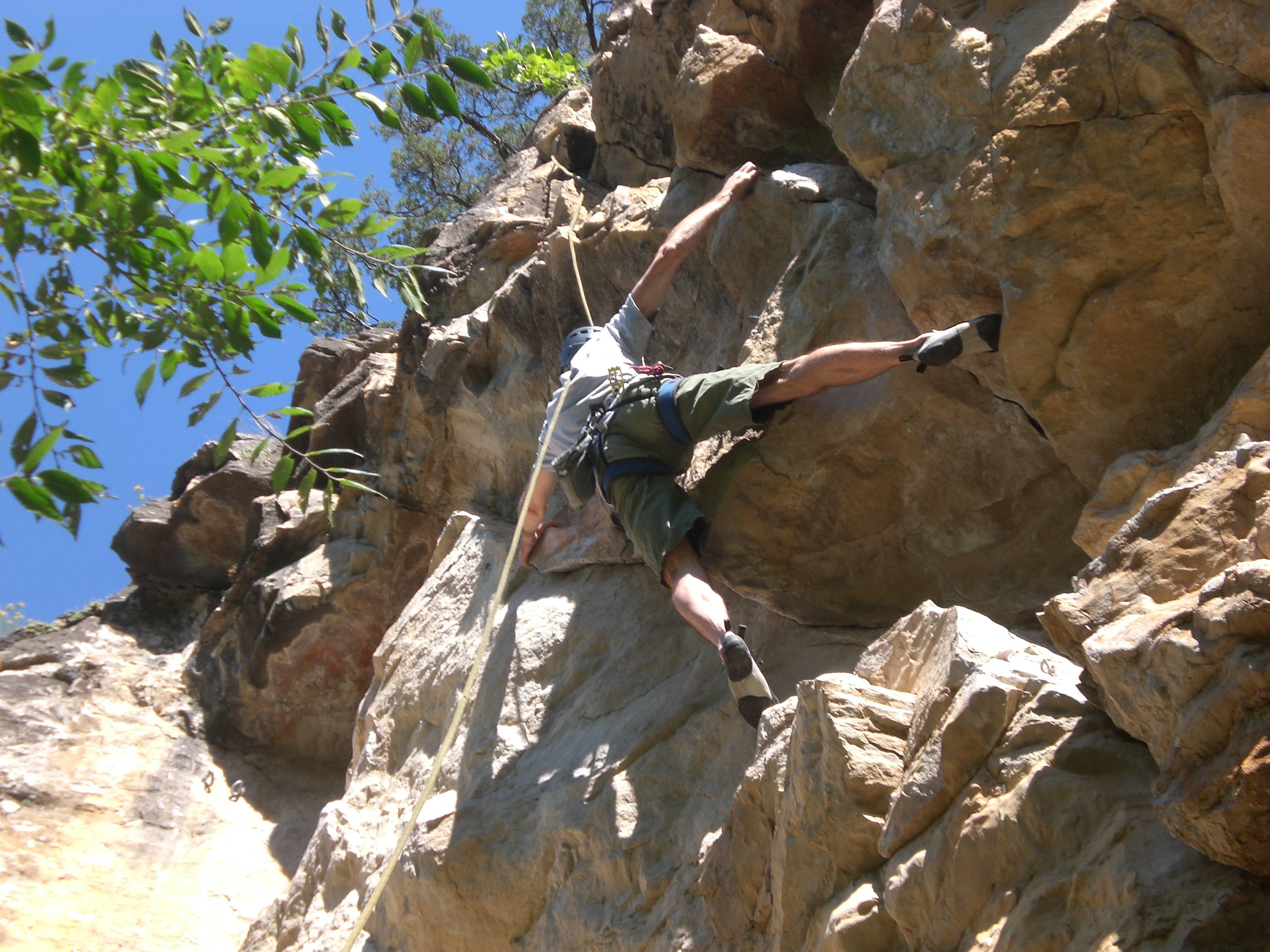
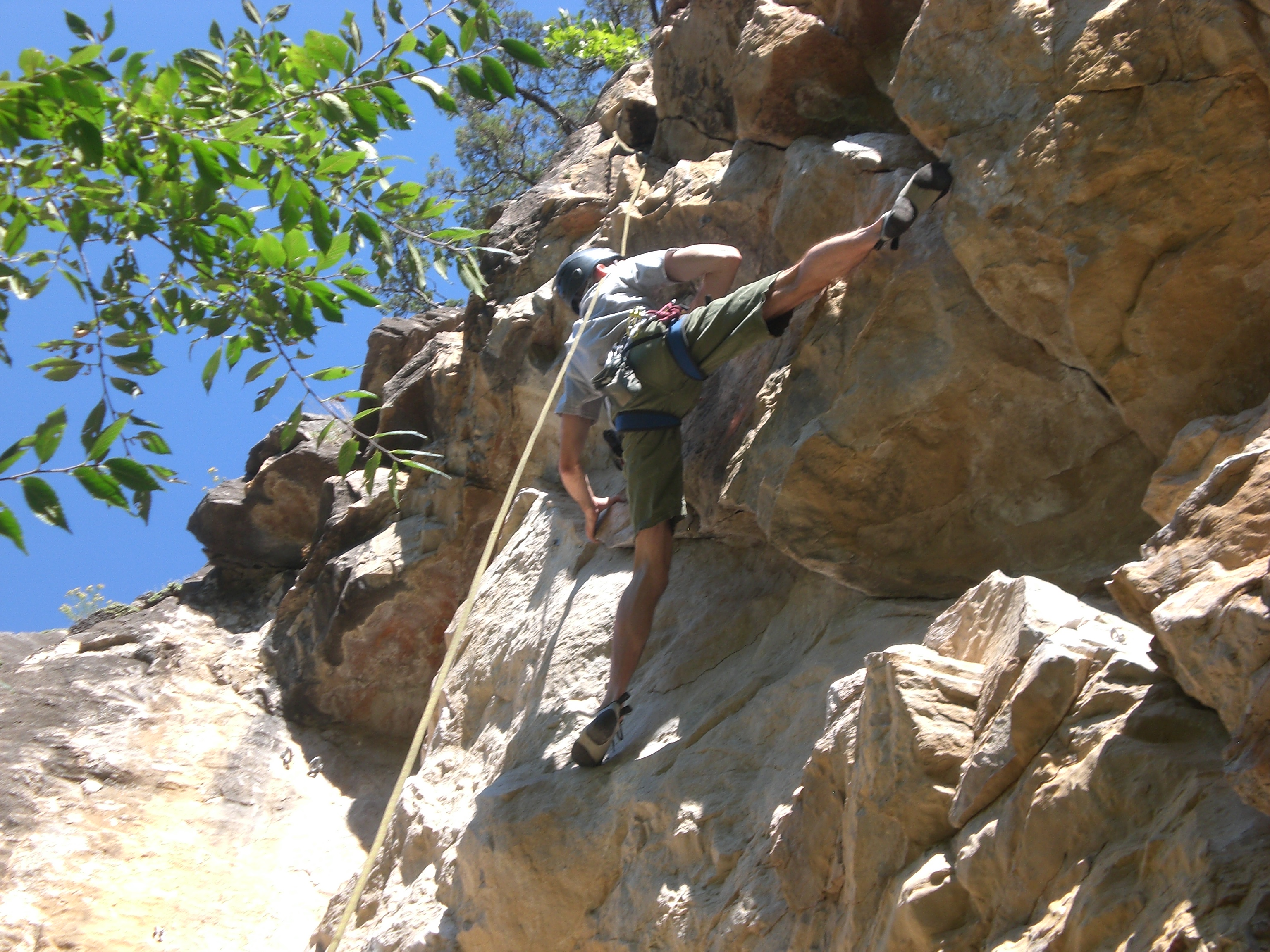
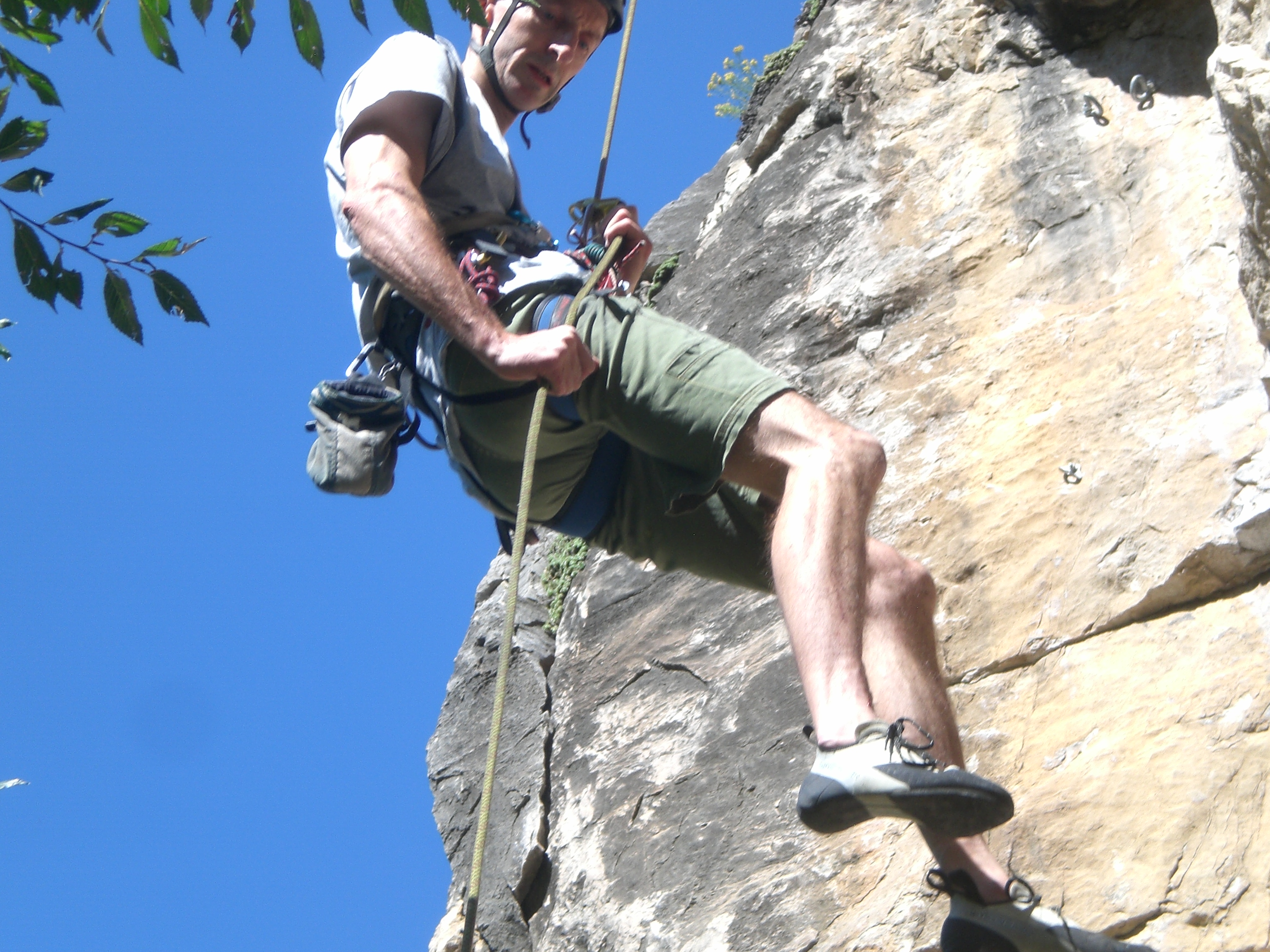
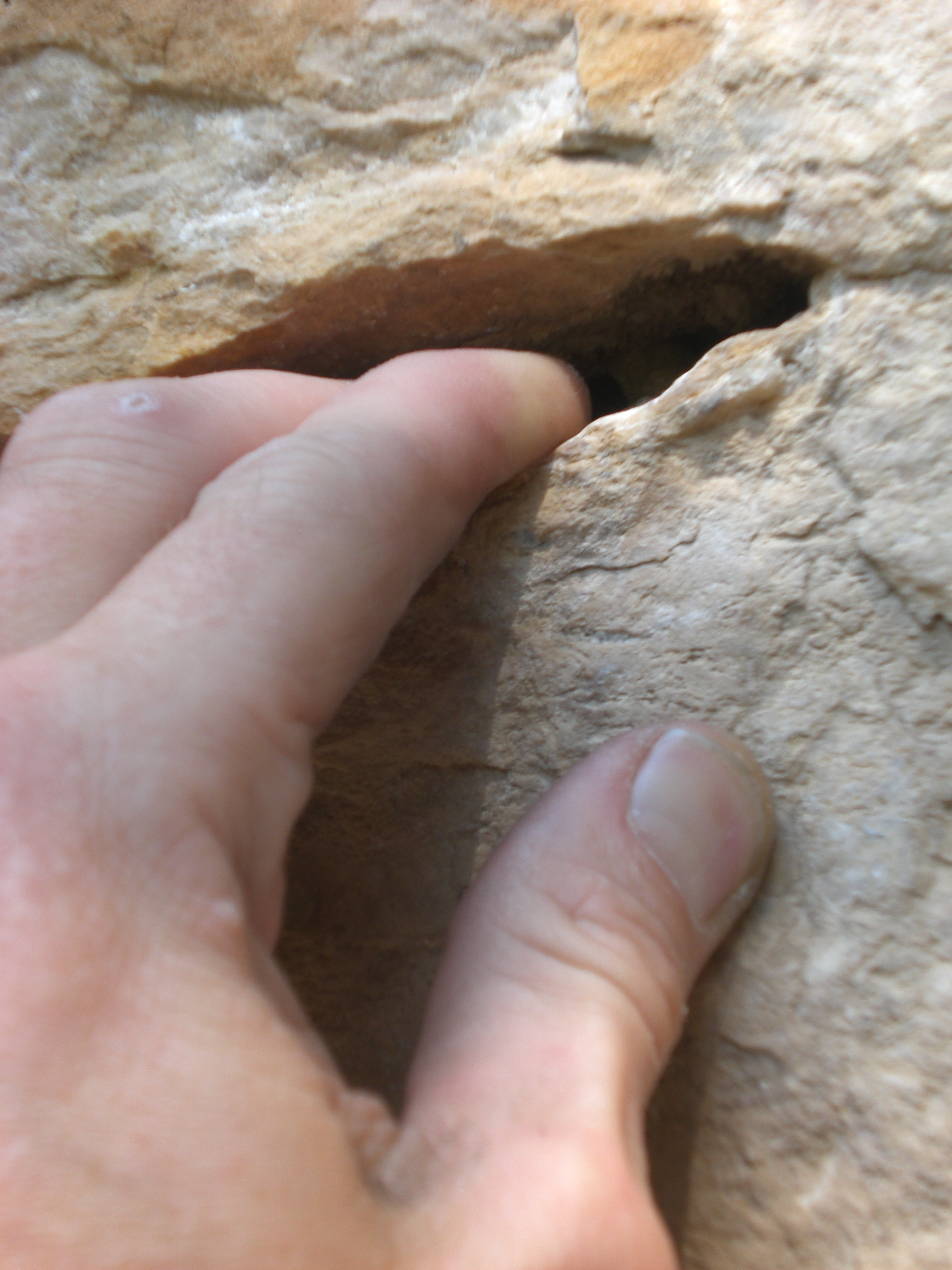
Author Archives: keithnoback

Being and Waspishness

In the Fall, our crags are swarming with wasps. Their source is a mystery. It is rare to see wasp nests in the cracks and pockets in the limestone, and when found, the nests are no bigger than a newborn’s clenched fist. The volume of the Fall swarms doesn’t comport with the numbers seen over the Summer. The wasps in Fall also differ in quality from the busy, irritable creatures encountered in Summer. The Autumn wasps are less likely to sting, but they are also harder to shoo away. When threatened, they flare their wings and wave their antennae.
A bunker mentality seems to have taken hold of them, perhaps as a consequence of excessive introspection, depression even. In flight, they behave with no less aimlessness than when clinging to the stone. They waft from perch to perch in short hops, always staying within a few feet of the crag, extending the arc of their flight only if they encounter another intransigent insect where they would land. They are not hunting, and do not appear to engage in courtship or any other purposeful behavior in the course of their days.
To the climbers who persist at the crags through the cooling season, the wasps look a feckless lot. Some observers go so far as to advocate swatting the insects on principle, as the wasps have lost their purpose and are simply waiting to die. Why let them suffer?

The Grand Auger, who sacrificed the swine and read omens in the sacrifice, came dressed in his long dark robes to the pig pen and spoke to the pigs as follows: “Here is my counsel to you. Do not complain about having to die. Set your objections aside, please. Realize that I shall now feed you on choice grain for three months. I myself will have to observe strict discipline for ten days and fast for three. Then I will lay out grass mats and offer your hams and shoulders upon delicately carved platters with great ceremony. What more do you want?”
Then, reflecting, he considered the question from the pigs’ point of view: “Of course, I suppose you would prefer to be fed with ordinary coarse feed and be left alone in your pen.”
But again, seeing it once more from his own viewpoint, he replied: “No, definitely there is a nobler kind of existence! To live in honors, to receive the best treatment, to ride in a carriage with fine clothes, even though at any moment one may be disgraced and executed, that is the noble, though uncertain destiny that I have chosen for myself.”
So he decided against the pigs’ point of view and adopted his own point of view, both for himself and for the pigs also.
How fortunate, those swine, whose existence was thus ennobled by one who was at once an officer of the state and a minister of religion.
– Zhuang Zi as translated by Thomas Merton

The same sentiment applies to the wasps. Trivially, some of the wasps which a climber sees in Fall are foundresses of next Spring’s colonies. No one would question their having a meaningful existence, in wasp terms. They represent the sisters passed, of the colony that bore them and back down the line. When we say ‘meaning’ in regard to a creature’s existence, we imply just such a representation on the creature’s part. After all, meanings don’t have meanings, symbols do. When we speak of purpose in the same context, we refer to the relationship between the representation and the meaning behind it, with the purpose of the representation being to signify the meaning.
Next Spring’s founding females have a purpose: to represent their colonies of origin and so on, in the genes they express, the ova they carry, and the smells they remember. The colony is gone but the intention of the colony remains, represented by the heiress.
People are no different. We represent our backgrounds and their intentions. We try to live up to our potential, what we are born with and what we acquire by learning. For us, as for the wasps, this representation is always in the present, pulling at the intention groping behind it. The colony’s heiress begins her own take on her mother’s colony. Her ownership changes the intention a bit. Her smell is a little bit different. Depending on what confronts her in the Spring, she may recruit the help of her fellow survivors to start her nest or usurp another’s. No matter, the next generation will recall a different ideal in its turn. We too, will try to live up to the tales of the deeds of our ancestors (by blood or tradition), rather than the deeds themselves, and the tales of the tales and so on.
But where does all this leave the true left-overs, the workers who will soon die in the cold? For them, the colony is lost forever. They represent the end. No one could blame the human observer for imagining these insects as little Macbeths, with their petulant defense of limestone cubby-holes and their swarming a soliloquy pleading for release from the futile farce which their lives have become, maybe which their lives have been from the start.
Still, they fly. They utilize the behaviors passed to them as social insects in their new context. They sting if pressed. They taste the air for familiar scents. They seek the light and shade with the progression of heat through the day. For their part, they signify the heritage of social insects as much as the females who will survive the Winter. If they have lost anything by losing the meaning and purpose of their role in the nest, it wasn’t much.
All representations work this way and the losses associated with any loss of significance are no more than the losses a cipher suffers in moving from one equation to another. When we pose the question, “Why should we let them suffer?”, the wasps might answer us like little Mallorys rather than little Macbeths: “Because I’m here.” That is exactly what they are saying when they wave their antennae at an approaching hand.

Tagged , , , , , ,

You Can’t Have Your Pie and … You Just Can’t Have Your Pie

The ratio of a circle’s circumference to its diameter is 3.14…
The rationalist proposes that the “…” is there because there is something wrong with the world. The empiricist proposes that the “…” is there because there is something wrong with mathematics. If there is something wrong with the world, we are in trouble. If there is something wrong with mathematics, we are in trouble. Either way we are in trouble. Kneel and pray; your trouble will not change. Sit and drink; your trouble will not change. Go and do; your trouble will not change, but that is the only truth you’ve got. And, at least you’ll be doing something.

Tagged , , , , , ,

Looks Like Warhol Was Wrong

So was Nietzsche. We achieved the egalitarian culture envisioned in Warhol’s prediction of 15 minutes of fame for all, but the result was not a new richness of expression or exploration. Nor did we go under, though we have realized the veneration of the Last Man which Zarathustra foretold. Instead, we leapt right over our potential into an unanticipated and more horrible age – the age of the Spectacular Idiot.
The original idiots, to whom the Greek root-word referred, were ordinary rabble, lacking in the judgment which comes with mastering a skill. The English derivation means incapable of rational conduct. Our current iteration has boosted the concept to a new level by replacing the ‘incapable’ with ‘self-consciously dismissive’. Representation is everything. Our idiots are nothing if not democratic, exalted by, of and for the rabble and its discomforts.
The Idiots of this age are driven and sustained by discomfort born of psychic vacuum. Ideas are not ideas for our Idiots; ideas are badges to adorn the clothing which cloaks scarecrow personalities. If one has no sense of efficacy, criticism or modification of one’s adornments is then a disconcerting, existential threat. Alertness, capability in the face of changing circumstance, and the ability to appreciate the immediate cannot be a source of self-worth for stuffed clothing on a stick. None of Warhol’s bubbling, creative ferment for these folks.
When he contemplated the consequences of mass communication and global culture, Warhol missed the possibility of Idiot ascendency because he was an artist. Though not noted for a consistent ability to overcome their own insecurities, artists must at least accept the inevitability of insecurity to do what they do.
Nietzsche recognized the weakness which led to the Age of the Spectacular Idiot, but missed its positive symptoms. He saw the timidity but not the fear.

…Alas, the time of the most despicable man is coming, he who is no longer able to despise himself. Behold, I show you the last man…Becoming sick and harboring suspicion are sinful to them: one proceeds carefully. A fool, whoever still stumbles over stones or human beings! A little poison now and then: that makes for agreeable dreams. And much poison in the end, for an agreeable death.

Little did he know, the last men would not simply sip their poison in silent relief if it were placed at the bedside. They would drain the cup and screech for more, even pushing some of their number forward to fetch it. The last men of the Mediterranean, the Middle East, Eurasia and North America have stood up such cup-bearers for themselves and for everyone.
Sadly, the political right has bred these fellows. It is no accident, for circulating in the conservative vital essence is an element of comforting authoritarianism, the extract of which makes the best soporific toxin. The process is sad because the necessary juices must be boiled off the base solution of sobriety and caution which makes the conservative indispensable, destroying all healthy self-despite in the distillation.
What remains is the Spectacular Idiot, who not only bears the cup, but also supplies the juice for the last men. The words of the bearers do not matter, nor does the content of their ideas. What matters is the rhythm of the sounds, the smell of the thought, the fit of the jacket and the sparkle of its badges. Spectacle, upstanding and forthright, dulls the pangs which come of the last men’s impoverished experiential diet. Idiocy eases the last men’s insecurity, displacing it with denser righteousness. There is only one cure. Somehow, the last men must have their capacity for self-despite restored, so they can clear their stuffing. They need a purgative to make room for some personal integrity. The question is: How to accomplish a rehabilitation at this late hour without being poisoned as well?

Tagged , , , , , ,

That’s a Thing? I Thought People Just Did That ‘Cause They’re Nasty.

CIMG4127
Like so many other aged and out-of-touch Americans, I learned a new word this Summer. No, I’m not talking about “sequestration”; I’m talking about “twerking”. Thanks Miley.

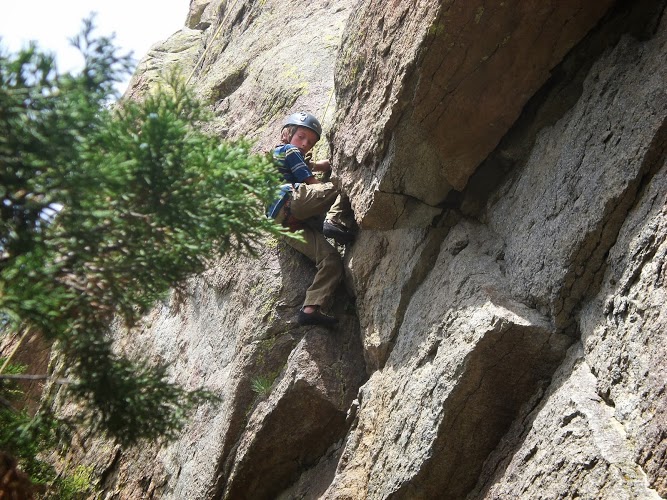
Chris wishing he was off-width climbing - or maybe twerking - instead of guiding,

Chris wishing he was off-width climbing – or maybe twerking – instead of guiding,


My first take on twerking was the standard one for the aged and out-of-touch regarding any cultural innovation – “That’s ridiculous!”. I’ve no right to heap scorn on the twerkers though, because sometimes, I climb off-widths.
Trying to stay out of the foot-wide crack.

Trying to stay out of the foot-wide crack.


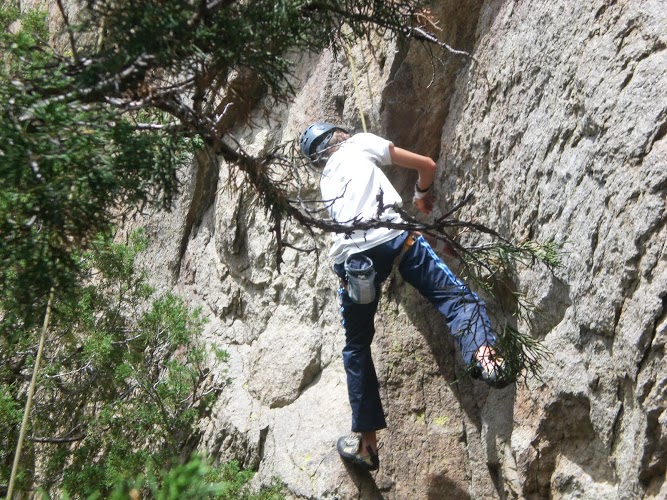
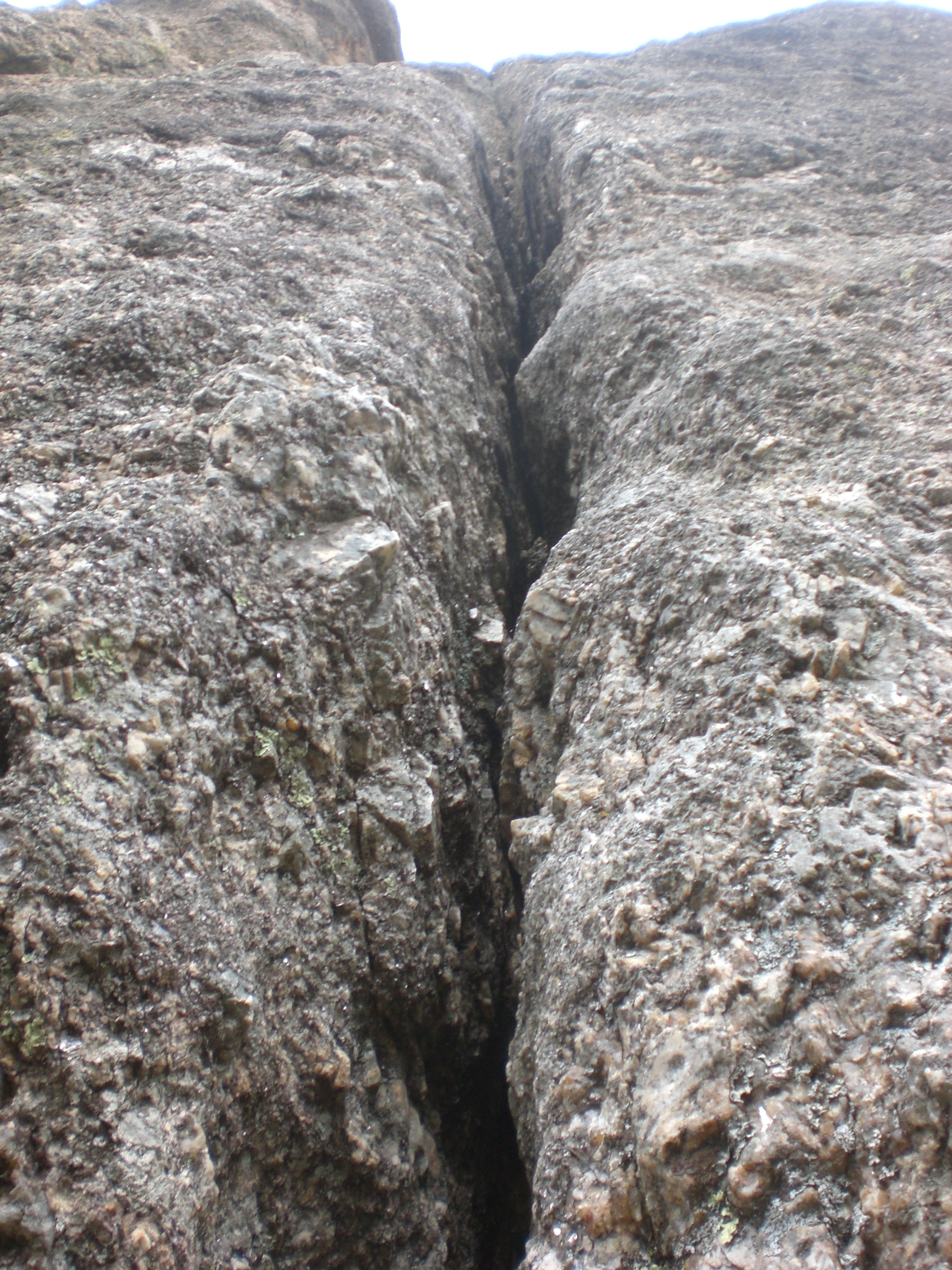
Actually, these are the times that I climb off-widths – when the weather is cool enough to wear clothes with full coverage, but not cool enough to justify breaking out the ice tools. Coverage is a big deal because an off-width is any crack wider than a climber’s clenched fist. In other words, to climb an off-width, the more pampered body parts must get involved.
CIMG4118
Now, I am the Miley Cyrus of off-width climbing. A brief foray onto YouTube will reveal, by comparison, Miley’s incomplete mastery of the technique which takes the squatting butt-pump beyond its overt nastiness, transforming it to an artistic representation of nastiness. Like Miley, I’m still at the stage where I’m constantly challenged to recall that I just need to relax, that body position is critical, and that proper technique consists of mostly small movements. But at least me and Miley have passed the first barrier. We’ve gotten past the mortification, and whether or not we’re good at it, realized that nastiness can be kind of fun (if you’re doing it on purpose).
Finally, it becomes a chimney.

Finally, it becomes a chimney.

Tagged , , ,

Bloody Mary, Bloody Mary…

This post is in response to Kevin Moore’s posts about physicalism, evolution and consciousness at “The Placebic View”. I want to start by saying that I admire Kevin’s interest in philosophical positions to which he does not subscribe. Earnest examination of positions other than one’s own helps a person improve their own ideas and appreciate other people a little more. Here is some more grist for the mill.
This is my take on physicalism. I think it is not controversial to say that physicalist philosophy is a work in progress. There are a number of competing branches and sub-theories. For good or ill, I’ll only speak for myself and my non-professional understanding of the issues at hand.

1) It seems as if some things are up to me. For example, when I am deliberating over whether to, say, raise my hand or not, it seems as if I am in control over whether I actually endeavor to raise my hand. It does not seem to me as if such endeavorings are determined. Admittedly, such seemings do not entail the falsity of determinism, like seemings of pain entail the occurrence of pain. And, this means that if one were to infer the falsity of determinism solely on the basis of such seemings they would be going beyond their evidence and could very well be wrong. But, that doesn’t matter, here. All that matters for the success of this argument are the presence of such seemings; their veracity can be presently be ignored.

I’m not sure exactly what Kevin is getting at here. He is either talking about intentionality or the subjective quality of movement. I think it is the latter, and that is what I’ll address below.
Intentionality poses little difficulty for physicalism. What ever else intention is, it requires subjects and objects which are, or can be reduced to, entities having relative location and causal relations. Intention does not exist without such subjects and objects. Even when we think about love or a five-dimensional cube, we derive our ideas of these things from experience writ large, including the way in which we are predisposed at birth to feel about our parents and, with the proper exposure, perceive depth. No, intentionality is not the hard part, subjectivity is, and I think that is what Kevin is after here.

2) The naturalist worldview rests on the foundation of two seemingly indispensable pillars: Darwinian evolution (or something near enough) and physicalism. In brief, the theory of Darwinian evolution is suppose to be able to tell us why biological life is the way that it is and the physicalist theory is suppose to be able to tell us why everything is the way that it is. Without the support of both of these pillars, the naturalist worldview is hardly a worldview at all.

If physicalist theory is supposed to tell us why everything is the way it is and Darwinian evolution is supposed to be able to tell us why biological life is the way it is, then physicalist theory does not depend on Darwinian evolution and if physicalism undergirds a naturalist worldview, then neither does a naturalist worldview. Moving on.

3) Now, according to physicalism, everything must be explainable from the bottom-up. In other words, theoretically, once you’ve explained all of the physics for some event, there will be no remainder. Therefore, since our seemings are not identical to any physical states, whatever our seemings are, they must result from some underlying physical states and be epiphenomenal or causally inert. So, according to physicalism, there is no top-down causation where agents really choose anything. And, any seemings to the contrary isn’t to be trusted.

Now we get to the good parts. First, let us be clear on what constitutes an epiphenomenon. An epiphenomenon is one which occurs secondary to a primary phenomenon, a phenomenon which is caused, but causes not.
But this definition is unsatisfying. It simply instructs us in spotting epiphenomena and says nothing about their hows and whys. So how do epiphenomena arise and what are the relations which they have to regular, causal phenomena? Here are a couple of examples which demonstrate what I think those mechanisms and relations are.
First, consider that quintessential epiphenomenon: fever. Before medical science knew the details of the inflammatory response, fever was thought to cause illness. It was thought to be part of the pathological process. It turns out that fever is no such thing. Fever is a byproduct, the elevation of body temperature secondary to a particular biochemical process. So, fever is causally inert. Or is it? On an analytic basis, it is causally inert. Any ‘rules of fever’, for example ‘fever follows from infection’, are inaccurate and properly devolve to the rules of the primary process, which is the biochemistry of inflammation. But sometimes, the elevation of body temperature associated with inflammation inhibits bacterial and viral replication. Fever does something. What is going on here?
These are not the same fever. The fever which inhibits bacterial and viral replication does not give rise to rules nor does it itself participate in law-like relationships; the biochemistry of inflammation takes care of those things. But the biochemistry of inflammation does not, by its rules and law-like relationships, specify the causal relationship between elevation of body temperature and inhibition of bacterial and viral replication. If we started from the primary, biochemical phenomena we might never know about that causal relationship in particular. That’s fever’s job.
To clarify further, consider Hepatitis C. I don’t want to imply that the Hepatitis C virus is an epiphenomenon, ’cause it’s a virus. But the relationship that it might have held relative to the disease Hepatitis C by a certain theory of the disease, is an instructive analogy for the relationship which epipenomena have to their primary phenomena. Once upon a time, many scientists suspected that the Hepatitis C virus did not actually damage the cells in which it replicated. This turns out not quite to be the case, but it was a serious possibility, and let’s pretend for a moment that the theory was accurate. On an analytic basis, the Hep. C virus would be a non-entity. We could substitute “X provocative factor for inflammation” with no theoretical consequences. But Hep. C virus is precisely that provocative factor for those individuals infected with it, and in those cases the replicative habits and specific structure of the virus determine, in part, the natural history of the disease though the virus does not cause any of the pathology.
So, do fever and the non-cytopathic version of the Hep. C virus have causal efficacy? Are fever and Hepatitis C real things? Yes and no. Yes in the individual cases and no as generalities. Or rather, they pick out some real category of historical relations even though the theoretical causal analysis associated with fever and non-cytopathic Hep. C virus may ignore them. Inverting our perspective, cytokines, helper T-cells, etc. may tell us why John may have an elevation of his temperature – such explanations account for fever and even eliminate the need for the term in analysis – but the biochemical explanation of temperature elevation due to inflammation in response to viral infections cannot tell us all about why John has this temperature elevation due to inflammation. “John has a fever.” fills in the gap between the theory and the case, as the statement stands for the specific history of the virus, John’s genetics, his previous illnesses, his nutritional status; in short, all the messy data without which an account of John’s fever on November 10, 1999 at 10 AM via the theory of the primary phenomenon is impossible.
With this understanding of epiphenomena in hand, is physicalism committed to epiphenomenal consciousness? Yes and no, I think. Your patience please, for one more example.
There is a well known thought experiment proposed by the philosopher Frank Jackson called “Mary the Color Scientist”. In the thought experiment, Mary has been confined to a room without any color at all for her entire life. During her time in the colorless room, she has become obsessed with the neurophysiology of color perception and has managed to learn everything there is to know about the perception of the color red. One day, she is released from the room and thus confronted with all the colors of the outside world, including her first actual red perception. Does she say, “Wow!” or does she say, “Meh”? Does she gain any new knowledge via that perception?
Before we get to the final question, there is another question within the scenario. It has as a premise that physicalism requires, in principle, that Mary could know everything about red perception. For her knowledge to be complete, however, she must know much more than the neurophysical rules of red color perception. She must know all there is to know about the history leading up to her particular red perception. If physicalism’s view of events is assumed to be the case, all this knowing must happen in time and there is simply not enough, in principle.
“Sophistry!”, one may object, “She doesn’t have to know all that, just what makes for red perception right now, as she is first seeing red.”
Remember that little issue that Kevin mentioned in passing at the start: determinism? On physical determinism, all that is what constitutes red perception right now. An analytic theory of red, ‘averaged over’ red, however detailed, will not do. We want to know if there is a difference between knowing the reductive explanation of red and the perceptual experience of the same thing. To meet that requirement Mary must know the theory and the associated history which gives the theory its application. In such a case, Mary’s impression of red, as a thing in itself, stands for this otherwise inaccessible detail and so is a real thing just like fever – as a necessary part of the explanation of each case, and so as historical category as well. If the understanding of epiphenomena regarding fever and Hepatitis C extends to subjective experience, then even an epiphenomenal status for our seemings may be explicable in a physicalist framework, and avoid concerns of irrelevancy in the same ways.
However, I don’t think that our consciousness and its subjectivity are epiphenomenal because I don’t think our impressions are primary phenomena. Since we are playing pretend, let’s ignore physical determination and its implications, however improper that may be, and say Mary just does have the reductive explanation of exactly that red experience which is her first. I think she still says, “Wow!”. I think she gains the efficacious knowledge of red + Mary’s recourse to red references, or if we were to ask her, how red works. Red becomes an object of direct reference, where it was previously an object of reflection only. In fact, I think this is the basis of intention and awareness. Red’s ‘seeming’ on Mary’s first perception of it is Mary’s pre-red identity plus the actual, red sense-data compared to Mary’s pre-red identity including, most importantly, pre-red Mary’s expectation of post-red identity. Before her red perception, when Mary perceived an apple, she would first have to see the apple shape, depth to the shape, a stem, all of which brings “apple” to mind, and then reflect that the apple is also red. Her complete knowledge could not change that operational arrangement for her. After her red perception, red becomes available for Mary’s apple anticipations, and so her apple identifications directly, and subsequent apple viewings will give her an idea of ‘red like that apple’, and so on for the rest of her conscious life. I think this is a good description of what her basic conscious life is, if we want to distinguish it from unconscious processes like pupillary reactions to light. Without the momentary, non-reflective, anticipation-based integration of these alterations of identity, we have the zombies which are feared to plague physicalist explanations of mind – creatures with unmediated, locally contingent stimulus-response as their sole operational process. What the evolutionary consequences of such a distinction may be, I won’t guess, but the possibility of consequences addresses the concerns regarding potential invisibility to selection (misplaced though they are).

Tagged , , , ,

Samsara

Setting up for the finger lock.

Setting up for the finger lock.

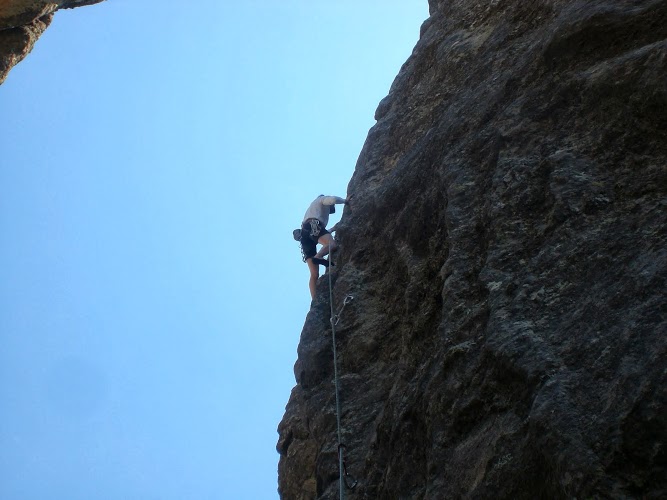
The endless cycle of suffering which is death and rebirth. This has been the Samsara Summer. It is a story familiar to every climber. Just as the season gets rolling, the rain starts, a partner gets hurt, work asserts itself and the momentum dies. You’re left training, but it isn’t really training. Training implies a purpose, and soloing on a top rope and doing pull-ups has no end-point.
For me, what is left when the cycle turns is Tongueless Wonder.
The route is a Pete deLannoy creation at the most unfashionable crag in Spearfish canyon. I don’t know if Pete put this thing up in the absurd, power-drill-on-lead style for which he was famous. I kind of doubt it, though it would be fitting. The whole thing is ridiculous. It is a horrible crack-climb, with as many pockets and pinches as it has hand-jams and finger-locks. It is a horrible sport climb for the same reason. Furthermore, it is an ethical disaster. The bolted crack could be protected with clean gear, but only as a nightmare. The route is only twenty meters; most of the time on route would be spent with only one piece of gear between yourself and the ground. Much of that gear would be placed blindly due to the serpentine nature of limestone cracks.
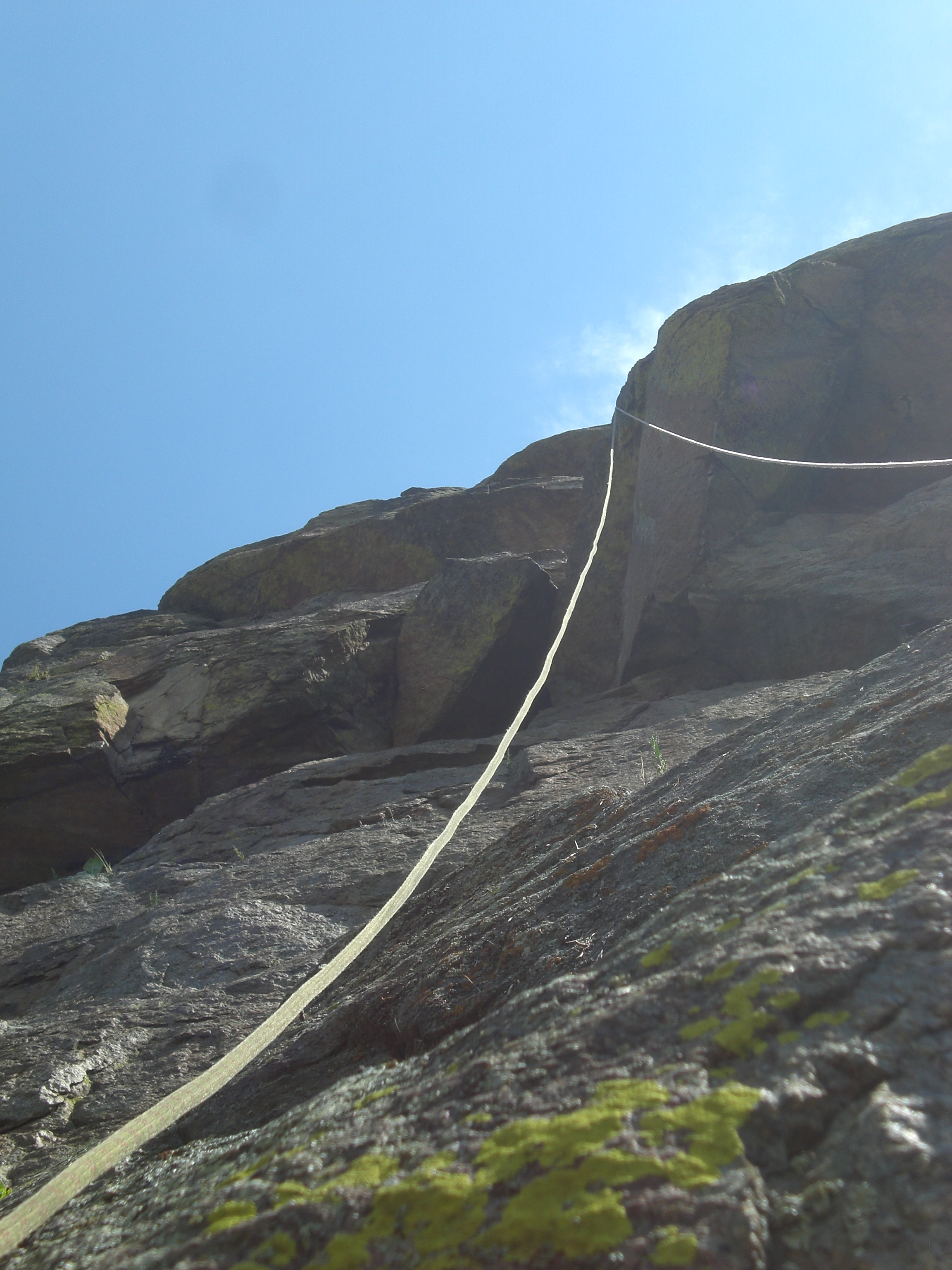
I’ve lead it on the bolts, so I’ll never have the clean, first lead on gear. What I’ve got left to me is that most absurd of all climbing achievements: the headpoint. Headpointing is the thoroughly rehearsed lead, with the moves and gear placements worked out and practiced in advance on top-rope. In its own peculiar way, a headpoint is quite alarming. During the rehearsal, you fall off. Denial, the onsight climber’s friend, becomes unavailable. One is motivated to get the route wired.
CIMG4106
I’ve been working on this one for, four years, five maybe? I’ve been almost ready several times, but Fall caught me and I had to start over the following year. Perhaps the situation is closer to the Greek version of an endless cycle of suffering – Sisyphus in the underworld. Except, I don’t have Zeus to blame. I’ve chosen to push this, but it is finally an excuse. I like the climb, and that’s the only truth. Climbing it on gear is an arbitrary purpose which keeps me coming back to the route with renewed motivation.
Next lap coming up.

Next lap coming up.


It’s pointless, but so is climbing in all its forms, and work, and every one of our silly struggles – Samsara. We still do it, though. We’re groomed for this game by our heritage. We can’t lose, because points and pointlessness don’t stick to us; the truth is we like the doing and that’s all. Just like Sisyphus, who I believe out-foxed Zeus in the end. Maybe not on the tenth lap, or the fiftieth, but maybe by the thousandth or ten thousandth, old Sisyphus was into it, I’m sure. Then it didn’t matter whether he ever got to the top; he’d beaten Zeus and escaped the cycle of suffering.

Tagged , , ,

Sediments

Like it was made to be climbed...

Like it was made to be climbed…


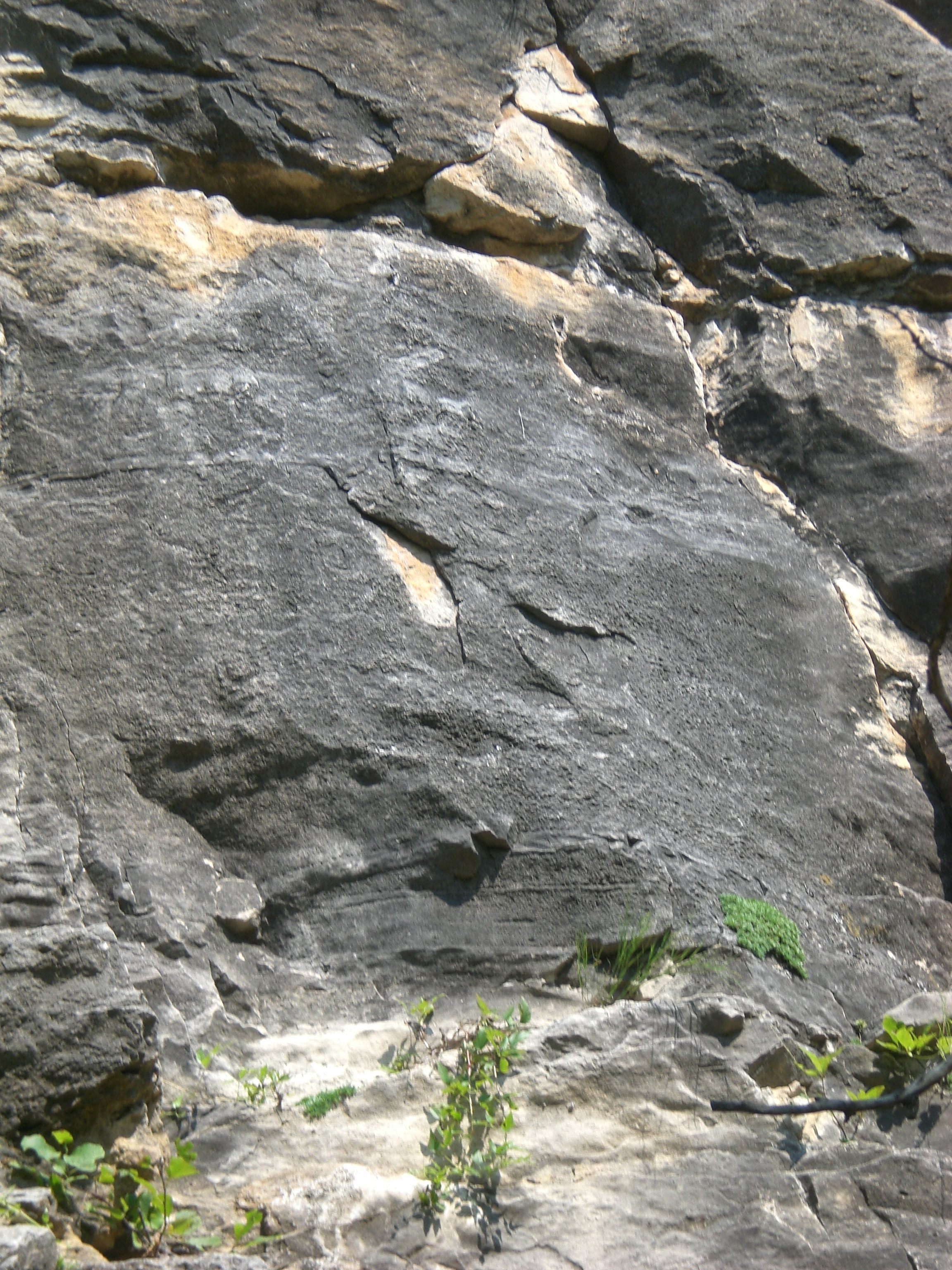
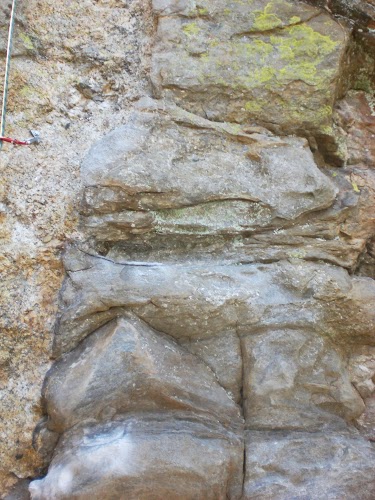
The Hills have lots. Limestone is one of our most abundant resources. Most of it is the typical yellow stuff, with many small pockets, butter-dish edges and thin cracks.
CIMG4100
There is some black rock mixed in. Much of it is moderately overhanging, with a few roofs, often close to the ground.
CIMG4091
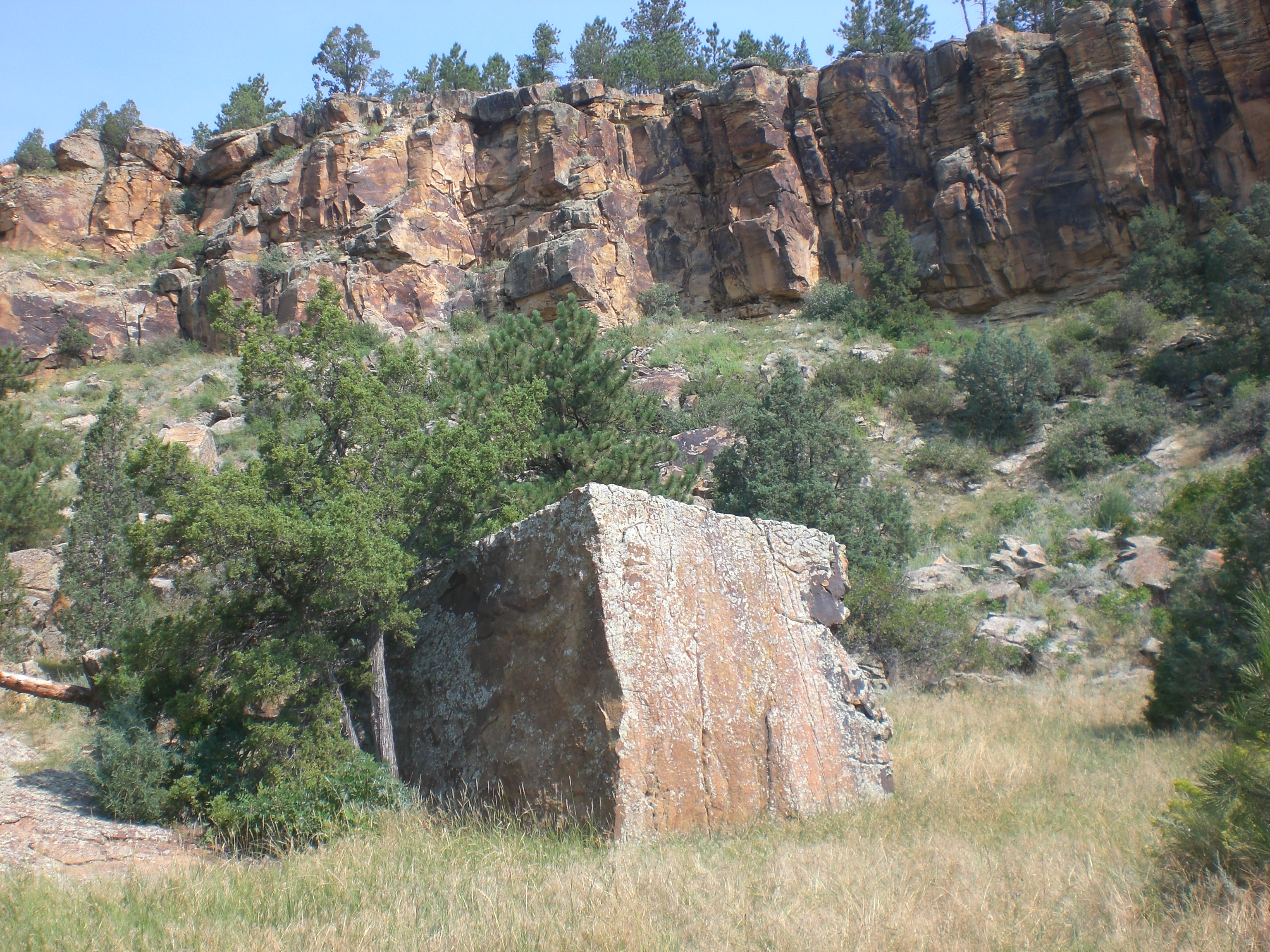
There is also a bit of sandstone. Nothing like the acres of patina found in the South, but of good quality.
Looking up at the roofs on Dedicated to the Game on the SW shoulder of Devils Tower

Looking up at the roofs on Dedicated to the Game on the SW shoulder of Devils Tower


For sport climbers and boulderers, there are worse places to be. Still, the magma-forged stone is the main attraction.
CIMG4088
CIMG4094

Tagged , , ,

Dear Texas A.G.,

I listened to your statement regarding the voter I.D. lawsuit today with a great sense of nostalgia. You see, I grew up in the South. I know the code. I was a soft-spoken, clean-cut kid and so people let me in on it without thinking twice. You might say racists educated me.
I was learning when they said things about what you should reasonably expect of someone, about what was only fair, and how certain people just were.
I was learning when the guy on our work crew vetoed a job applicant because, “I don’t want to ride around in the truck with one of them, the way they smell.”
When our church’s choir director turned to my father and said, “Isn’t that just like a nigger?”, after my friend in the heavyweight division got pinned and lost the tournament: another lesson.
I learned that some people just weren’t like us white folks. Some people didn’t deserve the same consideration. My instructors taught me to look down on people based on affiliations, manners of speech and origins. I got it, but not like they thought I would. You see, my teachers succeeded; I just came to feel that way about them.
The thing is, I wasn’t raised to bite my tongue like the black kids with whom I went to school and worked. By the time I had to do it to get by, the thing had already grown nerves. It galled me, and I guess I took it personally.
So, don’t blame me when I say this, blame my teachers – your ideological predecessors. When I hear some pig-fucking, redneck, piece of shit start talking Reasonable Racism – the code – I just get blind mad. I hate. So piss off. And if you decide not to piss off, as my teachers would say, “Don’t come ’round here, boy.”

Tagged

Determinism and the Demon Experience -or- If You Say Free Will One More Time, I Won’t Be Held Responsible for What Happens Next

Well, after long deliberation, I finally did it. I sold my soul. It turned out to be more difficult than I anticipated, the thing put up – a struggle? I can’t call it a fight; it was more like an argument. It claimed it was a special substance and the only example of that substance which I’d ever hope to possess. When I told it that the fact just strengthened my position with the buyer, it began to claim it was an indispensable consequence of my existence and would carry on representing my self for all eternity if only I didn’t cut it loose. I’m not sure how that was supposed to motivate me in one direction or another, but it reminded me that my soul was putting up an argument because it couldn’t put up a fight. It couldn’t do anything, unless you call standing around acting as a rationalization for teleology doing something. It had me for a while, but it was just stalling. In the end, it needed me much more than I needed it. I could have kept it around for old times’ sake, but I guess I’m not that sentimental. Besides, even though what I could get for my soul couldn’t do anything more than the soul could, it turns out the demon whose consultation I purchased helps me keep me in perspective much better than the soul could. In retrospect, my soul was all about me, a bit of a selfish bastard, and I’m kind of glad to be rid of it, period.
Anyone who knows me, knows the demon to whom I refer: Laplace’s Demon. He is the perfect calculator, brought to life by an Ontological argument just like God:

P1) Numbers necessarily represent identity; the law-based relationships between numbers represent causation.
P2) It is possible for the relationships between numbers to be calculated (causation exists).
1) A complete representation and calculation of all causes over all time is conceivable.
2) There is some possible world in which a complete calculation has occurred.
3) If a complete calculation has occurred in one possible world, it encompassed conditions in all possible worlds.
4) A complete calculation has occurred for this world.
5) A calculation demands a calculator.
6) A universal calculator exists.

Some would say the demon is an aspect of God; it is certainly just as inscrutable. Anyway, the demon itself says there isn’t any difference. Why the demon might trade something for my soul remains a mystery, though I have my pet theory about its motive. I’m not even sure that what it has given me in exchange actually is anything. It can’t cause anything to happen anymore than my soul could.
What I got was a little voice in my head. I’m pretty sure it is different from the other voices which generate my internal dialog. The demon says it is. The demon says a lot of things, but as I’ve noted most of them are of little significance and none are of any consequence.
One of its favorites is, “If you could only look at this from an atemporal viewpoint…”. Whatever follows is moot. A viewpoint removed from time is, of course, its viewpoint. If its calculations occurred in context, it would still be calculating and would have gotten to just exactly this point by now. It could hardly be said to exist as an identifiable thing were that the case, even a proto-consciousness (a proto-proto-consciousness maybe?). No, it doesn’t mind time. That’s the problem, because since it doesn’t mind time it can’t convey any real information.
For example, here’s a conversation we had repeatedly early in our relationship: “What’s going to happen to me tomorrow?” I’d ask.
“It’s complicated,” it would reply.
“How complicated?” I’d persist.
“You don’t have the time.” it would answer.
I’ve found that I cannot ask it any questions about the future; they are just too confusing. If I ask it, for example, “Will I like this carnival ride?” it can give me a theoretical answer, based on the me of the current moment’s appreciation of what it knows will occur on the ride. But it can also give an instantaneous answer, to the me which experiences the ride and at once experiences the resolution of his expectations of the experience. Finally, it can answer the question for the me who will have completed the ride and has integrated the experience into the narrative of all his other experiences. We went round and round about these sorts of questions, but in the end I had to acknowledge that it was right; when I ask it, “Will I..?” it can’t know to whom the hell it should address the answer, and neither can I. Retrospective questions have proven more satisfying.
Questions about what happened didn’t excite me at first. We expect to be able to sort that out ourselves. Asking an all-knowing demon about the past is just indulging one’s own laziness, I thought. I’ve found that it is much more, though, because the demon’s view of history is incredibly complex – much more complex than we could ever hope to know. To a perfect calculator, all the little details matter. For example, when we look at a hydrogen atom, we see something pretty generic. We can’t tell one from another and why should we? To the demon, each one of those hydrogen atoms is there, now in a way that makes it (and its constituents) distinguishable from every other identifiable thing. That’s about as close as anything can get to being a universal truth, and it lends a certain weight to the demon’s pronouncements regarding past events.
Even the answer to the question, “Why did I do that?”, expressed as it is in the stock phrase, “It’s complicated.”, means something more. I always thought I had my reasons for the choices I made. I now have confirmation, not just for the choices which I can readily explain, but for the choices I make just because I feel like it. “Because I feel like it” is as much a gross approximation as the demon’s, “it’s complicated”, but just as true. My whim may not be a reason I pick the dark chocolate rather than milk chocolate in the same way that the dark chocolate’s higher phenol content is a reason for my choice. However, my whim contains such a reason, and in a unique, specific sense. My whim isn’t whimsical as much as it is complicated. My having it as a whim rather than as the demon’s analysis is why I can do something with it while the demon can’t.
I’ve found the demon’s gift of confirmation quite comforting. Everybody has this intuition that something causes decisions, for others as well as for themselves. It is at the core of our Theory of Mind – the notion that other people have their own whims and are not just zombies acting out a complex algorithm.
I’ll admit to having had doubts about my theory of mind. It should have been enough for me, as it is for most people, that I can communicate with others using natural language instead of something like binary code. The implication being that “whim”, for example, has content – all the demon’s complicated stuff – and isn’t just a representation of “emotional impulse”. Despite such logic, I always suspected that I was just projecting my ineffectual feelings onto an algorithm or acting out a psychotic delusion, with my theory of mind serving as a rationalization for discontinuous interactions. Having the demon confirm that the psychotic also had his reasons – that the basics of content remained intact even when the representations were disconnected – was a relief. My theory of mind would not crumble some day to reveal an uglier truth which it had been covering up all along.
The demon’s gift seems relatively cheap, but I don’t want to leave the impression that the gift was without complications of its own. I’ve had to accept some vulnerabilities and abandon some values which I’d prefer to deny and retain respectively. The psychotic does have his reasons, so the demon says. So does the heroin addict. In either case, the demonic complications mean that the person’s reasons may not be accessible or amenable to their consciousness in a way which we would like them to be. Worse, their intransigence may be the only essential difference between those reasons and the reasons which determine our volitions. I’d like to think that Thorazine and Methadone were not necessary. I’d like to think that volition is self-motivated, but the people who really think that are just the people who get the Thorazine prescriptions – in those cases to treat delusions of thought insertion. My motives and their volitions all have a basis, as do everyone’s, and they don’t so much determine my choices as resolve them. Sometimes, the will even requires some tangible adjuncts, like medications, to give it traction in its resolving. There is nothing about me which is truly self-contained and invulnerable.
I can accept being an open system, because I can do things. The demon can have its analysis. It’s frozen out by its status as a universal calculator. It can account for whims and hunger, but it will never have a whim or feel hungry because it cannot ever be there, now. Those identity-resolving phenomena are unnecessary for a thing outside the causal realm and inherently unavailable to it. I initially thought that the demon might have valued my soul because it was jealous of human experience and wished to possess a record of such or at least deprive another of some of that precious history. I no longer think that; the demon couldn’t know the difference. I think it saw the essential identity as a missing piece of its account, though per its method, the account was indeed complete. Judgments like the one I laid on the demon are a human by-product, and they are the last casualties of my association with the demon.
To have a qualitative experience is to be defined by it. Since it contains all the complicated stuff which the demon can’t explain to me (within my constraints), subjectivity is a powerful token in my resolutions. I can tell that my current hunger is like the hunger I have when I’m peckish, rather than the hunger I have when I’m starving. So, as an example of the efficacy of subjective qualities, I won’t try to chase the hyenas away from the food this time. But I can know what it’s like to have my hunger satisfied – to be ‘full’ – as well. That too is a powerful token. I find being full from eating a bowl of donuts to have a quality distinguishable from the quality of being full from eating a bowl of oatmeal. The distinction affects my resolutions as powerfully as the distinction between peckishness and starving hunger. Don’t get me wrong. What I’ve learned from the demon is not that we are automatons moving to the tick of our impressions, just that as creatures occurring in time, we have our limits and live and die by our history – it’s the cost of participation. However, I have therefore had to admit that the romantic and horrific world of tradition is a mistake. We are not heroes or villains, playing out our self-contained natures in some epic, teleological struggle. The demon is not jealous of my soul. Sure, such a model is shiny, well-defined, and action-packed, but it is mistaken. The simplistic evaluations of the traditional model ( the purpose-built, unitary self) don’t represent us well. We are – complicated.
To recap: I needn’t fear zombies or determinism; analysis may be accurate without being completely adequate; qualia have relevant content; identity accrues and so fixed evaluations are invalid. These are the things I have gained and lost by selling my soul to the perfect calculator. I still feel it was a decent bargain.

Tagged , , , , , , ,

Functional Geology

CIMG4082

The Hills have been rainy. In a place where it is difficult to climb well, we can usually count on the weather to help us. We are displeased. The bad weather has me thinking about the other impediments to climbing hard in the Hills. The weather really is the only one of those factors which is just a spoiler. The rest are…well, difficulties. Take the rock; our problem there is an embarrassment of riches.
CIMG4065
We have so many different types of rock that it is hard to stay focused.
CIMG4071
In the Needles, there is a coarse-grained variety of pegmatite. Pegmatite is a kind of granite with giant crystals mixed in. The crystals are quartz, feldspar, and other, exotic minerals some of which, I am told, are quite valuable. I don’t care; to me, they’re all holds – sharp, glassy, oddly-sloped holds. You can’t lever or pull out on the crystals too much, so the program is “feet low and move slow”. Stepping up on faith alone is a bad idea.
CIMG4073
CIMG4066
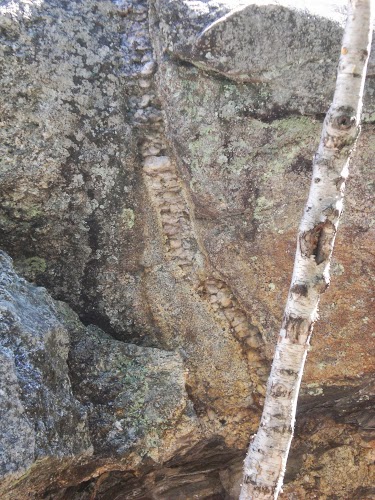
Mt. Rushmore is a pegmatite area too, but the rock is finer-grained with bands of crystals like wrinkles in the surface of the granite domes. Plus it has schist. There isn’t a lot of the metamorphic mineral around, but it makes up the steep portion of some of the steeper climbs. The inclusion dikes along with the schist favor a technique emphasizing balance, counter-tension and spurts of faith-based movement.
CIMG4068
CIMG4075
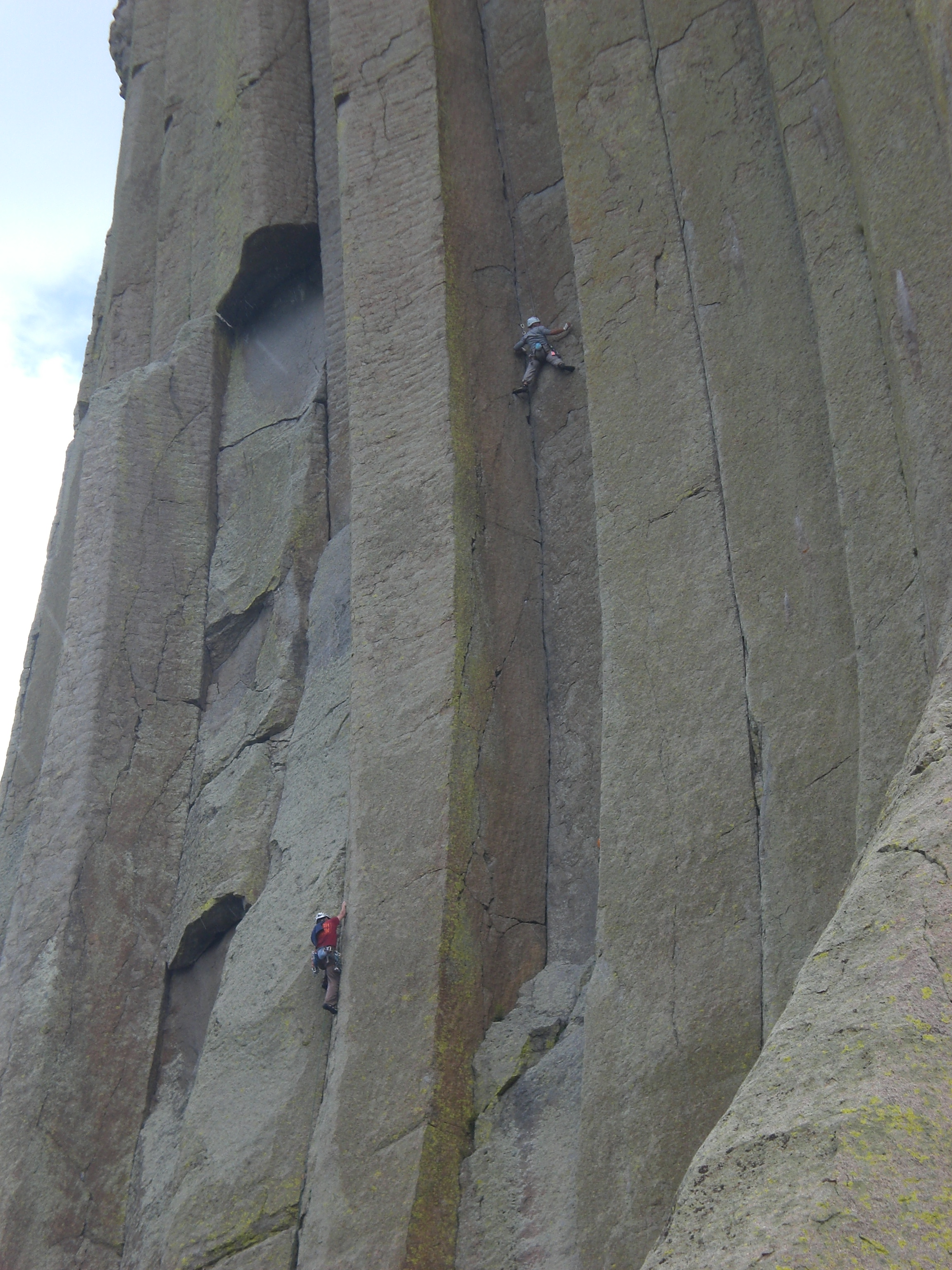
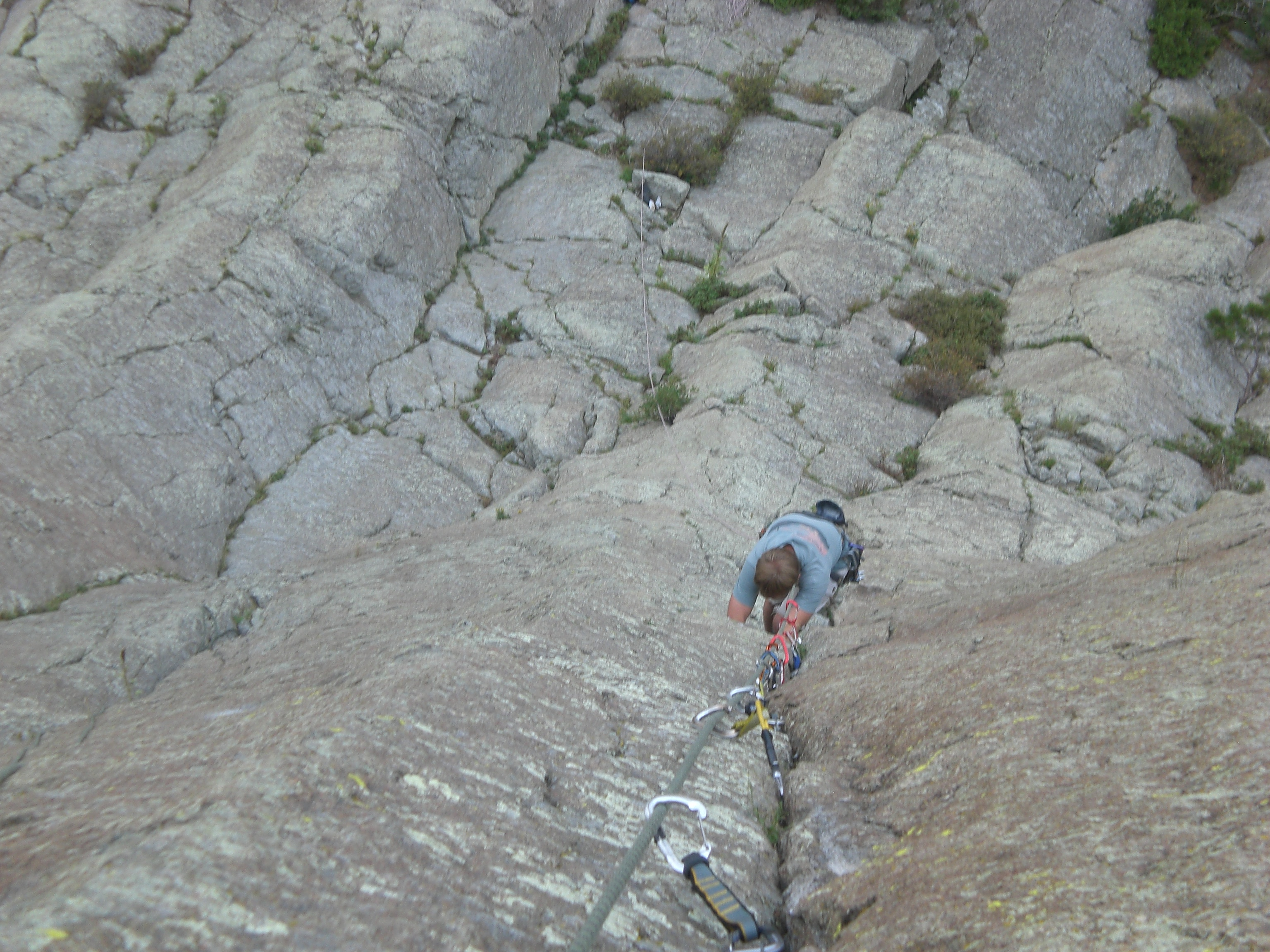
The Tower is phonolite porphyry. It is not basalt. One more time: The Tower is not basalt. Basalt is much smoother, with sharper edges where it is fractured. Much of the climbing at the Tower is friction/crack climbing in the classic sense – jams, not locks, with feet smeared on divots and small rugosities.
CIMG4081
And there is more, so much more. I haven’t even got to the sedimentary rocks yet.
CIMG4077

Tagged , ,