Category Archives: evolution

Catfight Safari

I didn’t seek a share in the house or anything that went along with it. I was drafted for it by my friend, Tim. I had been living in Seattle after graduating from college and came back to southeast Tennessee to help my parents after my mother became ill. The move was abrupt and left me renting a basement room from my parents. Mom’s health stabilized over the next few weeks, and I began looking around for alternative accommodations. I had a lead on a new job by that time too. I had been working on a landscaping crew in Seattle. Landscaping work, however, was harder to come by in the South, so I checked in with a former employer, the local Hibachi steakhouse. I had parted ways with the restaurant on good terms. I thought maybe they would be willing to take me back doing kitchen prep and cleaning up alongside Tim and two of his brothers. I was ready to settle for the same, but lucky for me, Tim stayed with the restaurant after I left, and subsequently got promoted to bartender. He put in a good word for me and may have exaggerated my mixological experience. Soon, I was blending daiquiris in a dress shirt and shiny shoes, behind an air-conditioned bar, for about the same wage as I got for kitchen work, plus tips.

While Tim was orienting me to the new job, I mentioned my living situation to him. He perked up immediately. Destiny must be at work he told me. He was just finishing up a successful house hunt and needed people to sign on for rooms and shares of the rent and deposit. I said yes without a second thought.

The landlord was more responsive than most to cash payments, and we had the place within a week. By that time, 3 others had joined the enterprise. Like me, they were on intermission. They had well-paying jobs. In different circumstances, they might have committed to those jobs and the brands that came with them and become Dan the Welder or Jim the Waiter, for instance. The last step, where the aspirant gave up their soul for security was always semi-voluntary and taken under pressure from various directions. We could put off the big moment because we had education, a little bit of family wealth, and a friendly social network. We were destined for more than socioeconomic stagnation at a decent wage. We had little insight into our fortunes, yet we behaved like we were well aware of the backstop between us and total disaster. The barrier meant that we could be a little lax, take a break from expectations and explore socioeconomic alternatives, like voluntary communal living.

The house sat on the corner of an intersection between a numbered street and a dead-end, frontage road. The single story, brick residence started life as a duplex at some more hopeful time in the distant past. It predated the ‘race riots’ the city strove to deny or, better yet pointedly forget. It was old enough to come with a warning that lead might be present in the paint flakes that fell from the windows whenever we opened or closed them. The floor was not level and sagged in spots to boot. The adjacent houses, as well as those on the next block down, were of similar construction and in similar shape. At the time, my only means of transportation was a motorcycle, and I was glad for it, because the driveway was tiny, and the parking on the street was crowded. Though they looked functional, somewhere around half of the cars parked on the curb never appeared to move. The frontage road dead ended to the west, where it disappeared under a freeway off ramp. Beyond the frontage road to the south, a fence topped with barbed wire secured the railroad tracks.

I was not with Tim when he went to pick up the keys,. He was determined to assimilate to the neighborhood as much as possible. He said that he wanted to set the tone before everybody moved in, and he told me that he wanted to begin the process by introducing himself on behalf of all the tenants, to the neighbor who lived across the numbered street from us. The neighbor was an older gentleman whose ancestors had likely been brought to the region as slaves. He sat on the front porch when I rode by to have a look at our rental before signing my copy of the lease. He did not look particularly interested in what I was doing. He did not look particularly interested in making new friends. Yet he was still probably the best point of contact for the neighborhood. The house up the street from us was vacant, as was the house up the street from his.

The neighbor’s house was smaller than others on the block. It was 2 bedrooms at most. The rest of the space on the lot was taken up by a much larger than normal side yard. At least, we assumed that it was a side yard. We could not see directly into the area, as it was obscured by an 8-foot-high strip of chain-link, unsupported in the middle and leaning towards the sidewalk under the weight of several sheets of three-quarter inch plywood laid loose across the inside of the fencing for its entire length.

I doubted that our neighbor had ever had much of a break from anything, and although none of us asked for our status, and none of us could change it, his experience may have engendered some resentment towards those who could indulge in an intermission. Though I favored my friend’s intention, I suggested that we might let the man across the street make the first move. Tim later informed me that he had paused for a few seconds on the basis of my advice before he went to knock on the door.

We worked evenings, so he picked up the keys for our rental late in the day. It was dark when he crossed the street. No one was on the porch, and all the windows were black. He had just stepped across the sidewalk when the plywood sheets slammed against the chain-link fencing just a few feet to his left. Horrible growling, snapping, and scrabbling sounds followed the impact . He bolted back across the street and hid in the rental house until the sounds died down. He never went back to knock on the door, and he never wavered in his assessment that whatever lurked behind that plywood, it was no dog.

Once everyone moved in, we quickly stopped bothering with the neighborhood. We lost interest partly because we found other, more immediate concerns, and partially because we realized that the neighborhood was not concerned with us, or anybody else, who lived there. The occupants of all the nearby houses were bound by a tacit agreement to, more or less, mind their own business. For our part, we took care where we parked. I never cranked the throttle until I got my motorcycle out of the area. The bimonthly parties stayed in the house, including the ethanol fireballs, card games, and fighting.

We gave nothing and we took nothing. After a few months, when our commitment to the pact of benign indifference, was unquestionable the neighborhood sent us a liaison. Tim insisted that he heard a knock, but when he opened the door, all he found on the threshold was a somewhat undersized, sick looking, black-and-white male cat. Without a sound or an upward glance, the animal just walked right into our kitchen, limping on his right front leg. When he reached the middle of the room, he flopped down on the linoleum and looked up at us. We stood by for a minute or two with the door propped open while he failed to find a reason to go back outside.

It became apparent over the next 48 hours, that he was there to stay. He was a good cat. He was very calm and would sit by you on the couch without ever inviting himself onto your lap. He never stole food from the counter or squeegeed your face with his tail. Tim invested in a vet visit which revealed that the cat did not have feline leukemia virus, but did have a bite wound which had healed over a bone infection in his right elbow. The cat even took the pills for his infection without too much fuss. Since he had obviously been socialized before he arrived on our doorstep, we made a reasonable effort to find out if he belonged to someone else in the vicinity. We put up signs on a few telephone poles, but never received any inquiries.

Once he was clearly ours, we set about finding him a name. Nothing really seemed to fit though. His personality was thoroughly feline, so something like “Jim Bob” or “Melvin” was out of the question. He wasn’t particularly fat or bony. He didn’t have any really distinctive markings. He wasn’t especially lazy or rambunctious. We decided to table the matter until something happened to show us the way. We would not have to wait long.

The cat was getting a drink from his water bowl, which sat on a windowsill at the far end of the kitchen counter. In the garbage can below, the empty bottle of antibiotic sat atop the trash. The kitchen window looked out across the alleyway to the building behind us. Another cat appeared in a lower-level window of that building. The interloper showed no signs of hostility, and judging by its behavior, may not have even seen us watching it. Our cat exploded in a screeching, growling, hissing fury. He slapped at the window as if blows to the image could transmit the force of his hatred indirectly to the other cat. He remained transfixed by rage until his enemy jumped down from the windowsill and disappeared into the neighboring house.

The sounds of murder had drawn a crowd in the meantime. We stared dumbfounded at our mascot, who now sat calmly licking his foot.
Tim spoke for the crowd in summary, “Jesus fucking Christ!”
And so our cat had a name.
In the interest of comity, we agreed to limit the use of his full name to conversations between housemates alone. In all other circumstances, JFC would suffice. His transformation repulsed the others. I was fascinated. Something so dramatic must mean something. I could not imagine what force could completely and immediately overturn a personality, especially without an existing foothold in the nature of the affected individual.

At that point, we should have kept JFC inside. But the concept of an indoor cat was unfamiliar to us, so we did not block him when he slipped between our feet as we left the house, and some of us even let him out when he begged at the door. I’ll admit, I should have restrained myself, but I was one who let him out whenever he asked, and I took every opportunity to follow him when he went out. He never travelled far. Sometimes he would just slink around the backs of nearby buildings and alleyways. More often, he would duck under the railroad fence. The vast majority of his excursions consisted of sniffing tours around curbs and stairwells punctuated by an occasional spritz of urine on the walls. Sometimes however, he encountered another cat and that was why I was along. Inevitably a fight ensued. The sheer violence was compelling enough, but as I became accustomed to the shrieking and the swirling chunks of fur, I discovered a pattern in these conflicts. I needed to learn more, so I began to venture into the alleyways and through holes in the railroad fence without JFC in the lead. This was easy enough in the neighborhood. I’d take a beer with me and sit down on one of the garbage cans to wait for the action. If someone walked by or came out of a door, I was protected by the pact of benign indifference. As soon as people recognized me they went back to their own business. The same was not true of the railyard. I had to skulk around like the cats themselves when I went there. Security was easy enough to evade in that era, and the very best fights happened in the isolated corners of the yard, so I ended up spending most of my nights out sitting in the shadows of stacked ties and surplus freight cars listening for yowling or footsteps.

I learned a lot. Of course, cat fights basically depended on angle and anticipation, like any other fight. There was much more beyond the basics though. All fights began with growling and shrieking. Intense scrutiny accompanied the noise and prompted subtle shifts in position. Each cat was waiting for the other to experience a brief lapse in concentration. Cats are prone to such lapses, so it was a worthwhile tactic. When the other cat’s nose twitched or their gaze shifted slightly, the aggressor leapt. An ideal pounce would land the jumper on his enemies back, well positioned to deliver a bite to the spinal column or the back of the skull. A cat’s long, relatively thin, and gently curved canines were perfect for that purpose, and it was how they killed larger prey.

The bite never worked on other cats however. The defender reacted by rolling onto his back and fending off the leap with his hind legs, while attempting to get a grip on the opponent’s upper body with his front claws. When the defense worked perfectly, the combatants ended up on their sides, facing each other. From that position, they both launched raking attacks with their back feet while attempting a bite to the shoulder. Since the claws on the back feet got used for running and jumping, the tips were not very sharp, and the raking attacks resulted in loss of belly fur, and not much more. The biting option was fraught. A successful bite on an opponent’s shoulder left the attacker open to a similar move.

Sometimes a cat would just accept the return bite and try to work their teeth deeper into the opponent’s shoulder, wagering that the additional pain would make the other cat let go. However they played it, the position was unstable. Most of the time one or the other would try to break out of it and get back on his feet. Several maneuvers were possible when escaping the face-to-face, recumbent position. The best ones ended up with the attacker standing perpendicular to the defender with the defender on his back. From that position, the attacker had a couple of options. First, he could try for an elbow bite. If executed safely, an elbow bite was much more effective than a shoulder bite. It stood a better chance of disabling the leg, and it was much more painful, since it meant teeth digging into bone. Though the cats could not factor it into their strategy, by the same token, an elbow bite would frequently result in a bone infection like JFC had suffered.

It was difficult to achieve a safe elbow bite however. Positioning for the bite left the attacker open to a similar bite in response, like the situation with the shoulder bite. And as with the shoulder bite, some cats would simply accept the return bite to deliver the attack. More often, the attacker went for a neck bite instead. From the standing, perpendicular position, the front and middle of the opponent’s neck were theoretically accessible. Because of the anatomy in the area, a bite to those structures was very difficult to achieve in practice. All the defender had to do was tuck his chin a little bit and the bite would land on the cheek or the side of the face in front of the ear. That outcome was still a good one. A face bite could injure the jaw muscles, and typically resulted in quite a bit of bleeding. Moreover, it blocked the return bite.

The fights carried on for anywhere from half a minute to half an hour. I typically had trouble predicting who would yield based on injuries sustained. Both cats came away with bite wounds. Often, it was simply down to which cat was more enthralled by its own aggression, and so willing to suffer the injury. As an outsider examining the phenomena objectively, I knew that it all boiled down to territory, which really meant access to female cats. But the combatants couldn’t see that. They felt the push and pull of fury, pain, and fear, which were driven in turn by chemicals in their bloodstream and in their brains, which were driven in turn by genes.

The genetic forces would balance themselves out across the population regardless of what happened to the individual cats and even if someone could wave a magic wand and bestow clear and complete understanding of the situation upon the cats, they lived for the sensations and would do no different. Now, it was my turn to feel repulsed.

I stopped going to the railyard, which towards the end of my catfight investigations, had become an almost daily event. As a result, I was hanging around the house a lot more, and noted some deterioration in the atmosphere. Camaraderie had taken a beating. None of the housemates would deny that, but none of us understood the implications. We didn’t understand that camaraderie, as the sentiment resulting from a commitment to the well-being of one’s fellows, served as the foundation for any group effort, including communal living.

The decay of foundational sentiment began where it always does, in the refrigerator. At the beginning, when the household was solid, we shared food with each other, and even prepared group meals on occasion. As the novelty wore off, extravagant meal prep came to feel more like a chore than a celebration. Inequities in food sharing developed. A couple of the tenants began eating out almost exclusively. If they needed a snack, there was no recourse other than what was in the fridge, which was necessarily other people’s food. Eventually, those of us who still ate at home resorted to hiding our supplies. Most of us accepted that nothing was safe in the refrigerator and switched entirely to nonperishable foods. Two of us continued to stock the fridge. One of those diehards secured his food with padlocks attached to ammo cans from the Army surplus store. For things which did not fit the containers, he attached the following note, “Would I poison something just to prove a point? Have a taste and find out.”

The next thing to go rotten was the housework. When everyone first moved in, we drew up the customary list of chores to be assigned on a rotating basis. When food violations progressed to the point where some housemates resorted to dining out exclusively, dishes began to accumulate in the sink. Additionally, fast food bags, plastic utensils, and pizza boxes built up on the counter and on the tables. The backlog of cleaning got worse and worse until somebody broke and took care of it all themselves in a single Herculean effort which left them resenting all the slackers. By the time I had finished my research with the cats, the chore rotation calendar, whose completion constituted the final chore, was blank going back several months.

Occupancy of the house grew progressively unstable. Some of those who were paying rent, barely came by anymore. To them, the place had become an expensive shower and closet. As the main signer on the lease, Tim had to track these people down and get the money from them in person. That wasn’t easy, because most of them were sleeping in various places on a weekly or even nightly basis. Our house became one of those places for other people. If friends of friends had come over the night before to drink or throw darts or wrestle on the living room carpet, it was not surprising to find several of them still there in the morning, sleeping on the couch or the floor, or perusing the fridge for breakfast items which appeared least likely to be spiked with strychnine.

JFC was a constant in the flux. Stuck with the household through its devolution. He didn’t seem to mind strangers picking him up. He would help with the cleanup of edible scraps, and when his litter box got full and did not get cleaned for a week at a time, he would go outside instead of making a mess in the house. Yet he was becoming a problem at the same time. Unlike me, he had not stopped attending the cat fights. He kept coming back with hematomas and abscesses. Some of these injuries required expensive veterinary services. Evolutionary forces had shaped the cats to survive their fights. Those same forces made him a good companion which pushed us to care for his health and so inadvertently ensured that he was in tip top shape for the next round.

A similar set of forces propped up the house in its devolved state. From the outside, it looked like one out-of-control, endless party. It had such a large pool of prospective occupants that on any given night someone with some claim on the right to flop would have steam to blow off. For those of us who still slept there for most nights of the week, the transient population became a concern, because most of them did not know about the pact. Neighbors up the street had to come by a couple of times to ask us to keep the volume down. The visits were brief, and not overly friendly, but through those brief conversations, we solved the mystery of the others’ relative invisibility. They were working up to 3 jobs each. Some of these were combinations of full and part-time jobs, and some were multiple part-time jobs, all carefully stitched together so that, in theory, if a person immediately fell asleep at the end of their last shift, they could get a full 8 hours of sleep before the next shift began. When they got home, they went straight to bed, and when they woke up, they went straight to work.

Without any conversation or formal agreement, several of us took it in turns to referee nighttime activities. We did whatever it took to keep the noise down. For reasons less clear, our devolution piqued the interest of the neighbor across the street as well. We never exchanged a single word with the man, but he took to sitting out on his porch again, almost every night. He drank from a Mason jar while he stared at the goings-on and chuckled to himself now and then. He would sit there until late in the night or until someone waved to him. He would then return the gesture with a wave hello which turned into a wave get lost, whereupon he stood up laughing quietly and shaking his head, as he staggered back into his house. I kept it to myself, but I knew why he kept watch over the disintegration across the street. Somehow, he knew bootleggers who brought him moonshine to power his vigil. He somehow survived in the face of malicious neglect meted out by the society writ large and his relations in particular. He kept the embodiment of blood thirsty rage in the side yard, just for spite. He watched chaos overcome until he became it himself. Our comedy alone brought him satisfaction, but It seems he lost interest after a couple of months, because he returned to his hermitage, and nobody saw him ever again. We wouldn’t have noticed except a 2nd generation housemate, who had formally taken over rent payments from one of the originals, mentioned it to us. He brought it up because he was planning to walk across the street and check on the old guy. He had exchanged waves with the man once or twice during the emergence, and had the weird notion that there was some kind of bond between them.

The conversation with the 2nd generation fellow came about in the first place because we were trying to formally hand over responsibility for rent by that time. During the slide into disorder, most of us had quietly been looking for alternative accommodations. We’d seen the writing on the wall. The situation was going to continue to deteriorate until some disaster ensued, or the remaining housemates were evicted. Intermission was over. It was time for the backstop to gobble us up. None of us were ever going to feel compelled by cat-like sentiments distilled from indifferent evolutionary forces, not in that house or anyplace else. Better to get it over with. Before he ended the conversation, the gen2 guy mentioned that no one had seen JFC for a couple days. They had set his food and water outside, and it had been consumed, but they couldn’t be sure by who.

Tim decided to stay over to try and find the cat. He heard about the results of the welfare check on the old man across the street. The monster was still behind the plywood. Nobody answered the door. Our detective even had the guts to walk around the side of the house and knock on some windows there. He had seen no sign of life.

On the morning of the 3rd day, the cat returned. Tim found him on the back porch by the door, laid out on his side, panting. The vet confirmed a recurrent bone infection. It was in the same elbow as before, but it was much more extensive. He could take antibiotics again, but even then, there was no guarantee that the leg would not need amputation. The whole process was going to be expensive. Tim was exasperated. He was not going to go on subsidizing the cat’s stupidity. He was also unable to find some sucker to take JFC off his hands.

So, JFC died by lethal injection. Really, it wasn’t the potassium infused directly into his heart that killed him. He died from a shift in those indifferent forces which drove him to fight and us to take care of him. He was a martyr because of that, but he was a sort of champion as well. No matter the consequences, JFC heeded the call of those forces and stayed true to the end. I am sure that if we amputated his leg, he would have hopped right back to the fights.

A week or so after we killed JFC, the remainder of the original housemates packed up and formally vacated the premises. We went on to various occupations and living situations, but wherever we went, we became more and more subject to the expectations of other people. With time, martyrdom and triumph passed out of reach entirely. The original housemates did not keep in touch. The whole enterprise felt more like a bad experience as it faded into the past. For my part, once adequate time had elapsed, I felt the desire to watch cat fights again.

It was different upon return, and more like what I imagined that the Romans felt when they watched slaves and captive animals tear each other to pieces. I wanted to see them fight despite themselves. I wanted to see them driven to kill an enemy who had inherited the capacity to survive all their attacks. And when they walked away with their bite wounds festering, I wanted to feel sorry for them and feel for a moment like I was above it all.

Tagged , , , , ,

Knock Out Mouse Revolution

mighty-mouse-cartoon-clipart-16

Standing in the New Orleans convention center felt a little eerie. The interior was clean and neat. It looked like an airport. Still, I could not help but recall images of Katrina, when the huge edifice had become a beacon of false hope, luring the populace through its doors with the promise of aid, only to leave those who entered trapped like rats.

We had come to a conference to learn about endocrinology, which I had not considered too creepy before. I was wrong.

The proceedings began innocently. Hundreds of physician scientists, and I, filed quietly into a giant auditorium. I want to make clear my lack of qualifications relative to the rest of the group. I am no scientist, and barely a physician. I would much rather read philosophy books and climb around on crumbly sandstone towers than pipette solutions into a gel matrix.

But my job is mostly about helping people protect themselves from diabetes. Plus my wife had a poster to present. So, there I was, attending as an imposter.

The keynote speaker got a prolonged introduction. He deserved it. He was an important person with important research credentials. It was the kind of introduction where a name is never mentioned, for dramatic effect, and because everybody already knows exactly who the subject is. It is a an effective strategy for generating anticipation in the majority who are already quite familiar with the speaker, as well as in those who have never heard of him. It works for everyone, except my wife. She is honest to a fault, and that means that she is a real subject-object-verb kind of person. When presented with a dramatic, obscure speech, her attention lapses. As the speaker walked onstage to the sound of his name, she asked me who this Francis Collins person was.

After a long moment’s reflection, I told her that Francis Collins was a bad philosopher. She seemed to accept my summary, because she promptly settled back in her theater chair to nap through the rest of the lecture. I could not sleep, though I was feeling a little jet lag as well. The lecture was fascinating. Dr. Collins had been right in the middle of genetic research since the beginning of the human genome project, and he took the audience on a trip through the whole endeavor, right up to the current moment: the Big Data revolution.

The Big Data revolution referred to the use of advanced mathematical and computing techniques to sort through scads of data for druggable targets in endocrine diseases. The special techniques had become necessary because the database had exploded. Dr. Collins and his compatriots had deciphered the genomic book of life, but when they sat down to read it, they discovered that they needed a lamp, reading glasses, bookmarks, and indeed, the semantics of the language. The genes turned out to be active in the context of all sorts of transcription factors, promotors, coactivators, corepressors, etc. There was layer upon layer of conditionals which gave meaning to the genetics.

The source of the Big Data revelation was the knockout mouse. The knockout mouse and its cousins, the knockin mouse and the humanized mouse, were what happened when researchers turned to their traditional test subjects with gene manipulation techniques learned in dissecting the genome. By studying mice with selectively induced genetic defects, the researchers had produced the dense pile of data on gene regulation which advanced computing methods might sort out for us.

By the end of the keynote address, I had mouse fever. I wanted to hear all about the things which these creatures could do, and it turned out that I had come to the right place. Over the next few days, I would hear about mutant mice who could run on a treadmill off the couch like they had trained for months. Mice who developed diabetes. Mice who could turn on their brown fat to alter their metabolism. And many of these mice could serve as their own experimental controls. They had mechanisms inserted in their genomes which could turn their genetic defects on and off in response to substances in their mouse chow.

I’ll admit, when I heard about designer mice and their custom mouse chow, I got a little side-tracked. I had been eager to get out of medicine for a while. It all seemed so futile, and even a bit of a sham. Knockout mice might have been the ticket.

Two incidents elevated that thought to conscious consideration. The first was sighting a booth devoted to mouse chow in the exhibit hall.

To understand the significance of the chow booth, one must understand what the exhibit hall is all about. There is an exhibit hall at every conference. They are huge and opulent sometimes, sometimes modest, but always staffed by beautiful, shiny people and stocked with treats, from lattes to foam-model pancreases. Brands like Coach or Louis V. would feel at home amongst the booths.

Giant pharmaceutical companies ruled the hall, and the mouse kibble guys were right there in the mix. If mouse chow could buy an exhibit booth, the mice themselves must be golden.

The second incident was a conversation overheard in the poster hall.

The poster hall is a huge open space with row upon row of cork boards. Researchers pin up posters with summaries of their investigations on the boards, and attendees walk up and down the rows soaking in the knowledge. Usually there is a clearing in the middle with a nest of round banquet tables where everyone can go to take a break, chat and have a cup of pharma coffee. That’s where I sat while my wife presented her poster. I did not sit randomly.

As I walked up on the tables, I spotted a fat man in a plaid shirt and a yarmulke leaning in to say something to a thin, swarthy, bearded companion wearing a dark olive sport coat and a gold medallion. I needed in on that conversation, so I settled in the chair next to them, and swirled my coffee thoughtfully. Imagine my surprise as I picked up on the subject of their conspiracy.

“Yes,” said the fat man, ” I have been trying to find some of those mice. I need them to finish my work, but you can’t find them anywhere.”

“Yes,” echoed his friend, “those mice are nowhere to be found.”

“The closest I came,” the fat man continued, “was this Korean lady in San Fransisco. She said she had some, even said she would send me a few. But she never came through, and now I can’t get a hold of her anymore.”

The mice must be golden.

But my dreams of becoming a mouse Baron were short-lived. Upon further investigation, I found that genetically altered mice did not thrive. It was hard enough to get them past the embryonic stage. Once they could breathe on their own, they often required special conditions and diets just to survive. Worst of all, most of the really good mice had been patented. You bought the limited rights to a strain of mice when you bought the animals themselves. The patent system was the impetus for the black market discussion in the poster hall. You could trade for mice underground and avoid some costs, at the risk of incurring the wrath of the mouse factory lawyers after publication.

Despite the disappointment on economic grounds, I left the conference optimistic. I still had the image of all those colored bars from Dr. Collins’ slide in my head. Each one was a gene which a mouse model could exemplify, and therefore each one was potentially a druggable target. We had this. It was just a matter of time, and mice.

On my way to work, I have some time to think, though not too deeply. I leave early to beat the traffic, but I never do. Most commutes demand constant attention to collision avoidance. The situation is unfortunate, because the commute is the only time to think. Once work starts, I am behind. Someone constantly needs something from me to satisfy someone else who needs something from them, etc.. My workplace is carefully structured to facilitate this cycle. If I need to communicate with someone, odds are that I can lean over to one side and speak to them directly. Otherwise, my computer contains a messaging system which will pop in on whoever I need to inform or interrogate. Patient rooms cluster around my workstation, so I never need to walk more than 6 steps. However, patient contact occupies only a minor portion of my time. Most of the day is passed on the computer and the phone, addressing questions, requests and lab results. At the end of the day the freeway awaits again. By the time I get home, I am burned out and may or may not have it in me to do some physical training and watch television before retiring to get up and do it all again the next morning.

As luck would have it, traffic was light on the first day back from New Orleans. As I drove, I dreamed of druggable targets; Dr. Collins’ slides with the colored bars swam before me. Most of my patients were already on carefully targeted medications, but reaching down into the genome would ramp up medication effectiveness by orders of magnitude. Yet, not all my thoughts were so happy. Other images kept popping into my head, unbidden. I saw other colored slides, from another lecture by another renowned researcher. They were Dr. Brawley’s slides on the geographic and socioeconomic correlates of life expectancy and the epidemiology of conditions like obesity, cancer and diabetes. I could not banish those intrusive images, and by the time I was walking across the clinic parking lot, my mood had deteriorated.

I made it through the day, and finally got to resume my train of thought as I walked back to the car to drive home. I thought about gene targets and Dr. Brawley’s maps again. Then thoughts of one of the day’s patients joined the fray. She was very overweight, and had the metabolic problems that went with excess adipose tissue. She was on targeted therapy for her diabetes in the form of a monoclonal antibody directed at a counter-regulatory hormone receptor. It was the best science had to offer, but she often missed her doses. She had 2 jobs and no car, so she was up early and home late, and she simply forgot her meds sometimes. She set an alarm, but often could not attend to it, or forgot to reset it. We did not even discuss diet and exercise. She lived on a busy street with non-contiguous sidewalks, had no money for a gym, and no time to travel to a safe park. She could not cook, because she had grown up on packaged foods. In any case, she had grown too heavy by now. Her knees had given out under the weight. She could only mobilize fat stores in the face of severe calorie restriction. To reclaim  her life, assuming that was our aim, she would need two joint replacements and a gastric bypass.

I began to re-experience the rising panic which I had felt at the end of her appointment. Dr. Collins & Co. had let me down; I was not armed for this struggle, nor would I be. I stopped to take a breath and get my bearings. The parking lot was nearly empty. A bad smell rose from a nearby drainage grate, and a noise like water flowing.

I imagined that the noise might be something else. Maybe, instead of waste water, it was all those knockout mice, rising through the  sewers from the depths of the New Orleans convention center where the disappointments of Katrina had flowed down to bring the little fellows back, like a time-delayed Ghost Dance. The mice were coming with their little spectral incisors primed to clip down the cages, the labs, the chow booth, the convention center, and all the rest in a massive, surgical revision. I became convinced that the sound was the mice coming. It had to be. It was the only way that the knockout mice could save us.

mouse


Tagged , , , , , , , , , , , ,

The Simple Life

Life? Don’t talk to me about Life.

– Marvin the Robot


Life, living matter and, as such, matter that shows certain attributes that include responsiveness, growth, metabolism, energy transformation, and reproduction.

– Encyclopedia Brittanica

The javelina was dead, no doubt about it. By the looks (and odor) of the ruin which lay in the ditch, it had been several days since the animal had lived, as such.

Most likely, it had been hit on the nearby road and dragged itself to the protection of the ditch before collapsing. ‘Collapsing’ means: it ceased to respond as a javelina. Certain nerve cells lost their flow of metabolic substrate, could no longer transform energy in covalent bonds into electrical potential across cell membranes, and so could no longer respond as nerve cells.

The javelina behaved as a javelina if and only if those nerve cells behaved as nerve cells: no more nerve behaviors, no more javelina behaviors. Yet the remainder of the organism ticked along for quite a while after its defining brain functions ceased. Less sensitive tissues took minutes, or even hours to stop responding, growing, reproducing, etc.

Even after the last of the body’s eukaryotic cells ceased to do all those life-defining things, the prokaryotic components of the javelina carried on. Many of the bacteria which had worked with its other cells to keep the animal alive and healthy before it came to lie still in the ditch, continued to grow, metabolize, reproduce, etc.

At the other end of the javelina’s timeline, we see a similar situation. Before its mother could conceive, the environmental circumstances had to be right for piglets. Furthermore, its mother and father had to be right for the circumstances. They had to have a set of characteristics which led to survival and relative prosperity in their particular living conditions.

Within those proper circumstances, gamete membranes met and fused, DNA recombined, placental syncytium formed, organogenesis took place, the piglet began to exhibit its own physiology, and the little  javelina emerged from the amnion to take its first breath.  From some fairly basic biochemical reactions to the defining processes of biology itself, the animal faded into life, much as it faded into death.

Many people find this picture disconcerting. They yearn for the simple life, where our definitions are definitive and what’s real is real in and of itself. But that’s not what we have. The simple life, and its decadent certainty, are not available to us.


Tagged , , , , , ,

Is a Virus Alive?

life, living matter and, as such, matter that shows certain attributes that include responsiveness, growth, metabolism, energy transformation, and reproduction. – Encyclopedia Brittanica

Close enough, and encompassing the generally accepted criteria: responsiveness, reproduction, metabolism and adaptation. My older son asked the question about viruses the other day. I have been looking forward to this question. It means that he is prepared to understand some things about life which are important. It is a tricky question if considered from the wrong viewpoint. A virus displays some of the characteristics which define a living organism. It can respond to stimuli, attaching to the proper cells and injecting its genetic material through the cell membrane when it makes contact. It can replicate. It can adapt to avoid a host immune response. But it does not have the capacity to metabolize. It cannot, in other words, run its own show. It is entirely dependent on its host organism in that respect. Nor is the virus alone on the gray borders of life. Certain families of bacteria lack some essential metabolic processes which would make them autonomous. They must live inside another cell, and depend on their host’s metabolism to survive. Yet, they too can reproduce, adapt, and respond to stimuli in their environment. Because they have a membrane which is active, biologists are prone to give obligate intracellular bacteria, like mycoplasma and Rickettsia, a break. Most biologists are less charitable when it comes to prions. Prions are mis-folded proteins which replicate by somehow inducing their own conformal change in normally folded proteins with which they come in contact. Prions can reproduce, but they cannot metabolize. They cannot adapt much (although they have managed to pass from cows to humans), but they can respond to their environment, albeit in a very limited way. Still, the difference between the prion and the obligate intracellular bacterium would seem to be one of magnitude rather than quality. Differences in their classification reflect a little bit of membrane chauvinism on the part of biologists. The same prejudice is evident in the gray zone at the other end of the complexity scale. By our criteria for life, is a male angler fish alive? The fish can survive for a short period of time independently, but it cannot carry on its own metabolic processes independently for the long-term. It must rely on a female angler fish. It must quickly sniff out a female and attach itself to her, permanently. The male fish spends most of its existence as a tissue of the female angler fish’s body; its brief, free swimming existence is a transitional aberration. Its ability to adapt is extremely limited. Its existence can be mapped on an algorithm only barely more complex than the one which describes a prion’s lifestyle. So what does differentiate the male angler fish from a mycoplasma bacterium, a virus, or even a prion? A few extra membranes make the only difference. Even our own status as living things is at risk if we apply our criteria strictly. We can certainly reproduce, just like the viruses, obligate intracellular bacteria, prions, and angler fish. But it is questionable whether or not we can independently metabolize. We actually rely on hereditary intracellular symbionts for our primary metabolic process. Without these symbionts, our mitochondria, we could live only minutes on the metabolic processes encoded by our own genetic material. So, we can hardly be blamed for fudging our criteria. We certainly want to call ourselves alive. Since it looks and acts alive, we want to call the male angler fish alive. For practical purposes, we also want to call Rickettsia and mycoplasma alive, as well as viruses from time to time. As for the prions, it is often more convenient to view them as sophisticated toxins rather than living things. And that’s the upshot of my son’s question. The issue of whether or not a virus is alive is only confusing if we consider “life” an actual, efficacious thing. But life is just a category. When we look out across the terrible landscape of things, we see phenomena which cluster about each other by dint of their shared heritage. Our account of our cluster is biology, and our criteria for life provide the outline for our biological stories. This is correct viewpoint on the question of life, and what is alive. But this is not the popular viewpoint. The popular viewpoint attempts to preserve life as a thing, as vital essence or emergent property. Unfortunately, the popular viewpoint is not feasible. It leads inexorably back to the original question rephrased, “where is the life in a thing to be found?” In the end, we find that the essence or the emergent property is explained by the operational mechanisms and properties of the thing in question, but it in turn, explains nothing about the thing; it just notes where that particular thing lies on the vast, terrible landscape of things. Despite its glaring inadequacy, the popular viewpoint remains popular because it seems to save us from losing an idea that we don’t feel comfortable losing. But we don’t need to worry, becoming a category doesn’t vitiate life. We have the things which the category marks clustered around us after all, even if it’s only according to our viewpoint. We can’t escape life anymore than we can climb out of our skins. So, the answer to the question? Sure, a virus is alive – as long as you can explain why.

Tagged , , , , , , ,

Is Intelligent Design Distinguishable from Creation Science?

Yes, as horse shit is distinguishable from bull shit. ID is a deductive argument from analogy and teleology. As such, it is neither valid nor scientific. Both Creation Science and ID are based in the politics of religion, a genre which degrades both politics and religion, but ID is an attempt at subterfuge whereas Creation Science is at least an honest effort to advance an agenda.
Both are like unwanted attention from a belligerent drunk, but where Creation Science is like a shove, ID is like the question, ” What are you looking at?”. As with the shove or the question, one response is in order.

Tagged , , ,

Blip! Intelligent Design Is Done Before It Gets Going…

I’m republishing this because I think it bears repeating in light of the ongoing activities of intelligent design advocates, and because I realized that I was wrong about something right at the beginning. The core errors in ID do power the evolution-bashing arm of creationism. I’ve noticed that the error of de-contextualization which characterizes the positive argument for ID forms the core of many people’s arguments against evolution. Obviously, I think that this is no accident. To many creationists, evolution is one rationalizing story among many. This would be true, provided one considered the theory of evolution out of historical context. But remember, the hypothesis was derived from observations of biological variation across environments. Then came the archeological evidence predicted, and later the genetic evidence predicted. That historical evolution is the difference between all proper scientific theories and mere rationalizing stories. So, one more time – I swore I wouldn’t get into this anymore. The intelligent design crowd keeps pushing this crap, though, and I have kids who are at risk. Beyond that, I suppose intelligent design’s sort of dishonesty just galls me. Don’t say I didn’t warn you.

I am about to give an argument by analogy. I do so with trepidation, because analogies are always in danger of going off in the wrong direction and have no deductive validity in the first place. However, I think this form is the only fair tool for the subject since I’m going to use this argument by analogy to critique another argument by analogy: intelligent design (ID). Rather, I’m going to critique the positive arm of the intelligent design argument. This is the withered limb compared to the evolution-bashing arm, but it is necessary to the whole and the negative argument is a morass. Since scientific knowledge is never complete, critics have available to them an endless list of objections. The positive side of the ID case is more a philosophical than a scientific argument, so it can be settled on that level.

The positive ID argument is as follows: when humans start with a purpose (a problem to solve) and devise a tool to serve that purpose, the end product looks a certain way. Biological structures have a similar appearance, so biological systems must result from the same sort of process. An immediate problem arises at this point. Since proponents wish the analogy between man-made objects and biological structures to be precise the argument commits the fallacy of the undistributed middle (Designed structures look like X, Biological structures look like X, therefore Biological structures are Designed structures).

The proponents of ID subsequently introduce a number of modifiers to try to alleviate this situation. Complex specified information is not only used to portray designed and biological structures as essentially similar, it is also used to try to pare down the middle by saying it is statistically negligible. Appeals to abductive reasoning serve the same purpose, suggesting that design is so far and away the “best guess” that there’s no need to worry about the logic. There are deeper problems than the modifiers and the middle but those are the simplest things to consider, so let’s go there first. Let me tell you how I built my son a mountain bike.

The bike came in a big box in a bunch of pieces with a couple dozen pages of instructions. The instructions were complex and very specific. In fact, if you read the instructions through, you would know that a mountain bike and nothing but a mountain bike would result from following those instructions, even without actually building a bike to find out. But, I didn’t read the instructions. I know how bike parts work, so I just eyeballed the problem and figured it out. So, even though the Complex Specified Information (CSI) in the instructions has all the qualities that the advocates of biological CSI wish it to have, it doesn’t have the necessary relationship to the endpoint that those advocates want from it. There are multiple paths through the middle to the mountain bike. There is still a way out for ID, though. I must have picked up on the CSI contained in the parts themselves. It’s true. When I looked at the parts, they fit together in certain configurations and orders of assembly best, as I expected. My expectations were key, too. Over the years, bike designers had shaped those expectations, in effect teaching me to read the information they put in the parts so I could use my abductive reasoning to make a really good guess about how the parts should go together.

I use this “best guess” faculty all the time, because it is a great shortcut and pretty reliable in familiar circumstance. Notice I said ‘pretty reliable’. Also note that I said I didn’t use the instructions, but I didn’t say I threw them away. Sometimes the bike makers come up with an innovation and then my abductive reasoning is worthless and I have to rely on the instructions again to tell me what to do about the new part. I get in trouble if I try to rely on that ‘best guess’ shortcut in clinical medicine, too. The causal history of a manufactured bike is well-defined because people decided to make it that way. If the causal history of a patient’s symptoms is well-defined for me, it’s because I have decided so. Used outside of a situation with known prior constraints on the variables, the ‘good guess’ becomes confirmation bias. So, the problem is with the complex specified information. In biological structures, to achieve ‘specification’ and thus make the ‘best guess’ inference to design, the causal history has to be constrained after the fact. Anything less leaves open those pesky intermediate paths through the middle. ID imposes that constraint by assigning purpose to all biological structures it considers. Assigning purpose is easy for us humans and we like to do it because it lets us use shortcuts like guessing. Attributions of purpose (intent) are so appealing that we have trouble keeping them in the realm of human behavior where they belong (and not even there without some confirmatory process to check the attributions). Who hasn’t said their car “worked hard” to get up a steep hill? It’s just as easy to say that E. coli intends to swim to new food sources with its flagellum. In fact, it takes just that sort of presumption of intent to wrangle an object’s causal history into CSI, resulting in a bit of a Cartesian circle (if the flagellum is made for swimming, then it has a complex history treading a narrow path to that endpoint, which shows that the flagellum was made for swimming). Still, we should be able to safely use this attribution of intent after the fact in limited circumstances, as long as we’re careful, right? For instance, it is surely accurate to say that the guys who designed my son’s bike did so from an original purpose. However, even that presumption of intent from the endpoint is not accurate, and the problem with the retrospective attribution of purpose/intent in such a case leads us back to the problem with intelligent design that predates any attempt to distribute or minimize the middle.

What do we know about design? We really just know what we do and what we do requires an agent (us), a purpose, and means. The problem is that the relationship between those three factors is not linear, nor is it even hierarchical. When considering bike design, for instance, we could go back to the origin of the means via the agent and examine the influence the means then had on the agent’s intent and subsequent development of further means. We could track back to the origin of the wheel in geometry, which is in turn based on observed properties of materials, which are in turn based on some basic laws of physics, all of which humans bothered to investigate and remember in the first place because, if you are a tool-maker, it’s easier to investigate and remember than to, um, ‘reinvent the wheel’. We could trace bicycle history back to the wheel and beyond, but let’s keep it brief and just consider the design of mountain bikes.

Mountain biking started when some California bike racers moved to the country. Their new environment confronted them with the problem of riding, and of course racing, on gravel roads. Their road bikes’ narrow tires were too unstable for that purpose, so they found some preexisting cruiser bikes with wide tires that would at least be ridable on the fire roads near their homes. The cruiser bikes were not perfect. They were heavy and hard to pedal, so the riders raced them downhill. Even that compromise lead to problems though. The brakes and bearings on the cruisers couldn’t survive that kind of abuse. The riders replaced the brakes and bearings with motorcycle and road bike components. The riders soon found that the revised cruisers, now possessing cassettes of gears with the road bike bearings, were capable of riding on rough trails as well as fire roads. Trail riding prompted further modifications to the bikes. These guys in rural California invented the mountain bike, but not all at once and not out of the blue. They worked through a progressive series of problems, each leading to the next, until they arrived at a relatively stable final design that did something very different from the structure they started with. The mountain bike evolved. Of course, this is microevolution; the mountain bike is just a tweaked cruiser bike. Neither the mountain bike nor the cruiser looks anything like an old penny-farthing with the giant wheel in front. The lineage is clear though, and bike development has proceeded by the same basic process from the wheel to the velocipede to the mountain bike. Moreover, the agents in this process acted as selective forces and were acted upon by selective forces – and not just physically. As designers altered the bikes, the bikes’ new capabilities altered their conception of where and why they might ride a bike and thus their purpose in the next set of modifications.

To fingerprint design as the ID scheme misrepresents it, we really must close that Cartesian Circle by presuming intent for any and all endpoints we wish to examine. Then the history of that point is seen separated from any branches or external contingencies. If the mountain bike comes from a mountain bike factory, surely the mountain bike factory holds the entire explanation for its structure. When defined after the fact like this, the history of a structure looks irreducibly complex; if you take away one part it is rendered meaningless because it is its own context. ID’s analogy between designed structures and biological structures not only fails to distribute the middle, it doesn’t even accurately depict design processes as we undertake them. People, the source of everything we know about design, don’t start cold from an undetermined purpose and design toward that purpose in an implacable, irreducibly complex chain of events. Replication may work a bit like that, but not design.

What this method really does is provide for a hierarchical relationship between presumed intent and biological structures, where the intent causes the structure. Such a relationship seems to allow for a supernatural cause. This is why ID’s advocates have gone through such contortions to make it work (or at least look like it might) – see the Wedge Document. Yet the intelligent Design model fails even as a portal for the supernatural. It offers no solution to the interaction problem in dualism. This is a real problem because, as far as I can tell, one tenant of ID is that the design process in nature is ongoing. To drag a spiritual being into the material world and have it start doing things, one has to explain how it does so without being in some way beholden to the same laws, and thus part of the same causal history, as the rest of matter. If there is no good explanation, then the spiritual being from another realm is just a bizarre, unexpected new part of nature. Though this may seem an obscure technicality at first glance, here is an example of just how sticky the problem really is.

Descartes tried to defend the independence of the mind from brain processes. He offered the analogy of a virtuoso violinist asked to play on a broken instrument. The listener would have no clue as to his true skill. Likewise the damaged, diseased, or intoxicated brain may just be a broken instrument unable to give voice to the intact mind which plays upon it. Unfortunately, this analogy raises the question: May the virtuoso be a virtuoso without a violin? Study of music theory or any other purely mental operation is insufficient. He must play a physical violin. Yet the skill he gains is a mental faculty which is subject to his creativity, religious concepts, and emotion. The brain and its adjuncts affect the mind. There is no escape from this problem in a world of two supposedly separate substances in active contact. Deism or a strict idealism offer the only outs (and Deism may just push the problem back in time). Either of these scenarios keeps the supernatural supernatural, but thereby makes it irrelevant to any practical understanding of nature/matter. This is why it is best for religion that science adhere to methodological naturalism. This is why intelligent design is insidious as well as invalid, for all concerned. It robs religion of any hope of philosophical integrity, just as it misrepresents biology. Reason enough for everyone to drop this bullshit for good.

The Dry Cat Food Paradox

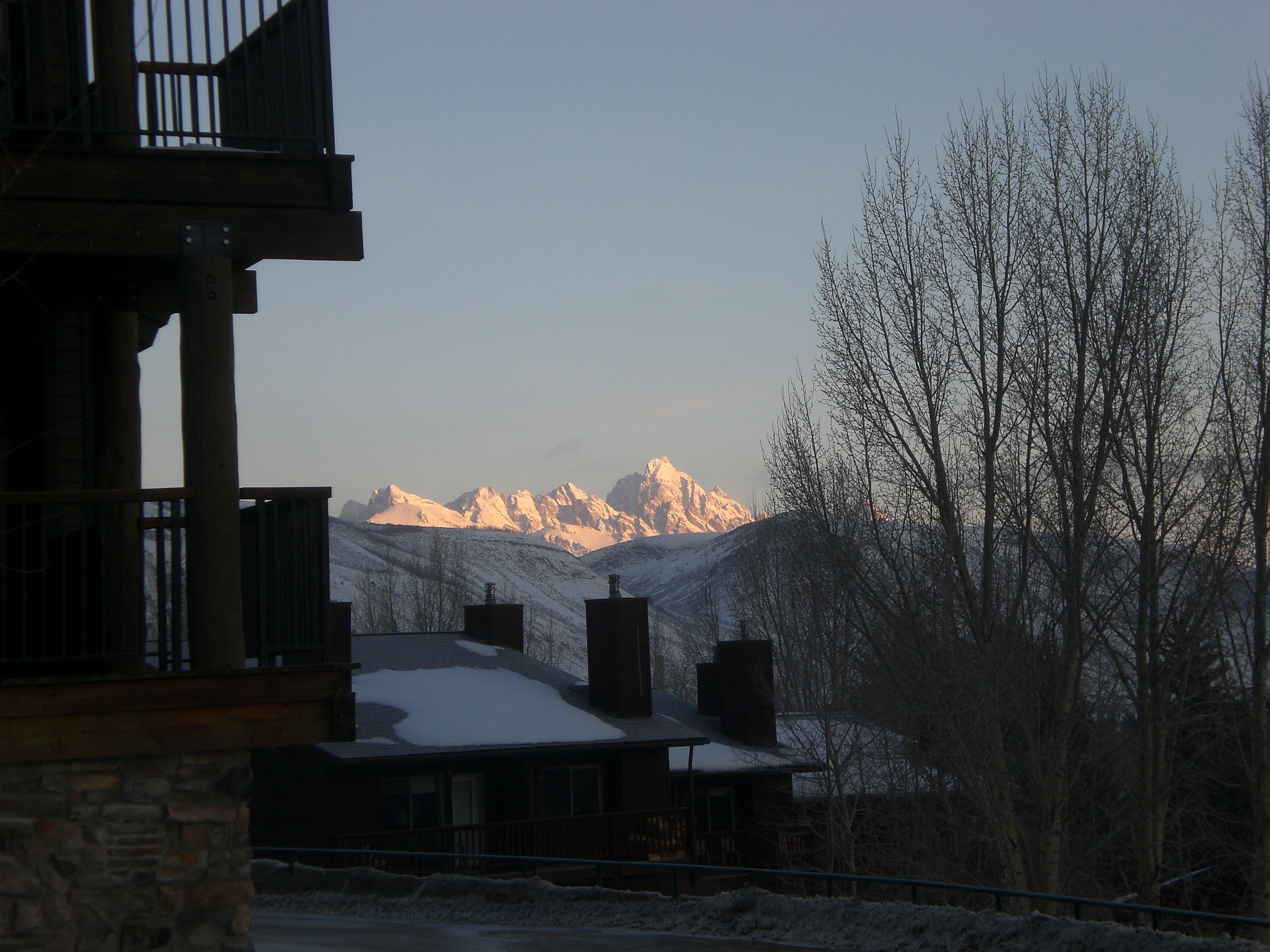
So close, yet so far...the Tetons

So close, yet so far…the Tetons

I’ve recently had the privilege of attending a continuing education conference in Jackson, Wyoming. As a climber who thinks of himself as primarily an alpinist headed to the Tetons, I should have felt like the proverbial cat who ate the canary. Instead, I left my gear in the basement. It wouldn’t have fit in the car with all the ski equipment and clothes anyway (the whole family of four was signed up for the trip). It wouldn’t have done me any good even if it did fit. Four months out of the year, those mountains are shut down due to a horrendous snowpack. When conditions allow, the climbing is still high up and far back.

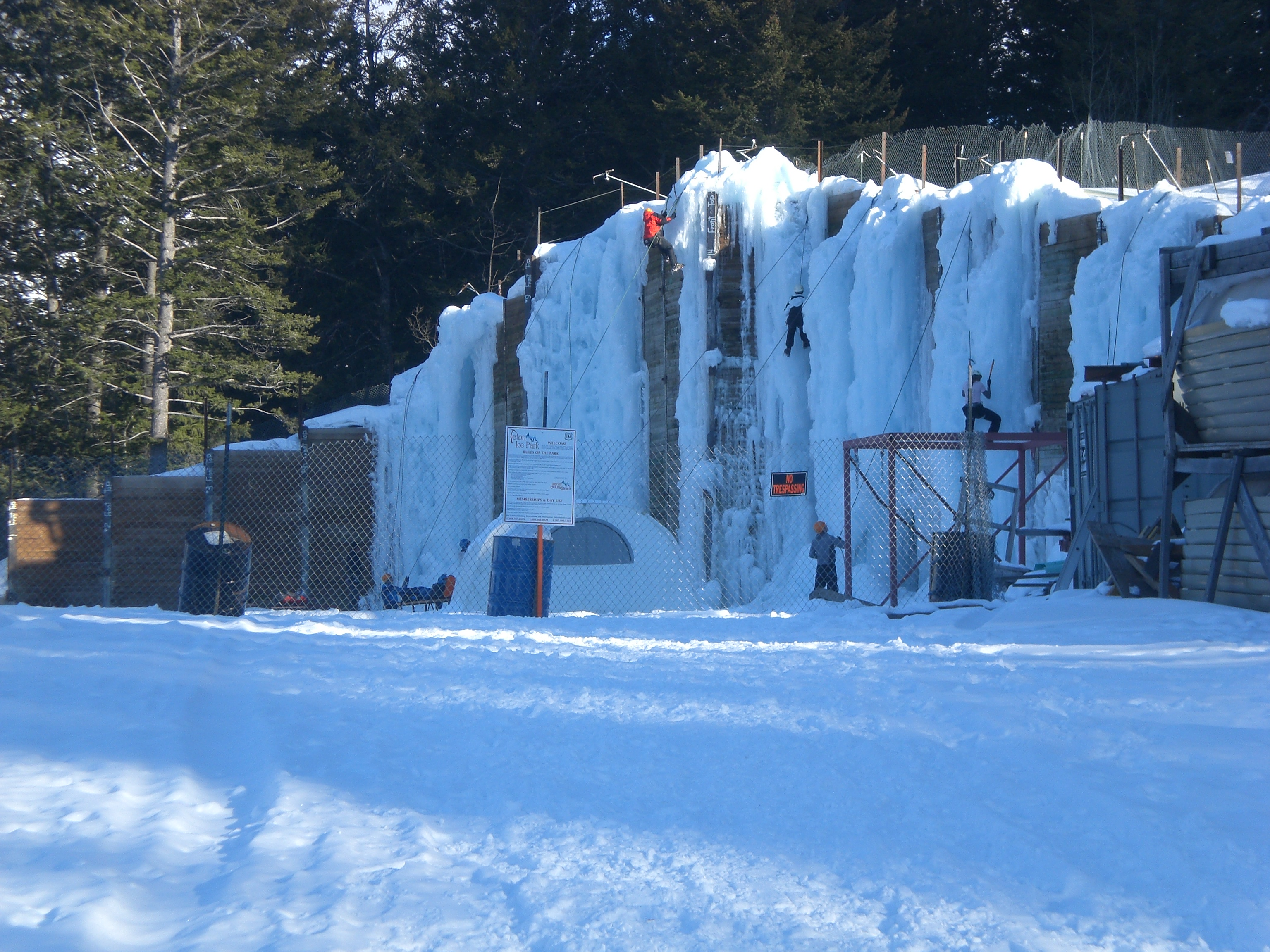
It turns out that it is almost as hard for a climber to subsist on Teton routes as it is for a cat to live on hunted birds. Signs of compensation for these difficulties were everywhere in Jackson. Right around the corner from the conference center, was a sign for the “Teton Ice Park”. When the first morning of lectures ended, I walked up to take a look. What I saw was the result of  a noble effort, but one obviously born of desperation. An enterprising guide service had run a few hoses over a 40 ft. retaining wall to produce about five, moderately-angled chunks of ice. The ice park rented gear, but I decided to utilize a different compensatory facility – the climbing gym just outside of town. It turned out to be quite nice.

CIMG4000

Back in the conference center that evening, I was mulling over the dissonance of indoor climbing in the Tetons when the next set of lectures began. Maybe I should have been paying better attention to the speakers. However, it was a series about nutrition, and though the subject is interesting, the hard science behind it could be covered in about fifteen minutes rather than the three hours allotted  As I considered my Teton climbing experience, I kept coming back to the viewpoint which kept me in the Black Hills for all these years: alpine climbing is more about training than actually climbing. Adaptation to harder routes in the mountains paradoxically required less time climbing mountains. Living in a place like Jackson resulted in strong legs and weak skills. Unless a climber availed himself of  an artificial training facility, the volume of technical climbing needed to improve was just not accessible, at least to anyone with a job. My mind wandered back to the lecturer. He was talking about the Paleo Diet and I found it strangely relevant to the contradictions involved in trying to be a good alpine climber.

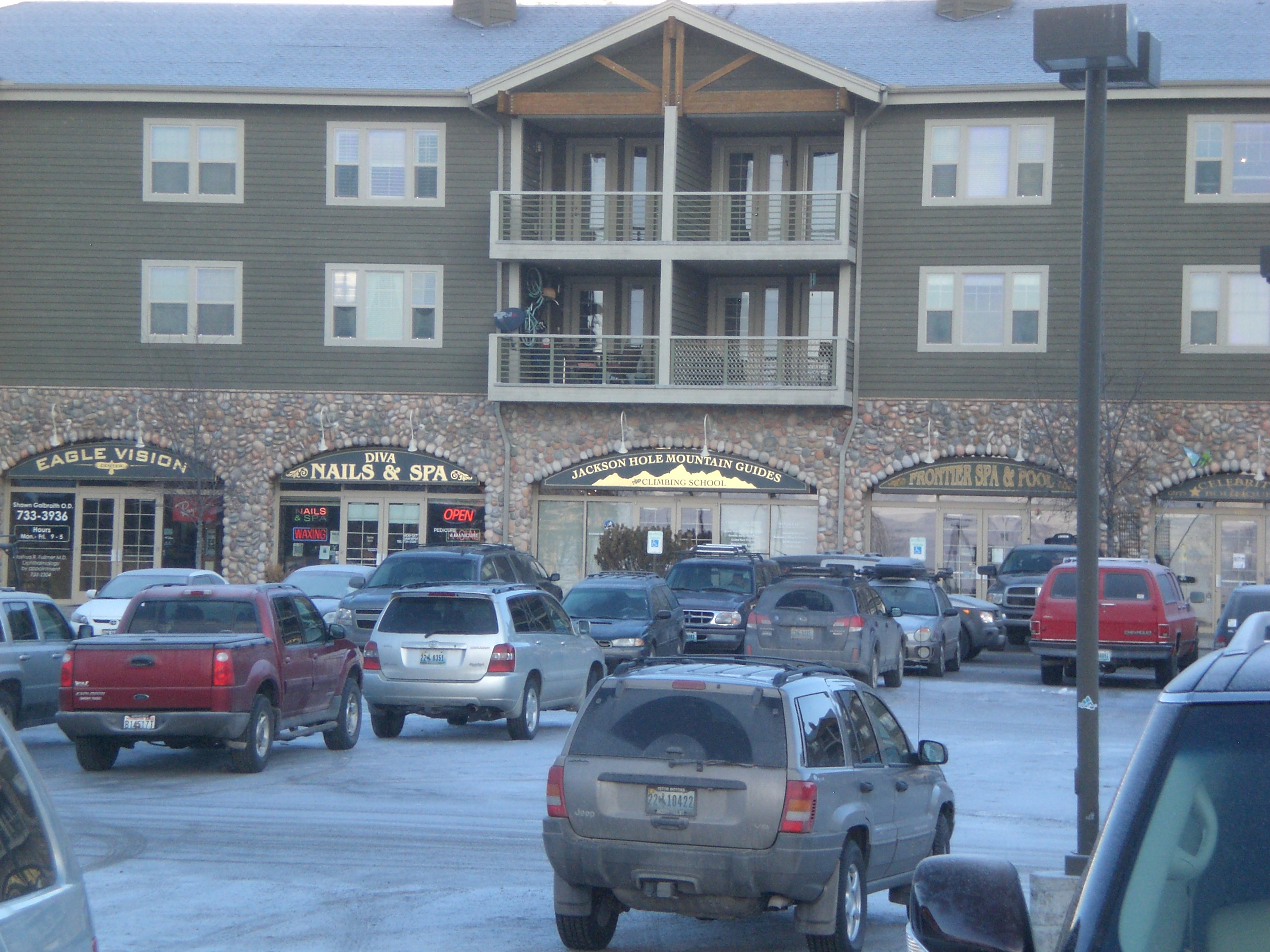
Guide service storefront.

Guide service storefront.

This diet is supposed represent our nutritional heritage. It encompasses the type and mix of foodstuffs our hunter-gatherer ancestors adapted to eat. Therefore, runs the logic of the diet’s proponents, it is the mix of foods that we ought to eat to  maximize our health and longevity. On the menu is lots of meat and a few plants. Grains and legumes are out. We should eat more like cats than cows, the speaker admonished. To back up his assertion, he flashed a slide on the screen with a picture of a cat at the top and a chart favorably comparing the body compositions of hunter-gatherers with those of cats.

The picture looked a little like my cat, but my cat thrives on dry cat food. I say “thrives”, because I have a dietary comparison-state for her. She was a stray who showed up in our garage when the weather got cold. Before coming to live in our house, she had, in fact, been subsisting on the cat version of the Paleo Diet – fresh, free-range mouse and bird meat. She wasn’t doing so well. She was thin and listless. After a few weeks living inside and dining on kibbles, however, she was tearing around the house like a maniac, destroying rolls of toilet paper and climbing the curtains.

Here are the first four ingredients listed on her cat food label: chicken by-product meal, corn grits, chicken fat, tuna, brewer’s rice. One would expect a wild cat to catch birds, but I doubt one ever took down a tuna, much less an ear of corn or rice. Still, a cat’s ability to live a long and active life eating nothing but rock-hard brown morsels shouldn’t surprise us. Evolution makes the most  of things, not necessarily the best of things. Wild cats developed the capacity to survive on mice and birds. Cats are therefore well suited to that diet. That doesn’t mean that there isn’t a diet better suited to cats. Perhaps humans are much the same.

A subsequent  slide showed a Kung! tribesman butchering an antelope with a stone tool, and then a chart with cholesterol levels and heart disease rates demonstrating the sterling health of various modern hunter-gatherers. Unfortunately, the health data for the Tarahumara, a group of indigenous people living in Mexico and renowned for their feats of long-distance running, look just as good. The Tarahumara subsist primarily on corn, beans, chiles, and beer.The answer to this dietary conundrum is not found in the diet, but what comes with the diet. Both the Kung! and the Tarahumara are incredibly active, and they do not suffer from surplus. The Paleo diet is not the answer to our health problems. No such simple answer exists.

Of course, there are limits imposed by natural adaptation and on artificial adaptation. Artificial answers are also incomplete. To be a good alpinist, one must climb a certain number of big routes in the mountains. But plate after plate of summits will limit a climber’s potential in the end. Though it isn’t complete in itself, some artifice is required as well. Likewise, when my cat came to live in the house, she didn’t just get dry food, she got a warm, stress-free place to sleep, immunizations, and anti-parasitic medicine. I’m sure she would not be so healthy if we limited our involvement with her to setting out a plate of kibbles on the driveway.

Of the billions of humans alive now, most are suffering from the short-comings of an agricultural, and subsequently an industrial, society and a few are suffering from its excesses. As the most realize the economic, social and technological benefits which drove the move to agriculture in the first place, they no longer get the grace period which the few enjoyed. The harms of excess come right along with the initial development. We can’t simply go back, though. Solutions will require some artifice, and may have an unsatisfying appearance – less like grass-fed beef  and more like a bowl of dry cat food or an indoor climbing gym in the Tetons.

Tagged , , , , ,

You Eyeballin’ Me?

ATTENTION

ATTENTION

An older gentleman lay on the gurney. His son had brought him in from the ranch suffering from abdominal pain. I pushed on his liver.

“Does that hurt?”, I asked.

“Well,” he replied after a moment’s reflection, “it ain’t sore, but it is a little tender.”

Attention

Attention

Tender, not sore. Twelve years and I still don’t know what the hell that means. A former colleague grew up in Wyoming, and since she habitually spoke more than three words in a day (not including ‘Yep’ and Nope’) I asked her a couple of times to explain it to me. She just looked annoyed and said it didn’t matter. I finally understood that she was right. The difference between sore and tender is clinically irrelevant.

attention

attention

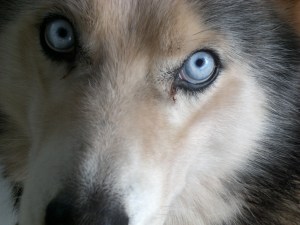
‘Tender’ does not have any distinct denotative value, only a connotative one. It still bothers me not to understand its meaning. I’d like to think language can give me a working knowledge of other people’s thoughts and feelings. My expectation of understanding is not realistic. Symbols and their associated concepts just approximate the sets of unique experiences that constitute our shared mental universe. It’s all a big analogy of me to you, words or no. While imprecise, the analogy has one great advantage: it is durable. I may not be able to compare my experience of tenderness to the rancher’s to any good effect, but I can achieve a dialog with the dogs.

Attn.

Attn.

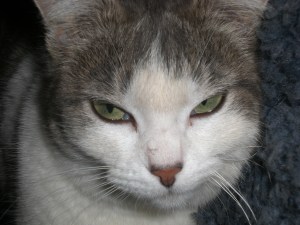
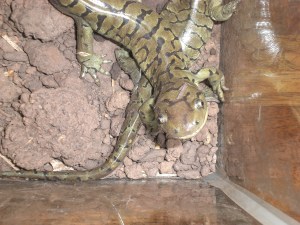
I can even predict the salamander’s response to me looking at it and it can anticipate my response to it clawing at the glass. All of us know our perceptions of each other are about something, which allows us to form these relationships, however vague and riddled with projection they may be (though the salamander does not beg food from people who are not looking at it or objects moving outside the glass, it does respond to the cat staring at it and she is surely looking in with a different intent than it understands).

Attention

Attention

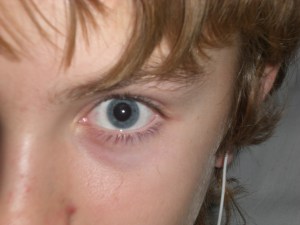
I’m pretty sure I share an extensive mutual understanding with the mammals in the house, even the ones with ear-buds. I’m less confident about what passes between myself and the slimy monsters in the terrarium, but after a day of contemplating human tenderness with all its consequences and deficiencies, an amphibian’s intentional stare is the most reassuring.

Tagged ,

Beetle Battle

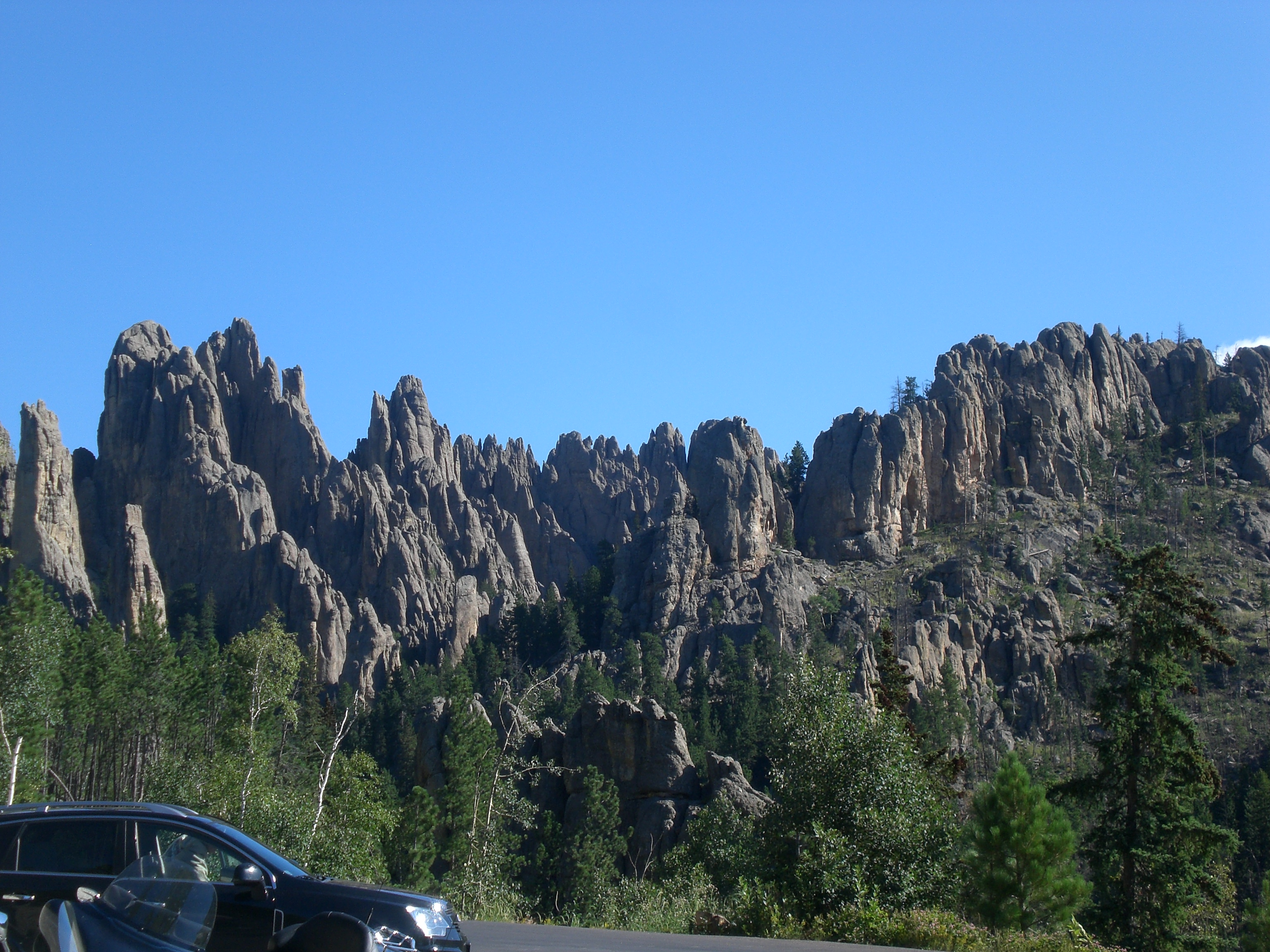
The Cathedral Spires after the beetles

The mountain pine beetle is a native son of the Black Hills, but nobody around here is very proud of the little guy. I like him. He’s tiny and a weak flyer. A victim of his own reproductive tactics, he’s a bit like the Lemming – doomed to population booms and busts that make him look stupid. Nevertheless, this little insect has thwarted the will of the baddest mammal on the planet.

For the most part, the life cycle of the pine beetle is typical, boring high school biology. It’s one of those egg-larvae-adult-egg affairs that fits well in a circle of arrows on the textbook’s margin. In late summer, adult beetles emerge from trees infested the year before and fly to new trees, where they burrow into the bark and lay eggs. The eggs hatch quickly into grub-like larvae which begin to eat the tender, inner layers of the bark. After a Winter’s break, the larvae finish their meal, metamorphose into adults and the cycle begins again.Within this staid tale, there are a few interesting details that, under the right conditions, conspire to make the smoldering, little endemic population of beetles into a conflagration.

First, there’s that Winter dormancy. To prepare for the cold, the larvae produce antifreeze. If cold weather strikes before they are ready, many will die. If they are ready, though, they can survive temperatures down to thirty below zero, Fahrenheit. Besides allowing more larvae to survive, adequate preparation means the larvae are further along in their development when they wake up in the Spring. Sometimes, they are far enough along to complete two generations in one year.

Second, the trees don’t just stand there and take it. They have an immune response to the beetles. As the insects dig into the inner bark, the injury prompts the tree to force resin upwards.  Sap spills out of the defect in the bark, smothering the beetles. If the beetles are few enough, and the tree is strong enough, the immune system can prevail. In turn, the beetles have adapted to overcome the trees’ defenses. They produce a pheromone which calls other beetles to a tree under attack, giving them the opportunity to exhaust the tree’s immunity with sheer numbers.

Blue stain fungus

The beetles have also developed a symbiotic relationship with a fungus that weakens the trees. The ‘blue stain’ fungus thrives in the core wood of pine trees, where it interferes with water transport to the crown. Beetles carry fungal spores on their bodies as they breach the outer layers of bark which normally bar the fungus entry.

Under usual conditions, things work out so a few trees die and a few beetles survive. However, if the weather is right and the trees are already weak, a positive feedback loop ensues and the beetle population explodes. Usually these excursions amount to little bursts, limited by the availability of suitable trees.  But presently, due to a lucky convergence of human and beetle preferences, there is no limit to the availability of suitable trees.

The forest that we have cultivated is made of trees which are just the species and size that the beetles prefer. Plus, we’ve made a dense forest, so even the mountain pine beetles’ weak flying skills carry them easily from trunk to trunk. Our relationship with the pine forest has unwittingly, coincidentally helped turn the little pops in beetle numbers into a boom. Modern human activity on the land, from fire suppression to agriculture to habitation, has attenuated a kind of herd immunity inherent in the age, size and density of the trees.

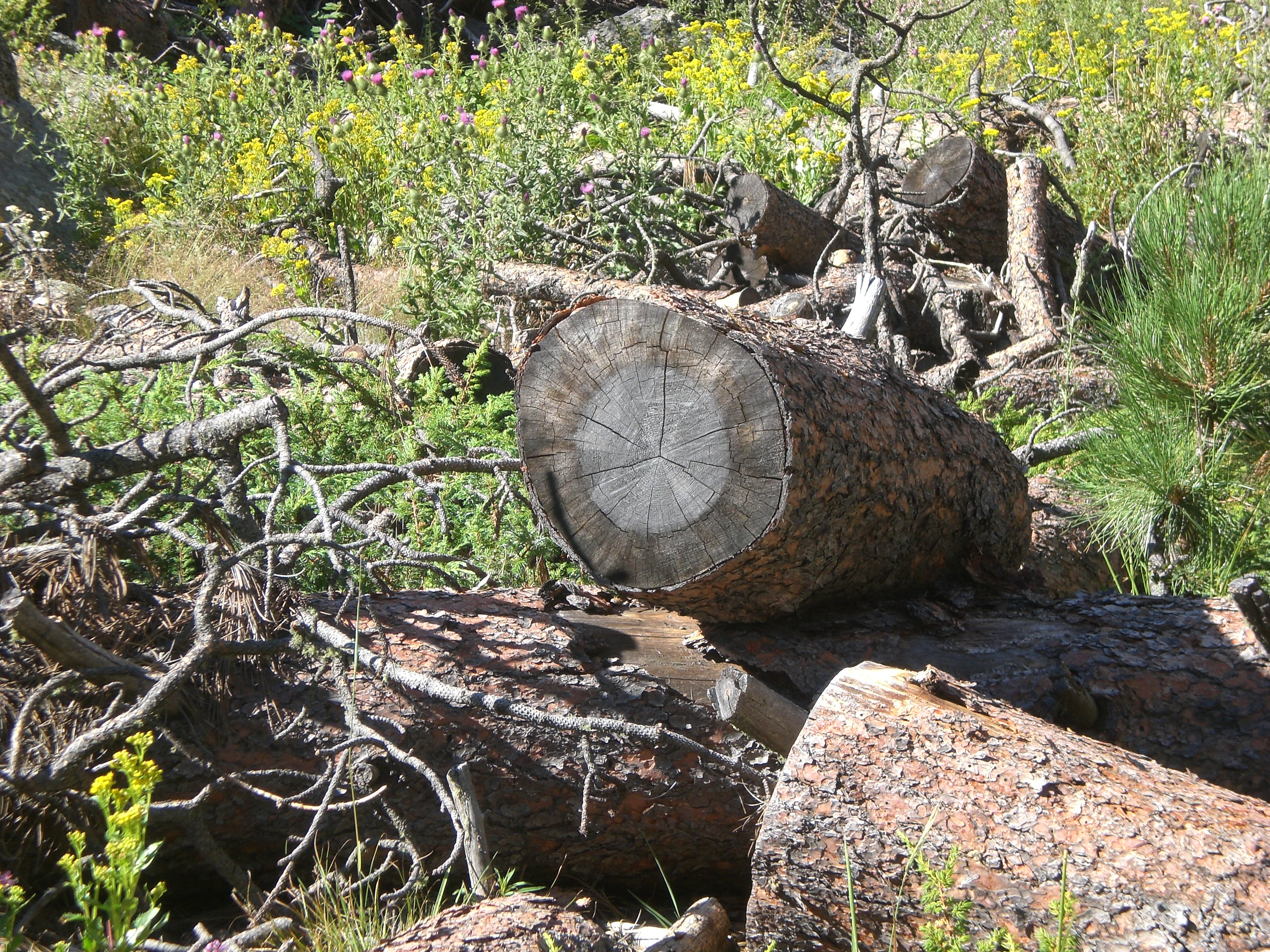
Cuttin’ & Chunkin’

Now, we are trying to stand in for that herd immunity. We want our forest back the way it was. It gave us logs, shelter and aesthetic satisfaction. So, we try to cut infected trees before the beetles can emerge. We try to trick the beetles with pheromones (the insects actually release a repellant pheromone when their host tree harbors too many beetles). We even spray neurotoxins on the trees in ‘high value’ areas, like Mt. Rushmore.

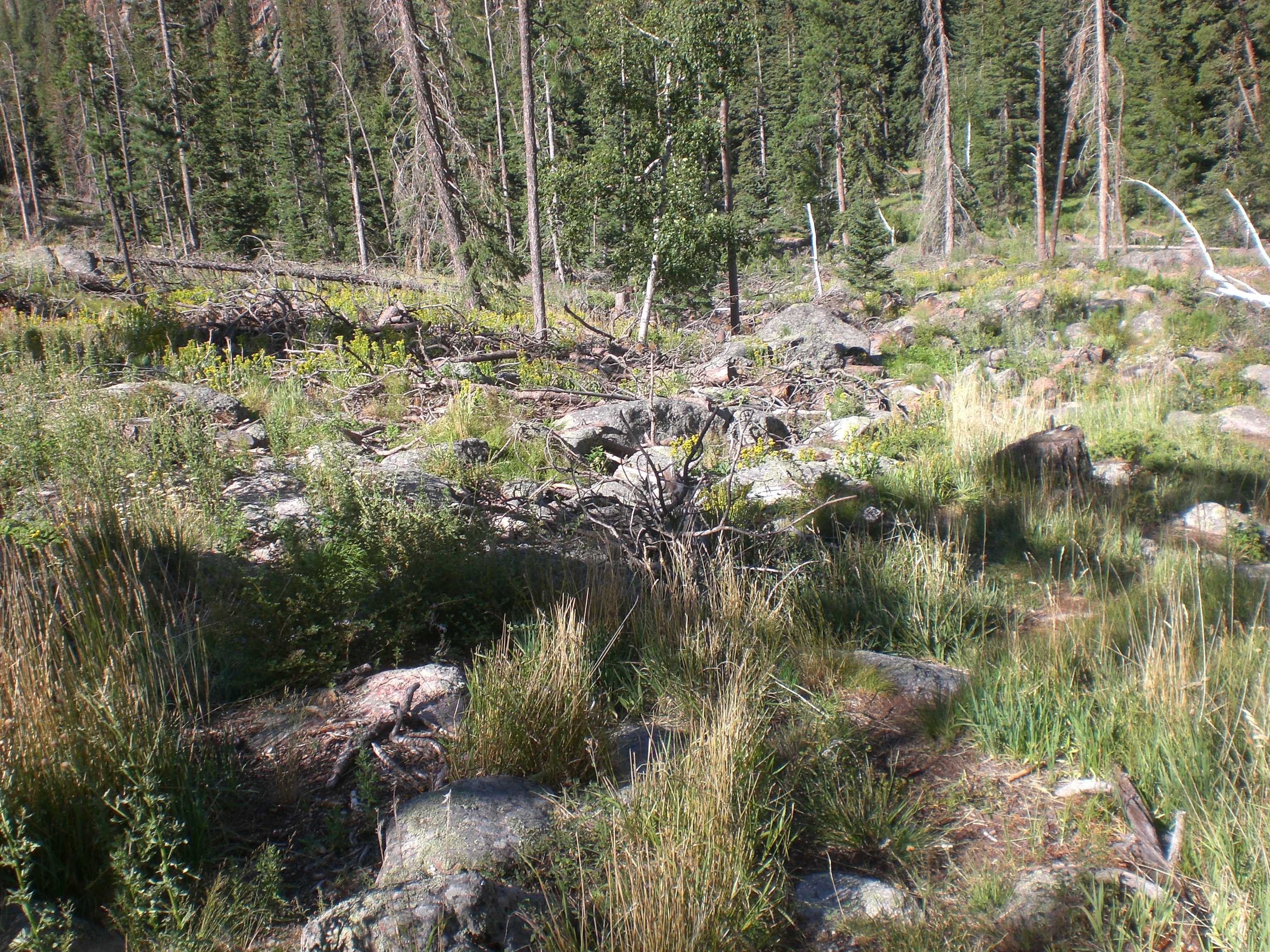
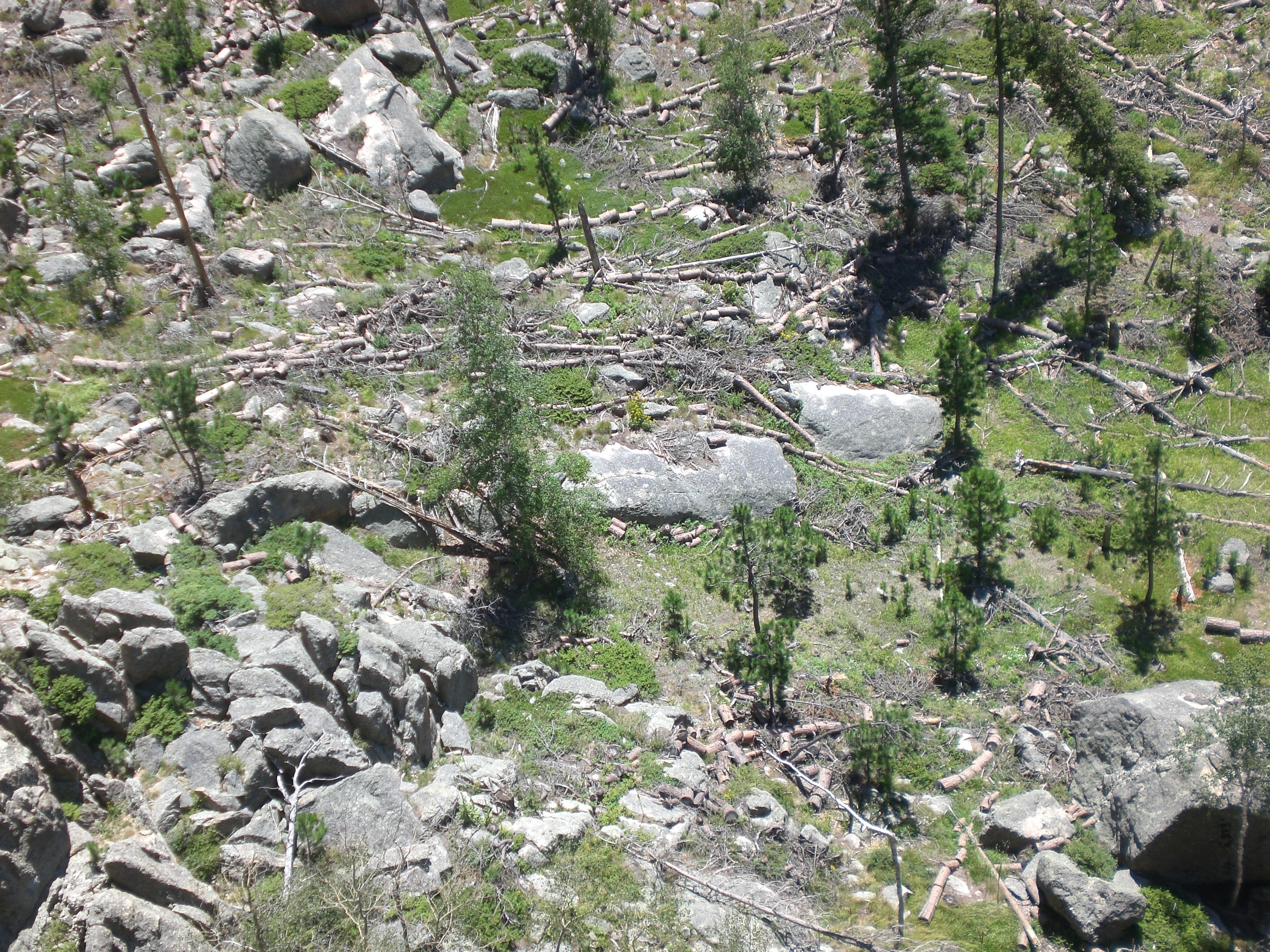
Beetle-thinned forest

Close up, our efforts look pretty smart, like a beetle attack on an individual tree looks smart, with its chemical communications, antifreeze equipped larvae, and fungal force multiplier. But just as the beetles are already doomed to population collapse by the time they start to thrive, we have already ensured that we won’t have the forest back the way we like it, simply because we liked it that way so much in the first place.

It will work out in the end. Preservation is a fool’s errand anyway. We pursue it for sentimentality’s sake, and because it makes us feel like we may be able to avoid our own eventual extinction. When the beetle epidemic is over, we will learn to like the new forest and maybe we will recognize the beetle battle as a farce. For at a proper distance, our interaction with the habitat is indistinguishable from that of the beetles. Like them, and the Lemmings, we’re condemned to a lifestyle that allows us to survive in spite of a built-in vulnerability to chaos.

Tagged , ,

Blip!

I swore I wouldn’t get into this anymore. The intelligent design crowd keeps pushing this crap, though, and I have kids who are at risk. Beyond that, I suppose intelligent design’s sort of dishonesty just galls me. Don’t say I didn’t warn you.

I am about to give an argument by analogy. I do so with trepidation, because analogies are always in danger of going off in the wrong direction and have no deductive validity in the first place. However, I think this form is the only fair tool for the subject since I’m going to use this argument by analogy to critique another argument by analogy: intelligent design (ID). Rather, I’m going to critique the positive arm of the intelligent design argument. This is the withered limb compared to the evolution-bashing arm, but it is necessary to the whole and the negative argument is a morass. Since scientific knowledge is never complete, critics have available to them an endless list of objections. The positive side of the ID case is more a philosophical than a scientific argument, so it can be settled on that level.

The positive ID argument is as follows: when humans start with a purpose (a problem to solve) and devise a tool to serve that purpose, the end product looks a certain way. Biological structures have a similar appearance, so biological systems must result from the same sort of process. An immediate problem arises at this point. Since proponents wish the analogy between man-made objects and biological structures to be precise the argument commits the fallacy of the undistributed middle (Designed structures look like X, Biological structures look like X, therefore Biological structures are Designed structures).

The proponents of ID subsequently introduce a number of modifiers to try to alleviate this situation. Complex specified information is not only used to portray designed and biological structures as essentially similar, it is also used to try to pare down the middle by saying it is statistically negligible. Appeals to abductive reasoning serve the same purpose, suggesting that design is so far and away the “best guess” that there’s no need to worry about the logic. There are deeper problems than the modifiers and the middle but those are the simplest things to consider, so let’s go there first. Let me tell you how I built my son a mountain bike.

The bike came in a big box in a bunch of pieces with a couple dozen pages of instructions. The instructions were complex and very specific. In fact, if you read the instructions through, you would know that a mountain bike and nothing but a mountain bike would result from following those instructions, even without actually building a bike to find out. But, I didn’t read the instructions. I know how bike parts work, so I just eyeballed the problem and figured it out. So, even though the Complex Specified Information (CSI) in the instructions has all the qualities that the advocates of biological CSI wish it to have, it doesn’t have the necessary relationship to the endpoint that those advocates want from it. There are multiple paths through the middle to the mountain bike. There is still a way out for ID, though. I must have picked up on the CSI contained in the parts themselves. It’s true. When I looked at the parts, they fit together in certain configurations and orders of assembly best, as I expected. My expectations were key, too. Over the years, bike designers had shaped those expectations, in effect teaching me to read the information they put in the parts so I could use my abductive reasoning to make a really good guess about how the parts should go together.

I use this “best guess” faculty all the time, because it is a great shortcut and pretty reliable in familiar circumstance. Notice I said ‘pretty reliable’. Also note that I said I didn’t use the instructions, but I didn’t say I threw them away. Sometimes the bike makers come up with an innovation and then my abductive reasoning is worthless and I have to rely on the instructions again to tell me what to do about the new part. I get in trouble if I try to rely on that ‘best guess’ shortcut in clinical medicine, too. The causal history of a manufactured bike is well-defined because people decided to make it that way. If the causal history of a patient’s symptoms is well-defined for me, it’s because I have decided so. Used outside of a situation with known prior constraints on the variables, the ‘good guess’ becomes confirmation bias. So, the problem is with the complex specified information. In biological structures, to achieve ‘specification’ and thus make the ‘best guess’ inference to design, the causal history has to be constrained after the fact. Anything less leaves open those pesky intermediate paths through the middle. ID imposes that constraint by assigning purpose to all biological structures it considers. Assigning purpose is easy for us humans and we like to do it because it lets us use shortcuts like guessing. Attributions of purpose (intent) are so appealing that we have trouble keeping them in the realm of human behavior where they belong (and not even there without some confirmatory process to check the attributions). Who hasn’t said their car “worked hard” to get up a steep hill? It’s just as easy to say that E. coli intends to swim to new food sources with its flagellum. In fact, it takes just that sort of presumption of intent to wrangle an object’s causal history into CSI, resulting in a bit of a Cartesian circle (if the flagellum is made for swimming, then it has a complex history treading a narrow path to that endpoint, which shows that the flagellum was made for swimming). Still, we should be able to safely use this attribution of intent after the fact in limited circumstances, as long as we’re careful, right? For instance, it is surely accurate to say that the guys who designed my son’s bike did so from an original purpose. However, even that presumption of intent from the endpoint is not accurate, and the problem with the retrospective attribution of purpose/intent in such a case leads us back to the problem with intelligent design that predates any attempt to distribute or minimize the middle.

What do we know about design? We really just know what we do and what we do requires an agent (us), a purpose, and means. The problem is that the relationship between those three factors is not linear, nor is it even hierarchical. When considering bike design, for instance, we could go back to the origin of the means via the agent and examine the influence the means then had on the agent’s intent and subsequent development of further means. We could track back to the origin of the wheel in geometry, which is in turn based on observed properties of materials, which are in turn based on some basic laws of physics, all of which humans bothered to investigate and remember in the first place because, if you are a tool-maker, it’s easier to investigate and remember than to, um, ‘reinvent the wheel’. We could trace bicycle history back to the wheel and beyond, but let’s keep it brief and just consider the design of mountain bikes.

Mountain biking started when some California bike racers moved to the country. Their new environment confronted them with the problem of riding, and of course racing, on gravel roads. Their road bikes’ narrow tires were too unstable for that purpose, so they found some preexisting cruiser bikes with wide tires that would at least be ridable on the fire roads near their homes. The cruiser bikes were not perfect. They were heavy and hard to pedal, so the riders raced them downhill. Even that compromise lead to problems though. The brakes and bearings on the cruisers couldn’t survive that kind of abuse. The riders replaced the brakes and bearings with motorcycle and road bike components. The riders soon found that the revised cruisers, now possessing cassettes of gears with the road bike bearings, were capable of riding on rough trails as well as fire roads. Trail riding prompted further modifications to the bikes. These guys in rural California invented the mountain bike, but not all at once and not out of the blue. They worked through a progressive series of problems, each leading to the next, until they arrived at a relatively stable final design that did something very different from the structure they started with. The mountain bike evolved. Of course, this is microevolution; the mountain bike is just a tweaked cruiser bike. Neither the mountain bike nor the cruiser looks anything like an old penny-farthing with the giant wheel in front. The lineage is clear though, and bike development has proceeded by the same basic process from the wheel to the velocipede to the mountain bike. Moreover, the agents in this process acted as selective forces and were acted upon by selective forces – and not just physically. As designers altered the bikes, the bikes’ new capabilities altered their conception of where and why they might ride a bike and thus their purpose in the next set of modifications.

To fingerprint design as the ID scheme misrepresents it, we really must close that Cartesian Circle by presuming intent for any and all endpoints we wish to examine. Then the history of that point is seen separated from any branches or external contingencies. If the mountain bike comes from a mountain bike factory, surely the mountain bike factory holds the entire explanation for its structure. When defined after the fact like this, the history of a structure looks irreducibly complex; if you take away one part it is rendered meaningless because it is its own context. ID’s analogy between designed structures and biological structures not only fails to distribute the middle, it doesn’t even accurately depict design processes as we undertake them. People, the source of everything we know about design, don’t start cold from an undetermined purpose and design toward that purpose in an implacable, irreducibly complex chain of events. Replication may work a bit like that, but not design.

What this method really does is provide for a hierarchical relationship between presumed intent and biological structures, where the intent causes the structure. Such a relationship seems to allow for a supernatural cause. This is why ID’s advocates have gone through such contortions to make it work (or at least look like it might). Yet the intelligent design model fails even as a portal for the supernatural. It offers no solution to the interaction problem in dualism. This is a real problem because, as far as I can tell, one tenant of ID is that the design process in nature is ongoing. To drag a spiritual being into the material world and have it start doing things, one has to explain how it does so without being in some way beholden to the same laws, and thus part of the same causal history, as the rest of matter. If there is no good explanation, then the spiritual being from another realm is just a bizarre, unexpected new part of nature. Though this may seem an obscure technicality at first glance, here is an example of just how sticky the problem really is.

Descartes tried to defend the independence of the mind from brain processes. He offered the analogy of a virtuoso violinist asked to play on a broken instrument. The listener would have no clue as to his true skill. Likewise the damaged, diseased, or intoxicated brain may just be a broken instrument unable to give voice to the intact mind which plays upon it. Unfortunately, this analogy raises the question: May the virtuoso be a virtuoso without a violin? Study of music theory or any other purely mental operation is insufficient. He must play a physical violin. Yet the skill he gains is a mental faculty which is subject to his creativity, religious concepts, and emotion. The brain and its adjuncts affect the mind. There is no escape from this problem in a world of two supposedly separate substances in active contact. Deism or a strict idealism offer the only outs (and Deism may just push the problem back in time). Either of these scenarios keeps the supernatural supernatural, but thereby makes it irrelevant to any practical understanding of nature/matter. This is why it is best for religion that science adhere to methodological naturalism. This is why intelligent design is insidious as well as invalid, for all concerned. It robs religion of any hope of philosophical integrity, just as it misrepresents biology. Reason enough for everyone to drop this bullshit for good.

Tagged , , , ,