Tag Archives: religion

Cutting Up an Ox

IMG_1312

Ben Sasse fears for our youth.

He is a U.S. Senator, and therefore he is a very busy man with little time to spare for side projects. Yet, so great is his concern for our kids’ predicament that he has taken the time to write a book about it. It is not a bad book, even if you disagree with what it says. You will have to trust me (or not) on the exact contents, because, “You may not make this e-book public in any way”, is all I will quote directly from it.

His thesis is laid out in the book’s title, The Vanishing American Adult, and he has summarized the gist of his prescription in the subtitle, Our Coming-of-Age Crisis – and How to Rebuild a Culture of Self-Reliance.

In the text, he depicts a generation afflicted by aimlessness. They have been stunted by coming up in the shade of social media and cultural relativism. Deprived of the harsh choices and bright lessons that come with social responsibilities and traditional rites of passage, kids have grown passive. They lack the ‘grit’ to sustain our society.

I won’t quibble with his depiction. Social media is a blight. The current generation operates on the assumption that ‘someone will take care of it’. Giving up is always an option for them.

I do disagree with his diagnosis and prescription, however. He seems to think that helplessness and hollowness result from a deficiency of citizenship. The correction would then involve a big shot of citizenship. He is completely mistaken. In fact, emptiness is the natural outcome of citizenship, and helplessness is just a reactive symptom.

On the most basic level, citizenship is a position in which one gets told that one’s life is fungible. One’s time, attention, motivation, and psyche can be chopped up and traded for goods to satisfy certain needs. Of course, Sasse recognizes this situation. He mentions “development of the individual” on a couple of occasions as a worthy pursuit, but only if it is pursued to certain ends (becoming responsible, self-sacrificing, ‘gritty’ – in other words, all those things that make a solid citizen). As far as I can tell, only the ends distinguish healthy developmental activities from selfishness, in Sasse’s estimation. And in a shocking coincidence, healthy ends are those for which the goods of citizenship come in handy.

“Why won’t my blood sugar go down?”

Maybe my analysis is unfair. Sasse contends that we are all a little defective, and our institutions may be a little defective, too. We should not expect a perfect synergy between man and social machine, even though the basic program is sound and actually the best that we can do.

But I hear differently all the time.

“I’m doing all those things that the diabetic educator told me to. I have changed my diet. I am walking every day. I am taking my medications like clockwork. So why is my blood sugar still high?”

This person is in my office every day, wearing a different, outfit, a different ethnicity, or a different gender. Yet they are the same person. They have a sit-down job, or two, in which they spend 40-60 hours per week dealing with an incestuous dataset – something so about itself, whether it is driving a cab or processing claims, that it demands attention to automatisms rather than any  particular skill. To ensure that their attention does not waver, an overseer tracks their activities and rates their efficiency. Their extraneous physiological and psychological functions are regulated by the employer as distractions.

The citizen in my office sleeps 6 hours per night, or less. They drink energy drinks to keep going, and eat foods which the package or the vendor says are healthy, because they haven’t the time or energy to prepare their own food. They are too exhausted to exercise properly.

As a result, they are obese, diabetic and hypertensive. As a result, they now require one of the goods for which they can sub-divide themselves: medical care.

Which brings us to where the defense of citizenship as a natural-born fertilizer for human development, breaks down. The trouble with the whole thing is not the palate of goods on offer, their costs, or the means of valuation. The trouble is the chopping, because the roots of experience (attention, motivation, responsiveness, etc.) can’t be cut up for a purpose, especially for delayed gratification of a specific need. The very notion mistakes the nature of needs and the relationship between our needs and our activities. Here, Sasse may have been better served by spending a little more time reading Nietzsche, and a little less time reading Rousseau and the Bible.

For an organism’s needs can’t really be parsed. The motivations underlying our activities are merely aspects of a single motive which Nietzsche labeled ‘will to power’. Even when we try to perform an isolated act of attention, we feel something about it, our neuro-hormonal system responds to it, and it tires us globally.

But Sasse seems to think there’s a neat way around the problem of dividing the indivisible.

Life on the Farm or 8 Pitches Up?

In the latter half of the book, Sasse talks about how he sent his daughter to work on a ranch. The idea was to teach her how to enjoy work – not any particular task, but work itself. Basically, he sought to teach her how to thrive as an instrument. It’s pretty clever, really.

He explains the strategy in a vignette:

Martin Luther met a man who had just become a Christian and wanted to know how best to serve the Lord. He asked Luther, “How can I be a good servant? What should I do?” He expected Luther to tell him that he should quit his job and become a minister, monk, or missionary.

Luther replied with a question, “What do you do now?

“I’m  cobbler. I make shoes”, the man answered.

“Then make great shoes”, Luther replied, “and sell them at a fair price – to the glory of God.”

In other words, find integrity in being a good instrument. I think the flaw in this reasoning is obvious: Why not make great shoes to the glory of Satan? It’s the devotion part that really matters, right? This notion of the human lost at heart and essentially in search of a set of rails (any rails) undergirds fascism through the ages, and it works superficially, so long as the social venue is stable.

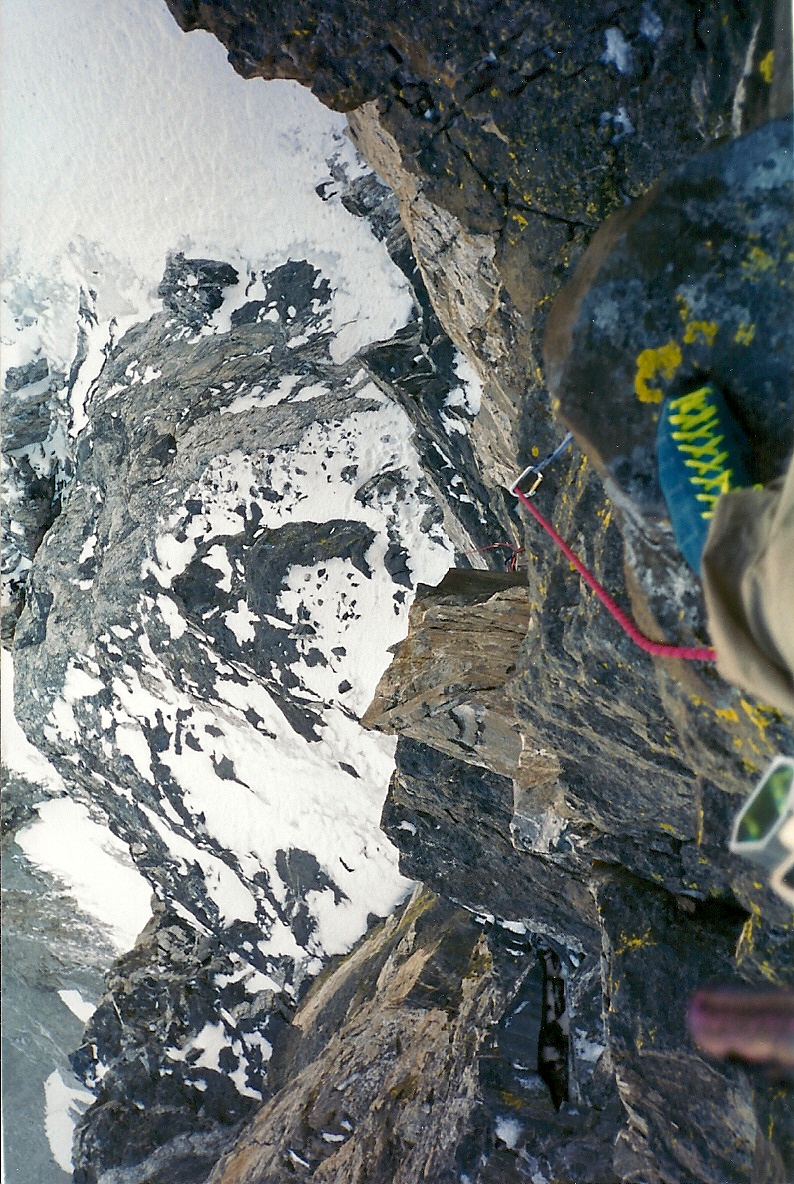
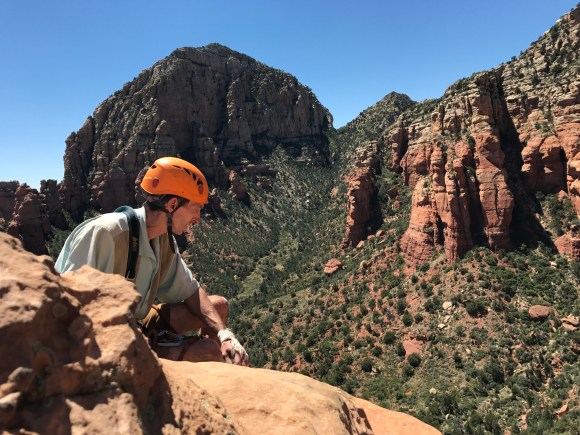
But I took another path with my kids, because I learned more from sitting on a ledge, than I ever did from a job.

We have climbed several long routes together. We have looked up, down, and out from ledges in the middle of those routes and soaked in the lessons: however precarious the position, what falls to us is to pass the water around, check the system, and find our way through the next rope-length of terrain; trust your partners as you trust yourself; no matter how cold, hot, tired or thirsty you are, the beauty of the sky and landscape remain; achievement, i.e. ‘ticking the route’, doesn’t really matter – it is only a means to get you to the ledge.

In taking them on those climbs, my hope was to offer them a way of life which put making a living in perspective, rather than telling them that making a living would put everything in perspective for them.

A different vignette illustrates my point:

     Cook Ding was cutting up an ox for Lord Wenhui. At every touch of his hand, every heave of his shoulder, every move of his feet, every thrust of his knee — zip, zoop! He slithered the knife along with a zing, and all was in perfect rhythm, as though he were performing the Dance of the Mulberry Grove or keeping time to the Jingshou Music.
“Ah, this is marvelous!” said Lord Wenhui. “Imagine skill reaching such heights!”
Cook Ding laid down his knife and replied, “What I care about is the Way [“Dao”], which goes beyond skill. When I first began cutting up oxen, all I could see was the ox itself. After three years I no longer saw the whole ox. And now, now I go at it by spirit and don’t look with my eyes. Perception and understanding have come to a stop and spirit moves where it wants. I go along with the natural makeup, strike in the big hollows, guide the knife through the big openings, and follow things as they are. So I never touch the smallest ligament or tendon, much less a main joint.”
“A good cook changes his knife once a year — because he cuts. A mediocre cook changes his knife once a month — because he hacks. I’ve had this knife of mine for nineteen years and I’ve cut up thousands of oxen with it, and yet the blade is as good as though it had just come from the grindstone. There are spaces between the joints, and the blade of the knife has really no thickness. If you insert what has no thickness into such spaces, then there’s plenty of room — more than enough for the blade to play about it. That’s why after nineteen years the blade of my knife is still as good as when it first came from the grindstone.”
“However, whenever I come to a complicated place, I size up the difficulties, tell myself to watch out and be careful, keep my eyes on what I’m doing, work very slowly, and move the knife with the greatest subtlety, until — flop! the whole thing comes apart like a clod of earth crumbling to the ground. I stand there holding the knife and look all around me, completely satisfied and reluctant to move on, and then I wipe off the knife and put it away.”
“Excellent!” said Lord Wenhui. “I have heard the words of Cook Ding and learned how to nurture life!”
— Zhuangzi, chapter 3 (Watson translation)

I do not see the current generation as sissified hedonists, any more than previous generations. The hypersensitivity, the passivity, the absorption (self and otherwise) all look like symptoms of a bunker mentality. They see what’s in store for them and they don’t like it, but they don’t seem to know how to resist.

A Sasse-type message has gotten through. The citizenry coming of age does think that it must learn to embrace a social role (little worker, little voter, little contributor) wholeheartedly in order to fully mature, and it just can’t bring itself to do so. The instinct is right. Kids growing up in this era are being asked to pursue a sort of faux-maturity which involves merely “giving up childish things”, and the achievement of that state will leave them empty and utterly dependent on a structure which deals with them on the basis of a flawed methodology.

They need a little less Ben Sasse, and a little more Cook Ding, when it comes to advice about how to grow up. Because maturity means dealing with your situation – not just endorsing it – and dealing with it artfully. It means getting over being The Cobbler, The Christian, The Cobbler-Christian, or even The Cook.

In Sasse’s terms, I have laid out the Romantic counter-argument to his Realist argument regarding the nature of the individual’s relationship to civilization. But I reject that characterization to some extent. There isn’t an inherent conflict between the individual and the civilization. We are stuck with our civilization. It lies before us like the carcass of a great ox, and it is just as indifferent.

We get chopped up in our interaction with it, but our own hand is on the knife. And I agree with Ben Sasse here,  maturity is the solution. Not the faux maturity which the senator espouses, which is just a form of selling out, but actual maturity which sets limits and carves its own way, not towards some magical future, but like the cook’s knife, in the present where we all reside.
IMG_3666

Tagged , , , , , , , , , , , , , , ,

This again?

“Life! Don’t talk to me about life!”

Marvin the robot

My day began with a woman on the radio proclaiming a great victory for life. For the first time in a long time, a world in which no unborn child got murdered looked to her like a real possibility. Her statement contained a pile of red hot words, resting on one simple word: life. Let us be as clear as possible about the definition of life, because those who have adopted the label “pro-life” will not be. When they talk about life, they don’t mean to talk about biochemistry, they mean to talk about the soul. They mean to talk about all those little souls, bearing some indefinite relationship to little bundles of cells. Via that bond, the soul somehow sanctifies an embryo, while remaining completely uninvolved with biochemistry. What follows are the familiar discontents of substance dualism.

Like most of the pro-life crowd, the woman on the radio barged past the interaction problem and its implications with loud assertions. I got the sense that she may not have fully appreciated those implications herself, and so the rhetorical bum rush may have been a means of self defense as much as it was an offensive tactic.

Poor insight is no excuse though. She deserves the heap of scorn coming her way. Yet she doesn’t bear sole responsibility for her inconsistency. She no doubt labors under the influence of a defective definition of biology. In school, she probably learned a series of rhetorical tautologies (life is organism, organism is metabolism plus reproduction) in her biology classes which amounted to saying, “life is what biologists study”. Nor is biology unique in that regard. All of the sciences have backfilled their metaphysics.

Yet, the associated metaphysics is what really interests us. Though it is fantastic to know about the microscopic structure of the wood in the ship of Theseus, what we really want to know is not the composition of the planks, but the defining relationships of those boards in context. The planks are the ship of Theseus because they floated around the Aegean trod upon by Greek heroes, not simply because the boards consist of a cellulose polymer capable of floating around the Aegean while being trod upon by Greek heroes.

Life is not the Krebs cycle or the DNA in a blastocyst’s nucleus, and it is certainly not some vital substance wafting about, indefinable in principle, and opaque in its activity. Life is what sustains defining change across circumstances. In other words, it is the fulcrum of a dynamic equilibrium. Consider a bacterium in a nutrient broth. Energy from the broth translates into new molecules like the molecules which came before in the cell wall, ring chromosome, and cytoplasm of the bacterium. Having built up enough substrate, bacterium divides, relaying its balance point on through time and space. Then someone drops an antibiotic into the broth. Energy from the broth stops flowing into new substrate and shifts to the activation of efflux pumps. That’s life.

If the organism is overcome, it becomes adrift in its circumstances. Once its equilibrium gets tipped too far, it cannot make its way through the broth or the antibiotic exposure with its causal explanations intact.It’s molecules react with surrounding molecules based on ambient energy states. It cedes all its explanations to whatever is floating around with it in the broth. It is dead.

Beyond this stark boundary between life and death, lies an expansive liveliness. There is life that sails almost where it will (humans), life within life (Portuguese man of war, bees, lichen), and life explicable only in context (prions, chlamydia, embryos).

Embryos live strictly within the lives of their mothers. Embryo explanations require mothers. Embryo explanations do not require souls. Until someone comes up with an effective description of the soul and its relationship to a little ball of cells latched onto the endometrium, the soul remains an inert addition – an epiphenomenon at best. This is a problem which the pro-life fools can’t shout down or blow past. Because the problem with epiphenomena is that there is nothing really tying them down. They don’t do anything, so they can fill in wherever. The unknowable nature of the zygotic soul can justify whatever, from bombs to prayers. It’s a wonder that something so flimsy could ground a social movement of such size. The truth is though, it doesn’t.

The target of the pro-life movement has always been the women, as one might guess given the nature of trans placental relationship.

The vacuous nature of pro-life rhetoric needs exposure, so that we can get to the real purpose of that rhetoric, which is control. People in the pro-life movement are not really interested in the biology of human development, or even bioethics. Instead, they are interested in other people’s stories. Because their own narratives, jumbled as they are with souls, sins, and angels, are so weak, the pro-lifers see divergent narratives as invalidating. Accordingly, they try to curtail divergent narratives wherever they can.

That is the motivation behind the pro-life movement. I doubt that this motive is ever articulated within the ranks. I suspect it is held more as a feeling, which makes it even more dangerous. A stated policy can be confronted, criticized, and torn down. Opposition to a feeling is personal. Furthermore, feelings tend to take on lives of their own. Clarence Thomas is already telling us what comes of persistent, unleashed insecurity. Listen to him, and the rest, and then call them out.

Tagged , , , , , ,

Body and Soul

“You can kill my body, but you cannot kill my spirit.”

 - Bo Diddley

I love that song. I play it on the way home from every big day, whether I have succeeded or failed.

Today I failed. I didn’t even make it to the crag. Something is happening to me, and I am not sure what it is. I shake. My back is in pain. My muscles lock up. All these things happen in the course of normal activity. If I can just get to the stone, and put my hands on the holds, everything gets better. I get back fluid movement.
But I can’t get to the stone. The course of normal activity is in my way.

I fear that I may end up like Fred Becky. He lived to climb, and did hundreds, if not thousands of first ascents in the Cascades, and all over the world. He continued to climb until he was in his 80s. In the final years, he made backcountry forays in mountain ranges all over the world. He often struggled to get to the base of climbs, and for the most part, he did not end up climbing. Nevertheless, he dragged his bones back to the mountains again and again. Video footage of some of these endeavors exists, and it is clear from the images that he was struggling, and suffering all the way.

I used to think that his efforts were heroic. Now, I think he exemplified an element of the human condition which our old poets referenced in the tales of Prometheus and Sisyphus.
Fred couldn’t help himself any more than those mythical figures could help themselves.
The problem, for Prometheus, Sisyphus, and Fred was, of course, that the spirit can die.

The eagle eating your liver isn’t the real issue. The real issue is that your liver keeps growing back. The rock rolling down the hill isn’t the truth. The truth is your own, inescapable compulsion to push it back up.

The spirit dies with each peck and each bound of the boulder. Unlike the body, it is easy to kill. It will die over almost nothing. The catch is: it keeps coming back. It snaps back in an instant and sends you back to the bottom of the hill and prepares you for the eagle’s next visit.

I will drive back home. I will wake up tomorrow morning without having asked for it. I will do some pull-ups and climb on plastic as if I were training for something. Some onlookers may think this is admirable, others may think it is sad. From the inside, it just is.
The religions are wrong about what we go through. There is no heaven. There is no hell. There is no samsara. Those are views from the outside.
Maybe next weekend, I will get my hands on those holds. But I will act just the same, between now and then, as long as I live.

Tagged , , ,

The Dilemma of Divine Purpose

It is often said that God is the source of human (and indeed, animal) purpose, and that without God, there is no purpose.

But what is God’s purpose, and who can say?

Let’s dispense with the common confabulation offered in response: God’s purpose is to do  just what he does and to be just like he is. Of course, this response defines the difference between an explanation and an assertion, and when it is stated as an explanation, it makes a very tight circle.

When God acts, he manifests divine will.

God created the world, so the world is meant to be a manifestation of divine will. In other words, it is meant to be just what it is.

Any questions?

But there is no real answer within the common confabulation. Maybe the question can be reframed to elicit a precise response.

Can God say why he created the world?

This is not to say that he need explain himself to us. Is he able to explain it for himself ?

If creation was instrumental to some purpose for God – perhaps a cure for loneliness – then creation is actually dependent upon some set of determinants of divine will, i.e. circumstances to which the divine will responds.

If so, whence those cicumstances? Even if God can say, we all (us via God) are beholden to those circumstances. For all of us, the circumstances simply exist, and therefore, all of us simply exist.

But what if creation was not instrumental? Let’s say God simply willed it. In that case, there is no divine insight in principle – not even a Muse to blame – and again, all of us simply exist.

So,  we all simply exist, God too.


Tagged , , , , , , , , ,

Rabbit Holes

I have looked at the little wall for a couple of years in a slightly creepy way. The pathology  was reflected in the looks on my sons’ faces as they stood with me at the base of the cliff, and in the way that they looked away when I finally broke long, silent stares at the thin crack in the sandstone tower. Their expressions were familiar to me from my rotations on the psychiatric wards. The nurses looked at new admissions with the same expression right before noting in the record, “Patient appears to be responding to internal stimuli”. A person with that phrase recorded in their chart inevitably received an antipsychotic medication.

But, the boundary between dream and delusion is an eggshell composed of success, and I might just be able to climb this, after months of driving back and forth, writing a script composed of all the little holds and moves, dangling on a top-rope cursing, and route-specific training. All of these things are expected. I have done all of them before, with every project that I have done, just as I have sworn off projects after all of my other projects.

I fully expect to swear off projects after this project as well, even though I have been eyeing another route at the other end of the crack-width spectrum for several years, and with the same unhealthy obsession . The rejection of projecting at the end of each project results from an incremental increase in the sanity quotient which comes from terminating the effort. To be clear, I am not saying that anyone who engages in projecting is banking up mental health; quite the opposite.

To start considering a route on the edge of one’s ability, one first must feel a little bored and unmoored. One must ask oneself, “What am I doing with all this? Where am I at? What else is there?” before the darker ambitions can take over. The desire to take on a maximally uncertain climb is a mark of deterioration. The only enduring benefit may be a touch of healthy fatalism. A person taking on a project won’t help himself because he can’t. It is part of the lifecycle, which rolls on with or without our acceptance. Amor fati, or not, the route may go…

Tagged , , , ,

That Moment

scan0012

Every climber starts out believing in their own invulnerability. Death and injury happen to other people, because they are fools, suckers, or just don’t have the luck, like you do. Believing oneself impervious comes in very handy, especially during the formative years. In that era, every risk and critical action is still new.

scan0009

The other ‘O.S’ route, North Ridge of the Grand Teton

You will take big run-outs whether you plan on it or not. You will make potentially fatal mistakes along the way. If you think nothing bad will happen to you, then you will march on past those moments of critical danger and learn the game. Of course, other outcomes are possible. Some people get the chop during the formative era. Some get bored with their apparently inevitable success and abandon the sport.

For everyone who sticks with it, there comes a moment when the belief in one’s invulnerability gets wiped away. For me, it was watching people die, and nearly being killed by the falling bodies. After that, there was no wishing my way back to the last age, where it couldn’t happen to me, no matter how convenient such a wishful belief may have been.

We can’t pick and choose what we believe in the end. No matter what, those moments come to spoil the utility of our delusions. Yet after the disappointment fades, you begin to understand: what you do after those moments is what really matters.

801424


Tagged , , , , , , , , ,

He Baked a Cake with Duty in It

Duties never truly conflict. Unless they are truly categorical. But if they are not categorical, are they truly duties? 

You know what, I gotta take a walk. Forget all that stuff I said before.

– Immanuel Kant (astral form) as related to me, 0300 June 8, 2018


Every act is a political act.

-Cain, to whoever would listen.

A baker in Colorado claims to have managed the feat. He said that the totally gay-free contents of his cake fulfilled his obligation to show love for the Baby Jesus. Because, as everybody knows, the Baby Jesus don’t like the gays. Wait. Strike that. The Baby Jesus loves everybody, so he just don’t like the gayness.

Anyway, this baker loved the Baby Jesus. He refused to bake any cake with any gayness in it, and in doing so, baked into each cake his duty to abide by the wishes of the Baby Jesus.

Some might ask how the baker’s achievement were possible. Cakes are made of flour, sugar, mixing and heat. You will never find respect for the Baby Jesus between the crumbs or under the frosting. But that assessment is not fair.

The folks who ask to see the duty in the cake (God bless their simple hearts) are the same ones who, when told that green experiences reside in the brain, ask to open up a skull to see the green inside. They like to hold the notion of supervenience  upside down, because it seems easier to grasp that way.

But it isn’t so much that neurons and photons and retinal pigments add up to green; the point is that green experiences break down in certain, common ways. Admittedly, the difference is a little tricky to apprehend. It has eluded smarter folks than the poor bastards delving for green things in a pile of brains. Mistakes about the difference have led some very smart people to propose that we can get rid of green, and everything else. Instead of saying “green”, we can just hold up a balance sheet with all the retinal pigments, neurons and photons on it. But then we’ll need a balance sheet for the neurons, photons and retinal pigments, and so on and so on. You can’t get away without primarily localizing things somehow, and you always end up reaching for the balance sheet labeled “green” when you want to indicate “green”, and then you  might as well just say “green” in the first place.

The same mistake about supervenience gives rise to the notion of emergence. Emergence is the balance-sheet scheme for those who just can’t let go of Aristotle (and a very uncharitable reading of Aristotle at that). The only thing on the balance sheet, in the emergent case, is something like a metaphysical time-share: property theoretically without exclusive ownership, but available for occupancy by a variety of occupants in turn. For green, the pigments, neurons and photons tally up to a certain critical point and then begin acting with ‘greenity’, which subsequently begins to explain everything else directly related to green. In the case of the cake, flour, sugar, water, heat, and so on tally up to a certain point and suddenly – cakeity. Ask the obvious question – where does the cakeity or the greenity begin – and the whole thing unravels, just like the more detailed balance-sheet scheme. You circle back to simply saying ‘cake’ and ‘green’, and ‘cake’ and ‘green’ then break down in certain, common ways. Each cake and each green perception has its own, unique identity, without a homogenizing property reaching down to bring it into the categorical fold.

Now we can get around to duty in the cake. Not only will we fail to find specks of duty among the crumbs, but we can’t expect it to pop out of the baking process, or even to be the sum of baking, Bible verses, and love of the Baby Jesus. That’s OK, though. So far, duty fares no worse than green, or cake itself. But it is worse for duty, because duty does not break down in any reliable way. It doesn’t even break down in any definitive way.

The baker baked a cake without any gayness in it, because he loved the Baby Jesus. He told the world, but he would have felt that he was true to the Baby Jesus, even if the baker himself was the only one who knew that there was no gayness in the cake. So then, the duty can’t break down to any relationship between ideas or even attitudes. Maybe it breaks down to just the baker’s attitude toward the Baby Jesus. But then you don’t have an account of the compelling part of the perceived duty, especially regarding gay-free cake.

Loving the Baby Jesus is just loving the Baby Jesus. In itself, the attitude does not contain any obligation. You can’t break down moral obligations (or any other moral “properties”) to a supervenience base. Therefore, we also lack reliable generalizations regarding moral obligations and moral representations.

You can’t even make a cakeity (emergent) case for duties, because duties don’t arguably emerge at some compositionally determined phase. Duties can pop up anywhere along the way, from turning on the lights in the bakery to accepting money for the cake.

The inevitable response to the above observation is an argument from incredulity which refers to the holocaust or infanticide. You can always say that it is morally wrong to throw a baby on the campfire, bake a gay cake, or exterminate a certain group of people, but such statements are always after the fact and are supported by historical fixation of the facts in the acrylic of moral terminology.

After all, moral arguments have been made in favor of all the above activities. And, the moral advocates have not differed with moral opponents of those actions on the factual contents of the actions; they have merely assigned different moral properties to the things and events which can, like a cake or a fire, be said to have a supervenience base, and about which effective theories are possible. In other words, moral ‘properties’ are merely attitudinal ephemera, pinned to the facts of the matter, whatever the matter may be.


Tagged , , , , , , , , , , ,

The Sad Side of the Road

Being awake is swimming around in a lake of the undead.

And the undead are like a bunch of friends who demand constant attention.

Demanding constant attention, will only  lead to attention,

And once they have that attention, they’ll use it to ask for attention…

They Might Be Giants

The white truck was about a foot from our bumper. I looked in the mirror at the pick-up trucker. He wore mirrored aviators and had his head cocked in an expression of bored annoyance which only the rich white folks can pull off. I gave it right back, followed by the finger.

Over in the driver’s seat, my son was oblivious to the exchange. He was too gripped. He was driving the freeway for maybe the third time ever, and had shifted into survival mode on the entrance ramp. The truck pulled out and blew past us. At least he passed on the left. As the truck cleared our flank, I glanced around its tailgate at the Eastbound lanes.

On a Tuesday morning at 0630, the Eastbound side was the sad side of the road. Thousands of people parked in the lanes, distracting themselves with cell phones, the condescending humor and invective of AM radio, or their own expressions of hatred towards the filthy slacker stalling traffic in front of them. I wondered, as I had countless mornings before: Where were they all going?

Most were off to willingly trade their lives for money. Some were probably going to try to game the system, like us. Maybe they played ball in a league, or played a musical instrument, or read books and then thought about what they read. I was pretty sure that the gamers were a tiny minority. If there were lots of those people, then the sad side of the road would not exist in the first place.

I had thought about the sad side of the road on many mornings, as I drove to work. I rarely got to see things from the passenger’s seat though, and that Tuesday morning, from the passenger’s seat, I began to consider my own side of the road, too.  I wondered where the jackass in the truck was going. He was in a hurry, so he was going to cash in somewhere.

Maybe he was going to buy a ride on one of the hot air balloons which hovered above the dirty thermocline in the near Northern suburbs. I could see a couple from the freeway at 0630 on a Tuesday morning. The trucker seemed like the sort who would enjoy a balloon ride. He seemed ambitious, and looking down on the anthill from just above its pollution was good for the ambitious, especially if it was just a peek, and a costly enough peek to exclude the losers.

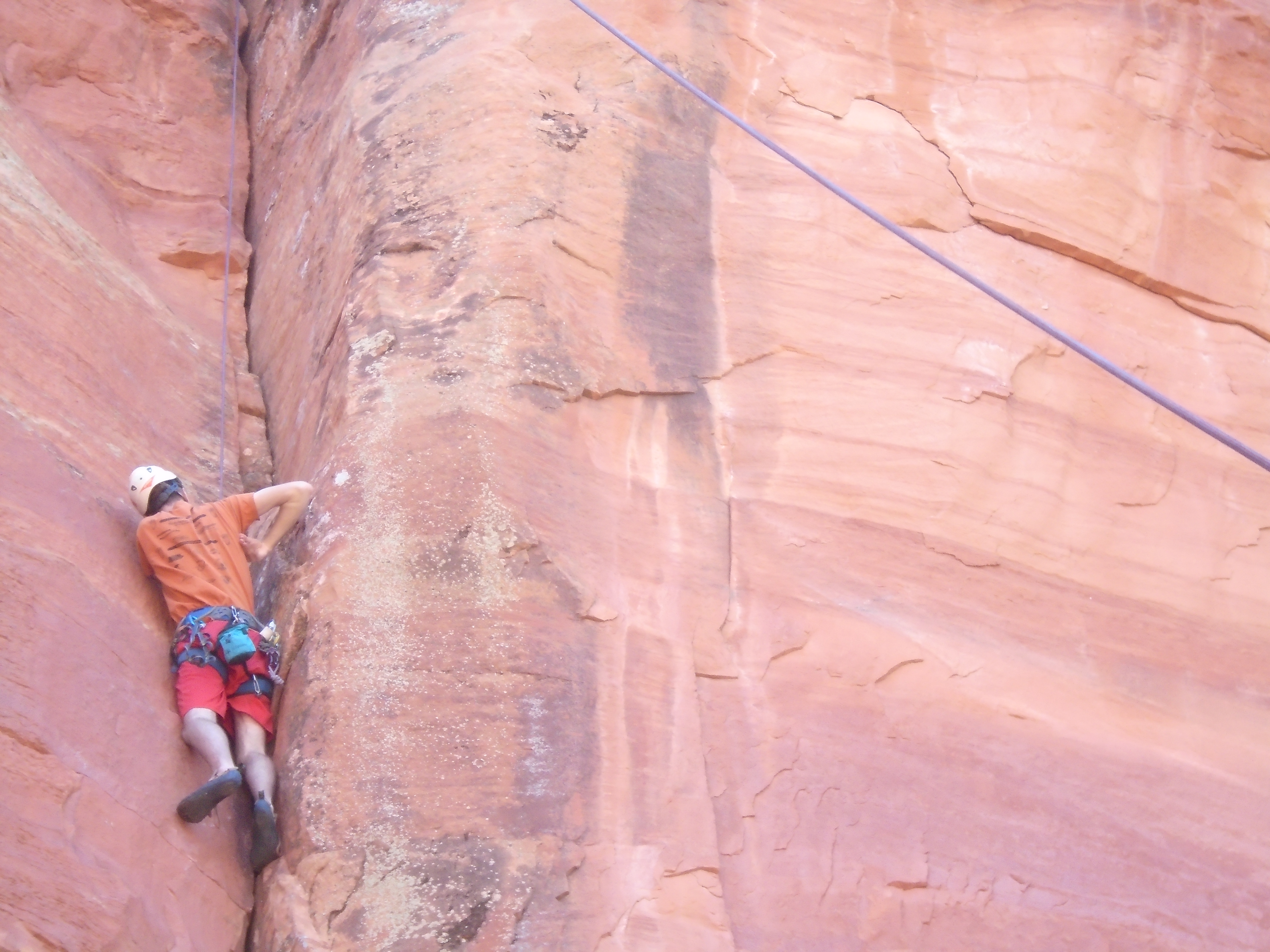
I knew where we were going. We were headed for Sedona, to climb a sandstone pinnacle. It was a traditional climb, which means I had to carry and place removable anchor pieces on my way up. I preferred traditional climbing to sport climbing, where the routes were protected by in situ anchor bolts.

I preferred traditional climbing because it got right to the point. Helmuth von Moltke the Elder was right: No plan survives contact with the enemy. In climbing, we sought to verify the corollary to that bit of Prussian wisdom: If you wanted to live, you couldn’t defer or hold back. You could not buy your way through. No faking allowed. When you placed your own gear, the corollary was on you right away. If you clipped bolts, it didn’t hit until you maxed out.

When I glanced back over at my son, he looked a little more relaxed. He had picked up driving quickly. I had tried to work on strategy with him. I hoped that he would continue to drive defensively and remain focused once the operational routines of driving became automatic. I hoped that he would not end up like the trucker. Even just being a gamer was better than that.DSC00084

Tagged , , , , , , ,

Aimlessness

Purpose gives life value. Most people would agree with that (false) statement without being able to properly explain what it means.  To be fair, when its morally authoritative proponents speak of purpose in an existential  context, they may mean one of two things. The intertwining intents make for a confusing narrative, so some untangling is in order.

The first, predominant meaning, is the common usage of ‘purpose’: instrumental to an extrinsic end. A good example this sort of purpose is the purpose of a humble noun.

“Cat” has an instrumental purpose. All it does is represent a certain class of lazy, mammalian parasites (who we love anyway). We could name the same category with a different phoneme and nothing would change. The sound and spelling derive their purpose from their use toward an end outside themselves.

The second, less commonly expounded thing to which moral leaders refer when they speak of existential purpose, is something more like ‘content’. The word then gestures at the richness of a personal story. On this account, Immanuel Kant and Idi Amin led purposeful lives.

Of course, lay-speakers often intend both meanings at once and also equivocate freely between the notions ‘instrumental’ and ‘full-of-content’. And lay-speakers cannot be blamed for the muddle. It is intentional.

We are all told, explicitly and implicitly, morning to night, from birth to death, that content comes of instrumental purpose, and one justifies the other. Our religions tell us this. Our politicians tell us this. Our employers and professions tell us this. And they all tell us that this mechanism gives value to existence.

The pervasive message of human civilization is: instrumental  purpose makes purposeful content, makes value. But that is not how we work. Acting as an instrument may serve as a means of expression, but expression of motive (will to power) actually produces the value of our personal stories.

The endpoint itself makes no difference.

Nor does the report of our lives’ content capture their value. A slave may live a wild adventure from crib to deathbed and still, rightfully feel cheated. To think that the endpoint. and content generated in pursuit of that endpoint, themselves yield value, is itself a moral failure

It is all in the doing.


Tagged , , , , ,

‘Cause You’re Doin’ it Wrong

Regarding thoughts and discussion of deity, the question must eventually arise, ” Why?”. Once one has decided not to take such notions too seriously, why engage on the matter with those who do?

Morbid curiosity is part of the answer. Or to paraphrase a famous psychologist’s response to the same question about his interest in UFO’s: I am more interested in the motives for holding the belief, than I am in the belief itself.

But beyond morbid curiosity, there is an ethical impetus. For within the mish-mash of desperate apology and cognitive dissonance, lies a kernel of consistency. It begins with the question, “Why is there something rather than nothing?”

It is a ridiculous question, but the reason why it is ridiculous is interesting. We are in the world and can never step outside to see whether the world must be as it is, what other way it might be, or whether it must be at all. In light of our blindness on the matter, an assertion of existential necessity appears to need no further justification. And that’s good, because nothing explains (existential necessity) God, though (existential necessity) God explains everything  – if you believe it. And that’s as far as it goes, for those few who are ethically sound.

For the rest, they go on to endow existential necessity with intentionality, motive and any number of other, inconsistent properties, all as a way of swinging their dicks around  (to allay their own anxieties, most often). That is doing it wrong, and I just hate to see folks doing it wrong.


Tagged , , , , , , , , ,