Tag Archives: politics

Cutting Up an Ox

IMG_1312

Ben Sasse fears for our youth.

He is a U.S. Senator, and therefore he is a very busy man with little time to spare for side projects. Yet, so great is his concern for our kids’ predicament that he has taken the time to write a book about it. It is not a bad book, even if you disagree with what it says. You will have to trust me (or not) on the exact contents, because, “You may not make this e-book public in any way”, is all I will quote directly from it.

His thesis is laid out in the book’s title, The Vanishing American Adult, and he has summarized the gist of his prescription in the subtitle, Our Coming-of-Age Crisis – and How to Rebuild a Culture of Self-Reliance.

In the text, he depicts a generation afflicted by aimlessness. They have been stunted by coming up in the shade of social media and cultural relativism. Deprived of the harsh choices and bright lessons that come with social responsibilities and traditional rites of passage, kids have grown passive. They lack the ‘grit’ to sustain our society.

I won’t quibble with his depiction. Social media is a blight. The current generation operates on the assumption that ‘someone will take care of it’. Giving up is always an option for them.

I do disagree with his diagnosis and prescription, however. He seems to think that helplessness and hollowness result from a deficiency of citizenship. The correction would then involve a big shot of citizenship. He is completely mistaken. In fact, emptiness is the natural outcome of citizenship, and helplessness is just a reactive symptom.

On the most basic level, citizenship is a position in which one gets told that one’s life is fungible. One’s time, attention, motivation, and psyche can be chopped up and traded for goods to satisfy certain needs. Of course, Sasse recognizes this situation. He mentions “development of the individual” on a couple of occasions as a worthy pursuit, but only if it is pursued to certain ends (becoming responsible, self-sacrificing, ‘gritty’ – in other words, all those things that make a solid citizen). As far as I can tell, only the ends distinguish healthy developmental activities from selfishness, in Sasse’s estimation. And in a shocking coincidence, healthy ends are those for which the goods of citizenship come in handy.

“Why won’t my blood sugar go down?”

Maybe my analysis is unfair. Sasse contends that we are all a little defective, and our institutions may be a little defective, too. We should not expect a perfect synergy between man and social machine, even though the basic program is sound and actually the best that we can do.

But I hear differently all the time.

“I’m doing all those things that the diabetic educator told me to. I have changed my diet. I am walking every day. I am taking my medications like clockwork. So why is my blood sugar still high?”

This person is in my office every day, wearing a different, outfit, a different ethnicity, or a different gender. Yet they are the same person. They have a sit-down job, or two, in which they spend 40-60 hours per week dealing with an incestuous dataset – something so about itself, whether it is driving a cab or processing claims, that it demands attention to automatisms rather than any  particular skill. To ensure that their attention does not waver, an overseer tracks their activities and rates their efficiency. Their extraneous physiological and psychological functions are regulated by the employer as distractions.

The citizen in my office sleeps 6 hours per night, or less. They drink energy drinks to keep going, and eat foods which the package or the vendor says are healthy, because they haven’t the time or energy to prepare their own food. They are too exhausted to exercise properly.

As a result, they are obese, diabetic and hypertensive. As a result, they now require one of the goods for which they can sub-divide themselves: medical care.

Which brings us to where the defense of citizenship as a natural-born fertilizer for human development, breaks down. The trouble with the whole thing is not the palate of goods on offer, their costs, or the means of valuation. The trouble is the chopping, because the roots of experience (attention, motivation, responsiveness, etc.) can’t be cut up for a purpose, especially for delayed gratification of a specific need. The very notion mistakes the nature of needs and the relationship between our needs and our activities. Here, Sasse may have been better served by spending a little more time reading Nietzsche, and a little less time reading Rousseau and the Bible.

For an organism’s needs can’t really be parsed. The motivations underlying our activities are merely aspects of a single motive which Nietzsche labeled ‘will to power’. Even when we try to perform an isolated act of attention, we feel something about it, our neuro-hormonal system responds to it, and it tires us globally.

But Sasse seems to think there’s a neat way around the problem of dividing the indivisible.

Life on the Farm or 8 Pitches Up?

In the latter half of the book, Sasse talks about how he sent his daughter to work on a ranch. The idea was to teach her how to enjoy work – not any particular task, but work itself. Basically, he sought to teach her how to thrive as an instrument. It’s pretty clever, really.

He explains the strategy in a vignette:

Martin Luther met a man who had just become a Christian and wanted to know how best to serve the Lord. He asked Luther, “How can I be a good servant? What should I do?” He expected Luther to tell him that he should quit his job and become a minister, monk, or missionary.

Luther replied with a question, “What do you do now?

“I’m  cobbler. I make shoes”, the man answered.

“Then make great shoes”, Luther replied, “and sell them at a fair price – to the glory of God.”

In other words, find integrity in being a good instrument. I think the flaw in this reasoning is obvious: Why not make great shoes to the glory of Satan? It’s the devotion part that really matters, right? This notion of the human lost at heart and essentially in search of a set of rails (any rails) undergirds fascism through the ages, and it works superficially, so long as the social venue is stable.

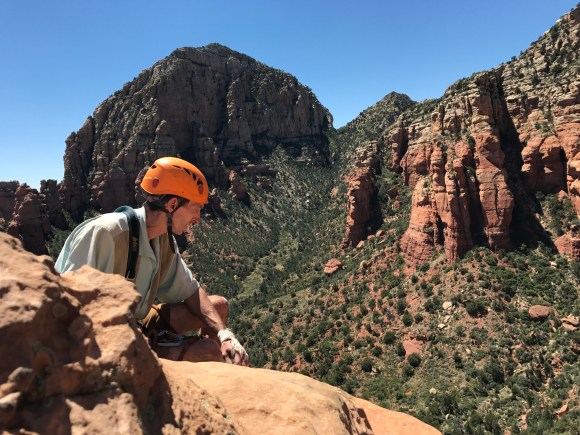
But I took another path with my kids, because I learned more from sitting on a ledge, than I ever did from a job.

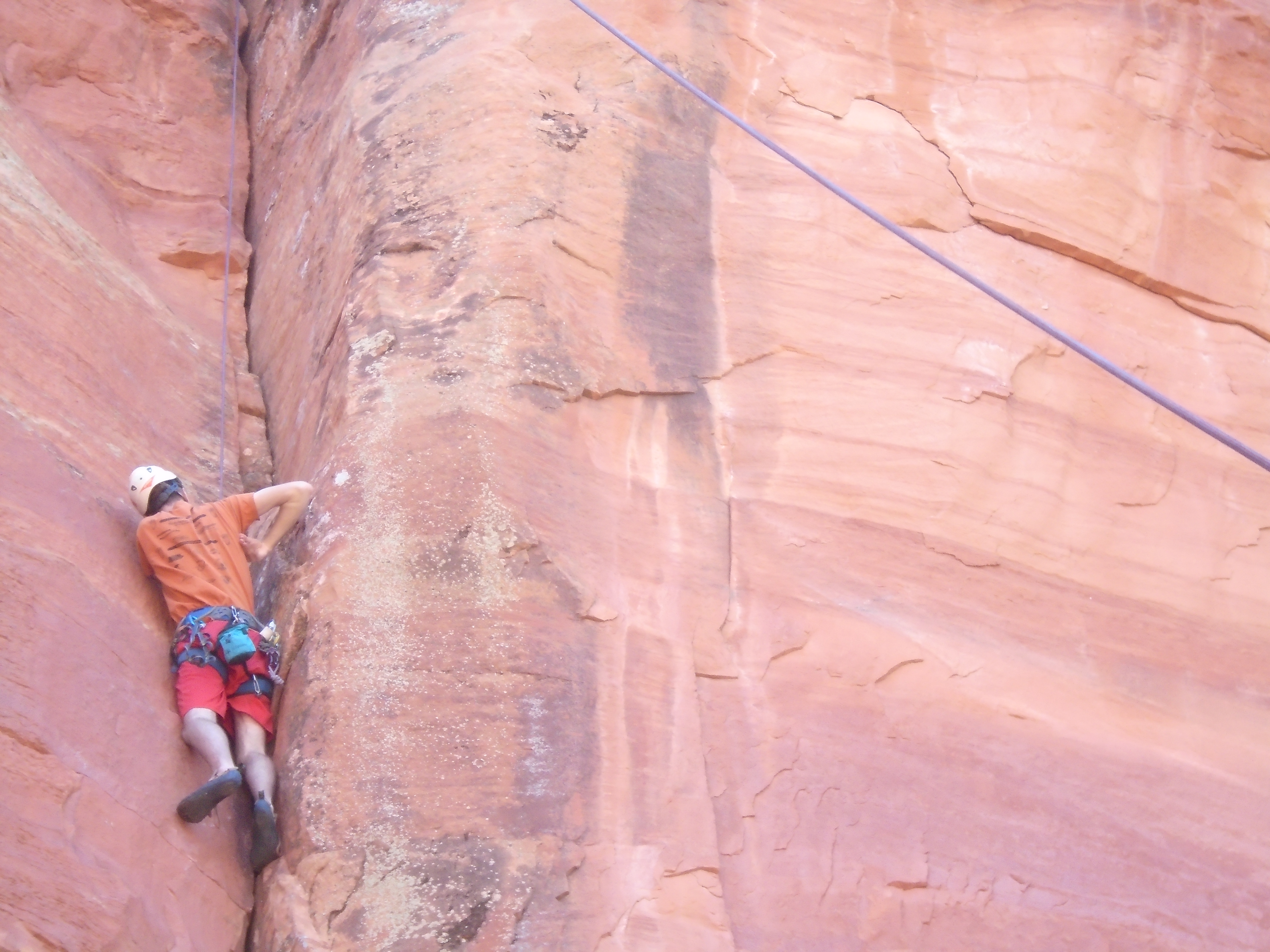
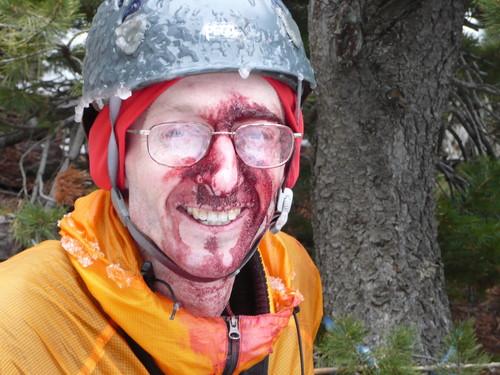
We have climbed several long routes together. We have looked up, down, and out from ledges in the middle of those routes and soaked in the lessons: however precarious the position, what falls to us is to pass the water around, check the system, and find our way through the next rope-length of terrain; trust your partners as you trust yourself; no matter how cold, hot, tired or thirsty you are, the beauty of the sky and landscape remain; achievement, i.e. ‘ticking the route’, doesn’t really matter – it is only a means to get you to the ledge.

In taking them on those climbs, my hope was to offer them a way of life which put making a living in perspective, rather than telling them that making a living would put everything in perspective for them.

A different vignette illustrates my point:

     Cook Ding was cutting up an ox for Lord Wenhui. At every touch of his hand, every heave of his shoulder, every move of his feet, every thrust of his knee — zip, zoop! He slithered the knife along with a zing, and all was in perfect rhythm, as though he were performing the Dance of the Mulberry Grove or keeping time to the Jingshou Music.
“Ah, this is marvelous!” said Lord Wenhui. “Imagine skill reaching such heights!”
Cook Ding laid down his knife and replied, “What I care about is the Way [“Dao”], which goes beyond skill. When I first began cutting up oxen, all I could see was the ox itself. After three years I no longer saw the whole ox. And now, now I go at it by spirit and don’t look with my eyes. Perception and understanding have come to a stop and spirit moves where it wants. I go along with the natural makeup, strike in the big hollows, guide the knife through the big openings, and follow things as they are. So I never touch the smallest ligament or tendon, much less a main joint.”
“A good cook changes his knife once a year — because he cuts. A mediocre cook changes his knife once a month — because he hacks. I’ve had this knife of mine for nineteen years and I’ve cut up thousands of oxen with it, and yet the blade is as good as though it had just come from the grindstone. There are spaces between the joints, and the blade of the knife has really no thickness. If you insert what has no thickness into such spaces, then there’s plenty of room — more than enough for the blade to play about it. That’s why after nineteen years the blade of my knife is still as good as when it first came from the grindstone.”
“However, whenever I come to a complicated place, I size up the difficulties, tell myself to watch out and be careful, keep my eyes on what I’m doing, work very slowly, and move the knife with the greatest subtlety, until — flop! the whole thing comes apart like a clod of earth crumbling to the ground. I stand there holding the knife and look all around me, completely satisfied and reluctant to move on, and then I wipe off the knife and put it away.”
“Excellent!” said Lord Wenhui. “I have heard the words of Cook Ding and learned how to nurture life!”
— Zhuangzi, chapter 3 (Watson translation)

I do not see the current generation as sissified hedonists, any more than previous generations. The hypersensitivity, the passivity, the absorption (self and otherwise) all look like symptoms of a bunker mentality. They see what’s in store for them and they don’t like it, but they don’t seem to know how to resist.

A Sasse-type message has gotten through. The citizenry coming of age does think that it must learn to embrace a social role (little worker, little voter, little contributor) wholeheartedly in order to fully mature, and it just can’t bring itself to do so. The instinct is right. Kids growing up in this era are being asked to pursue a sort of faux-maturity which involves merely “giving up childish things”, and the achievement of that state will leave them empty and utterly dependent on a structure which deals with them on the basis of a flawed methodology.

They need a little less Ben Sasse, and a little more Cook Ding, when it comes to advice about how to grow up. Because maturity means dealing with your situation – not just endorsing it – and dealing with it artfully. It means getting over being The Cobbler, The Christian, The Cobbler-Christian, or even The Cook.

In Sasse’s terms, I have laid out the Romantic counter-argument to his Realist argument regarding the nature of the individual’s relationship to civilization. But I reject that characterization to some extent. There isn’t an inherent conflict between the individual and the civilization. We are stuck with our civilization. It lies before us like the carcass of a great ox, and it is just as indifferent.

We get chopped up in our interaction with it, but our own hand is on the knife. And I agree with Ben Sasse here,  maturity is the solution. Not the faux maturity which the senator espouses, which is just a form of selling out, but actual maturity which sets limits and carves its own way, not towards some magical future, but like the cook’s knife, in the present where we all reside.
IMG_3666

Tagged , , , , , , , , , , , , , , ,

Welcome to the Aftermath

“Show me a good loser, and I’ll show you a loser.”

  Vince Lombardi

“There only three sports: bullfighting, motor racing, and mountaineering; all the rest are merely games

Ernest Hemingway

“The ideal form of government is democracy tempered with assassination.”

 Voltaire

The difference between Hemingway’s sports and games is, of course, a matter of winning. In games, winning really is the only thing. In those other endeavors, winning is nothing.
Simply engaging in sport yields the maximum voluntary experience. Engagement delivers everything on the spot, whether or not the participant comes out on the other side, and certainly regardless of winning and losing.
Trophies, money and ribbons only serve to dress sports up by equating them with games. The civilization must thereby disparage sporting ends, since it strives constantly to the opposite goal.
The civilization turns out to be really good at window dressing though. Its props and costumes create a realistic illusion in which games are wholesome and sports are pathologic. Maybe that is why we now live in an age of games and gamesmanship. Our culture has created a situation where Lombardi is right.
Excessive trappings have made sports and sportsmanship not only unrecognizable, but incomprehensible.
Subsequently we have the rise of the consummate gamesman: Trump. To him, there are only winners and losers. Failure to engage and success in shifting the cost define the gamesman’s method.
Allowing him to operate so at the controls of our society has given the whole thing a gamy taint.
To clean it up, we need to make things a little more sporty, though we might not need to make politics quite as sporty as Voltaire suggests.
Perhaps it would be enough to replace the inauguration ceremony with a bullfight.

Tagged , , , , ,

International Domestic Abuse

I confess to listening to the impeachment trial. I did so without much interest at first, especially during the opening statement from team Trump.

What else were they going to say that had not already been said by all his other flunkies? As Cipollone began speaking, my expectations were momentarily fulfilled, but then he did something surprising. He read a section of Trump’s call to the Ukrainian president which he felt was exculpatory and which he claimed had been omitted on that basis from the House’s presentation.

The President: Well it’s very nice of you to say that. I will say that we do a lot for Ukraine. We spend a lot of effort and a lot of time. Much more than the European countries are doing and they should be helping you more than they are. Germany does almost nothing for you. All they do is talk and I think it’s something that you should really ask them about. When I was speaking to Angela Merkel she talks Ukraine, but she doesn’t do anything. A lot of the European countries are the same way so I think it’s something you want to look at but the United States has been very very good to Ukraine. I wouldn’t say that it’s reciprocal necessarily because things are happening that are not good but the United States has been very very good to Ukraine.”

This move elicited a strange mix of amusement, puzzlement and deja vu. It did not seem too helpful for Trump’s case, quite the opposite, in fact. And I had heard this kind of bizarre exposition before. It took me a moment to realize that it was straight out of those training videos on domestic abuse which are required viewing for my job.

One of the techniques employed by the abuser to control the victim goes just like the passage above, something along the lines of, “Nobody loves you like I do baby, you know that. Who else is going to love you like I do, give you all those things you need, if you throw it all away and leave me? You understand now why I get so upset, even lose control sometimes when you disappoint me? It’s because I love you so much.”

It all became clear in that moment. The nature of Trump & Co.’s relationship with the rest of the world is the nature of an abuser’s relationship to the victim. It explains the lack of insight (the abusers are always happy to use the same defense to outsiders, oblivious to its lack of force absent the power disparity). It explains the displacement of guilt (looking at you Pompeo, you fat, stinking sack of pig shit). It explains everything.

Tagged , , ,

Knock Out Mouse Revolution

mighty-mouse-cartoon-clipart-16

Standing in the New Orleans convention center felt a little eerie. The interior was clean and neat. It looked like an airport. Still, I could not help but recall images of Katrina, when the huge edifice had become a beacon of false hope, luring the populace through its doors with the promise of aid, only to leave those who entered trapped like rats.

We had come to a conference to learn about endocrinology, which I had not considered too creepy before. I was wrong.

The proceedings began innocently. Hundreds of physician scientists, and I, filed quietly into a giant auditorium. I want to make clear my lack of qualifications relative to the rest of the group. I am no scientist, and barely a physician. I would much rather read philosophy books and climb around on crumbly sandstone towers than pipette solutions into a gel matrix.

But my job is mostly about helping people protect themselves from diabetes. Plus my wife had a poster to present. So, there I was, attending as an imposter.

The keynote speaker got a prolonged introduction. He deserved it. He was an important person with important research credentials. It was the kind of introduction where a name is never mentioned, for dramatic effect, and because everybody already knows exactly who the subject is. It is a an effective strategy for generating anticipation in the majority who are already quite familiar with the speaker, as well as in those who have never heard of him. It works for everyone, except my wife. She is honest to a fault, and that means that she is a real subject-object-verb kind of person. When presented with a dramatic, obscure speech, her attention lapses. As the speaker walked onstage to the sound of his name, she asked me who this Francis Collins person was.

After a long moment’s reflection, I told her that Francis Collins was a bad philosopher. She seemed to accept my summary, because she promptly settled back in her theater chair to nap through the rest of the lecture. I could not sleep, though I was feeling a little jet lag as well. The lecture was fascinating. Dr. Collins had been right in the middle of genetic research since the beginning of the human genome project, and he took the audience on a trip through the whole endeavor, right up to the current moment: the Big Data revolution.

The Big Data revolution referred to the use of advanced mathematical and computing techniques to sort through scads of data for druggable targets in endocrine diseases. The special techniques had become necessary because the database had exploded. Dr. Collins and his compatriots had deciphered the genomic book of life, but when they sat down to read it, they discovered that they needed a lamp, reading glasses, bookmarks, and indeed, the semantics of the language. The genes turned out to be active in the context of all sorts of transcription factors, promotors, coactivators, corepressors, etc. There was layer upon layer of conditionals which gave meaning to the genetics.

The source of the Big Data revelation was the knockout mouse. The knockout mouse and its cousins, the knockin mouse and the humanized mouse, were what happened when researchers turned to their traditional test subjects with gene manipulation techniques learned in dissecting the genome. By studying mice with selectively induced genetic defects, the researchers had produced the dense pile of data on gene regulation which advanced computing methods might sort out for us.

By the end of the keynote address, I had mouse fever. I wanted to hear all about the things which these creatures could do, and it turned out that I had come to the right place. Over the next few days, I would hear about mutant mice who could run on a treadmill off the couch like they had trained for months. Mice who developed diabetes. Mice who could turn on their brown fat to alter their metabolism. And many of these mice could serve as their own experimental controls. They had mechanisms inserted in their genomes which could turn their genetic defects on and off in response to substances in their mouse chow.

I’ll admit, when I heard about designer mice and their custom mouse chow, I got a little side-tracked. I had been eager to get out of medicine for a while. It all seemed so futile, and even a bit of a sham. Knockout mice might have been the ticket.

Two incidents elevated that thought to conscious consideration. The first was sighting a booth devoted to mouse chow in the exhibit hall.

To understand the significance of the chow booth, one must understand what the exhibit hall is all about. There is an exhibit hall at every conference. They are huge and opulent sometimes, sometimes modest, but always staffed by beautiful, shiny people and stocked with treats, from lattes to foam-model pancreases. Brands like Coach or Louis V. would feel at home amongst the booths.

Giant pharmaceutical companies ruled the hall, and the mouse kibble guys were right there in the mix. If mouse chow could buy an exhibit booth, the mice themselves must be golden.

The second incident was a conversation overheard in the poster hall.

The poster hall is a huge open space with row upon row of cork boards. Researchers pin up posters with summaries of their investigations on the boards, and attendees walk up and down the rows soaking in the knowledge. Usually there is a clearing in the middle with a nest of round banquet tables where everyone can go to take a break, chat and have a cup of pharma coffee. That’s where I sat while my wife presented her poster. I did not sit randomly.

As I walked up on the tables, I spotted a fat man in a plaid shirt and a yarmulke leaning in to say something to a thin, swarthy, bearded companion wearing a dark olive sport coat and a gold medallion. I needed in on that conversation, so I settled in the chair next to them, and swirled my coffee thoughtfully. Imagine my surprise as I picked up on the subject of their conspiracy.

“Yes,” said the fat man, ” I have been trying to find some of those mice. I need them to finish my work, but you can’t find them anywhere.”

“Yes,” echoed his friend, “those mice are nowhere to be found.”

“The closest I came,” the fat man continued, “was this Korean lady in San Fransisco. She said she had some, even said she would send me a few. But she never came through, and now I can’t get a hold of her anymore.”

The mice must be golden.

But my dreams of becoming a mouse Baron were short-lived. Upon further investigation, I found that genetically altered mice did not thrive. It was hard enough to get them past the embryonic stage. Once they could breathe on their own, they often required special conditions and diets just to survive. Worst of all, most of the really good mice had been patented. You bought the limited rights to a strain of mice when you bought the animals themselves. The patent system was the impetus for the black market discussion in the poster hall. You could trade for mice underground and avoid some costs, at the risk of incurring the wrath of the mouse factory lawyers after publication.

Despite the disappointment on economic grounds, I left the conference optimistic. I still had the image of all those colored bars from Dr. Collins’ slide in my head. Each one was a gene which a mouse model could exemplify, and therefore each one was potentially a druggable target. We had this. It was just a matter of time, and mice.

On my way to work, I have some time to think, though not too deeply. I leave early to beat the traffic, but I never do. Most commutes demand constant attention to collision avoidance. The situation is unfortunate, because the commute is the only time to think. Once work starts, I am behind. Someone constantly needs something from me to satisfy someone else who needs something from them, etc.. My workplace is carefully structured to facilitate this cycle. If I need to communicate with someone, odds are that I can lean over to one side and speak to them directly. Otherwise, my computer contains a messaging system which will pop in on whoever I need to inform or interrogate. Patient rooms cluster around my workstation, so I never need to walk more than 6 steps. However, patient contact occupies only a minor portion of my time. Most of the day is passed on the computer and the phone, addressing questions, requests and lab results. At the end of the day the freeway awaits again. By the time I get home, I am burned out and may or may not have it in me to do some physical training and watch television before retiring to get up and do it all again the next morning.

As luck would have it, traffic was light on the first day back from New Orleans. As I drove, I dreamed of druggable targets; Dr. Collins’ slides with the colored bars swam before me. Most of my patients were already on carefully targeted medications, but reaching down into the genome would ramp up medication effectiveness by orders of magnitude. Yet, not all my thoughts were so happy. Other images kept popping into my head, unbidden. I saw other colored slides, from another lecture by another renowned researcher. They were Dr. Brawley’s slides on the geographic and socioeconomic correlates of life expectancy and the epidemiology of conditions like obesity, cancer and diabetes. I could not banish those intrusive images, and by the time I was walking across the clinic parking lot, my mood had deteriorated.

I made it through the day, and finally got to resume my train of thought as I walked back to the car to drive home. I thought about gene targets and Dr. Brawley’s maps again. Then thoughts of one of the day’s patients joined the fray. She was very overweight, and had the metabolic problems that went with excess adipose tissue. She was on targeted therapy for her diabetes in the form of a monoclonal antibody directed at a counter-regulatory hormone receptor. It was the best science had to offer, but she often missed her doses. She had 2 jobs and no car, so she was up early and home late, and she simply forgot her meds sometimes. She set an alarm, but often could not attend to it, or forgot to reset it. We did not even discuss diet and exercise. She lived on a busy street with non-contiguous sidewalks, had no money for a gym, and no time to travel to a safe park. She could not cook, because she had grown up on packaged foods. In any case, she had grown too heavy by now. Her knees had given out under the weight. She could only mobilize fat stores in the face of severe calorie restriction. To reclaim  her life, assuming that was our aim, she would need two joint replacements and a gastric bypass.

I began to re-experience the rising panic which I had felt at the end of her appointment. Dr. Collins & Co. had let me down; I was not armed for this struggle, nor would I be. I stopped to take a breath and get my bearings. The parking lot was nearly empty. A bad smell rose from a nearby drainage grate, and a noise like water flowing.

I imagined that the noise might be something else. Maybe, instead of waste water, it was all those knockout mice, rising through the  sewers from the depths of the New Orleans convention center where the disappointments of Katrina had flowed down to bring the little fellows back, like a time-delayed Ghost Dance. The mice were coming with their little spectral incisors primed to clip down the cages, the labs, the chow booth, the convention center, and all the rest in a massive, surgical revision. I became convinced that the sound was the mice coming. It had to be. It was the only way that the knockout mice could save us.

mouse


Tagged , , , , , , , , , , , ,

OK

Send migrants from the border  to sanctuary cities. Give those cities control of the manpower and financial resources currently employed by the federal government for immigration enforcement, too.

Because, the move to make immigration and the asylum process somebody else’s’ problem is an admission of incompetence.

So, go ahead and put the grown-ups back in charge Trump, you whining little prick.

Just do it properly…Oh. Never mind.


Tagged

What Did You Expect?

Did you expect that professional intelligence officers would involve a bunch of loud-mouthed incompetents in their operation?

Did you expect any persuasive evidence to come from an investigation for a population which, as Trump accurately estimated, would not change its vote if its candidate shot someone on 5th avenue?

Did you really need a conspiracy theory to convince you that the author of the Mexican rapist invasion, fine folks in the Neo-Nazi (Alt-right) ranks, Enemy of the People press, dictator admiration and non-stop smack/lies needed to be evicted from office and reviled in the histories?

Really?

Tagged , , ,

The Takeaway

One: Special K says that he understands his opponents’ viewpoint. He has been a Machiavellian political operative too. And he has been, apparently without regret.

Two: Kavi argues that he is being assaulted where he stands, while he vies for a position of prestige and power. The implication is clear. The position is his by right, and part of the ground upon which he stands.

The latter attitude is consistent with the attitude of Kavi’s sponsor, and it is the attitude which summarily defines them both as little bitches.

That’s the takeaway.


Tagged , ,

He Baked a Cake with Duty in It

Duties never truly conflict. Unless they are truly categorical. But if they are not categorical, are they truly duties? 

You know what, I gotta take a walk. Forget all that stuff I said before.

– Immanuel Kant (astral form) as related to me, 0300 June 8, 2018


Every act is a political act.

-Cain, to whoever would listen.

A baker in Colorado claims to have managed the feat. He said that the totally gay-free contents of his cake fulfilled his obligation to show love for the Baby Jesus. Because, as everybody knows, the Baby Jesus don’t like the gays. Wait. Strike that. The Baby Jesus loves everybody, so he just don’t like the gayness.

Anyway, this baker loved the Baby Jesus. He refused to bake any cake with any gayness in it, and in doing so, baked into each cake his duty to abide by the wishes of the Baby Jesus.

Some might ask how the baker’s achievement were possible. Cakes are made of flour, sugar, mixing and heat. You will never find respect for the Baby Jesus between the crumbs or under the frosting. But that assessment is not fair.

The folks who ask to see the duty in the cake (God bless their simple hearts) are the same ones who, when told that green experiences reside in the brain, ask to open up a skull to see the green inside. They like to hold the notion of supervenience  upside down, because it seems easier to grasp that way.

But it isn’t so much that neurons and photons and retinal pigments add up to green; the point is that green experiences break down in certain, common ways. Admittedly, the difference is a little tricky to apprehend. It has eluded smarter folks than the poor bastards delving for green things in a pile of brains. Mistakes about the difference have led some very smart people to propose that we can get rid of green, and everything else. Instead of saying “green”, we can just hold up a balance sheet with all the retinal pigments, neurons and photons on it. But then we’ll need a balance sheet for the neurons, photons and retinal pigments, and so on and so on. You can’t get away without primarily localizing things somehow, and you always end up reaching for the balance sheet labeled “green” when you want to indicate “green”, and then you  might as well just say “green” in the first place.

The same mistake about supervenience gives rise to the notion of emergence. Emergence is the balance-sheet scheme for those who just can’t let go of Aristotle (and a very uncharitable reading of Aristotle at that). The only thing on the balance sheet, in the emergent case, is something like a metaphysical time-share: property theoretically without exclusive ownership, but available for occupancy by a variety of occupants in turn. For green, the pigments, neurons and photons tally up to a certain critical point and then begin acting with ‘greenity’, which subsequently begins to explain everything else directly related to green. In the case of the cake, flour, sugar, water, heat, and so on tally up to a certain point and suddenly – cakeity. Ask the obvious question – where does the cakeity or the greenity begin – and the whole thing unravels, just like the more detailed balance-sheet scheme. You circle back to simply saying ‘cake’ and ‘green’, and ‘cake’ and ‘green’ then break down in certain, common ways. Each cake and each green perception has its own, unique identity, without a homogenizing property reaching down to bring it into the categorical fold.

Now we can get around to duty in the cake. Not only will we fail to find specks of duty among the crumbs, but we can’t expect it to pop out of the baking process, or even to be the sum of baking, Bible verses, and love of the Baby Jesus. That’s OK, though. So far, duty fares no worse than green, or cake itself. But it is worse for duty, because duty does not break down in any reliable way. It doesn’t even break down in any definitive way.

The baker baked a cake without any gayness in it, because he loved the Baby Jesus. He told the world, but he would have felt that he was true to the Baby Jesus, even if the baker himself was the only one who knew that there was no gayness in the cake. So then, the duty can’t break down to any relationship between ideas or even attitudes. Maybe it breaks down to just the baker’s attitude toward the Baby Jesus. But then you don’t have an account of the compelling part of the perceived duty, especially regarding gay-free cake.

Loving the Baby Jesus is just loving the Baby Jesus. In itself, the attitude does not contain any obligation. You can’t break down moral obligations (or any other moral “properties”) to a supervenience base. Therefore, we also lack reliable generalizations regarding moral obligations and moral representations.

You can’t even make a cakeity (emergent) case for duties, because duties don’t arguably emerge at some compositionally determined phase. Duties can pop up anywhere along the way, from turning on the lights in the bakery to accepting money for the cake.

The inevitable response to the above observation is an argument from incredulity which refers to the holocaust or infanticide. You can always say that it is morally wrong to throw a baby on the campfire, bake a gay cake, or exterminate a certain group of people, but such statements are always after the fact and are supported by historical fixation of the facts in the acrylic of moral terminology.

After all, moral arguments have been made in favor of all the above activities. And, the moral advocates have not differed with moral opponents of those actions on the factual contents of the actions; they have merely assigned different moral properties to the things and events which can, like a cake or a fire, be said to have a supervenience base, and about which effective theories are possible. In other words, moral ‘properties’ are merely attitudinal ephemera, pinned to the facts of the matter, whatever the matter may be.


Tagged , , , , , , , , , , ,

The Sad Side of the Road

Being awake is swimming around in a lake of the undead.

And the undead are like a bunch of friends who demand constant attention.

Demanding constant attention, will only  lead to attention,

And once they have that attention, they’ll use it to ask for attention…

They Might Be Giants

The white truck was about a foot from our bumper. I looked in the mirror at the pick-up trucker. He wore mirrored aviators and had his head cocked in an expression of bored annoyance which only the rich white folks can pull off. I gave it right back, followed by the finger.

Over in the driver’s seat, my son was oblivious to the exchange. He was too gripped. He was driving the freeway for maybe the third time ever, and had shifted into survival mode on the entrance ramp. The truck pulled out and blew past us. At least he passed on the left. As the truck cleared our flank, I glanced around its tailgate at the Eastbound lanes.

On a Tuesday morning at 0630, the Eastbound side was the sad side of the road. Thousands of people parked in the lanes, distracting themselves with cell phones, the condescending humor and invective of AM radio, or their own expressions of hatred towards the filthy slacker stalling traffic in front of them. I wondered, as I had countless mornings before: Where were they all going?

Most were off to willingly trade their lives for money. Some were probably going to try to game the system, like us. Maybe they played ball in a league, or played a musical instrument, or read books and then thought about what they read. I was pretty sure that the gamers were a tiny minority. If there were lots of those people, then the sad side of the road would not exist in the first place.

I had thought about the sad side of the road on many mornings, as I drove to work. I rarely got to see things from the passenger’s seat though, and that Tuesday morning, from the passenger’s seat, I began to consider my own side of the road, too.  I wondered where the jackass in the truck was going. He was in a hurry, so he was going to cash in somewhere.

Maybe he was going to buy a ride on one of the hot air balloons which hovered above the dirty thermocline in the near Northern suburbs. I could see a couple from the freeway at 0630 on a Tuesday morning. The trucker seemed like the sort who would enjoy a balloon ride. He seemed ambitious, and looking down on the anthill from just above its pollution was good for the ambitious, especially if it was just a peek, and a costly enough peek to exclude the losers.

I knew where we were going. We were headed for Sedona, to climb a sandstone pinnacle. It was a traditional climb, which means I had to carry and place removable anchor pieces on my way up. I preferred traditional climbing to sport climbing, where the routes were protected by in situ anchor bolts.

I preferred traditional climbing because it got right to the point. Helmuth von Moltke the Elder was right: No plan survives contact with the enemy. In climbing, we sought to verify the corollary to that bit of Prussian wisdom: If you wanted to live, you couldn’t defer or hold back. You could not buy your way through. No faking allowed. When you placed your own gear, the corollary was on you right away. If you clipped bolts, it didn’t hit until you maxed out.

When I glanced back over at my son, he looked a little more relaxed. He had picked up driving quickly. I had tried to work on strategy with him. I hoped that he would continue to drive defensively and remain focused once the operational routines of driving became automatic. I hoped that he would not end up like the trucker. Even just being a gamer was better than that.DSC00084

Tagged , , , , , , ,

Before I Forget…

Happy first, you bloated tick on America’s bunghole, and thank you.

You have given me so much over the last 12 months.

You have revealed the disgusting weakness of the full third of my fellow citizens who voted for you and continue to support you wholeheartedly.

You have confirmed my thesis: Facebook is for stupid people; Twitter is for people too stupid for Facebook.

You have given me refuge. No matter how low I feel, I can always say, “At least I’m not Trump.”

Thanks.

Now go back to reality TV.

Tagged